
Application of Integrals Class 12 OP Malhotra Exe-25A Area Under a Curve ISC Maths Solutions Ch-25. In this article you would learn How to find the area under a curve example and Practice questions / Problems with Answer / Solutions. Visit official Website CISCE for detail information about ISC Board Class-12 Mathematics.

Application of Integrals Class 12 OP Malhotra Exe-25A Area Under a Curve ISC Maths Solutions Ch-25
| Board | ISC |
| Publications | S Chand |
| Subject | Maths |
| Class | 12th |
| Chapter-25 | Application of Integrals |
| Writer | OP Malhotra |
| Exe-25(a) | Calculation of Area Under a Curve |
Calculation of Area Under a Curve
Application of Integrals Class 12 OP Malhotra Exe-25A ISC Maths Solutions Ch-25
Que-1: Using integration, find the area of the region bounded by
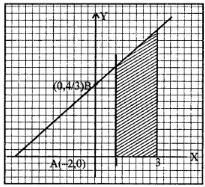
(i) the line 3 y = 2 x + 4, the x-axis and the lines x = 1 and x = 3.
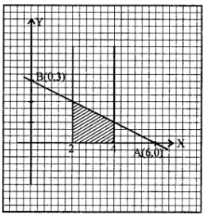
(ii) 2 y = -x + 6, the x-axis and the lines x = 2 and x = 4.
Sol: (i) The eqn. of given line be
3 y = 2 x + 4 ……………..(1)
eqn. (1) meets x-axis at A(-2, 0) and y-axis at B (0,4/3)
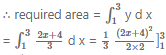
= 1/12 [(10)2 – 62]
= 1/12(100 – 36)
= 64/12 = 16/3 sq. units
(ii) The eqn. of given line be
2y = -x + 6
it meets coordinate axes at A(6, 0) and B(0, 3).
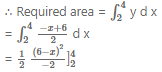
= -1/4 [4 – 16]
= 3 sq. units
Que-2: (i) Using integration, find the area of the region bounded between the line x = 2 and the parabola y2 = 8 x.
(ii) Find the area of the region bounded by the parabola y2 = 12 x and its latus rectum.
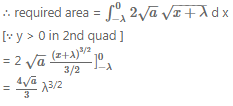
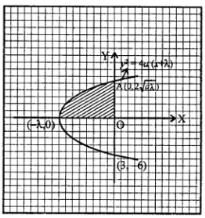
(iii) Find the area enclosed between the co-ordinate axes and the curve y2 = 4 a(x + λ) in the second
Sol: (i) Clearly the figure is symmetrical about x-axis.
∴ area enclosed by the parabola
= 2 × area enclosed by parabola
and x = 2 in Ist quadrant
Divide the region in first quadrant into vertical strips each vertical strip has its lower end on x-axis and upper and on the parabola y = √8x. So the approximating rectangle has length |y| and width d x. This rectangle can move between x = 0 and x = 2.
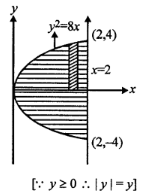
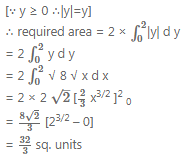
(ii) Given eqn. of parabola be y2 = 12 x represents a right handed parabola with vertex at (0,0). Here 4 a = 12
⇒ a = 3
∴ required area = 2 × area of region OABO
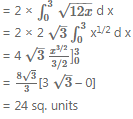
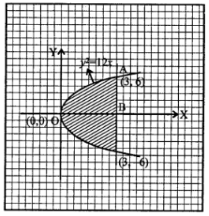
(iii) The given eqn. of parabola be
y2 = 4 a(x + λ)
represents a right handed parabola with vertex (-λ, 0) it meets y-axis at A(0, 2√aλ)
Que-3: Draw the rough sketch of the curve y =√3x+4x and find the area under the curve, above the x-axis and between x = 0 and x = 4.
Sol: The eqn. of given curve y = √3x+4
The table of values is given as under :
| x | 0 | 4 | 2 |
| y | 2 | 4 | √10 |
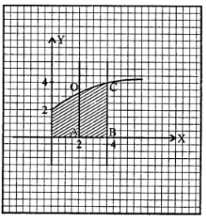
Plot the points (0, 2) ;(4, 4) and (2,√10) on graph paper and join then by free hand curve.
∴ Required area of region OABCO
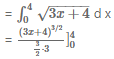
= 2/9[(16)3/2-(4)3/2]
= 2/9[64 – 8]
= 112/9 sq. units
Que-4: Sketch the graph of y = |x + 1|. Evaluate
4
∫
2
|x + 1| d x. What does the value of the integral represent on
Sol: For Graph ; For x < -1; y = f(x) = -(x + 1) For x = -1 ; y = 0 For x > -1 ; y = x + 1
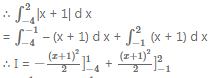
= −1/2(0 – 9) + 1/2(9 – 0)
= 9/2 + 9/2 = 9
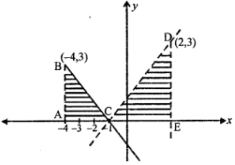
When x = -4 < -1 ∴ y = -(-4 + 1) = 3 i.e. point becomes (-4, 3). When x = 2 > -1
∴ y = 2 + 1 = 3 i.e. point becomes (2, 3).
Further, area of ∆ ABC = |1/2×(−3)×(3)| = 92 sq. units
and area of ∆CDE = |1/2×3×3| = 9/2 sq. units

= sum of areas of two ∆ from -4 to -1 and -1 to 2 .
Que-5: Find the area bounded by the curve y = x2 and the line y = 16. [Fig. 25.41]
![Que-5: Find the area bounded by the curve y = x2 and the line y = 16. [Fig. 25.41]](https://icsehelp.com/wp-content/uploads/2025/11/23.png)
Sol: (i) The given curve y = x2
and the line y = 16 intersects when 16 = x2
⇒ x = ± 4
∴ Region R = {(x, y) ; x2 ≤ y ≤ 10 ; 0 ≤ x ≤ 4}
![Que-5: Find the area bounded by the curve y = x2 and the line y = 16. [Fig. 25.41]](https://icsehelp.com/wp-content/uploads/2025/11/13-1.png)
= 64 – 64/3
= 128/3 sq. units
![Que-5: Find the area bounded by the curve y = x2 and the line y = 16. [Fig. 25.41]](https://icsehelp.com/wp-content/uploads/2025/11/14-1.png)
![Que-5: Find the area bounded by the curve y = x2 and the line y = 16. [Fig. 25.41]](https://icsehelp.com/wp-content/uploads/2025/11/15-1.png)
Que-6: Sketch the region lying in the first quadrant and bounded by y = 4 x2, x = 0, y = 1 and y = 4. Find the area of the region, using integration.
Sol: The given curve is y = 4 x2 be an upward parabola with vertex at (0, 0) and is symmetrical about y-axis.
∴ required area = area of region OABCO
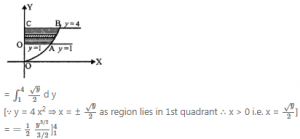
= 1/3[8 – 1]
= 7/3 square units
Que-7: Find the gradients of the curve y = x2(2 – x) at the points (0, 0) and (2, 0) and sketch the part of the curve of which both x and y are positive. Find the area between this part of the curve and the axis.
Sol:
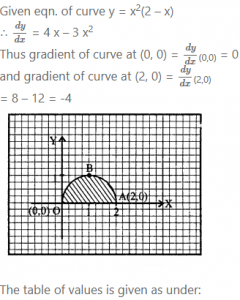
| x | 0 | 1 | 2 | 3/2 |
| y | 0 | 1 | 0 | 9/8 |
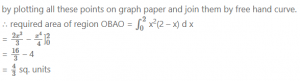
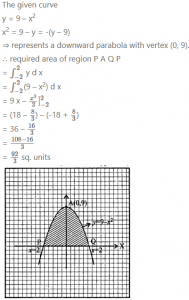
Que-8: Find the area included between the curve y = 9 – x2 , the X-axis and the lines x = -2 and x = ± 2.
Sol:
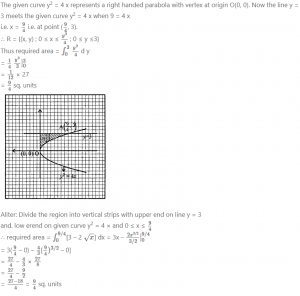
Que-9: Find the area bounded by the curve y2 = 4 x, the line y = 3, and the y-axis.
Sol:
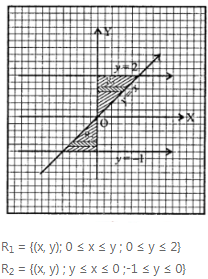
Que-10: Find the area of the region bounded by y = -1, y = 2, x = y and x = 0.
Sol: Given lines are
y = -1 ……………….(1)
y = 2 ……………….(2)
x = y ……………….(3)
x = 0 …………………(4)
and
Since y = -1 and y = 2 are the lines are parallel to x-axis and x = 0 represents y-axis.
The line y = x passes through origin and making a slope of 45° with positive direction of x-axis.
Divide the region into horizontal strips as shown in shaded portion.
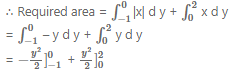
= −1/2(0 – 1) + 1/2 (4 – 0)
= 1/2 + 2 = 5/2 sq. units
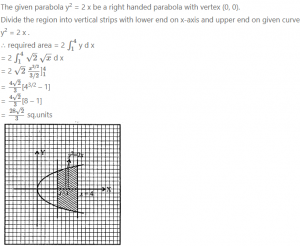
Que-11: Find the area bounded by the parabola y2 = 2 x and the ordinates x = 1 and x = 4.
Sol:
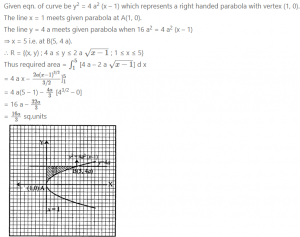
Que-12: Find the area bounded by the curve y2 = 4 a2 (x – 1) and the lines x = 1 and y = 4 a.
Sol:
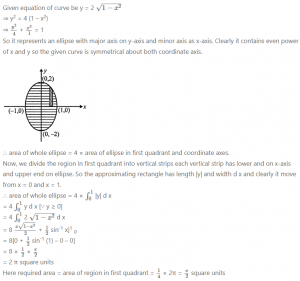
Que-13: Evaluate the area of the region bounded by the curve y = 2√1−x², and the X-axis, after drawings rough sketch of the same.
Sol:
Que-14: Make a rough sketch of the curve 3 y = (2 x + 1)(2 – x), and calculate its gradient at the point where it meets the axis of y. Find the area bounded by the curve and the axis of x.
Sol:
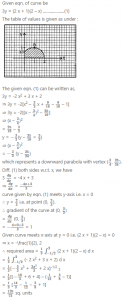
Que-15: Given alongside figure shows a sketch of the curve y = (x – 1)(4 – x). If P is the point (2, 2), verify that the tangent at P passes through the origin O as shown. Calculate the area O A P enclosed between the tangent, the curve and the axis of x.
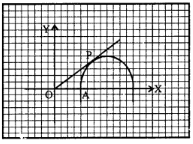
Sol:
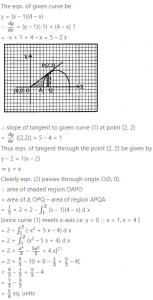
Que-16: The curve y = a x2 + b x + c passes through the points (1, 0),(2, 0) and its gradient at the point (2, 0) is 2 . Find the numerical value of the area included between the curve and the axis of x.
Sol: The eqn. of given curve y = a x2 + b x + c eqn. (1) passes through the point (1, 0) and (2, 0).
∴ 0 = a + b + c
0 = 4 a + 2 b + c
Diff. eqn. (1) both sides w.r.t. x; ; we have
dy/dx = 2 a x + b
∴ gradient of curve at point (2, 0) = 2
⇒ (dy/dx) (2,0) = 2
⇒ 4 a + b = 2
eqn. (3) -2 x eqn. (4) ; we have
4 a + 2 b + c – 8 a – 2 b + 4 = 0
⇒ -4 a + c = -4
⇒ 4 a – c = 4
eqn. (4) – eqn. (2) ; we have
3a – c = 2
eqn. (5) – eqn. (6) gives; a = 2
∴ from (6) ; c = 6 – 2 = 4
∴ from (4); b = 2 – 4 a = 2 – 8 = -6
Thus from (1); we have
y = 2 x2 – 6 x + 4
eqn. (7) meets x-axis when y = 0
∴ 2 x2 – 6 x + 4 = 0
⇒ (x – 1)(2 x – 4) = 0
⇒ x = 1,2
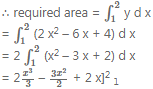
= |2(8/3) – 6 + 4 – 1/3 + 3/2 – 2]|
= 2[7/3 + 3/2 – 4]
= |2(14+9−24)/6|
= 1/3 sq. units
Que-17: The line y = 2 x meets the curve y2 = 4 x at the point O (the origin) and P, and P N is perpendicular to the y-axis. Prove that the area between the curve and O P is one-half the area enclosed by the lines O N, N P and the curve.
Sol: eqn. of given line be
y = 2 x
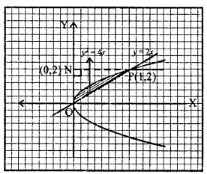
y2 = 4 x
and eqn. of given curve be
eqn. (2) represents a right handed parabola with vertex at (0, 0) and line (1) meets curve (2) when 4 x2 = 4 x
⇒ 4 x(x – 1) = 0
⇒ x = 0,1
∴ from (1); y = 0, 2
Thus the point of intersection are O(0, 0) and P(1, 2).
∴ area betwen the curve and OP
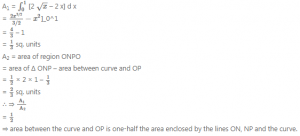
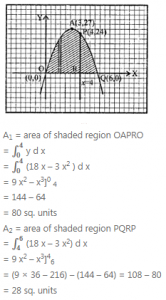
Que-18: Calculate the areas of the two parts into which the area enclosed by the x-axis and the curve y=18 x-3 x² is divided by the line x=4.
Sol: Given eqn. of curve be
y = 18 x – 3 x2
⇒ y = -3(x2 – 6 x + 9 – 9)
⇒ y = -3(x – 3)2 + 27
⇒ 3(x – 3)2 = 27 – y
⇒ (x – 3)2
= -1/3(y – 27)
which represents a downward parabola with vertex (3, 27). Curve (1) meets x-axis at y = 0
∴18 x – 3 x2 =0
⇒ 3 x(6 – x) = 0
⇒ x = 0, 6
i.e. at points (0, 0) and Q(6, 0)
The line x = 4 meets curve (1)
When y = 72 – 48 = 24 i.e. at P(4, 24)
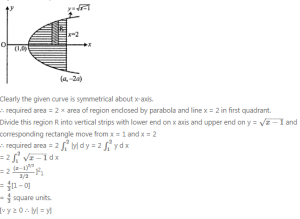
Que-19: Draw the rough sketch of y2 + 1 = x, x < 2 and find the area enclosed by the curve and the line x = 2.
Sol: Given equation of curve be y2 + 1 = x
⇒ y2 = x – 1 Clearly it represents a parabola (right handed) with vertex (1, 0) and does not meeting y-axis at any point.
Further the given curve meets the line x = 2 at y2 + 1 = 2
⇒ y = ± 1 i.e. at points (2, + 1) and (2, – 1).
Que-20: Find the area bounded by the curve y = 4 – x2 and the line y = 0 and y = 3.
Sol:
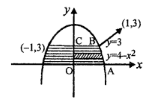
We want to find the area of region bounded by curves given below:
and
y = 4 – x2
y = 0, y = 3
eqn. (1) represents a parabola (downward) with vertex (0,4). y = 4 – x2 meets y = 3 when 3 = 4 – x2
⇒ x2 = 1
⇒ x = ± 1
∴ points of intersection are ( ± 1,3).
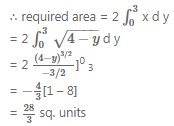
∴ required area = 2 × area of region OABCO
Divide the region into small horizontal strips. Each strip has left end on y-axis and right end on curve y = 4 – x2.
Que-21: Make a rough sketch of the following curves. Also, find the area enclosed between the curves and the axes.
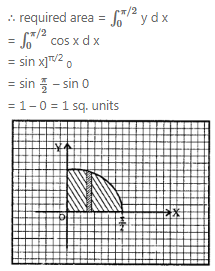
(i) y = cos x, 0 ≤ x ≤ π/2
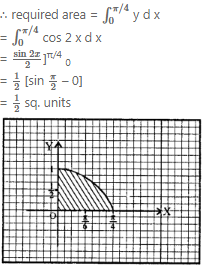
(ii) y = cos 2 x, 0 ≤ x ≤ π/4
(iii) y = sin x, 0 ≤ x ≤ π/2
(iv) y = cos ^2 x, 0 ≤ x ≤ π/2
Sol: (i) Given eqn. of curve be y = cos x ; 0 ≤ x ≤ π/2
Table of values is given as under:
| x | 0 | π/2 | π/3 | π/2 |
| y | 1 | 12 | 0 | 0 |
(ii) Given eqn. of curve be
y = cos 2 x ; 0 ≤ x ≤ π/4
| x | 0 | π/6 | π/4 |
| y | 1 | 1/2 | 0 |
(iii) Equation of given curve be
y = sin x ; 0 ≤ x ≤ π/2
| x | 0 | π/6 | π/4 | π/3 | π/2 |
| y | 0 | 1/2 | 1/√2 | √3/2 | 1 |
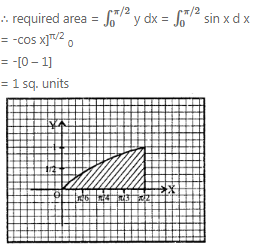
(iv) Given curve is y = cos2 x
For rough sketch we construct a table of values as under :
| x | 0 | π/6 | π/4 | π/3 | π/2 |
| y | 0 | 3/4 | 1/2 | 1/4 | 1 |
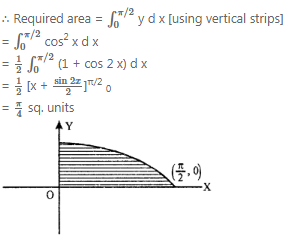
Que-22: Draw a rough sketch of the curve y = cos2 x in [0, π] and find the area enclosed by the the lines x = 0, x = π and the x-axis.
Sol: Given eqn. of curve be y = cos2 x in [0, π]
| x | 0 | π/6 | π/4 | π/3 | π/2 | 2π/3 | π |
| y | 1 | 3/4 | 1/2 | 1/4 | 0 | 1/4 | 1 |
![Que-22: Draw a rough sketch of the curve y = cos2 x in [0, π] and find the area enclosed by the the lines x = 0, x = π and the x-axis.](https://icsehelp.com/wp-content/uploads/2025/11/19-1.png)
Que-23: Draw a rough sketch of the curve y = 1/2 π + 2 sin2 x and find the area between the x-axis, the curve and the ordinates x = 0 and x = π
Sol: Given eqn. of curve be y = π/2 + 2 sin2 x
| x | 0 | π/6 | π/4 | π/3 | π/2 | 2π/3 | 3π/4 | 5π/6 | π |
| y | π/2 | π/2+1/2 | π/2+1 | π/2+3/2 | 3.57 | 3.07 | 2.57 | 2.07 | 1.57 |
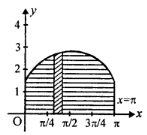
The rough sketch for given curve is given as under.
Divide the region into vertical strips. Each vertical strip has lower end on x-axis and upper end on given curve.
Thus the corresponding rectangle has length |y| and width d x and this rectangle move from x = 0 and x = π.
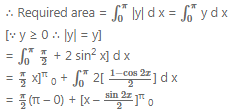
= π²/2 + [π – 0 – 0 – 0]
= π²/2 + π
=π/2 (π + 2) sq. units
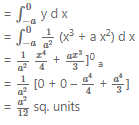
Que-24: Show that the area included between the x-axis and the curve a2 y = x2 (x + a) is a²/12
Sol: Clearly the curve a2 y = x2 (x + a)
meets x-axis i.e. y = 0, where x2 (x + a) = 0
⇒ x = 0,-a
∴ curve meets x-axis at (0,0) and (-a, 0).
∴ required area
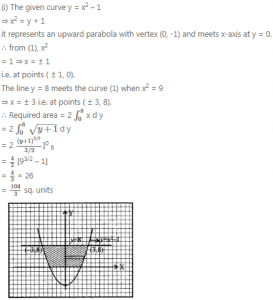
Que-25: (i) Calculate the area bounded by the curve y = x2 – 1, the x-axis and the line y = 8.
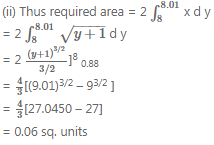
(ii). Calculate the approximate increase in this area, if the line y = 8 is changed to y = 8.01.
Sol:
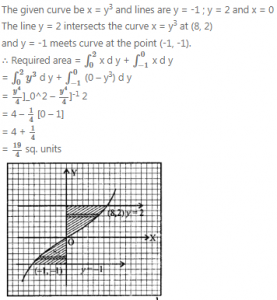
Que-26: Find the area of the region bounded by y = -1, y = 2, x = y3 and x = 0.
Sol:
Que-27: Find the area bounded by x = a t2 , y = 2 a t between the ordinates corresponding to t = 1 and t = 2.
Sol:
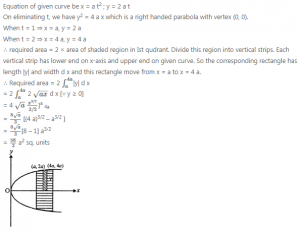
–: End of Application of Integrals Class 12 OP Malhotra Exe-25A ISC Maths Solutions Ch-25 :–
Return to :- OP Malhotra ISC Class-12 S Chand Publication Maths Solutions
Please share with your friends
Thanks




3 thoughts on “Application of Integrals Class 12 OP Malhotra Exe-25A ISC Maths Solutions”
No pdf no solution of OP malhotra in this website it is fake website
uuploaded again soon if unavailable
When the “soon” comes please answer you are telling that we will upload soon we will upload soon ???????