OP Malhotra Notes on Indices or Exponents Class-9 S.Chand ICSE Maths Ch-6. We Provide easy and simple notes on it and Step by Step Answer of Exe-6(a), Exe-6(b), Exe-6(c), Exe-6(d), with Chapter Test of S Chand OP Malhotra Maths. Visit official Website CISCE for detail information about ICSE Board Class-9.
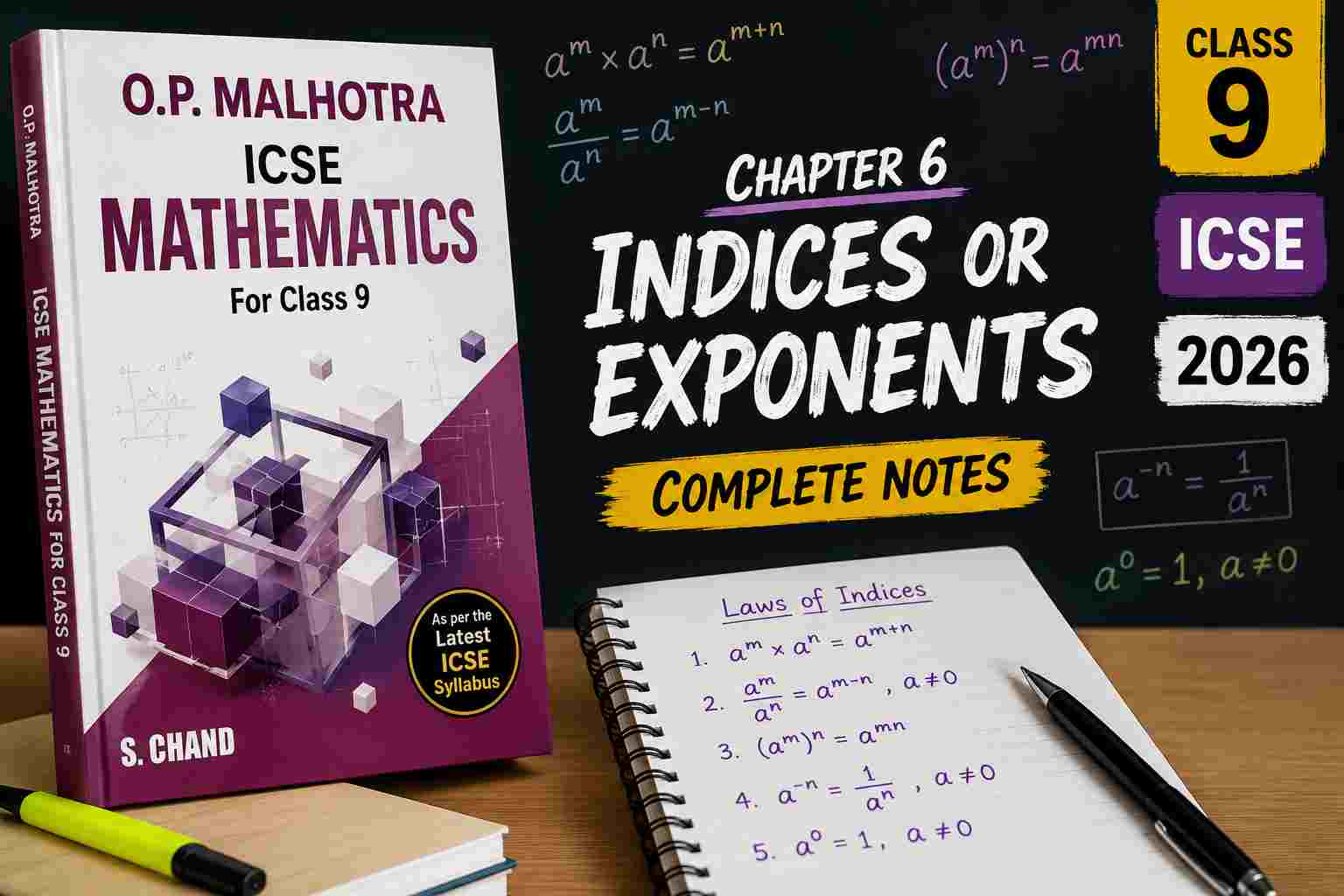


OP Malhotra Indices or Exponents Class-9 S.Chand ICSE Maths Ch-6
Index Definition :
A number or a variable may have an index. Index of a variable (or a constant) is a value that is raised to the power of the variable. The indices are also known as powers or exponents. It shows the number of times a given number has to be multiplied. It is represented in the form:
| am = a × a × a ×……× a (m times) |
Here, a is the base and m is the index.
The index says that a particular number (or base) is to be multiplied by itself, the number of times equal to the index raised to it. It is a compressed method of writing big numbers and calculations.
Example: 23 = 2 × 2 × 2 = 8
In the example, 2 is the base and 3 is the index.
Multiplication Law :
As per the multiplication law of exponents, the product of two exponents with the same base and different powers equals to base raised to the sum of the two powers or integers.
am × an = am+n
Division Law :
When two exponents having same bases and different powers are divided, then it results in base raised to the difference between the two powers.
am ÷ an = am / an = am-n
Practice Questions on Multiplication & Division Law :- Exercise-6(a)
Laws of Indices :
There are some fundamental rules or laws of indices which are necessary to understand before we start dealing with indices. These laws are used while performing algebraic operations on indices and while solving the algebraic expressions, including it.
Rule 1: If a constant or variable has index as ‘0’, then the result will be equal to one, regardless of any base value.
| a0 = 1 |
Laws of Exponents :
The laws of exponents are demonstrated based on the powers they carry.
- Bases – multiplying the like ones – add the exponents and keep the base same. (Multiplication Law)
- Bases – raise it with power to another – multiply the exponents and keep the base same.
- Bases – dividing the like ones – ‘Numerator Exponent – Denominator Exponent’ and keep the base same. (Division Law)
Let ‘a’ is any number or integer (positive or negative) and ‘m’, ‘n’ are positive integers, denoting the power to the bases, then;
Practice Questions on Laws of Exponents & Indices :- Exercise-6(b)
Negative exponents :
A negative exponent is used when 1 is divided by repeated multiplication of a factor. Say, 1/n is given by n-1, where -1 is the exponent. If a number is raised to negative exponents then it represents the reciprocal of it. For example, 3 raised to -2 is represented by 3-2, which is equal to 1/32.
Practice Questions on Laws of Exponents & Indices :- Exercise-6(c)
Unknown Variables
Solve exponential equations where the unknown variable is often in the index (power).
Example : 2x+1 = 4x-3
2x+1 = 4x-3 ⇒ 2x +1 = (22)x-3
⇒ 2x+1 = 22x-6
Comparing both sides, we get
x + 1 = 2x – 6 ⇒ 2x – x = 1 + 6
⇒ x = 7
Practice Questions on Unknown Variables :- Exercise-6(d)
In this chapter, we study all the topics on Indices or Exponents and do some practice questions also. Here we solve extra practice questions on this chapter for better understanding.
Here is the link for extra practice questions on Indices or Exponents :- Chapter Test
— : End of Indices or Exponents OP Malhotra S Chand Solutions :–
Return to :– OP Malhotra S Chand Solutions for ICSE Class-9 Maths
Thanks
Please Share with Your Friends