
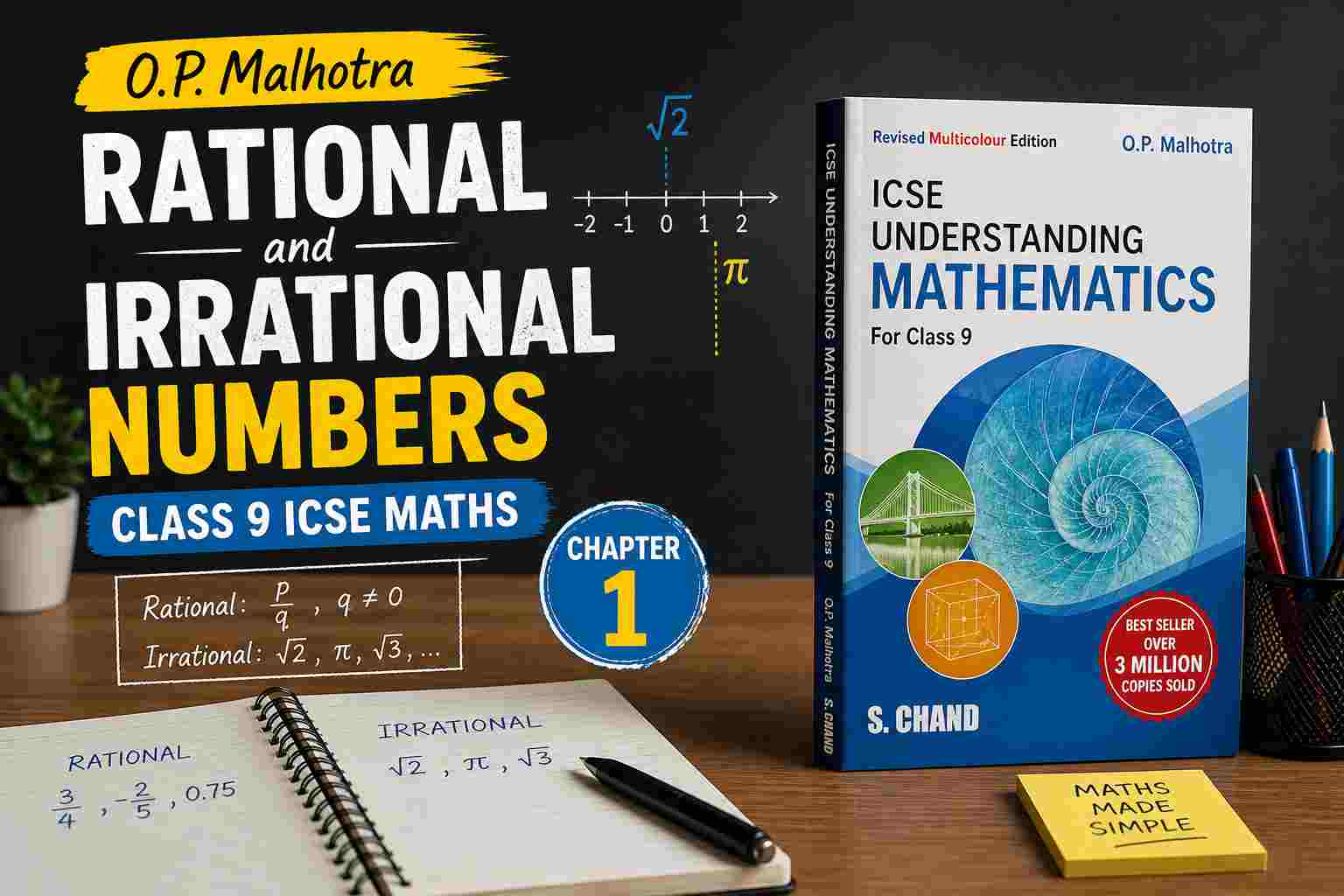
OP Malhotra Rational and Irrational Number Class-9 S.Chand ICSE Maths Ch-1 Solutions 2026. We Provide Step by Step Answer of Exe-1(a), Exe-1(b), Exe-1(c) with Chapter Test of S Chand OP Malhotra Maths . Visit official Website CISCE for detail information about ICSE Board Class-9.


OP Malhotra Rational and Irrational Number Class-9 S.Chand ICSE Maths Ch-1
Introduction to Number Systems :
Numbers :
Number: Arithmetical value representing a particular quantity. The various types of numbers are Natural Numbers, Whole Numbers, Integers, Rational Numbers, Irrational Numbers, Real Numbers etc.
Natural Numbers :
Natural numbers(N) are positive numbers i.e. 1, 2, 3 ..and so on.
Whole Numbers :
Whole numbers (W) are 0, 1, 2,..and so on. Whole numbers are all Natural Numbers including ‘0’. Whole numbers do not include any fractions, negative numbers or decimals.
Integers :
Integers are the numbers that includes whole numbers along with the negative numbers.
Rational Numbers :
A number ‘r’ is called a rational number if it can be written in the form p/q, where p and q are integers and q ≠ 0.
It is denoted by ‘Q’.
Properties of Rational Numbers
1. Closure Property
If a and b are rational, then:
a + b is rational
a − b is rational
a × b is rational
a ÷ b is rational (b ≠ 0)
2. Commutative Property
a + b = b + a
a × b = b × a
3. Associative Property
(a + b) + c = a + (b + c)
(a × b) × c = a × (b × c)
4. Distributive Property
a × (b + c) = ab + ac
5. Identity Elements
Additive Identity: 0 → a + 0 = a
Multiplicative Identity: 1 → a × 1 = a
6. Inverse
Additive inverse of a = −a
Multiplicative inverse of a = 1/a (a ≠ 0)
Some Special Characteristics of Rational Numbers :
- Every Rational number is expressible either as a terminating decimal or as a repeating decimal.
- Every terminating decimal is a rational number.
- Every repeating decimal is a rational number.
To insert rational numbers between two rational numbers [a/b and c/d] :
The simplest way to insert a rational number between two others is by calculating their average (midpoint). If (x) and (y) are two rational numbers, then a rational number between them is:
(x+y)/2
Example : Find one number between 1/4 and 1/2 is :
By using formula : (x+y)/2
[(1/4)+(1/2)]/2 = [(2+1)/4]/2
= (3/4)/2 = 3/8
Questions on this topics given below :-
Irrational Numbers :
Any number that cannot be expressed in the form of p/q, where p and q are integers and q≠0, is an irrational number. Examples: √2, 1.010024563…, e, π
Real Numbers :
Any number which can be represented on the number line is a Real Number(R). It includes both rational and irrational numbers. Every point on the number line represents a unique real number.
Identities for Irrational Numbers :
Arithmetic operations between:
- rational and irrational will give an irrational number.
- irrational and irrational will give a rational or irrational number.
Example : 2 × √3 = 2√3 i.e. irrational. √3 × √3 = 3 which is rational.
Decimal expansion of Rational and Irrational Numbers :
The decimal expansion of a rational number is either terminating or non- terminating and recurring.
Example: 1/2 = 0.5 , 1/3 = 3.33…….
The decimal expansion of an irrational number is non terminating and non-recurring.
Examples: √2 = 1.41421356..
Some Special Characteristics of Irrational Numbers :
- The non-terminating, non-repeating decimals are irrational numbers.
Example: 0.0100100001001…
- Similarly, if m is a positive number which is not a perfect square, then √m is irrational.
Example: √3
- If m is a positive integer which is not a perfect cube, then 3√m is irrational.
Example: 3√2
Properties of Irrational Numbers :
- These satisfy the commutative, associative and distributive laws for addition and multiplication.
- Sum of two irrationals need not be irrational.
Example: (2 + √3) + (4 – √3) = 6
- Difference of two irrationals need not be irrational.
Example: (5 + √2) – (3 + √2) = 2
- Product of two irrationals need not be irrational.
Example: √3 x √3 = 3
- The quotient of two irrationals need not be irrational.
2√3/√3 = 2
- Sum of rational and irrational is irrational.
- The difference of rational and irrational number is irrational.
- Product of rational and irrational is irrational.
- Quotient of rational and irrational is irrational.
Questions on this topics given below :-
Rationalize the Denominators
It involves removing irrational roots from the denominator of a fraction to make it a rational number. This is done by multiplying both the numerator and denominator by the conjugate, ensuring equivalent fractions.
Rationalizing Factor (RF):
- For √a, the RF is √a.
- For √a + √b, the conjugate is √a – √b.
- For √a – √b, the conjugate is √a + √b.
Formula/Technique :
Single Term : 1/√a = 1/√a × √a/√a = √a/a.
Two Terms : 1/(√a+√b) × (√a-√b)/(√a-√b) = (√a-√b)/(a-b)
Steps to Rationalize
- Identify the denominator, e.g., 3 + √5.
- Find the conjugate (conjugate of 3 + √5 is 3 – √5).
- Multiply numerator and denominator by this conjugate.
- Simplify the expression using (a² – b²) in the denominator.
Example : Rationalize : 2/(3+√7)
1. Conjugate : 3 – √7
2. Calculation : 2/(3+√7) × (3 – √7)/(3 – √7)
= [2(3 – √7)]/[3²-(√7)²] = (6-2√7)/(9-7)
= (6-2√7)/2 = 3 – √7.
Questions on this topics given below :-
In this chapter, we study all the topics on rational and irrational numbers and do some questions also. Here we solve extra practice questions on this chapter for better understanding.
Here is the link for extra practice questions :
— : End of Rational and Irrational Number OP Malhotra S Chand Solutions :–
Return to :– OP Malhotra S Chand Solutions for ICSE Class-9 Maths
Thanks
Please Share with Your Friends




3 thoughts on “OP Malhotra Rational and Irrational Number Class-9 S.Chand ICSE Maths Ch-1 2026”
Please upload chapter test
Where is chapter test???
Plzz upload it fast I need it plzzz
soon upload