
Three Dimensional Geometry Class 12 OP Malhotra Exe-23A ISC Maths Solutions Ch-23. In this article you would learn to solve questions on direction ratios and direction cosines of a vector and line. Visit official Website CISCE for detail information about ISC Board Class-12 Mathematics.

OP Malhotra Three Dimensional Geometry ISC Class-12 Maths Solutions Ch-23
| Board | ISC |
| Publications | S Chand |
| Subject | Maths |
| Class | 12th |
| Chapter-23 | Three Dimensional Geometry |
| Writer | OP Malhotra |
| Exe-23(a) | direction ratios and direction cosines of a vector and line |
Direction Ratios and Direction Cosines of a Vector and Line
Three Dimensional Geometry Class 12 OP Malhotra Exe-23A Solutions
Que-1: The direction ratios of a line are 1,- 2,-2. What are their direction cosines?
Sol: The direction ratio of line are < 1, -2, -2 >
∴ direction cosines of line be
<1/√1²+(−2)²+(−2)² , −2/√1²+(−2)²+(−2)² , −2/√1²+(−2)²+(−2)²
i.e., < 1/3, −2/3, −2/3 >
Que-2: If α, β, γ are angles which a line makes with the axes, prove that sin2 α + sin2 β + sin2 γ = 2
Sol: Given α, β and γ are the angles which a line makes with axes
∴ direction cosines of line are < cos α cosβ, cosγ >
∴ cos2 α + cos2 β + cos2 γ = 1
⇒ 1 – sin2 α + 1 – sin2 β + 1 – sin2 γ = 1
⇒ sin2 α + sin2 β + sin2 γ = 3 – 1 = 2
Que-3: Can a line have direction angles 45°, 60°, 120° ?
Sol: Direction cosines of line be < cos 45°, cos 60°, cos 120° >
< 1/√2, 1/2, cos(180° – 60°) >
i.e., < 1/√2, 1/2, – 1/2 >
Here, l = 1/√2, m = 1/2 and n = −1/2
∴ l² + m² + n²
= (1/√2)² + (1/2)² + (−1/2)²
= 1/2 + 1/4 + 1/4 = 1
Yes, a line can hence direction angles 45°, 60° and 120°
Que-4: Prove that 1,1,1 cannot be direction cosines of a straight line.
Sol: Here, l = m = n = 1
∴l2 + m2 + n2
= 1 + 1 + 1 = 3 ≠ 1
Thus, < 1, 1, 1 > can’t be the direction cosines of straight line.
Que-5: Find the dir√ection cosines and direction ratios of the line joining the points
(i) A(0, 0, 0), B(4, 8, -8)
(ii) A(1, 3, 5), B(-1, 0, -1)
(iii) A(5, 6, -3), B(1, -6, 3)
(iv) A(4, 2, -6), B(-2, 1, 3).
Sol: We know that, direction ratios of the line joining the points A(x1, y1, z1) and B(x2, y2, z2) are < x2 – x1, y2 – y1, z2 – z1 >
(i) Direction ratios of line AB are < 4 – 0, 8 – 0, -8 – 0 >
i.e., < 4, 8, -8 >
i.e., < 1, 2, -2 >
∴ Direction cosines of line AB are
< 4/√4²+8²+(−8)² , 8/√4²+8²+(−8)², −8/√4²+8²+(−8)² >
i.e., < 4/12, 8/12, −8/12 >
i.e., < 1/3, 2/3, −2/3 >
(ii) D ratios of line AB are < -1 – 1, 0 – 3, -1 – 5 >
i.e., < -2, -3, -6 >
i.e., < 2, 3, 6 >
∴ D cosines of line AB are
< 2/√2²+3²+6² , 3/√2²+3²+6² , 6/√2²+3²+6² >
i.e., < 2/7, 3/7, 6/7 > .
(iii) D ratios of line AB are < 1 – 5, -6 – 6, 3 + 3 >
i.e., < -4, -12, 6 >
i.e., < 2, 6, -3 >
∴ D cosines of line AB are
< 2/√2²+6²+(−3)² , 6/√2²+6²+(−3)², −3/√2²+6²+(−3)² >
i.e., < 2/7, 6/7, −3/7 >
(iv) D ratios of line AB are < -2 – 4, 1 – 2, 3 + 6 >
i.e., < -6, -1, 9 >
i.e., < 6, 1, -9 >
∴ D cosines of line are
< 6/√6²+1²+(−9)², 1/√6²+1²+(−9)², −9/√6²+1²+(−9)² >
i.e., < 6/√118 , 1/√118 , −9/√118 >
Que-6: By using direction ratios method, show that the following set of points are collinear:
(i) A(1, 2, 3), B(4, 0, 4) and C(-2, 4, 2)
(ii) (-2, 4, 7), (3, -6, -8), (1 -2, -2).
Sol: (i) Direction ratios of line AB are < 4 – 1, 0 – 2, 4 – 3 > i.e., < 3, -2, 1 >
Direction ratios of line BC are < -2 – 4, 4 – 0, 2 – 4 >
i.e., < 3, -2, 1 >
Thus line AB is parallel to line BC and the point B is common in both lines
∴ points A, B and C line on same line
∴ points A, B and C are collinear.
(ii) Direction ratios of line AB are < 3 + 2, -6 – 4, -8 – 7 >
i.e., < 5, -10, -15 >
i.e., < 1, -2 – 3 > and Direction ratios of line BC are < 1 – 3, -2 + 6, -2 + 8 >
i.e., < -2, 4, 6 >
More -1/2 = −2/4 = −3/6
i.e., direction ratios of both lines are proportional and hence lines AB and BC are parallel and the point B in common to both lines
∴ A, B and C are collinear.
Que-7: A line makes an angle of π/4 with each of the x-axis and the y-axis. Find the angle made by it with the z-axis.
Sol: Let θ the angle made by the line with z-axis
∴ direction cosines of given line be < cos π/4, cos π/4, cosθ >
i.e., < 12√, 12√, cosθ >
∴(1/√2)² + (1/√2)² + cos²θ = 1
[∵ l² + m² + n² = 1]
⇒ 1/2 + 1/2 + cos²
θ = 1 or cos²
θ = 0 or cosθ = 0
⇒ θ = π/2
Que-8: If the line O P makes with the x-axis an angle of measure 120° and withy x-axis an angle of measure 60°. Find the angle made by the line with the z-axis.
Sol: Let θ be the angle made by the line OP with z-axis
∴ direction casines of line OP are
< cos 120°, cos 60°, cos θ >
i.e., < −1/2, 1/2, cos θ >
Since, l² + m² + n² = 1
⇒ (−1/2)² + (1/2)² + cos²θ = 1
⇒ 1/2 + cos²θ = 1
⇒ cos²θ = 1/2
= (1/√2)²
= cos²(π/4)
⇒ θ = n π ± π/4
Since, 0 < θ < π
∴ θ = π/4, 3π/4
Que-9: Find the angle between the vectors whose direction cosines are proportional to 2, 3, -6 and 3, -4. 5.
Sol: Let θ be the angle between given vectors whose direction ratios are < 2, 3, -6 > and < 3, -4, 5 >
⇒ cos θ = −36/7×5√2
= −18√2/35
Que-10: If α, β, γ are the angles that a line makes with the axes, then find cos γ if
(i) cosα = 14/15, cos β = −1/3
(ii)α = 60°, β = 135°.
Sol: (i) Sinceα, β, γ are the angles that a line makes with the axes.
∴ direction cosines of line are < cosα, cos β, cos γ >
∴ cos²α + cos²β + cos²γ = 1
⇒ (14/15)2 + (−1/3)2 + cos²γ = 1
⇒ 196/225 + 1/9 + cos2 γ = 1
⇒ 221/225 + cos²γ = 1
⇒ cos²γ = 1 – 221/225
= 4/225 = (2/15)²
⇒ cos²γ = ± 2/15
(ii) Givenα = 60°, β = 135°
∴ cos²γ = 1 – cos²60° – cos²135°
= 1 – (1/2)² – (1/√2)²
= 1 – 1/4 – 1/2 = 1/4
⇒ cos²γ = (1/2)²
⇒ cos γ = ± 1/2
Que-11: If the coordinates of A and B be (2, 3, 4) and (1, -2, 1) respectively, prove that O A is perpendicular to O B, where O is the origin.
Sol: D ratios of line OA are < 2 – 0, 3 – 0, 4 – 0 > i.e., < 2, 3, 4 >
D ratios of line OB are < 1 – 0, -2 – 0, 1 – 0 > i.e., < 1, -2, 1 >
Here a1 a2 + b1 b2 + c1 c2
= 2(1) + 3(-2) + 4(1) = 0
∴ line O A be ⊥ to line O B.
Que-12: Show that therein of the points (1, 2, 3), (4, 5, 7) is parallel to the join of the points (-4, 3, -6) and (2, 9, 2).
Sol: Direction ratios of the line joining A(1, 2, 3) and B}(4, 5, 7) are
< 4 – 1, 5 – 2, 7 – 3 >
i.e., < 3, 3, 4 >
and D ratios of the loine joining C(-4, 3, -6) and D(2, 9, 2) are
< 2 + 4, 9 – 3, 2 + 6 > i.e. < 6, 6, 8 >
Here a1/a2 = b1/b2
= c1/c2 since 3/6
= 3/6 = 4/8 = 1/2
i.e., D ratios of both lines are proportional.
∴ line AB is parallel to line CD.
Que-13: Find the angles between the lines whose direction ratios are
(i) 5, -12, 13; -3, 4, 5;
(ii) 1, 1, 2 ; √3 – 1, −√3 – 1, 4.
Sol: (i) Given direction ratios of lines are < 5, -12, 13 > and < -3, 4, 5 >
a1 = 5 ; b1 = -12 ; c1 = 13
a2 = -3 ; b2 = 4 ; c2 = 5
Let θ be the angle between the lines.
Then cosθ
= a1a2+b1b2+c1c2/√(a1)²+(b1)²+(c1)² √(a2)²+(b2)²+(c2)²
= 5(−3)−12(4)+13(5)/√5²+(−12)²+13² √(−3)²+4²+5²
= −15−48+65 / √2×169 √25×2
= 25×13×2 = 165
∴ θ = cos-1 (165)
(ii) Here a1 = 1 ; b1 = 1 ; c1 = 2
a2 = 3–√ – 1;
b2 = −3–√ – 1;
c2 = 4
∴ cosθ = a1a2+b1b2+c1c2/√(a1)²+(b1)²+(c1)² √(a2)²+(b2)²+(c2)²
= 1(√3−1)+1(−√3−1)+2(4) / √1²+1²+2² √(√3−1)²(−√3−1)²+4²
= √3−1−√3−1+8 / √6√(3+1+3+1+16)
= 6/√144
= 6/12
= 1/2
⇒ θ = π/3
Que-14: If P, Q, R are respectively (2, 3, 5),(-1, 3, 2) and (3, 5, -2), find the direction cosines of the sides of the triangle P Q R.
Sol: ∴ D ratios of line PQ are < -1 – 2, 3 – 3, 2 – 5 >
i.e., < -3, 0, -3 > i.e., < 1, 0, 1 >
∴ D cosines of lines PQ are < 1/√1+1, 0/√1+1, 1/√1+1 >
i.e., < 1√2, 0, 1√2 >
D ratios of line QR are < 3 + 1, 5 – 3, -2 – 2 >
i.e., < 4, 2, -4 >
i.e., < 2, 1, -2 >
∴ D cosines of line QR are < 2/√4+1+4, 1/√4+1+4 , −2/√4+1+4 >
i.e., < 2/3, 1/3, −2/3 >
D ratios of line PR are < 3 – 2, 5 – 3, -2 – 5 >
i.e., < 1, 2, -7 >
∴ D cosines of line PR are < 1/√1+4+49, 2/√1+4+49, −7/√1+4+49 >
i.e., < 1/3√6, 2/3√6, −7/3√6 >
Que-15: Prove that the three points P, Q, R, whose coordinates are respectively (3, 2, -4), (5, 4, -6) and (9, 8, -10) are collinear and find the ratio in which Q divides P R.
Sol: Here D ratios of line PQ are < 5 – 3, 4 – 2, -6 + 4 >
i.e., < 2, 2, -2 > and D ratios of line QR are < 9 – 5, 8 – 4, -10 + 6 >
i.e., < 4, 4, -4 > More 2/4 = 2/4 = −2/−4
i.e., D ratios of both lines PQ and QR are proportional
∴ line PQ and QR are parallel and the point Q is common to both lines
∴ P, Q and R lies on same line
∴ the points P, Q and R are collinear let the point Q divides the time PR in the ratio K : 1.
∴ Coordinates of point Q are
(9 K+3/K+1 , 8 K+2/K+1 , −10K−4/K+1 )
Also coordinates of point Q be (5, 4, -6)
∴ 9 +3/K+1 = 5 ⇒ 9K + 3 = 5K + 5 ⇒ 4K = 2 ⇒ K = 1/2
and 8 +2/K+1 = 4 ⇒ 8K + 2 = 4K + 4 ⇒ 4K = 2 ⇒ K = 1/2
Also, −10K−4/K+1 = -6 ⇒ -10K – 4 = -6K – 6 ⇒ 4K = 2 ⇒ K = 1/2
Times required rastio be K}: 1, i.e., 1: 2.
Que-16: Find the angle not greater than 90° between the lines joining the following pairs of points:
(i) (8, 2, 0), (4, 6, -7), and (-3, 1, 2), (-9, -2, 4);
(ii) (4, -2, 3), (6, 1, 7), and (4, -2, 3),(5, 4, -2);
(iii) (3, 1, -2), (4, 0, -4), and (4, -3, 3), (6, -2, 2).
Sol: (i) D ratios of line joining the points A(8, 2, 0) and B(4, 6, -7) are < 4 – 8, 6 – 2, -7 – 0 > i.e., < -4, 4, – 7 >
and D ratios of line joining the points C(-3, 1, 2) and D(-9, -2, 4) and < -9 + 3, -2 – 1, 4 – 2 > i.e., < -6, -3, 2 >
Let θ be the acute angle between the lines A B and C D
∴ cosθ = |−4(−6)+4(−3)−7(2)| / √16+16+49 √36+9+4
= 2 / 9×7 = 2/63
∴ θ = cos-1 (2/63)
(ii) D ratios of the line joining the points A(4, -2, 3) and B(6, 1, 7) are < 6 – 4, 1 + 2, 7 – 3 >
i.e., < 2, 3, 4 >
and D ratios of the line joining the points C(4, -2, 3) and D(5, 4, -2) are < 5 – 4, 4 + 2, -2 – 3 > i.e., < 1, 6, -5 >
Let θ be the angle between the lines A B and C D.
∴ cosθ = |2(1)+3(6)+4(−5)| / √4+9+16 √1+36+25
∴ θ = π/2
(iii) D ratio of the line joining the points A(3, 1, -2) and B(4, 0, -4) are < 4 – 3, 0 – 1, -4 + 2 > i.e. < 1, -1, -2 >
and D ratios of the line joining the points C(4, -3, 3) and D(6, -2, 2) are < 6 – 4, -2 + 3, 2 – 3 > i.e., < 2, 1, -1 >
Let θ be the angle between the lines AB and CD.
Then cosθ = |1(2)−1(1)−2(−1)| / √1+1+4 √4+1+1
= 3/√6√6 = 3/6
= 1/2 ⇒ θ = π/3
Que-17: Find the direction cosines of the line which is perpendicular to the lines with direction cosines proportional to 1, – 2, -2 ; 0, 2, 1.
Sol: Let the required direction ratios of given line be < a, b, c > and given line is ⊥ to the lines having direction ratios are < 1, -2, -2 > and < 0, 2, 1 >.
∴ a – 2 b – 2 c = 0
0 a + 2 b + c = 0
using cross-multiplication method, we have
a/−2+4 = b/0−1 = c/2−0
i.e., a/2 = b/−1 = c/2
∴ D ratios of line are < 2, -1, 2 >
Time required direction cosines of line are
< 2/√2²+(−1)²+2², −1/√2²+(−1)²+2², 2/√2²+(−1)²+2² >
i.e., < 2/3, −1/3, 2/3 >
Que-18: Find the direction ratios of a line perpendicular to the two lines determined by the pairs of points (2, 3, -4), (-3, 3, -2) and (-1, 4, 2), (3, 5, 1).
Sol: D ratios of given lines are < -3, -2, 3 – 3, -2 + 4 > and < 3 + 1, 5 – 4, 1 – 2 >
i.e., < -5, 0, 2 > and < 4, 1, -1 >
Let the direction ratios of required line be < a, b, c >.
Since the required line be ⊥ to given lines. Then -5 a + 0 b + 2 c = 0
4 a + b – c = 0
on solving eqn. (1) and eqn. (2), by cross multilplication method, we have
a/0−2 = b/8−5
= c/−5−0 i.e., a/−2 = b/3 = c/−5
∴ direction ratios of required line be < -2, 3, -5 >
Que-19: For what value of x will the line through (4, 1, 2) and (5, x, 0) be parallel to the line through (2, 1, 1) and (3, 3, -1).
Sol: D ratios of the line AB through the points A(4, 1, 2) and B(5, x, 0) are < 5 – 4, x – 1, 0 – 2 > i.e., < 1, x – 1, -2 >
also direction ratio of line (1) through the points C(2, 1, 1) and D(3, 3, -1) are < 3 – 2, 3 – 1, -1 – 1 > i.e., < 1, 2, -2 >
Since both lines are parallel
∴ direction ratios of both lines are proportional.
∴ 1/1 = x−1/2
= −2−2
⇒ x – 1 = 2 ⇒ x = 3
Que-20: For what value of x will the lines in Problem 19 be perpendicular?
Sol: Now both lines AB and CD are perpendicular.
∴ 1(1) + (x – 1) 2 + (-2)(-2) = 0
⇒ 1 + 2 x – 2 + 4 = 0 ⇒ 2 x + 3 = 0
[∵ a1 a2 + b1 b2 + c1 c2 = 0]
Que-21: Show that the points (4, 7, 8), (2, 3, 4), (-1, -2, 1) and (1, 2, 5) are the vertices of a parallelogram.
Sol: Let ABCD be the quadailateral.
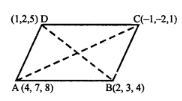
Mid point of AC = (4−1/2, 7−2/2, 8+1/2)
= (3/2, 5/2, 9/2)
and mid point of BD = (2+1/2, 3+2/2, 4+5/2),
i.e., (3/2, 5/2, 9/2)
Thus diagonals AC and BD bisect each other.
D ratios of line AB are < 2 – 4, 3 – 7, 4 – 8 > i.e., < -2, -4, -4 >
D ratios of side DC are < -1 – 1, -2 – 2, 1 – 5 > i.e., < -2, -4, -4 >
∴ AB || DC.
similarly direction ratios of side AD are < 1 – 4, 2 – 7, 5 – 8 >
i.e., < -3, -5, -3 > and direction ratios of side BC are < -1 – 2, -2 – 3, 1 – 4 >
i.e., < -3, -5, -3 >
Thus AD || BC
Hence, A, B, C and D are the vertices of parallelogram.
Que-22: Show that the points (5, -1, 1), (7, -4, 7), (1, -6, 10), and (-1, -3, 4) are the vertices of a rhombus.
Sol: Let A, B, C and D are the given vertices of quadrilateral.
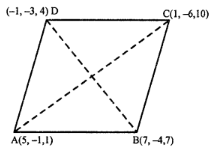
D ratios of side AB} are :
< 7 – 5, -4 + 1, 7 – 1 > i.e., < 2, -3, 6 >
D ratios of side AD are :
< -1 – 5, -3 + 1, 4 – 1 > i.e., < -6, -2, 3 >
Here D ratios of line AC are
< 1 – 5, -6 + 1, 10 – 1 > i.e., < -4, -5, 9 >
and D ratio of diagonal BD are
< -1 – 7, -3 + 4, 4 – 7 > i.e., < -8, 1, -3 >
Here a1 a2 + b2 b2 + c1c2 = (-4)(-8) + (-5) 1 + 9(-3) = 0
∴ both diagonals intersect each other at right angle.
Also mid point of AC= (5+1/2, −1−6/2, 1+10/2)
i.e., (3, −7/2, 11/2)
and mid point of BD = (7−1/2, −4−3/2, 4+7/2)
i.e., (3, −7/2, 11/2)
∴ both diagonals bisect each other at right angles.
|AB| = √(7−5)²+(−4+1)²+(7−1)² = √4+9+36 = 7
|AD| = √(−1−5)²+(−3+1)²+(4−1)² = 7
|DC| = √(7−1)²+(−4+6)²+(10−7)² = √36+4+9 = 7
|DC| = √(1+1)²+(−6+3)²+(10−4)² = 7
∴ |AB| = |BC| = |AD| = |DC|
Also,
|AC| = √(1−5)²+(−6+1)²+(10−1)² = √16+25+81 = √122
|BD| = √(−1−7)²+(−3+4)²+(4−7)² = √64+1+9 = √74
∴ |AC| ≠ |BD|
Clearly A, B, C and D are the vertices of rhombus.
Que-23: Find the foot of the perpendicular drawn from the point A(1, 0, 3) to the join of the points B(4, 7, 1) and C(3, 5, 3).
Sol: Let D be the foot of ⊥ drawn from A(1, 0, 3) to BC.
Let point D divides the line BC in the ratio K : 1
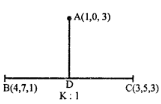
∴ Coordinates of point D are (3 K+4/K+1, 5 K+7/K+1, 3K+1/K+1)
∴ direction ratios of line AD are
< 3 K+4/K+1 – 1, 5K+7/K+1 – 0, 3K+1/K+1 – 3 >
i.e., < 2K+3/K+1, 5K+7/K+1, −2/K+1 >
Also direction ratios of line BC are < 3 – 4, 5 – 7, 3 – 1 >
i.e., < -1, -2, 2 > Since line AD is ⊥ to line BC.
∴ (2 K+3 K+1)(-1) + (5 K+7 K+1)(-2) + (−2 K+1) 2 = 0
⇒ -2K – 3 – 10K – 14 – 4 = 0
⇒ -12K – 21 = 0
⇒ K = −7/4
Thus required coordinates of foot of ⊥ D are (−(21/4)+4/−(7/4)+1, −(35/4)+7/−(7/4)+1, −(21/4)+1/−(7/4)+1)
i.e., (5/2, 7/3, 17/3)
Thus required coordinates of foot of ⊥ D are (−214+474+1, −354+7−74+1, −214+1−74+1)
i.e., (5/2, 7/3, 17/3)
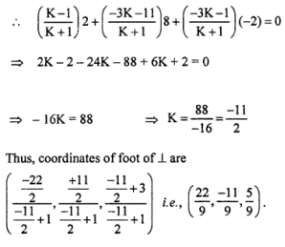
Que-24: A(1, 0, 4) and B(0, -11, 3), C(2, -3, 1) are three points and D is the foot of the perpendicular from A on B C. Find the coordinates of D.
Sol: Let the point D divide the line BC in the ratio K : 1.
Then coordinates of point D are
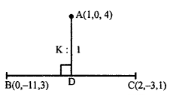
(2K/K+1, −3K−11/K+1, K+3/K+1)
∴ D ratios of line AD are
< 2K/K+1 – 1, −3K−11/K+1 + 1 – 0, K+3/K+1 – 4 >
i.e., < K−1/K+1, −3K−11/K+1, −3K−1/K+1 >
D ratios of line BC are < 2, -3 + 11, 1 – 3 >
Que-25: Calculate the cosine of the angle A of the triangle with vertices A(1,-1, 2), B(6, 11, 2),
Sol:
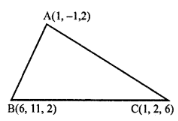
D ratios of side AB are
< 6 – 1, 11 + 1, 2 – 2 > i.e., < 5, 12, 0 >
D ratios of line AC are
< 1 – 1, 2 + 1, 6 – 2 > i.e., < 0, 3, 4 >
Here a_1 = 5 ; b_1 = 12 ; c_1 = 0
Here a_1 = 5 ; b_1 = 12 ; c_1 = 0
a_2 = 0 ; b_2 = 3 ; c_2 = 4
∴ cos A = a1a2+b1b2+c1c2/√(a1)²+(b1)²+(c1)² √(a2)²+(b2)²+(c2)²
= 5(0)+12(3)+0(4)/√5²+12²+0² √0²+3²+4²
= 36/13×5
= 36/65
Que-26: If A, B, C, D are the points (6, -6, 0), (-1, -7, 6), (3, -4, 4), (2, -9, 2) respectively, prove that A B is perpendicular to C D.
Sol: Here direction ratios of line A B are
< -1, -6, -7 + 6, 6 – 0 >
i.e., < -7, -1, 6 >
Direction ratios of line CD are
Here
< 2 -3, -9 + 4, 2 – 4 > i.e., < -1, -5, -2 >
and
a1 = -7 ; b1 = -1 ; c1 = 6
Now
a2 = -1 ; b2 = -5 ; c2 = -2
a1 a2 + b1 b2 + c1 c2
= (-7)(-1) + (-1)(-5) + 6(-2) = 7 + 5 – 12 = 0
Que-27: Find the angle between any two diagonals of a cube.
Sol: Let a be the length of edge of the cube and let one corner of the cube be at (0,0,0).
The the diagonals of cube are OP, AR, BS and CQ
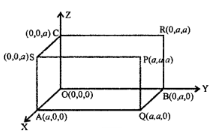
Let us consider the two diagonals OP and AR
∴ d ‘ratios of OP and AR are proportional to < a – 0, a – 0, a – 0 >
i.e. < a, a, a > and < 0 – a, a – 0, a – 0 > i.e. < -a, a, a >
Let θ be the angle between OP and AR
∴ cosθ = a(−a)+a(a)+a(a)/√a²+a²+a² √a²+a²+a²
= a²/√3a √3a
= 1/3
∴ θ = cos-1 (1/3)
Similarly the angle between other pairs of diagonals be cos-1 (1/3)
–: End of Three Dimensional Geometry Class 12 OP Malhotra Solutions of Exe-23A direction ratios and direction cosines of a vector and line :–
Return to :- OP Malhotra ISC Class-12 S Chand Publication Maths Solutions
Please share with your friends
Thanks




4 thoughts on “Three Dimensional Geometry Class 12 OP Malhotra Exe-23A ISC Maths Solutions”
Sir anwer dikhai nhi rha hai refuse content dikha rha hai
our engineer is suffering from dengue currently. even your problem will be solve soon
Sir isme solutions toh digiye please
yes given now