Exercise IV on Water Class 6 Concise Chemistry ICSE Solutions Ch-7. In this article you would learn how to solve Exercise IV on Water with hint and reason . Visit official Website CISCE for detail information about ICSE Board Class-6.
Exercise IV on Water Class 6 Concise Chemistry ICSE Solutions
| Board | ICSE |
| Publications | Selina Publication |
| Subject | Chemistry |
| Class | 6th |
| Chapter-7 | Water |
| Book Name | Concise |
| Topics | Solution of Exercise IV |
| Academic Session | 2025-2026 |
Exercise IV on Water
Exercise IV
Objective Type Questions
Que-1: Water pollution is caused due to the addition of:
(i)domestic sewage
(ii)pesticides
(iii)effluents
(iv)all of the above
Ans- all of the above
Reason- Water pollution is caused by the addition of domestic sewage, pesticides, and industrial effluents into water bodies. These substances contaminate water, make it unsafe for drinking, harm aquatic life, and disturb the natural balance of aquatic ecosystems. Therefore, all of the above cause water pollution.
Que-2: One of the methods to control water pollution is:
(i)using synthetic detergents
(ii)passing wastewater through effluent and sewage treatment plants
(iii)washing clothes and utensils near water bodies
(iv)using more fertilizers, pesticides, etc.
Ans- passing wastewater through effluent and sewage treatment plants
Reason- Effluent and sewage treatment plants remove harmful pollutants, chemicals, and germs from wastewater before it is released into rivers, lakes, or other water bodies. This helps prevent water pollution and protects aquatic life and human health. The other options increase water pollution rather than control it.
Que-3: Excess rainfall may cause:
(i)floods
(ii)droughts
(iii)soil erosion
(iv)both (i) and (iii)
Ans- both (i) and (iii)
Reason- Excess rainfall can cause floods due to the overflow of rivers and water bodies. It can also lead to soil erosion, as the flowing water washes away the fertile top layer of soil. Therefore, both floods and soil erosion may result from excessive rainfall.
Que-4: Conservation of water can be done by :
(i)rainwater harvesting
(ii)planting trees and plants
(iii)avoiding misuse of water
(iv)all of the above
Ans- all of the above
Reason- Water can be conserved by rainwater harvesting, which collects and stores rainwater for future use; by planting trees and plants, which help increase groundwater recharge and reduce soil erosion; and by avoiding misuse of water, which prevents wastage. Therefore, all these methods help in the conservation of water.
Assertion Reason Type Questions
Que-1: Assertion: The sea water is saline.
Reason: The sea water contains many dissolved salts and minerals.
(i)Both A and R are true and R is the correct explanation of A.
(ii)Both A and R are true and R is not the correct explanation of A.
(iii)A is true and R is false.
(iv)A is false and R is true.
Ans- Both A and R are true and R is the correct explanation of A.
Reason — A is true as sea water is salty.
R is true as sea water contains many dissolved salts and minerals.
Que-2: Assertion: Water is a universal solvent.
Reason: Water has the ability to dissolve most of the solid, liquid and gaseous substances in it.
(i)Both A and R are true and R is the correct explanation of A.
(ii)Both A and R are true and R is not the correct explanation of A.
(iii)A is true and R is false.
(iv)A is false and R is true.
Ans- Both A and R are true and R is the correct explanation of A.
Reason — A is true as water is called a universal solvent.
R is true as water can dissolve a large number of substances.
Que-3: Assertion: Water is a mixture.
Reason: Water is made up of hydrogen and oxygen combined together in a 2 : 1 ratio by volume.
(i)Both A and R are true and R is the correct explanation of A.
(ii)Both A and R are true and R is not the correct explanation of A.
(iii)A is true and R is false.
(iv)A is false and R is true.
Ans- A is false and R is true.
Reason — A is false as water is not a mixture; it is a compound.
R is true as water is made of hydrogen and oxygen combined in a fixed ratio (2:1 by volume), which is a property of compounds.
Que-4: Assertion: Seeds need water to germinate and grow into plants.
Reason: Ice, liquid water and steam have different physical and chemical properties.
(i)Both A and R are true and R is the correct explanation of A.
(ii)Both A and R are true and R is not the correct explanation of A.
(iii)A is true and R is false.
(iv)A is false and R is true.
Ans- Both A and R are true and R is not the correct explanation of A.
Reason — A is true as seeds need water for germination because water activates enzymes and helps in growth.
R is true as ice, liquid water, and steam have different physical properties
Fill in the Blanks
Que-1: Water is a ….. ……. … solvent.
Ans- Water is a universal solvent.
Que-2: …. …. ……. is the purest form of natural water.
Ans- Rain water is the purest form of natural water.
Que-3: Sand and dust are ….. …. …… impurities in water.
Ans- Sand and dust are insoluble impurities in water.
Que-4: Sea water has a high concentration of ….. …… ….
Ans- Sea water has a high concentration of dissolved salts.
Que-5: Water covers nearly … ……… .. of the surface of the earth.
Ans- Water covers nearly 70 % of the surface of the earth.
Que-6: Evaporation of rain water leaves … ……… … residue.
Ans- Evaporation of rain water leaves no residue.
Que-7: …… …. ….. is the chemical added to water to remove the tiny suspended particles.
Ans- Alum is the chemical added to water to remove the tiny suspended particles.
Que-8: A … …….. …. is a uniform mixture of a solute and a solvent.
Ans- A solution is a uniform mixture of a solute and a solvent.
Que-9: Ice, water and steam have different physical states but are chemically …. ….. ……
Ans- Ice, water and steam have different physical states but are chemically identical.
Que-10: Boiling kills most of the …. …….. … in water.
Ans- Boiling kills most of the germs in water
Que-11: The elements present in the molecules of water are …. …. ……. and …. …… …..
Ans- The elements present in the molecules of water are hydrogen and oxygen.
State True or False
Write true or false for the following statements:
Que-1: Water is an element. ……………
Ans- False
Correct Statement — Water is a compound. Hydrogen and Oxygen are present in a fixed proportion in a water molecule.
Ans- True
Que-3: Tap water does not contain dissolved impurities. ……………
Ans- False
Correct Statement — Tap water usually contains some dissolved salts, minerals, and chlorine.
Que-4: Distillation is a good method for purifying water for town supply. ……………
Ans- False
Correct Statement — Distillation is good method to get water for medicinal purposes and in laboratories.
Match the Following
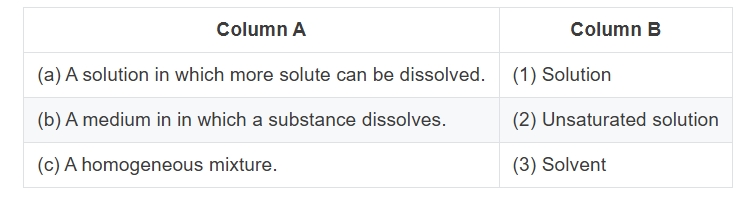
Ans- (a) – (2)
(b) – (3)
(c) – (1)
Short Answer Questions
Que-1: Name two water-borne diseases.
Ans- Two water-borne diseases are:
(i)Typhoid
(ii)Cholera
Que-2: What are effluents?
Ans- Effluents are liquid wastes or sewage discharged from homes, factories, industries, or treatment plants into rivers, lakes, seas, or other water bodies.
Que-3:`What is rainwater harvesting?
Ans- Rainwater harvesting is the process of collecting and storing rainwater from rooftops or other surfaces for future use.
Que-4:`What causes
(i) floods
(ii) soil erosion
(iii) droughts?
Ans- (i) Floods: Caused by excessive rainfall, overflowing rivers, or rapid melting of snow.
(ii) Soil erosion: Caused by the running action of water and wind, especially when there is little vegetation cover.
(iii) Droughts: Caused by very low rainfall or prolonged absence of rain over a long period.
Long Answer Questions
Que-1: What are the three main causes of water pollution ?
Ans- The three main causes of water pollution are:
(i) Domestic Sewage: Domestic sewage includes wastewater from homes, containing human excreta, soaps, detergents, food wastes, and other household wastes. When untreated sewage is discharged into rivers, lakes, and ponds, it contaminates the water and spreads water-borne diseases such as cholera and typhoid.
(ii) Industrial Effluents: Industries release liquid wastes called effluents, which may contain harmful chemicals, acids, dyes, oils, and heavy metals. When these untreated effluents are discharged into water bodies, they make the water toxic and harmful for aquatic life as well as human use.
(iii) Agricultural Runoff: Farmers often use fertilizers, pesticides, and insecticides to increase crop production. During rains, these chemicals are washed into nearby rivers, lakes, and ponds. This pollutes the water and affects aquatic plants and animals.
Que-2: State four steps to be taken to prevent water pollution.
Ans- The following four steps can be taken to prevent water pollution:
(i)Treat sewage before disposal: Domestic sewage should be properly treated in sewage treatment plants before being released into rivers, lakes, or other water bodies.
(ii)Treat industrial effluents: Industries should pass their liquid wastes through effluent treatment plants to remove harmful chemicals before discharge.
(iii)Reduce the use of fertilizers and pesticides: Excessive use of chemical fertilizers, insecticides, and pesticides should be avoided, as they can be washed into water bodies and cause pollution.
(iv)Do not dump waste into water bodies: Garbage, plastics, dead animals, and other wastes should not be thrown into rivers, lakes, ponds, or seas.
Que-3: (i) State three reasons to conserve water.
(ii) State four ways in which you as an individual can conserve water.
Ans- (i) Three Reasons to Conserve Water
(a)Fresh water is limited and only a small amount of the Earth’s water is available for human use.
(b)Water is essential for life, agriculture, industries, and domestic activities.
(c)Conserving water helps prevent water scarcity and ensures its availability for future generations.
(ii) Four Ways in Which an Individual Can Conserve Water
(a)Turn off taps when water is not in use, such as while brushing teeth.
(b)Repair leaking taps and pipes to prevent wastage of water.
(c)Use water carefully and avoid unnecessary wastage during bathing, washing, and cleaning.
(d)Practice rainwater harvesting by collecting and storing rainwater for future use.
Case Study Type Questions
Que-1: Siya kept two healthy potted plants A and B in sunlight. She watered plant A with tap water and plant B with saline water for a few days regularly. She observed that one of the plants grew well, the other could not.
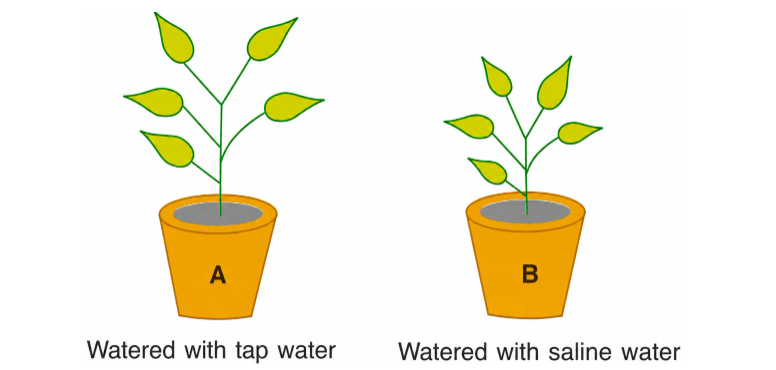
(i) Which potted plant did not grow well ? Why ?
(ii) What is saline water ?
(iii) What conclusion can you draw from Siya’s experiment ?
Ans- (i) Plant B did not grow well because it was watered with saline water, which contains excess salts. High salt concentration makes it difficult for roots to absorb water (due to osmosis), leading to poor growth or even damage to the plant.
(ii) Saline water is water that contains a high amount of dissolved salts.
(iii) Plants grow well with normal water, but excess salt in water is harmful to plants and affects their growth.
Que-2: During summer, Radha noticed that the ponds near her house became dry. But in the rainy season, those same ponds overflow with water. Curious, she asked her teacher why this happens. Her teacher explained that heat from the sun changes water from rivers, lakes and ponds into water vapour. Water vapour then rises up and forms clouds. When clouds become heavy, they release water back to the earth as rain. This natural process keeps water circulating on the earth.
(i) What is this continuous circulation of water called?
(ii) What is the process by which water vapour turns back into tiny droplets of water?
(iii) In which season is the evaporation of water the fastest?
(iv) Write two uses of water in your daily life, apart from drinking.
Ans-(i) The Water Cycle
(ii) Condensation
(iii) Summer season
(iv) Bathing and Washing clothes
— : End of Exercise IV on Water Class 6 Concise Chemistry ICSE Solutions :–
Return to:- ICSE Class-6 Concise Selina Solutions
Please, Share with your friends
thanks