OP Malhotra Circle Class-9 Exe-13A ICSE Maths Solutions Ch-13. In This article you would learn chord properties of circle with solved practice questions,. Visit official Website CISCE for detail information about ICSE Board Class-9 Maths.
OP Malhotra Circle Class-9 Exe-13A ICSE Maths Solutions Ch-13
| Board | ICSE |
| Publications | S. Chand |
| Subject | Maths |
| Class | 9th |
| Chapter-13 | Circle |
| Writer | OP Malhotra |
| Topics | Solution of Exe-13A Chord Properties of Circle |
| Academic Session | 2025-26 |
Chord Properties of Circle
OP Malhotra Circle Class-9 Exe-13A ICSE Maths Solutions Ch-13
Que-1: Calculate the length of a chord which is at a distance of 12 cm from the centre of a circle of radius 13 cm.
Sol: In the given circle radius OA = 13 cm and ⊥ OM = 12 cm
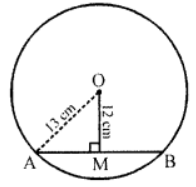
Let length of chord AB = 2x
∵ OM ⊥ AB
∴ M is midpoint of AB
∴ AM = 2x/2 = x
Now in right angled ∆OAM,
OA² = OM² + AM² (Pythagoras Theorem)
⇒ (13)² = (12)² + x²
⇒ 169 = 144 + x²
⇒ x² = 169 – 144
⇒ x² = 25 = (5)²
∴ x = 5
Length of chord AB = 2 x 5 = 10 cm
Que-2: In the figure, the radius of the given circle, with centre C, is 6 cm, if the chord AB is 3 cm away from the centre, calculate its length.
Sol: In the given circle,
Radius CA = 6 cm and ⊥ CM = 3 cm
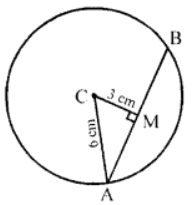
Let length of AB = x cm 1 x
Then AMC = 1/2 AB = 1/2 cm
Now in right angled ∆CAM,
CA² = CM² + AM² (Pythagoras Theorem)
⇒ (6)² = (3)² + (x/2)²
⇒ 36 = 9 + x²/4
∴x²/4 = 36 – 9 = 27 = (3√3)²
∴ x/2 = 3√3 x = 6√3
∴ Length of AB = 6√3 cm
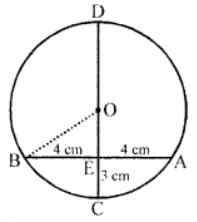
Que-3: In figure, CD is diameter which meets the chord AB in E, such that AE = BE = 4 cm. If CE is 3 cm, find the radius of the circle.
Sol: In the figure,
CD is the diameter of the circle with centre O
AB is chord which intersects CD at E and EA = EB = 4 cm and CE = 3 cm
Let r be the radius of the circle then
OC = r and OE = (r – 3)
Join OB In right ∆OBC,
OB² = BE² + OE² (Pythagoras Theorem)
⇒ r² = (4)² + (r – 3)²
⇒ r² = 16 + r² – 6r + 9
⇒ r² – r² + 6r = 16 + 9
⇒ 6r = 25 ⇒ r = 25/6 = 4*(1/6)
∴ Radius of the circle = 4*(1/6) cm
Que-4: In a circle of radius 5 cm, AB and CD are two parallel chords of length 8 cm and 6 cm respectively. Calculate the distance between the chords, if they are on
(i) the same side of the centre ;
(ii) opposite sides of the centre.
Sol: (i) When the chords are in the same side of the centre
Radius of the circle = 5 cm
Length of AB = 8 cm and CD = 6 cm
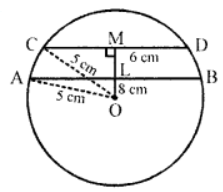
From O, draw a perpendicular on CD which intersects AB at L and meets CD at M
∴ M is the midpoints of CD and L is the midpoint ofAB
Join OA and OC
Now in right ∆OCM,
OC² = CM² + OM² (Pythagoras Theorem)
⇒ (5)² = (3)² + OM² (∵ CM = 1/2 CD = (1/2) x 6 = 3 cm)
⇒ 25 = 9 + OM² ⇒ OM² = 25 – 9 = 16 = (4)²
∴ OM = 4 cm
Similarly in right angled ∆OAL,
OA² = AL² + OL²
⇒ (5)² = (4)² + OL² (AL = 1/2 AB = (1/2) x 8 = 4 cm)
25 = 16 + OL²
⇒ OL² = 25 – 16 = 9 = (3)²
∴ OL = 3 cm
Now LM = OM – OL = 4 – 3 = 1 cm
∴ Distance between the two chords = 1 cm
(ii) When the chords are in the opposite sides of the centre
Draw OL ⊥ AB and OM ⊥ CD
In right ∆OCM,
OC² = CM² + OM² (Pythagoras Theorem)
⇒ (5)² = (3)² + OM² (∵ CM = 12 CD)
⇒ 25 = 9 + OM²
⇒ OM² = 25 – 9 = 16 = (4)²
OM = 4 cm
Similarly in right ∆OLA,
OA² = OL² + AL²
⇒ (5)² = OL² + (4)² (∵ AL = 1/2 AB)
⇒ 25 = OL² + 16
OL² = 25 – 16 = 9 = (3)²
∴ OL = 3 cm
∴ LM = OL + OM = 3 + 4 = 7 cm
∴ Distance between the two chords = 7 cm
Que-5: The radius of a circle is 2.5 cm. AB, CF are two parallel chords 3.9 cm apart. If AB = 1.4 cm, find CF.
Sol: In right angled ∆OAM,
AM = 0.7 cm
OA = 2.5 cm and OA² = AM² + OM²
(Pythagoras Theorem)
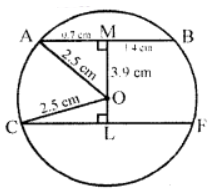
⇒ (2.5)² = (0.7)² + OM²
⇒ 6.25 = 0.49 + OM²
⇒ OM² = 6.25 – 0.49 = 5.76 = (2.4)²
∴ OM = 2.4
But LM = 3.9
∴ OL = LM – OM = 3.9 – 2.4 = 1.5 cm
Now in ∆OLC,
OC² = CL² + OL² (Pythagoras Theorem)
⇒ (2.5)² = CL² + (1.5)²
⇒ 6.25 = CL² + 2.25 CL²
= 6.25 – 2.25 = 4.00 = (2)²
∴ CL = 2
∴ Chord CF = 2 x CL = 2 x 2 = 4 cm
Que-6: A chord distant 2 cm from the centre of a circle is 18 cm long. Calculate the length of a chord of the same circle which is 6 cm distant from the centre.
Sol: Let r be the radius of the circle and chord
AB = 18 cm
and distance from the centre O
∴ OL = 2 cm
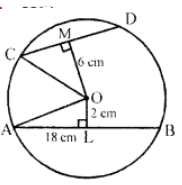
Let CD be another chord
OM ⊥ CD and OM = 6 cm
Now in right ∆OAL,
OA² = AL² + OL² (Pythagoras Theorem)
= (9)² + (2)² = 81 + 4 = 85 (AL = (1/2) AB = (1/2) x 18 = 9 cm)
Similarly in right ∆OCM,
OC² = OM² + CM²
⇒ OA² = OM² + CM² (∵ OA = OC radii of the same circle)
⇒ 85 = (6)² + CM²
⇒ 85 = 36 + CM² ⇒ CM² = 85 – 36 = 49 = (7)²
∴ CM = 7
∴ CD = 2 x CM
= 2 x 7 = 14cm
Que-7: In figure, circles are concentric with centre O. Find AC.
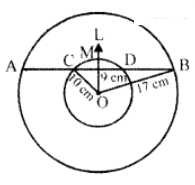
Sol: In the figure, two circles are concentric with centre O
Chord AB intersect the small circle at C and D
OB and OC are joined
OB = 17 cm, OC = 10 cm
OL ⊥ AB
Now in right ∆OMB,
OB2 = OM² + MB² (Pythagoras Theorem)
⇒ (17)² = (9)² + MB²
⇒ 289 = 81 + MB²
⇒ MB² = 289 – 81 = 208
MB = √208 = 14.42
or AM = 14.42 cm (∵ M is midpoint of AB)
Similarly in right ∆OCM,
OC² = OM² + CM²
⇒ (10)² = (9)² + CM²
⇒ 100 = 81 + CM²
⇒ CM² = 100 – 81 = 19
∴ CM = √19 = 4.36 cm
∴ AC = AM – CM = 14.42 – 4.36 = 10.06 cm
Que-8: The length of the common chord of two equal intersecting circles is 10 cm and the distance between the two centres is 6 cm. Find the radius of each circle.
Sol: Two equal circles with centre O and O’ intersect each other at A and B
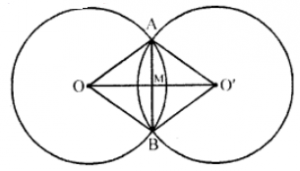
OO’, AB, OA, OB, O’A and O’B are joined
AB = 10 cm
OO’ = 6 cm
Let OO’ bisects AB at M i.e. AM = MB = 10/2 = 5cm
and OM = MO’ = 6/2 = 3 cm
Now in right ∆OAM,
OA² = OM² + AM² (Pythagoras Theorem)
= (3)² + (5)² = 9 + 25 = 34
∴ OA = √34 = 5.83 cm
Hence radius of each circle = 5.83 cm
Que-9: In figure, AB = 8 cm, CM = 1 cm, CM is the perpendicular bisector of AB. The radius OA = x cm. Find x.
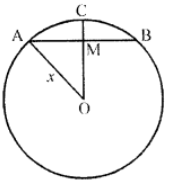
Sol: In circle with centre O, OA is its radius
AB is chord, OM ⊥ AB which is produced to meet the circle at C
AB = 8 cm, CM = 1 cm, OA = x
OC = OA = x
∴ OM = OC – CM = (x – 1)
Now in right ∆OAM,
OA² = AM² + OM² (Pythagoras Theorem)
x² = (4)² + (x – 1)² (AM = (1/2) AB = (1/2) x 8 = 4 cm)
⇒ x² = 16 + x² – 2x + 1
⇒ x² – x² + 2x = 17
⇒ 2x = 17 ⇒ x = 17/2 = 8.5
Hence x = 8.5 cm
Que-10: In figure, CD is the perpendicular bisector of the chord AB. If AB = 2 cm and CD = 4 cm, calculate the radius of the circle.
Sol: In the circle with centre O, AB is chord CD is perpendicular bisector of AB
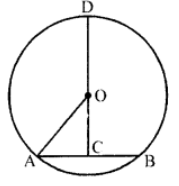
AB = 2 cm, CD = 4 cm
Join OA, let r be the radius of the circle
OA = OD = r
∴ OC = CD – OD = 4 – r
AC = (1/2) AB = (1/2) x 2 = 1 cm
Now in right ∆OAC,
OA² = OC² + AC² (Pythagoras Theorem)
⇒ r² = (4 – r)² + (1)²
⇒ r² = 16 + r² – 8r + 1
⇒ r² – r² + 8r = 17
⇒ 8r = 17
⇒ r = 17/8 = 2*(1/8)
∴ Radius of the circle = 2*(1/8) cm
Que-11:In figure, OD is perpendicular to the chord AB of a circle, whose centre is O. Prove that CA = 2OD.
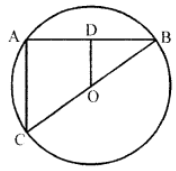
Sol: Given : In the circle AB is chord, OD ⊥ AB
BOC is the diameter of the circle
AC is joined
To prove : CA = 2OD
Proof: OD ⊥ AB
∴ D is midpoint of AB
and O is midpoint of BC
In ∆ABC, DO || AC
∴ In ∆ABC ~ ∆DBO,
∴ AB/BD = BC/BO = AC/OD
(Sides of similar triangles are proportional)
⇒ AB/(1/2)AB = CA/OD
⇒ 2/1 = CA/OD
⇒ CA = 2OD
Hence proved.
Que-12: In figure, OMNP is a square. A circle drawn with centre O cuts the square in X and Y. Prove that : ∆OXM ≅ ∆OYP. Hence prove that NX = NY.
Sol: Given : In the figure,
OMNP is a square
A circle with centre O is drawn which intersects the square at X and Y
Join OX and OY
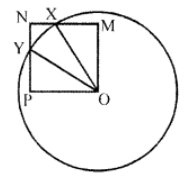
In right ∆OXM and ∆OYP,
Hyp. OX = OY (radii of the same circle)
Side OM = OP (sides of a square)
∴ ∆OXM ≅ ∆OYP (RHS axiom)
∴ MX = PY
But MN = PN (sides of a square)
∴ MN – MX = PN – PY
⇒ NX = NY
Hence proved.
∴ Least value of x = 2 cm and greatest = 8 cm
Que-13:Find the centre of given circle.
Sol: Steps of construction :
(i) Take three points A, B and C on the circle.
(ii) Join AB and AC.
(iii) Draw the perpendicular bisectors of AB and AC. Which intersect each other at O.
Then O is the centre of the circle
(We know that the perpendicular bisectors of chords of a circle passes through the centre of the circle) [Hint, see fig. 15.36]
Que-14: Draw an arc of a circle to pass through three points A, B and C not in the same st. line.
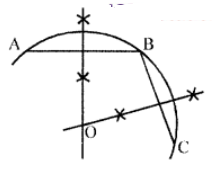
Sol: Steps of construction :
(i) Take three points A, B and C.
(ii) Join AB and BC.
(iii) Draw the perpendicular bisector of AB and BC intersecting each other at O.
(iv) With centre O and radius OA or OB or OC, draw an arc ABC.
This is the required arc.
∵ O lies on the perpendicular bisector of AB.
∴ OA = OB
Again O lies on the perpendicular bisector of BC
∴ OB = OC
∴ OA = OB = OC
Que-15: Answer true or false. Three circles can pass through three given points not in a straight line.
Sol: False : as through three points which are not in a straight line, one and only one circle can be drawn.
Que-16: Two chords A B and CD of a circle are parallel and a line l is the perpendicular bisector of AB. Show that l bisects CD.
Sol: AB and CD are two parallel chords of the circle and a line / is the perpendicular bisector of AB
i. e., AL = LB and ∠ALM = 90°
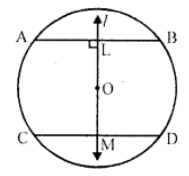
Line l is perpendicular bisector of chord AB
∴ It will pass through the centre of the circle
∵ AB || CD and l is perpendicular to AB
∴ l is also perpendicular to CD
∵ OM ⊥ CD
∴ M is the midpoint of CD
∴ l bisects CD
Hence proved.
Que-17: In the given figure, O and O’ are the centres of two intersecting circles and APB is parallel to 00′. Prove that AB = 200′.
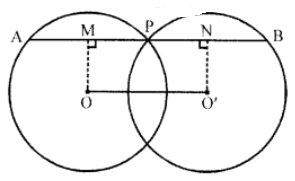
Sol: Given : Two circles with centre O and O’
intersect each other at P
APB || OO’ is drawn
To prove : AB = 200′
Construction : From O, draw OM ⊥ AP
and from O’, O’N ⊥ PB
Proof: ∵ OM ⊥ AP and O’N ⊥ PM
and OO’ || AB
∴ MN = OO’
Now ∵ OM ⊥ AP
∴ M is midpoint of AP
AM = MP ⇒ MP = (1/2) AP
Similarly PN = NB ⇒ PN = (1/2) PB
Adding we get
MP + PN = (1/2) AP + (1/2) PB
⇒ MN = (1/2) (AP + PB) = (1/2) AB
⇒ OO’ = 12 AB (∵ OO’ = MN)
⇒ 200′ = AB
or AB = 200′
Hence proved.
Que-18: Two equal chords AB and CD of a circle intersect at P, show that AP = PD and BP = CP.
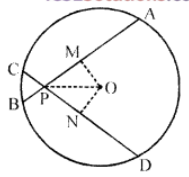
Sol: Given : In a circle with centre O,
Two equal chords AB and CD intersect each other at P
To prove : AP = PD and BP = CP
Construction : Draw OM ⊥ AB and ON ⊥ CD
Join OP
Proof : In right ∆OMP and ∆ONP,
Hyp. OP = OP (common)
Side OM = ON
(Equal chords are equidistant from the centre)
∴ ∆OMP ≅ ∆ONP (R.H.S. axiom)
∴ PM = PN (c.p.c.t.)
∵ OM ⊥ AB and ON ⊥ CD
∴ M and N are the midpoints of AB and CD respectively
or AM = MP and CN = NP
∵ Chords AB = CD
∴ AB – PB = CD – PC
⇒ AP = PD
Similarly BM – PM = CN – PN (∵ PM = PN)
⇒ BP = CP
Hence proved.
Que-19: In the figure, shows circle with centre O, with equal chords AB and CD; OE ⊥CD at H and OF ⊥ AB at G. Prove that EH = GF.
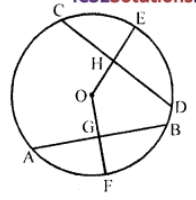
Sol: Given : In a circle with centre O,
chord AB = CD
OE ⊥ CD at A and OF ⊥ AB at G
To prove : EH = GF
Proof: ∵ OE ⊥ CD and OF ⊥ AB
∴ G and H are midpoints of AB and CD respectively
∵ and OG = OH
(Equal chords are equidistant from the centre)
But OF = OE (radii of the same circle)
∴ OF – OG = OE – OH
⇒ GF = EH
∴ EH = GF
Hence proved.
Que-20: In the figure, C is the centre of the circle. CB bisects the ∠DBE, CD ⊥ PQ and CE ⊥ RS. Prove that PQ = RS.
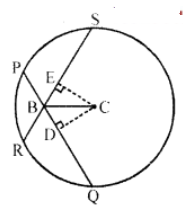
Sol: Given : In circle with centre C,
CB bisects ∠DBE
CD ⊥ PQ and CE ⊥ RS where PQ and RS are the chords which intersect each other at B
To prove : PQ = RS
Proof: In ∆EBC and ∆DBC,
∠E = ∠D (each 90°)
∠EBC = ∠DBC
(∵ BC is the bisector of ∠DBE)
BC = BC (common)
∴ ∆EBC ≅ ∆DBC (AAS axiom)
∴ and CE = CD (c.p.c.t.)
But these are the perpendicular distance from the centre and equal chords are equidistant from the centre
∴ RS = PQ
or PQ = RS
Hence proved.
Que-21: In the figure, AB and CD are equal chords of a circle whose centre is O. OM ⊥ AB and ON ⊥ CD. Prove that ∠OMN = ∠ONM.
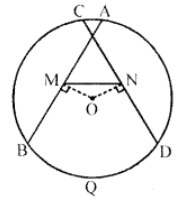
Sol: Given : In circle with centre O,
Two equal chords AB and CD intersect each other inside the circle
OM ⊥ AB and ON ⊥ CD
MN arejoined
To prove : ∠OMN = ∠ONM
Proof: ∵ Chord AB = CD
∴ OM = ON
(Equal chords are equidistant from the centre)
In ∆OMN,
∵ OM = ON
∴ ∠OMN = ∠ONM
Hence proved.
: End of OP Malhotra Circle Class-9 Exe-13A ICSE Maths Solutions Ch-13 chord properties of circle:–
Return to :– OP Malhotra S Chand Solutions for ICSE Class-9 Maths
Please Share with Your Friends
Thanks