Quadratic Equations Class 11 OP Malhotra Exe-10B ISC Maths Solutions Ch-10 Solutions. In this article you would learn about Equations Reducible to Quadratic Equations. Step by step solutions of latest textbook has been given as latest syllabus. Visit official Website CISCE for detail information about ISC Board Class-11 Mathematics.
Quadratic Equations Class 11 OP Malhotra Exe-10B ISC Maths Solutions Ch-10
| Board | ISC |
| Publications | S Chand |
| Subject | Maths |
| Class | 11th |
| Chapter-10 | Quadratic equations |
| Writer | O.P. Malhotra |
| Exe-10(B) | Equations Reducible to Quadratic Equations. |
Exercise- 10B
Quadratic Equations Class 11 OP Malhotra Exe-10B Solution.
Solve the following equations :
Que-1: x4 – 5x² + 6 = 0.
Sol: Given eqn. be, x4 – 5x² + 6 = 0 … (1)
put x² = t in eqn. (1) ; we have
t² – 5t + 6 = 0
⇒ (t – 2) (t – 3) = 0
⇒ t – 2 = 0 or t – 3 = 0
⇒ x² = 2 or x² = 3
⇒ x = ± √2 or x = ± √3
∴ x = ± √2, ± √3
Que-2: x5 + 242 = 243/x^5
Sol: Given eqn. be,
x^5 + 242 = 243/x^5 … (1)
putting x5 = y in eqn. (1) ; we have
y + 242 = (243/y) ⇒ y² + 242y – 243 = 0
⇒ y² – y + 243y – 243 = 0
⇒ y(y – 1) + 243 (y – 1) = 0
⇒ (y – 1) (y + 243) = 0
⇒ y = 1 = 0 or y + 243 = 0
⇒ y = 1 or y = – 243
⇒ x5 = 1 or x5 = (- 3)5
⇒ x = 1 or x = – 3
Thus, s = – 1, – 3
Que-3: 10x-2 – 9 – x-4 = 0.
Sol: Given eqn. be, 10x-2 – 9 – x-4 = 0 … (1)
putting x-2 = t in eqn. (1); we have
10t – 9 – t² = 0
⇒ t² – 10t + 9 = 0
⇒ t² – t – 9t + 9 = 0
⇒ t (t – 1) – 9 (t – 1) = 0
⇒ (t – 9)(t – 1) = 0
either t = 9 = 0 or t – 1 = 0
⇒ x-2 = 9 or x-2 – 1 = 0
⇒ 1/x² = 9 or 1/x² = 1
⇒ x = ± 1/3 or x = ± 1
Thus, x = ± 1/3, ± 1
Que-4: 32x – 10 x 3x + 9 = 0.
Sol: Given eqn. be,
32x – 10 x 3x + 9 = 0 …(1)
putting 3x = t in eqn. (1) ; we have
t2 – 10t + 9 = 0
⇒ t² – 9t – t + 9 = 0
⇒ t(t – 9) – 1 (t – 9) = 0
⇒ (t – 9) (t – 1) = 0
either t – 9 = 0 or t – 1 = 0
⇒ t = 9 or t = 1
⇒ 3x = 3x or 3x = 3°
⇒ x = 2 or x = 0
Thus, x = 0, 2
Que-5: 22x-1 – 9 x 2x-2 + 1 = 0.
Sol: Given equation be,
2^(2x-1) – 9 x 2^(x-2) + 1 = 0
⇒ (2x)² x 2^(-1) – 9 x (2^x) x 2^(-2) + 1 = 0 …(1)
putting 2x = t in eqn. (1); we have
t² x (1/2) – 9 x t x (1/4) + 1 = 0
⇒ 2t² – 9t + 4 = 0
⇒ 2t² – 8t – t + 4 = 0
⇒ 2t (t – 4) – 1 (t – 4) = 0
⇒ (2t – 1) (t – 4) = 0
either 2t – 1 = 0 or t – 4 = 0
⇒ t = (1/2) or t = 4
⇒ 2^x = (1/2) = 2^(-1) or 2^x = 2²
⇒ x = – 1 or x = 2
∴ x = – 1 or 2
Que-6: 32x+1 + 3² = 3x+3 + 3x.
Sol: Given eqn. be,
32x+1 + 3² = 3x+3 + 3x
⇒ (3x)² x 3 + 9 = 3x (3³ + 1) …(1)
putting 3x = t in eqn. (1) ; we have
3t² + 9 = 28t ⇒ 3t² – 28t + 9 = 0
⇒ 3t² – 27t – t + 9 = 0
⇒ 3t(t – 9) – 1 (t – 9) = 0
⇒ (t – 9) (3t – 1) = 0
either t – 9 = 0 or 3t – 1 = 0
⇒ t = 9 or t = (1/3)
⇒ 3x = 3² or 3x = 3-1
⇒ x = 2 or x = – 1
Thus, x = 2, – 1
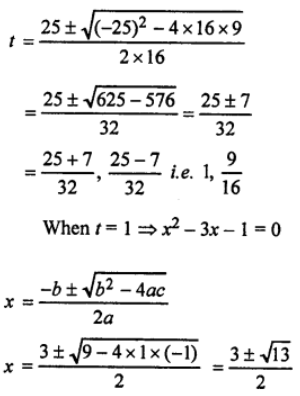
Que-7: √(x²-3x) = 4x²−12x−3
Sol: Given equation be,
√(x²-3x) = 4x²−12x−3 – 3 …(1)
putting x² – 3x = t in eqn. (1); we have
√t = 4t – 3 ;
on squaring both sides ; we have
⇒ t = (4t – 3)² ⇒ t = 16t² – 24t + 9 ⇒ 16t² – 25t + 9 = 0
Que-8: √{(x²+2)/(x²-2)} + 6√{(x²-2)/(x²+2)} = 5
Sol: Given equation be
√{(x²+2)/(x²-2)} + 6√{(x²-2)/(x²+2)} = 5
Putting √{(x²+2)/(x²-2)} = y in eqn. (1) ; we have
y + (6/y) = 5
⇒ y² – 5y + 6 = 0
⇒ (y – 2)(y – 3) = 0
⇒ y – 2 = 0 or y – 3 = 0
⇒ y = 2 or y = 3
Case-I: When y = 2
⇒ √{(x²+2)/(x²-2)} = 2
On squaring both sides ; we have
{(x²+2)/(x²-2)} = 4
⇒ x² + 2 = 4x² – 8
⇒ 3x² = 10
⇒ x² = 10/3
x = ±√(10/3)
When y = 3 ⇒ √{(x²+2)/(x²-2)} = 3
On squaring both sides ; we have
{(x²+2)/(x²-2)} = 9 ⇒ x² + 2 = 9x² – 18
⇒ 8x² = 20
⇒ x² = 52
⇒ x = ± √5/2
Hence x = ± √10/3, ±√5/2
Que-9: √{(2x²+1)/(x²-1)} + 6 √{(x²-1)/(2x²+1)} = 5.
Sol: Given equation be
√{(2x²+1)/(x²-1)} + 6 √{(x²-1)/(2x²+1)} = 5. ….. (1)
Putting √{(2x²+1)/(x²-1)} = t in eqn (1) we have,
t + (6/t) = 5
⇒ t² – 5t + 6 = 0
⇒ (t – 2)(t – 3) = 0
either t – 2 = 0 or t – 3 = 0
⇒ t = 2 or t = 3
Case-I: When t = 2
√{(2x²+1)/(x²-1)} = 2
On squaring both sides ; we have 2*2 + 1
{(2x²+1)/(x²-1)} = 4
⇒ 2x² + 1 = 4x² – 4
⇒ 2x² = 5
⇒ x = ±√5/2
Case-II: When t = 3
√{(2x²+1)/(x²-1)} = 3
On squaring both sides ; we have
{(2x²+1)/(x²-1)} = 9
2x²+1 = 9x²-9
7x² = 10
x² = 10/7
x = ±√10/7
x = ±√5/2, ±√10/7
Que-10: x (x – 1) (x + 2) (x- 3) + 8 = 0.
Sol: Given equation be
x (x – 1) (x + 2) (x – 3) + 8 = 0
⇒ (x² – x) [x² – x – 6] + 8 = 0 … (1)
putting x² – x = t in eqn. (1) ; we have
t(t – 6) + 8 = 0 ⇒ t² – 6t + 8 = 0
⇒ t² – 4t – 2t + 8 = 0
⇒ t(t – 4) – 2(t – 4) = 0
⇒ (t – 4)(t – 2) = 0
either t – 4 = 0 or t – 2 = 0
⇒ t = 4 or t = 2
Case-I: When t – 4
⇒ x² – x – 4 = 0
⇒ x = [−b±√(b²-4ac)]/2a
⇒ x = [−(−1)±√{(-1)²-4×1×(-4)}/2
⇒ x = (1±√17)/2
Case-II: When t = 2 ⇒ x² – x – 2 = 0
⇒ x² – 2x + x – 2 = 0
⇒ x (x – 2) + 1 (x – 2) = 0
⇒ (x + 1) (x – 2) = 0
⇒ x = – 1, 2
Hence x = – 1, 2, {(1±√17)/2}
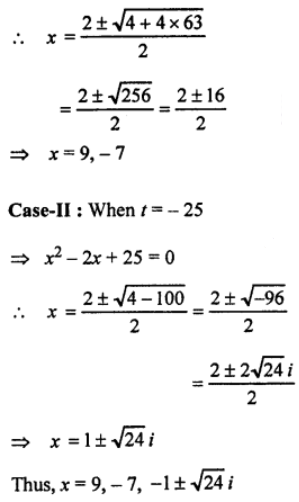
Que-11: (x – 7) (x – 3) (x + 1) (x + 5) = 1680.
Sol: Given eqn. be
(x – 7) (x – 3) (x + 1)(x + 5) = 1680
⇒ {(x – 7) (x + 5)} {(x-3) (x+ 1)} = 1680
⇒ {x² – 2x – 35} {x² – 2x – 3} = 1680 … (1)
putting x² – 2x = t in eqn. (1); we get
(t – 35) (t – 3) = 1680
⇒ t² – 38t + 105 – 1680 = 0
⇒ t² – 38t – 1575 = 0
∴ t = [38±√(1444+6300)]/2 = (38±88)/2
⇒ t = 63, – 25
Case-I: When t = 63 ⇒ x² – 2x – 63 = 0
Que-12: (2x – 7) (x² – 9) (2x + 5) = 91.
Sol: Given equation be,
(2x – 7) (x² – 9) (2x + 5) = 91
⇒ {(2x – 7) (x + 3)} {(x – 3)(2x + 5)} = 91
⇒ (2x² – x – 21)(2x² – x – 15) = 91 …(1)
putting 2x² – x = t in eqn. (1) ; we have
(t – 21) (t – 15) = 91
⇒ t² – 36t + 224 = 0
⇒ t² – 8t – 28t + 224 = 0
⇒ t (t – 8) – 28 (t – 8) = 0
⇒ (t – 8) (t – 28) = 0
either t – 8 = 0 or t – 28 = 0
⇒ t = 8 or t = 28
Case-I: When t = 8 ⇒ 2x² – x – 8 = 0
⇒ x = [−(−1)±√{(−1)²−4×2×(−8)}]/(2×2)
⇒ x = (1±√65)/4
Case-II: When t = 28
⇒ 2x² – x – 28 = 0
⇒ 2x² – 8x + 7x – 28 = 0
⇒ 2x (x – 4) + 7 (x – 4) = 0
⇒ (x – 4) (2x + 7) = 0
either x – 4 = 0 or 2x + 7 = 0
⇒ x = 4 or x = – 7/2
Hence, x = + 4, (–7/2), {(1±√65)/4}
Que-13: By substituting y = 2x, or otherwise, solve the equation
22x + 2x+2 – 4 x 2³ = 0.
Sol: Given eqn. be,
22x + 2x+2 – 4 x 2³ = 0 …(1)
putting 22x = y in eqn. (1) ; we have
y² + y . 2² – 32 = 0
⇒ y² + 4y – 32 = 0
⇒ y² + 8y – 4y – 32 = 0
⇒ y(y + 8) – 4(y + 8) = 0
⇒ (y + 8)(y – 4) = 0
either y + 8 = 0 or y – 4 = 0
⇒ y = – 8 or y = 4
⇒ 2x = – 8
it has no real solution (∵ 2x > 0)
or 2x = 4 = 22 ∴ x = 2
Thus x = 2
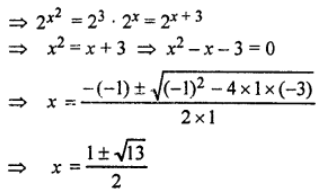
Que-14: 2x² : 2x = 8 : 1.
Sol: Given : 2x² : 2x = 8 : 1
2x² / 2x = 8
2x² = 8.2x
Que-15: 22x+3 + 2x+3 = 1 + 2x
Sol: Given eqn. be 22x+3 + 2x+3 = 1 + 2x
⇒ (2x)² x 2³ + 2x x 2³ = 1 + 2x …(1)
putting 2x = t in eqn. (1) ;
we have 8t² + 8t = 1 + t
⇒ 8t² + 7t – 1 = 0
⇒ 8t² + 8t – t – 1 = 0
⇒ 8t (t + 1) – 1 (t + 1) = 0
⇒ (t + 1) (8t – 1) = 0
either t + 1 = 0 or 8t – 1 = 0
⇒ t = – 1 or t = 1/8
⇒ 2x = – 1, which is not possible as 2x > 0
when t = 1/8
= 2x = 2-3 ⇒ x = – 3
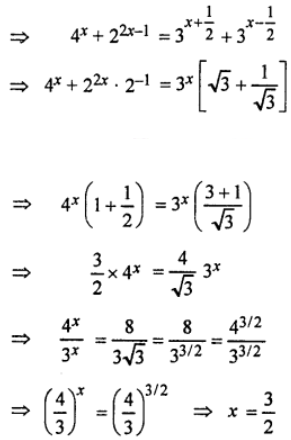
Que-16: (4^x) − 3^{x−(1/2)} = 3^{x+(1/2)} − 2^(2x−1)
Sol: Given equation be
(4^x) − 3^{x−(1/2)} = 3^{x+(1/2)} − 2^(2x−1)
–: End of Quadratic Equations Class 11 OP Malhotra Exe-10B ISC Maths Ch-10 Solutions. :–
Return to :- OP Malhotra ISC Class-11 S Chand Publication Maths Solutions
Thanks
Please share with your friends