
Inverse Trigonometric Functions Class 12 OP Malhotra ISC Class-12 Maths Solutions Ch-4. In this article you would learn some important topics such as Derivative and formulas, Questions and answer in Inverse Trigonometric Functions with graph. Visit official Website CISCE for detail information about ISC Board Class-12 Mathematics.

Inverse Trigonometric Functions Class 12 OP Malhotra ISC Class-12 Maths Solutions Ch-4
| Board | ISC |
| Publications | S Chand |
| Subject | Maths |
| Class | 12th |
| Chapter-4 | Inverse Trigonometric Functions |
| Writer | OP Malhotra |
| Exe-4(A) | Inverse T-Functions and its Properties. |
Inverse Trigonometric Functions and its Properties
Class 12 OP Malhotra ISC Class-12 Maths Solutions Ch-4
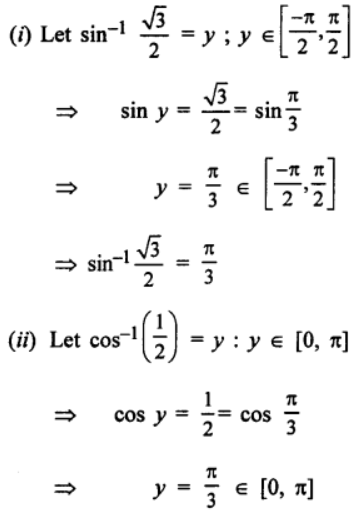
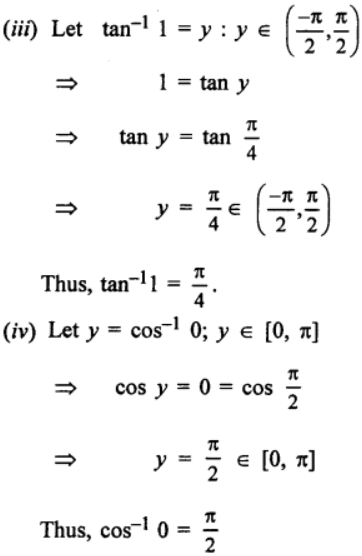
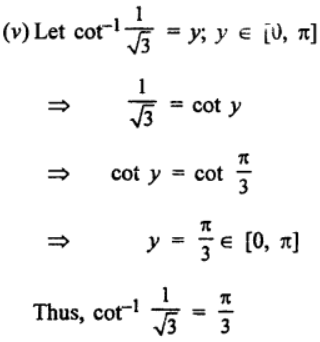
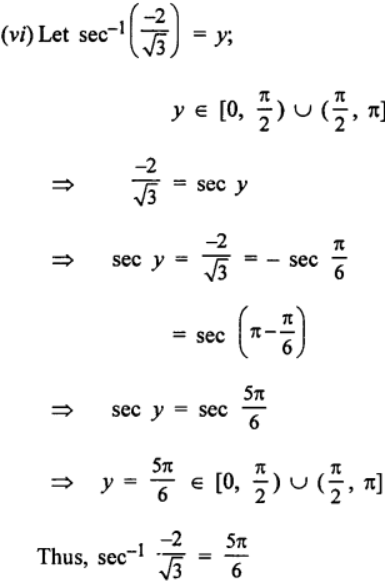
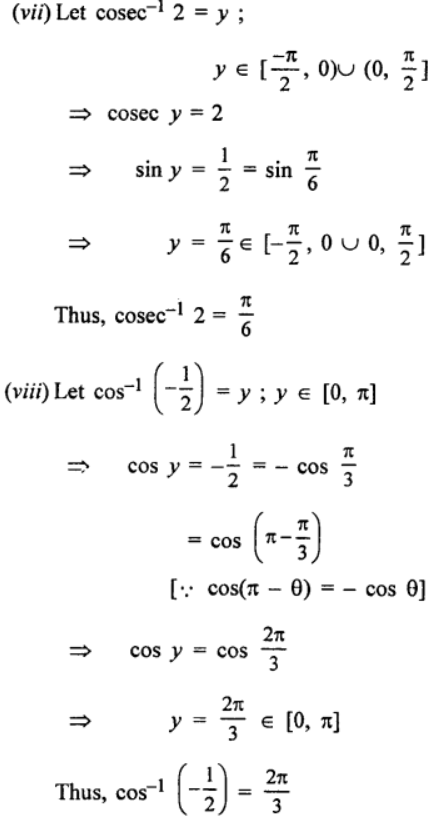
Que-1: Write down the values of :
(i) sin-1 √3/2
(ii) cos-1(1/2)
(iii) tan-1 1
(iv) tan-1 0
(v) cot-1(2/√3)
(vi) Sec-1 1/2
(vii) cosec-1 2
(viii) cos-1 (-1/2)
Sol:
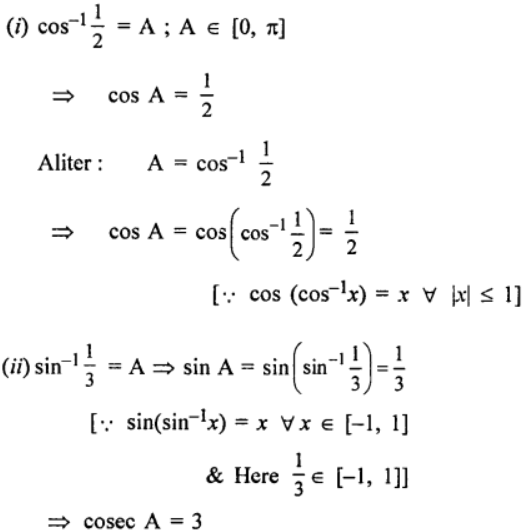
Que-2: (i) cos A, if cos-1(1/2) = A
(ii) cosec A, if sin-1 1/3 = A
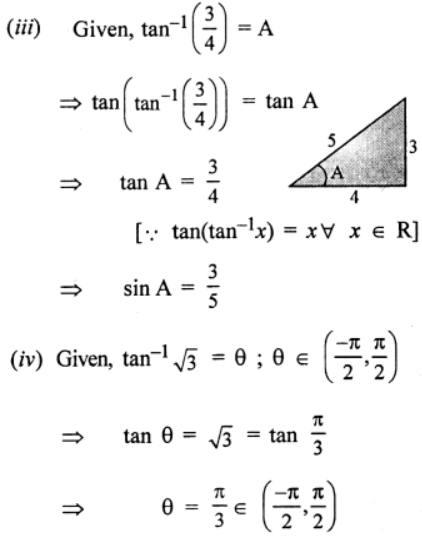
(iii) sin A, if tan-1(1/3) = A
(iv) θ, if tan-1 3 = θ
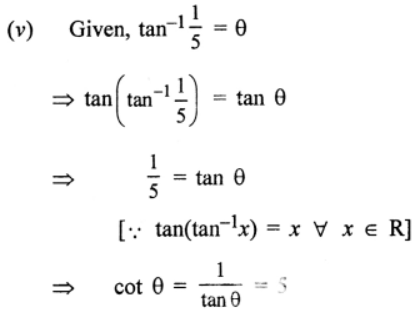
(v) cot θ, if tan-1√3 = θ
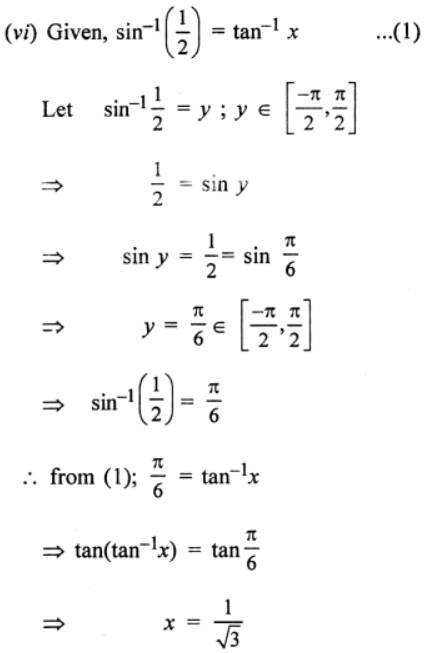
(vi) x, if sin-1(1/2) = tan-1x
Sol:
Que-3: Find the principal value of each of the following:
(i) sin (sin-1 1/2)
(ii) tan-1 tan(π/6)
(iii) cot-1 (tan-1 4/5)
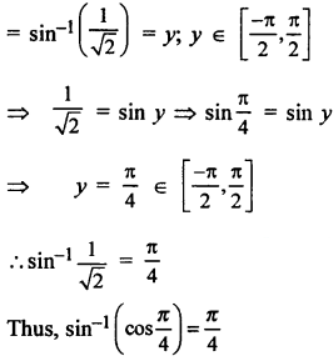
(iv) sin-1 (cos(π/4)
(v) sin(cos-1 1/2)
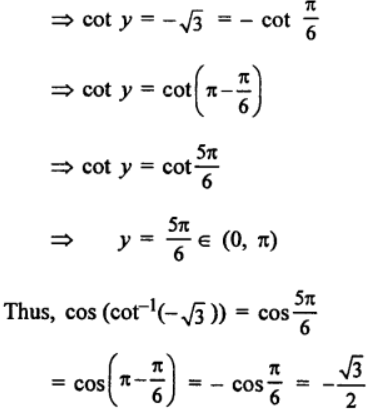
(vi) cos (cot-1 (-√3))
(vii) sin(2 sin-1 2/3)
(viii) cos-1 (sin 220°)
(ix) sin(1/2 cos-1 4/5)
(x) tan [sin-1 (-1)]
(xi) tan-1 (cot(4π/3))
(xii) sin(tan-1 1) + cos(cos-1 1/2)
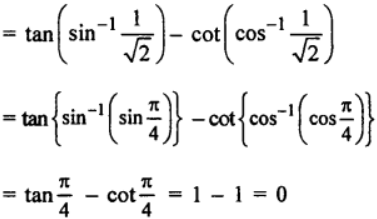
(xiii) tan(sin-1 (√2/2)) − cot(cos-1 (√2/2))
(xiv) tan-1 ((−√3/3))
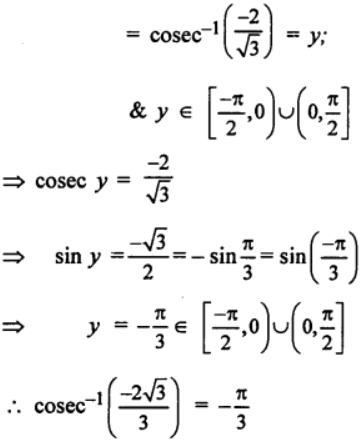
(xv) cosec-1 (-(−2√3)/3))
(xvi) cos-1 [sin (tan-1 (-1)]
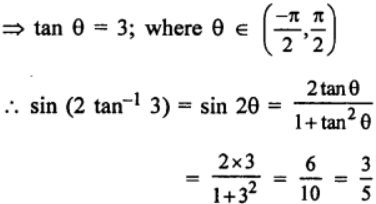
(xvii) sin(2 tan-1 3)
Sol: (i) sin (sin-1 1/2)
[∵ sin(sin-1x) = x ∀ x ∈ [-1, 1]]
(ii) tan-1 tan(π/6)
[∵ tan-1(tan x) = x ∀ x ∈ [0, π]]
Here, π/6 ∈(−π/2, π/2)
(iii) cot-1 (tan-1 4/5)
First of all, we convert tan-1 to cot-1. For this, we construct a right triangle with p = 4 & b = 5
∴ h = √(b²+p²)
= √(s²+4²) = √41
Thus, tan-1 4/5 = cot-1 5/4
∴ cot(tan-1 4/5) = cot(cot-1 5/4) = 5/4
[∵ cot (cot-1 x) = x ∀ x ∈ R]
(iv) sin-1 (cos(π/4)
(v) sin(cos-1 1/2)
= sin(cos-1 cos π/3)
= sin π/3 = √3/2
[∵ cos-1(cos x) = x ∀ x ∈ [- 0, π]
(vi) cos (cot-1 (-√3))
(vii) sin(2 sin-1 2/3)
Let sin-1 2/3 = θ ⇒ 2/3 = sin θ
∴ cos θ = √(1−sin²θ) = √(1−(4/9)) = √5/3
∵ θ ∈ [−π/2, π/2]
Thus sin(2sin-1 2/3) = sin 2θ
= 2 sin θ cos θ
= 2 x (2/3)×(√5/3) = (4√5/9)
(viii) cos-1 (sin 220°)
= cos-1{sin(180° + 40°}
= cos-1{- sin 40°}
= π – cos-1 {sin 40°}
[∵ cos-1(- x) = π – cos-1 x ∀ x ∈ [- 1, 1]]
= 180° – cos-1{cos{(π/2)– 40°)}
= 180° – (90° – 40°) = 130°
[∵ cos-1(cos x) = x ∀ x ∈ [0, π]]
(ix) sin(1/2 cos-1 4/5)
Put cos-1 4/5 = θ ⇒ cos θ = 4/5
where θ ∈ [0, π]
0≤θ≤π = 0≤(θ/2)≤(π/2)
sin (θ/2) > 0
sin [(1/2)cos-1 4/5] = sin (θ/2)
√[(1-cosθ)/2] = √[{1-(4/5)}/2] = 1/√10
sin θ = √[(1-cos2θ)/2]
(x) tan [sin-1 (-1)]
= tan[-sin-1 1]
[∵ sin-1(-x) = – sin-1x ∀x ∈ [-1, 1]]
tan[−π/2] = −tan (π/2) → −∞
(xi) tan-1 (cot(4π/3))
= tan-1 {cot(π+(π/3))}
= tan-1 {cot(π/3)}
= tan-1 [tan{(π/2)-(π/3)}]
(π/2)-(π/3) = π/6
(xii) sin(tan-1 1) + cos(cos-1 1/2)
= sin (π/4)+(1/2)
[∵ cos-1(cos-1) = x ∀ x ∈ [- 1, 1]]
= (1/√2)+(1/2) = (2+√2)/(2√2) = (√2+1)/2
(xiii) tan(sin-1 (√2/2)) − cot(cos-1 (√2/2))
(xiv) tan-1 ((−√3/3))
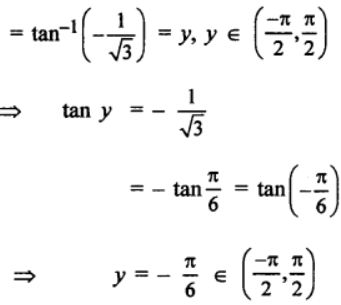
tan-1 (-√3/3) = -π/6
(xv) cosec-1 (-(−2√3)/3))
(xvi) cos-1 [sin (tan-1 (-1)]
![(xvi) cos-1 [sin (tan-1 (-1)]](https://icsehelp.com/wp-content/uploads/2025/10/6-4.png)
(xvii) sin(2 tan-1 3)
Que-4: Verify the following :
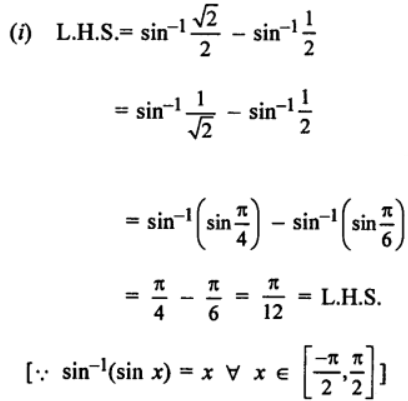
(i) sin-1 (√2/2) − sin-1 1/2 = π/12
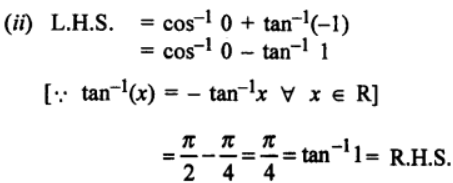
(ii) cos-1 0 + tan-1 (−1) = tan-1 1
Sol:
Que-5: Show that
(i) 2 sin-1 x = sin-1(2x √(1-x²))
(ii) 2 cos-1 x = cos-1 (2x² – 1) if 0 ≤ x ≤ 1
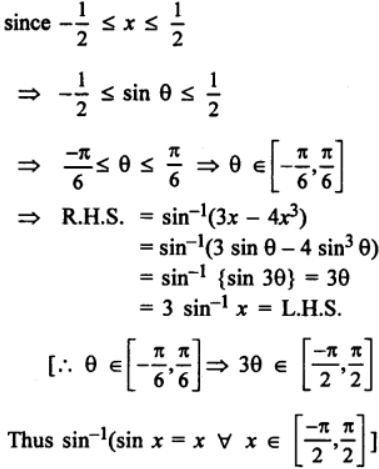
(iii) 3sin-1 = sin-1 (3x – 4x³) if – (1/2) ≤ x (1/2)
(iv) 3cos-1 x = cos-1(4x³ – 3x) if (1/2) ≤ x ≤ 1
(v) sin-1(- x) = – sin-1 x
(vi) cos-1 (- x) = π – cos-1 x
(vi) tan-1(- x) = – tan-1 x
Sol: (i) Put sin‾¹ x = θ
⇒ x = sin θ; θ ∈ [ −π/2, π/2 ]
∴ R.H.S = sin‾¹ (2x√(1−x²))
= sin‾¹ (2 sin θ √(1−sin²θ) )
= sin-1(2 sin θ |cos θ|)
= sin-1(2 sin θ cos θ)
[∵ cos θ > 0 ∀ θ ∈ [ −π/2, π/2 ]
Thus |cos θ| = cos θ]
= sin-1 (sin 2θ)
= 2θ = 2 sin-1x = L.H.S.
(ii) Put cos-1x = θ ⇒ x = cos θ
Now 0 ≤ x ≤ 1 ⇒ 0 ≤ cos θ ≤ 1
⇒ 0 ≤ θ ≤ π/2
∴ R.H.S. = cos-1(2x² – 1)
= cos-1(2 cos²θ – 1)
= cos-1(cos 2θ) = 2θ
= 2 cos-1 x = L.H.S.
[∵0 ≤ θ ≤ π/2 ⇒ 0 ≤ 2θ ≤ π ⇒ 2θ ∈ [0, π]
Thus cos-1(cos 2θ) = 2θ ∀θ ∈ [0, π]]
(iii) Let sin-1 x = θ ⇒ x = sin θ
(iv) Put cos‾¹ x = θ ⇒ x = cos θ
since 1/2 ≤ x ≤ 1 1/2 ≤ cos θ ≤ 1
⇒ 0 ≤ θ ≤ π/3
R.H.S.= cos-1(4x³ – 3x)
= cos-1 {4 cos³ θ – 3 cos θ}
= cos-1 {cos 3θ} = 3θ
= 3 cos-1x = L.H.S.
[∵0 ≤ θ ≤ π/3 ⇒ 0 ≤ 3θ ≤ π,
Thus cos-1(cos x) = x ∀ x ∈ [0, π]]
(v) Let sin-1(- x) = θ ⇒ – x = sin θ
⇒ x = – sin θ = sin (- θ)
⇒ sin-1 x = – θ ⇒ θ = – sin-1 x
⇒ sin-1 (-x) = – sin-1x
(vi) Let cos-1(-x) = θ ⇒ – x = cos θ
⇒ x = – cos θ = cos (π – θ)
⇒ cos-1 x = π – θ
⇒ π – cos-1(-x)
⇒ cos-1 (-x) = π – cos-1x
(vii) Let tan-1(- x) = θ ⇒ – x = tan θ
⇒ x = – tan θ = + tan(- θ)
⇒ tan-1(x) = – θ
⇒ tan-1 x = – tan-1(- x)
⇒ tan-1(- x) = – tan-1 x
Que-6: Show that :
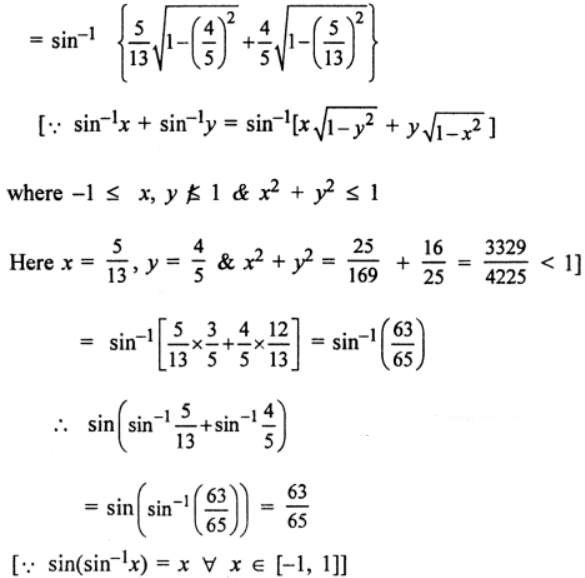
(i) sin(sin-1(5/13) + sin-1(4/5)) = 63/65
(ii) sin(tan-1(√3) + cot-1(√3))=1
(iii) tan(sin-1(√3/2) − cos-1(√3/2)) = √3/3
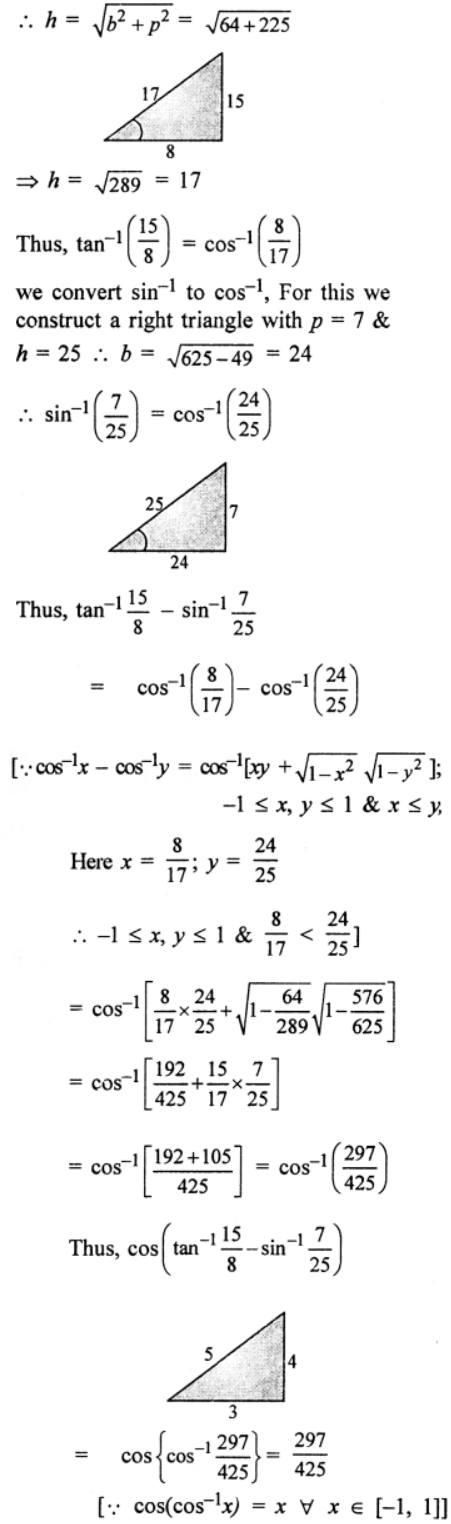
(iv) cos(tan-1(15/8) − sin-1(7/25)) = 297/425
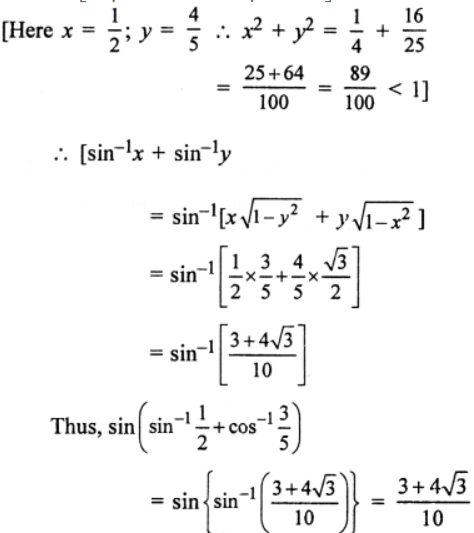
(v) sin(sin-1(1/2) + cos-1(3/2)) = (3+4√3)/10
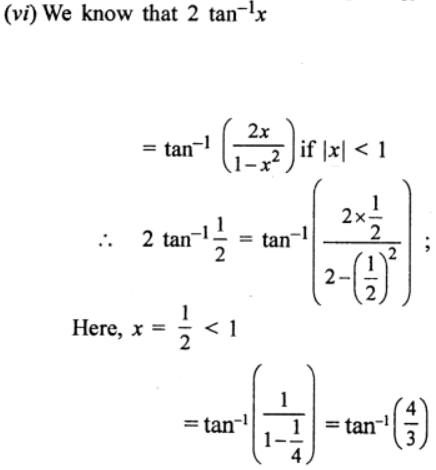
(vi) 2 tan-1(1/2) = tan-1(4/3)
Sol: (i) sin-1 (5/13) + sin-1 (4/5)
(ii) sin(tan-1 √3 + cot-1 √3) = sin π/2 = 1
[∵ tan-1 (x) + cot-1 x = π/2 ∀ x ∈ R]
(iii) tan(sin-1 (√3/2) − cos-1 (√3/2))
= tan[(π/3)-(π/6)] = tan (π/6) = 1/√3 = √3/3
(iv) First of all, we convert tan-1 to cos-1. For this we construct a right triangle with b = 8, p = 15
(v) First of all, we convert cos-1 to sin-1, for this we construct a right triangle with b = 3 and h = 5
∴ p = √(h²−b²) = √(25-9) = 4
Thus, cos-1 3/5 = sin-1 (4/5)
∴ sin-1 (1/2) + cos-1 (3/5) = sin-1 (1/2) + sin-1 (4/5)
= sin-1 [(1/2)√{1−(16/25)} + (4/5)√{1−(1/4)}]
Que-7: Simplify:
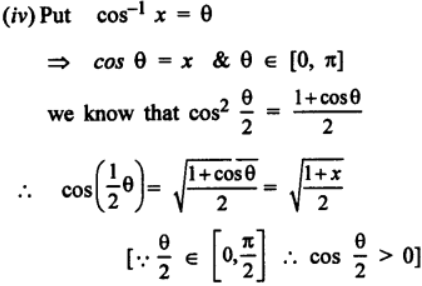
(i) sin (2 cos-1 x)
(ii) cos (2 sin-1 x)
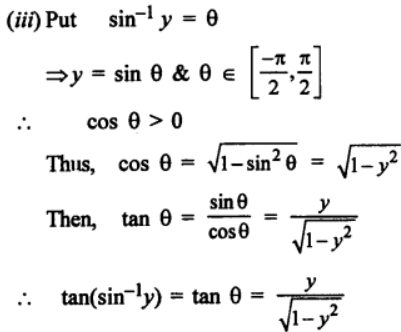
(iii) tan (sin-1 y)
(iv) y = (1/2) tan-1(x + π)
Sol: (i) Put cos-1 x = θ
⇒ x = cos θ & θ ∈ [0, π]
∴ sin θ = √(1−cos²θ) = √(1−x²)
[∵ sin θ > 0 ∀ x ∈ [0, π]]
Thus, sin (2 cos-1x) = sin(2θ)
= 2 sin θ cos θ
= 2x √(1−x²)
(ii) Put sin-1x = θ ⇒ sin θ = x;
where θ ∈ [−π/2, π/2]
∴ cos θ > 0
& cos θ = √(1−sin²θ) = √(1−x²)
∴ cos(2sin-1x) = cos 2θ = 2 cos0178θ – 1
= 2 (√(1−x²))²
= 2(1 – x²) – 1
= 1 – 2x²
Que-8: Solve the following for x in terms of y:
(i) y = 2sin-13x
(ii) y = 3cos-12x
(iii) y = 1/2 tan-1(x + π)
Sol: (i) Given y = 2 sin-1 3x …(1)
Let sin-13x = θ ⇒ 3x = sin θ
∴ from(1); y = 2θ ⇒ θ = y/2
⇒ sin θ = sin (y/2) ⇒ 3x = sin y/2
⇒ x = 1/3 sin y/2
(ii) Given y = 3 cos-1 2x ⇒ (y/3) = cos-12x
⇒ 2x = cos (y/3) ⇒ x = 1/2 cos (y/3)
(iii) Given y = (1/2) tan-1 (x + π)
⇒ 2y = tan-1(x + π)
⇒ tan 2y = tan {tan-1(x + π)} = x + π
[∵ tan (tan-1x) = x ∀ x ∈ R]
⇒ x = tan 2y – π
Que-9: Prove that :
(i) cos-1 (4/5) = tan-1 (3/4)
(ii) tan-1 2 − tan-1 1 = tan-1 (1/3)
(iii) 2tan-1 (1/3) = tan-1 (3/4)
(iv) 2tan-1 (1/3) + tan-1 (1/7) = π/4
(v) (9π/8) − (9/4)sin-1 (1/3) = (9/4)sin-1 (2√2)/3
(vi) sin-1 (4/5) + 2tan-1 (1/3) = π/2
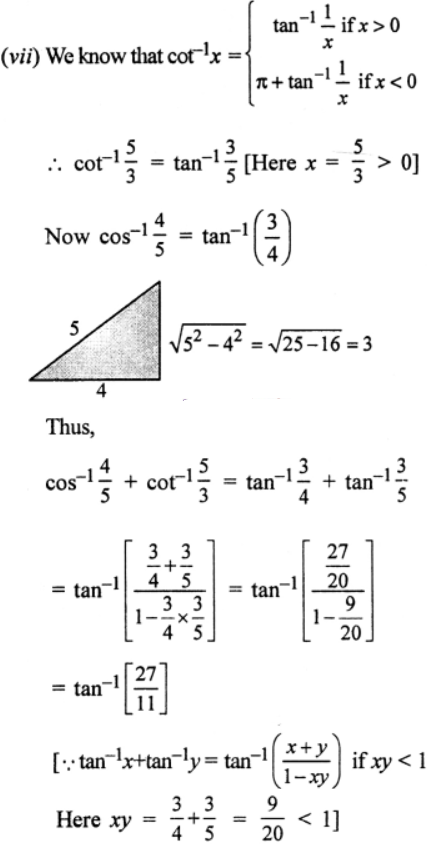
(vii) cos-1 (4/5) + cot-1 (5/3) = tan-1 (27/11)
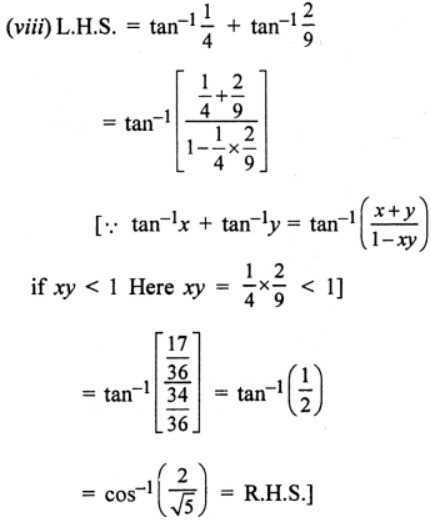
(viii) tan-1 (1/4) + tan-1 (2/9) = cos-1 2/√5
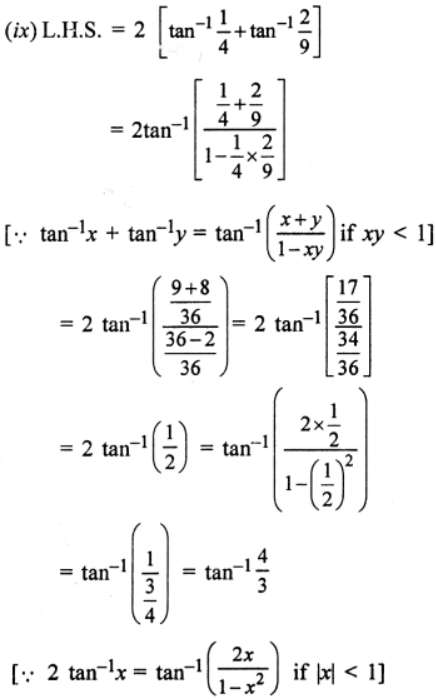
(ix) 2˙(tan-1 (1/4) + tan-1 (2/9)) = tan-1 (4/3)
Sol: (i) We convert cos-1 to tan-1 for this we construct a right triangle with b = 4 & h = 5
∴ P = √(h²-b²) = √(25−16) = 3
Thus, cos-1 4/5 = tan-1 3/4
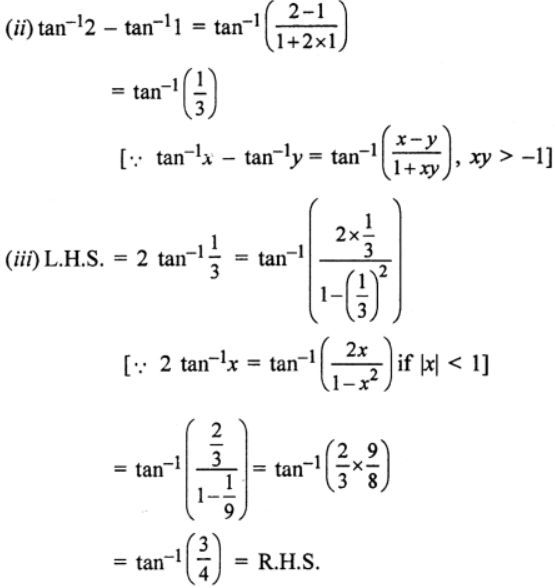
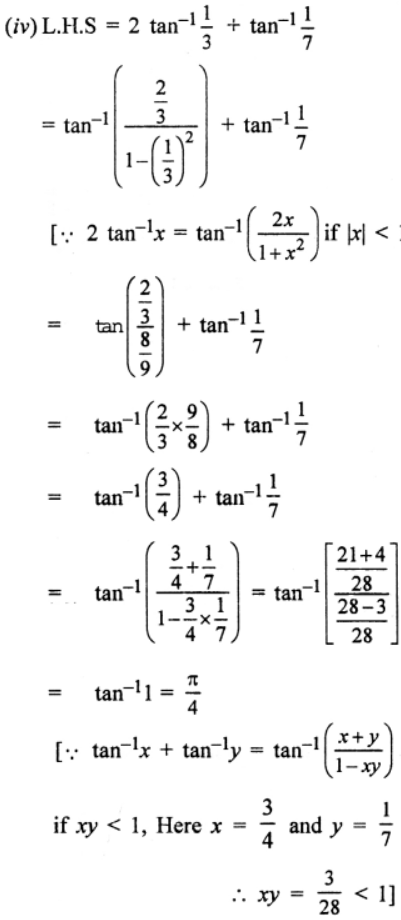
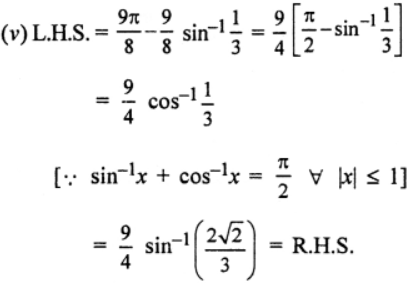
[we convert cos-1 to sin-1 for this we construct a right triangle with b = 1 and h = 3
p = √(h²-p²) = √(9-1) = √8 = 2√2
Thus, cos-1 (1/3) = sin-1 (2√2)/3
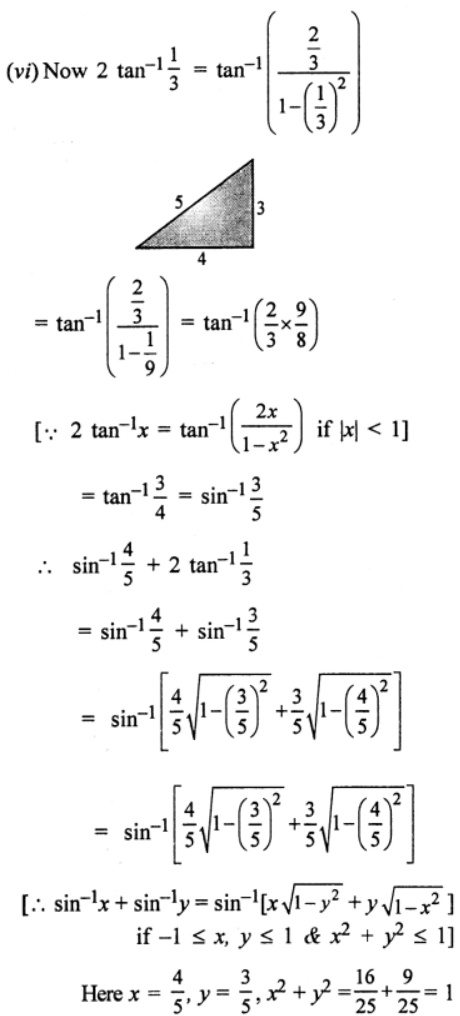
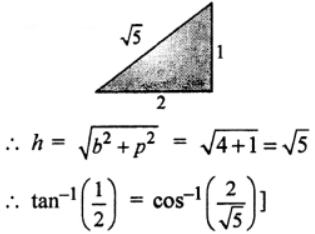
[We convert tan-1 to cos-1, for this we construct a right triangle with p = 1; b = 2
Que-10: Prove that
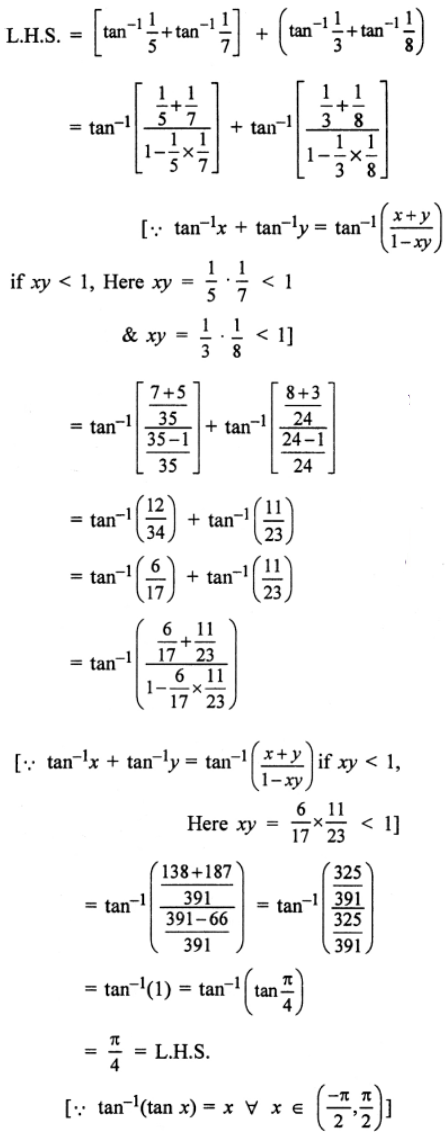
tan-1 (1/5) + tan-1 (1/7) + tan-1 (1/3) + tan-1 (1/8) = π/4
Sol:
Prove the following :
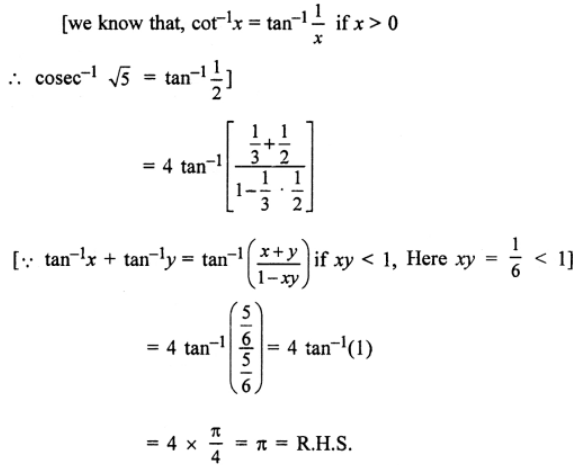
Que-11: 4(cos-13 + cosec-1(√5)) = π
Sol: LHS = 4(cos-13 + cosec-1(√5))
= 4 [tan-1(1/3) + tan-1(1/2)]
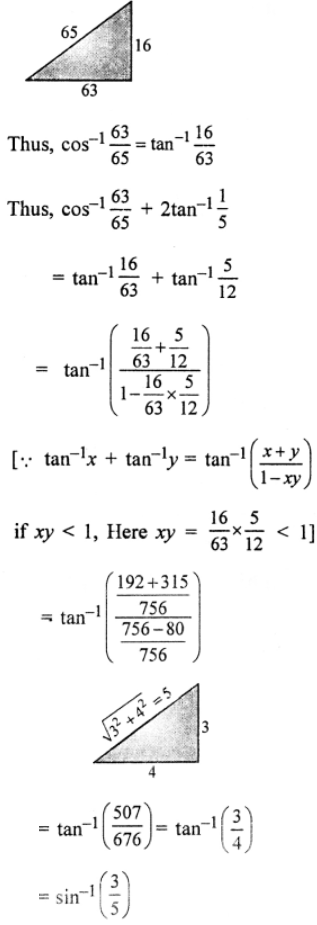
Que-12: cos-1(63/65) + 2tan-1(1/5) = sin-1(3/5)
Sol:
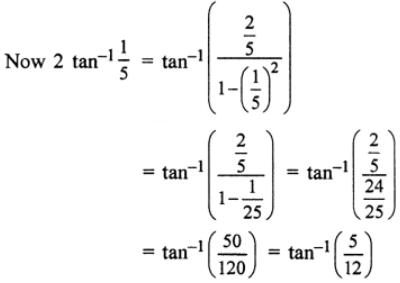
Now we convert cos-1 to tan-1 for this, we construct a right triangle with b = 63; h = 65
p = √(h²-b²) = √(65²-63²)
= √(2×128) = 16
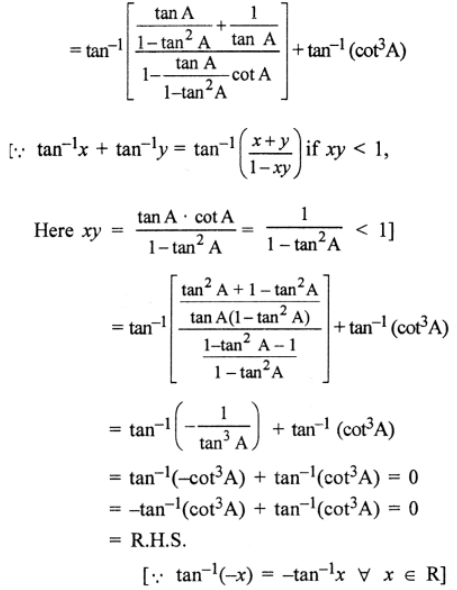
Que-13: tan-1 ((1/2)tan2.A) + tan-1 (cotA) + tan-1 (cot A³ A) = 0
Sol: LHS = tan-1 ((1/2)tan2.A) + tan-1 (cotA) + tan-1 (cot A³) = 0
= tan-1[(tan A)/(1-tan²A) + tan-1(cot A) + tan-1(cot A³)
Que-14: If tan-1x + tan-1y + tan-1z = π/2. show that xy + yz + zx = 1.
Sol: Given : If tan-1x + tan-1y + tan-1z = π/2
tan-1[(x+y)/(1-xy)] + tan-1z = π/2 provided xy < 1
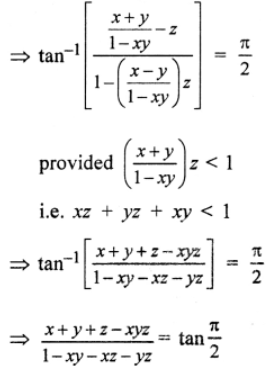
= 1 – xy – yz – zx = 0
= xy+ yz + zx = 1
Solve for x for the following equations:
Que-15: cos-1 x + sin-1(x/2) = π/6
Sol: Given : cos-1 x + sin-1(x/2) = π/6
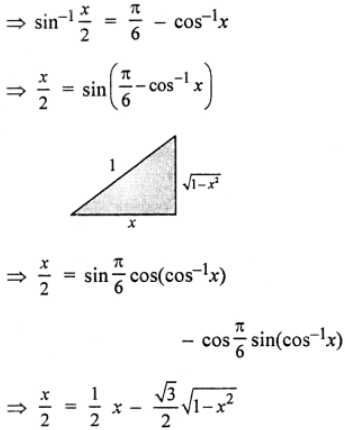
[∵ cos(cos-1x) = x ∀ x ∈ [-1, 1] & sin(cos-1x) = √(1-x²)]
√(1-x²) = 0 ⇒ x² = 1
⇒ x = ± 1
But x = – 1 does not satisfies eqn. (1).
where x = – 1;
L.H.S. = cos-1(- 1) + sin-1 (-1/2)
= π + (-π/6) = (5π/6) & RHS. = π/6
⇒ L.H.S. ≠ R.H.S.
Thus, x = 1 be the only solution.
Que-16: sin-1 x + sin-1 2x = π/3
Sol: Given eqn. be,
sin-1 x + sin-1 2x = π/3 … (1)
⇒ sin-1 2x = (π/3) – sin-1 x
⇒ 2x = sin((π/3) – sin-1 x)
⇒ 2x = sin(π/3) cos(sin-1 x) – cos(π/3) sin(sin-1 x)
⇒ 2x = (√3/2) √(1−x²) − (1/2x)
[∵ cos(sin-1 x) = √(1−x²) & sin(sin-1 x) = x ∀ x ∈ [-1, 1]]
⇒ (5x/2) = (√3/2) √(1−x²); on squaring both sides
⇒ 25x² = 3(1 – x²) ⇒ 28x² = 3
⇒ x = ± √(3/28) = ±(1/2) √(3/7)
When x = – (1/2) √(3/7), L.H.S. of eqn. (1) is negative while R.H.S. is positive.
Thus, the only solution be x = (1/2) √(3/7).
Que-17: tan-1 2x + tan-13x = π/4
Sol: Given : tan-1 2x + tan-13x = π/4
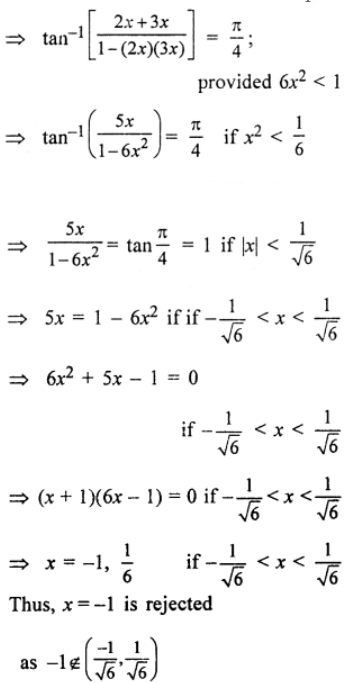
Hence x = 1/6 be the only solution.
Que-18: sin(sin-1 15 + cos-1 x) = 1.
Sol: Given : sin(sin-1 15 + cos-1 x) = 1
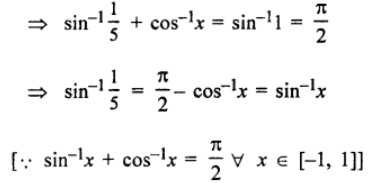
x = 1/5
Que-19: sin((1/5) cos-1 x) = 1.
Sol: Given : sin((1/5) cos-1 x) = 1
Let (1/2) cos-1 x = y ⇒ cos-1x = 5y
since 0 ≤ cos-1 x ≤ π ⇒ 0 ≤ 5y ≤ π
⇒ 0 ≤ y ≤ π/5
∴ sin y ≠ 1
Thus, the given equations has no solution.
Que-20: tan-1 {1/(2x+1)} + tan-1 −{1/(4x+1)} = tan-1 2/x²
Sol: Given : tan-1 {1/(2x+1)} + tan-1 −{1/(4x+1)} = tan-1 2/x²
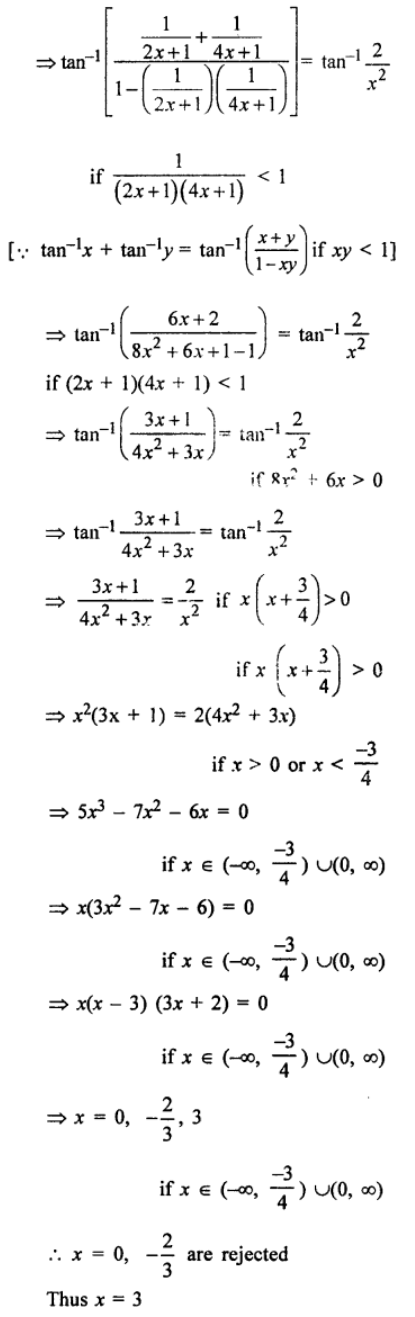
Que-21: tan-1 {(x−2)/(x−4)} + tan-1 {(x+2)/(x+4)} = π/4
Sol: Given : tan-1 {(x−2)/(x−4)} + tan-1 {(x+2)/(x+4)} = π/4
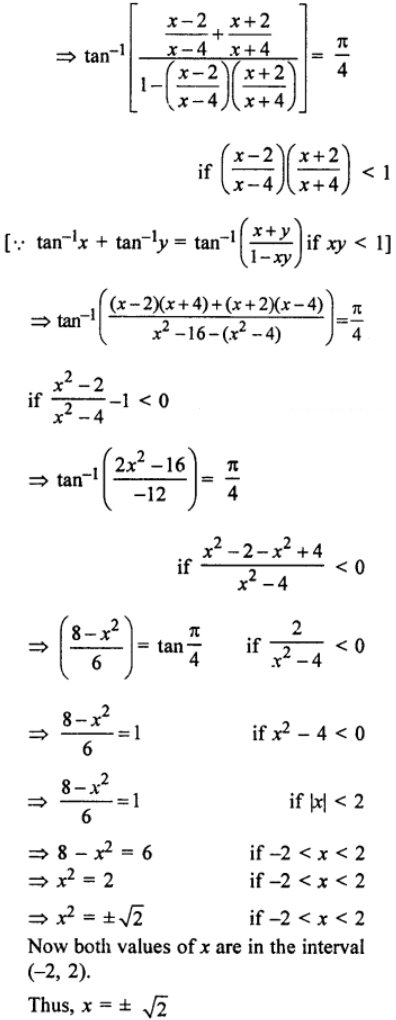
Que-22: 2 tan-1(cosx) = tan-1(2 cosec x)
Sol: Given eqn. be, 2 tan-1(cosx) = tan-1(2 cosec x)
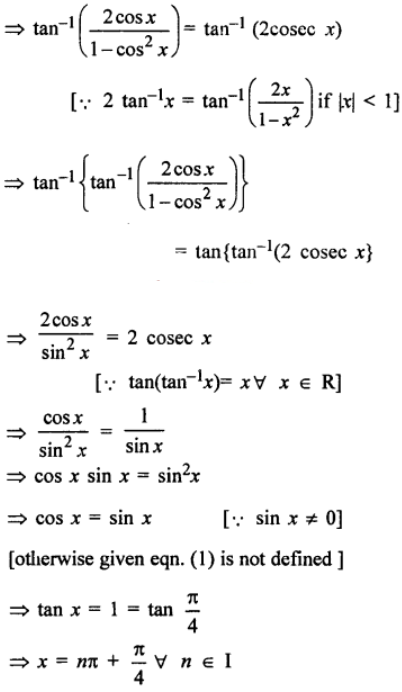
Que-23: Evaluate the following
(i) sin cot-1 cos tan-1 x
(ii) tan[sin-1 (3/5) + cot-1 (3/2)]
(iii) cos-1 x + cos-1 [(x/2)+{√(3-3x²)/2}], 1/2 ≤ x ≤ 1.
Sol: (i) Let tan-1x = y ⇒ x = tan y
Now see y = √(1+tan²y) = √(1+x²)
cos y = 1 / √(1+x²)
Let cot-1 [1 / √(1+x²)] = z
cot z = 1 / √(1+x²)
cosec z = √(1+cot²z)
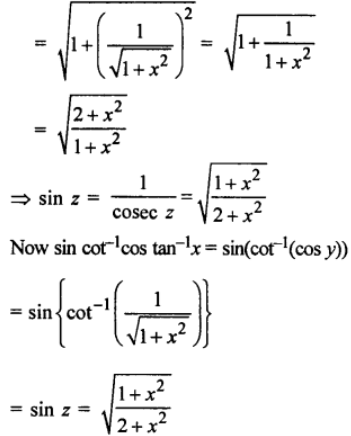
(ii) cot-1 (3/2) = tan (2/3)
![Que-23: Evaluate the following (ii) tan[sin-1 (3/5) + cot-1 (3/2)]](https://icsehelp.com/wp-content/uploads/2025/10/2-10.png)
= 17/6
(iii) Let cos-1 x = θ ⇒ x = cos θ
since 1/2 ≤ x ≤ 1
![Que-23: Evaluate the following (iii) cos-1 x + cos-1 [(x/2)+{√(3-3x²)/2}], 1/2 ≤ x ≤ 1.](https://icsehelp.com/wp-content/uploads/2025/10/3-10.png)
Que-24: Solve for x : cos(sin-1 x) = 1/9
Sol: Given cos(sin-1 x) = 19
put sin-1 x = θ ⇒ x = sin θ
& θ ∈ [−π/2, π/2]
∴ cos θ > 0
Thus cos θ = 1/9 ⇒ √(1−sin²θ) = 1/9
⇒ √(1−x²) = 1/9
on squaring both sides, we have
1 – x² = 1/81 ⇒ x² = 1 – (1/81) = 80/81
⇒ x = ± √(80/81) = ±(4√5)/9
Que-25: Find the value of tan 1/2 [sin-1 {2x/(1+x²)} + cos-1 {(1−y²)/(1+y²)}], |x| < 1, y > 0 and xy < 1.
Sol: Now, put x = tan θ ⇒ θ = tan-1x
∴sin-1 {2x/(1+x²)} = sin-1 {2tanθ/(1+tan²θ)}
= sin-1(sin 2θ) = 2θ = 2 tan-1x
[since – 1 < x < 1 ⇒ – 1 < tan θ < 1
= -π/4 < θ < π/4 = 2θ ∈ [(-π/2), (π/2)]
sin-1(sin 2θ) = 2θ
put y = tan Φ
= Φ = sin-1 y
![Que-25: Find the value of tan 1/2 [sin-1 {2x/(1+x²)} + cos-1 {(1−y²)/(1+y²)}], |x| < 1, y > 0 and xy < 1.](https://icsehelp.com/wp-content/uploads/2025/10/4-10.png)
Que-26: Solve the equation sin-1 6x + sin-1 (6√3x) = −π/2
Sol: Given : sin-1 6x + sin-1 (6√3x) = −π/2
sin-1 6x = −π/2 – sin-1 (6√3x)
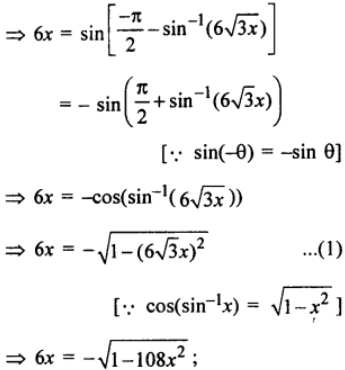
on squaring ; we have
⇒ 36x² = 1 – 108 x²
⇒ 144 x² = 1 ⇒ x = ± 1/12
Clearly eqn. (1) only satisfied when x < 0
Thus, x = – 1/12
Que-27: If sin[cot-1(x + 1)] = cos(tan-1 x), then find x.
Sol: Given, sin[cot-1(x + 1)] = cos(tan-1x) … (1)
we convert cot-1 to sin-1, for this we construct a right triangle with b = x + 1 ; P = 1
h = √(b²+p²) = √{(x+1)²+1}
= √(x²+2x+2)
cot-1(x + 1) = sin-1[1/{√(x²+2x+2)}] …….. (2)
Now we convert tan-1 to cos-1, we construct a right triangle with p = x, b = 1
∴ h = √(b²+p²) = √(1+x)²
∴ tan-1 x = cos-1 1/√(1+x²) … (3)
using eqn. (2) & eqn (3) in eqn (1); we have
sin[sin-1 [1/{√(x²+2x+2)}]] = cos[cos-1 {1/√(1+x²)}]
⇒ [1/{√(x²+2x+2)}]] = 1/√(1+x²) [∵ sin(sin-1 x) = x & cos(cos-1x) = x ∀ x ∈ [-1,1] ]
on squaring both sides; we have
1 + x² = x² + 2x + 2 ⇒ 2x = – 1 ⇒ x = – 1/2
Que-28: Show that tan-1 [((1/√3)tan(x/2)) = (1/2)cos-1 [{(1+2cosx)/(2+cosx)}]
Sol: Put tan x/2 = θ
![Que-28: Show that tan-1 [((1/√3)tan(x/2)) = (1/2)cos-1 [{(1+2cosx)/(2+cosx)}]](https://icsehelp.com/wp-content/uploads/2025/10/6-9.png)
Que-29: If cos-1 (x/2) + cos-1 (y/3) = θ, prove that 9x² – 12xycosθ + 4y² = 36sin²θ.
Sol: Given : cos-1 (x/2) + cos-1 (y/3) = θ
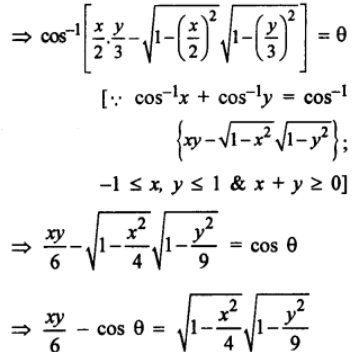
On squaring both sides; we have
⇒ {(xy/6)−cosθ}² = (1−(x²/4)) (1−(y²/9))
⇒ (xy – 6cos θ)² = (4 – x²)(9 – y²)
⇒ x²y² + 36 cos² θ – 12xy cos θ = 36 – 4y² – 9x² + x²y²
⇒ 9x² – 12xy cos θ + 4 y² = 36(1 – cos² θ) = 36 sin² θ
Que-30: If cos-1 x + cos-1 y + cos-1 z = π, prove that x² + y² + z² + 2xyz = 1.
Sol: Given eqn. be,
cos-1 x + cos-1y + cos-1z = π
⇒ cos-1 x + cos-1y = π – cos-1z
⇒ cos-1 {xy − √(1−x²) √(1−y²)} = π – cos-1z
⇒ xy – √(1−x²) √(1−y²)
= cos(π – cos-1z)
⇒ xy – √(1−x²) √(1−y²) = – cos(cos-1z)
⇒ xy + z = √(1−x²) √(1−y²) = – z
[cos(cos-1 x) = x ∀ |x| ≤ 1]
on squaring both sides, we have
⇒ (xy + z)² = (1 – x²)(1 – y²)
⇒ x²y² + z² + 2xyz = 1 – x² – y² + x²y²
⇒ x² + y² + z² + 2xyz = 1,
which is the required result.
–: End of Inverse Trigonometric Functions Class 12 OP Malhotra ISC Class-12 Maths Solutions :–
Return to :- OP Malhotra ISC Class-12 S Chand Publication Maths Solutions
Please share with your friends
Thanks



13 thoughts on “Inverse Trigonometric Functions Class 12 OP Malhotra ISC Class-12 Maths Solutions Ch-4”
When will the answers be uploaded
sir please provide the solution I want to complete my homework
very soon
When would be the solutions available?
will be upload it before sem-1 start if in syllabus
sir pleasee update
ok
The solutions are not provided.
work in progress
nothing is visible only theory is visible what to do
All chapter PDF solutions showing/ working
please visit again for analysis
how can i see the solutions
now full chapter showing now please visit again