
Basic Proportionality Theorem Class 10 RS Aggarwal Exe-16A ICSE Maths Goyal Brothers Solutions Ch-16 Similarity of Triangles. In this article you would learn how to solve questions on Basic Proportionality Theorem in Similarity of Triangles. Visit official Website CISCE for detail information about ICSE Board Class-10 Mathematics.
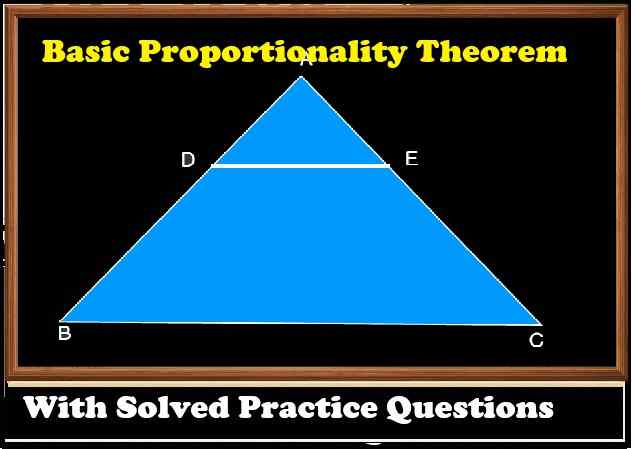


Basic Proportionality Theorem Class 10 RS Aggarwal Exe-16A ICSE Maths Goyal Brothers Solutions Ch-16 Similarity of Triangles
| Board | ICSE |
| Subject | Maths |
| Class | 10th |
| Chapter-16 | Similarity of Triangle |
| Writer/ Book | RS Aggarwal / Goyal Brothers |
| Topics | Solved Questions on Basic Proportionality Theorem |
| Academic Session | 2025-2026 |
Solved Questions on Basic Proportionality Theorem
Class 10 RS Aggarwal Exe-16A ICSE Maths Goyal Brothers Solutions Ch-16 Similarity of Triangles
Que-1: In the given figure, XY || BC.
Given that AX = 3cm, XB = 1.5cm and BC = 6cm.
Calculate : (i) AY/YC (ii) XY
Sol: (i) XY || BC
Given ,
AX = 3 cm
XB = 1.5 cm
BC = 6 cm
Due to basic proportionality theorem,
AX/XB = AY / YC
XY parallel to BC ,
AY similar to the AX
therefore AY = AX = 3 cm
BX similar to YC
therefore BX= YC = 1.5 cm
hence,
AY/YC = 3/1.5 = 2/1
(ii) Since XY ∥ BC, so from ΔABC and ΔAXY
∠A =∠A [Common]
∠AXY = ∠ABC [Corresponding angles]
∴ΔABC ∼ ΔAXY [By A.A. axiom of similarity]
⇒ XY/BC = AX/AB [Ratio of corresponding sides ]
⇒ XY/6 = 3/4.5
⇒ XY = (3×6)/4.5 = 4 cm
Que-2: In the given figure, DE || BC
(i) If AD = 3.6cm, AB = 9cm and AE = 2.4cm, find EC
(ii) If AD/DB = 3/5 and AC = 5.6cm, find AE
(iii) If AD = x cm, DB = (x-2)cm, AE = (x+2)cm and EC = (x-1)cm. Find the value of x.
Sol: (i) Given: AD = 3.6 cm, AB = 9 cm and AE = 2.4 cm DE∥BC
Since, DE ∥ BC, by Equal Intercept Theorem,
AD/BD = AE/EC
AD/(AB−AD) = AE/EC
3.6/(9−3.6) = 2.4/EC
EC = (2.4×5.4)/3.6
EC = 3.6 cm
(ii) ∴ AD/DB = AE/EC [By Thale’s Theorem]
⇒ AD/DB = AE/(AC−AE)
⇒ 3/5 = AE/(5.6−AE) [∵ AC = 5.6]
⇒ 3(5.6−AE) = 5AE
⇒ 16.8−3AE = 5AE
⇒ 8AE = 16.8
⇒ AE = 16.8/8 cm = 2.1 cm
(iii) In ΔABC, DE || BC
∴ AD/DB = AE/EC …(By basic proportionality theorem)
⇒ x/(x-2) = (x+2)/(x-1)
⇒ x(x – 1) = (x + 2) (x – 2)
⇒ x2 – x = x2 – 4
⇒ –x = –4
⇒ x = 4
Que-3: D and E are points on the sides AB and AC respectively of ΔABC. For each of the following cases, state whether DE || BC :
(i) AD = 5.7cm, BD = 9.5cm, AE = 3.6cm and EC = 6cm
(ii) AB = 5.6cm, AD = 1.4cm, AC = 9.6cm and EC = 2.4cm
(iii) AB = 11.7cm, BD = 5.2cm, AE = 4.4cm and AC = 9.9cm
(iv) AB = 10.8cm, BD = 4.5cm, AC = 4.8cm and AE = 2.8cm
Sol: (i) We have,
DE || BC
We have, AD = 5.7 cm, BD = 9.5 cm, AE = 3.6 cm and EC = 6 cm
Now, AD/DB = 5.7/9.5 = 57/95
⇒ AD/DB = 3/5
And, AE/EC = 3.6/6 = 3/5
⇒ AE/EC = 3/5
Thus DE divides sides AB and AC of ΔABC in the same ratio.
Therefore, by the converse of basic proportionality theorem.
We have DE || BC
(ii) We have,
DE || BC
We have, AB = 5.6cm, AD = 1.4cm, AC = 9.6cm and EC = 2.4cm
DB = AB – AD = 5.6 – 1.4 = 4.2cm
AE = AC – EC = 9.6 – 2.4 = 7.2cm
According to law of similarity,
AD/DB = AE/EC
1.4/4.2 = 7.2/2.4
1/3 ≠ 3/1
DE is not parallel to BC.
(iii) We have,
DE || BC
We have, AB = 11.7cm, BD = 5.2cm, AE = 4.4cm and AC = 9.9cm
AD = AB – BD = 11.7 – 5.2 = 6.5cm
EC = AE – AE = 9.9 – 4.4 = 5.5cm
According to law of similarity,
AD/DB = AE/EC
6.5/5.2 = 4.4/5.5
5/4 ≠ 4/5.
Therefore, DE is not parallel to BC.
(iv) We have,
DE || BC
We have, AB = 10.8cm, BD = 4.5cm, AC = 4.8cm and AE = 2.8cm
AD = AB – BD = 10.8 – 4.5 = 6.3cm
EC = AC – AE = 4.8 – 2.8 = 2cm
According to law of similarity,
AD/DB = AE/EC
6.3/4.5 = 2.8/2
7/5 = 7/5
Therefore, DE || BC
Que-4: In the given figure, it is given that ∠ABD = ∠CDB = ∠PQB = 90°. If AB = x units, CD = y units and PQ = z units, prove that (1/x)+(1/y) = 1/z.
Sol: Since AB || PQ || CD, using A-A similarity ΔBQP∼ΔBDC and ΔDQP∼ΔDBA.
In ΔDQP and ΔDBA, QD/BD = PQ/AB = z/x
∴ QD/BD = z/x −−−−(1)
In ΔBQP and ΔBDC, BQ/BD = PQ/CD = z/y
∴ BQ/BD = z/y
⇒ 1 − (BQ/BD) = 1 − (z/y)
⇒ (BD−BQ)/BD = (y−z)/y
⇒ QD/BD = (y−z)/y −−−−(2)
From (1) & (2), we get, z/x = (y−z)/y
⇒ y/x = (y−z)/z
⇒ y/x = (y/z) − 1
⇒ (1/x) + (1/y) = 1/z.
Que-5: In ΔABC, AD is a bisector of ∠A. If BC = 10cm, BD = 6cm and AC = 6cm, find AB.
Sol: In triangle ABC, AD is the bisector of angle A, BC = 10 cm, BD = 6 cm and AC = 6 cm.
We need to find the measure of AB.
BD + CD = BC
6 + CD = 10
CD = 10-6 = 4
Using angle bisector theorem:
AB/6 = 6/4
AB = (6×6)/4
AB = 9cm.
Que-6: In the given figure, AC || DE || BF. If AC = 24cm, EG = 8cm, GB = 16cm, BF = 30cm.
(i) Prove that ΔGED ∼ ΔGBF (ii) Find DE (iii) Find DB : AB.
Sol: (i) In ΔGED and ΔGBF,
DE || BF
⇒ ∠GED = ∠GBF …(Alternate angles)
And ∠GDE = ∠GFB …(Alternate angles)
Also ∠DGE = ∠FGB …(Vertically opposite angles)
ΔGED ∼ ΔGBF …(AAA – axiom)
Hence Proved
(ii) ΔGED ∼ ΔGBF
∴ DE/BF = GE/GB
DE/30 = 8/16
⇒ DE = (30×8)/16 = 15 cm
(iii) In ΔABC and ΔDBE
DE || AC
∴ DB/AB = DE/AC
DB/AB = 15/24 = 5/8
⇒ DB : AB = 5 : 8.
Que-7: In the adjoining figure, ABCD is a parallelogram, P is a point on side BC and DP when produced meets AB produced at L.
Prove that : (i) DP : PL = DC : BL (ii) DL : DP = AL : DC
Sol: (i) In ∆DPC and ∆BPL, we have
∠DPC = ∠BPL …[Vertically opposite angles are equal]
∠DCP = ∠PBL …[Alternate angles (as AB || DC) are equal]
∴ ∆DPC ~ ∆BPL …[By A.A.]
Since the corresponding sides of similar triangles are proportional.
DP/PL = DC/BL
i.e., DP : PL = DC : BL.
(ii) From part (i) we get,
⇒ DP/PL = DC/BL
⇒ PL/DP = BL/DC
⇒ (PL/DP) + 1 = (BL/DC) + 1
⇒ (PL+DP)/DP = (BL+DC)/DC
⇒ Since, AB = DC as ABCD is a || gm
⇒ (PL+DP)/DP = (BL+AB)/DC
⇒ DL/DP = AL/DC.
Hence, proved that DL : DP = AL : DC.
Que-8: In the given figure, ABCD is a parallelogram, E is a point on BC and the diagonal BD intersects AE at F. Prove that : DF×FE = FB×FA
Sol: We have:
∠𝐴𝐹𝐷= ∠𝐸𝐹𝐵 (𝑉𝑒𝑟𝑡𝑖𝑐𝑎𝑙𝑙𝑦 𝑂𝑝𝑝𝑜𝑠𝑖𝑡𝑒 𝑎𝑛𝑔𝑙𝑒𝑠)
∵ DA || BC
∴ ∠𝐷𝐴𝐹= ∠𝐵𝐸𝐹 (𝐴𝑙𝑡𝑒𝑟𝑛𝑎𝑡𝑒 𝑎𝑛𝑔𝑙𝑒𝑠)
Δ DAF ~ Δ BEF (AA similarity theorem)
⟹ 𝐴𝐹𝐸𝐹=𝐹𝐷𝐹𝐵
Or, AF × FB = FD × EF
This completes the proof
Que-9: In the adjoining figure, PS=4cm, SR=2cm, PT=3cm and QT=5cm. (i) Show that ΔPQR ∼ ΔPST (ii) Calculate ST, if QR = 5.8cm.
Sol: (i) ΔPQR ∼ ΔPST
∠P = ∠P [Common Angle]
PR/PT = PQ/PS
6/3 = 8/4
2/1 = 2/1
Therefore, ΔPQR ∼ ΔPST [by SSA Similarity]
(ii) ΔPQR ∼ ΔPST
QR/ST = PR/PT
QR/ST = 2/1
ST × 2 = QR × 1
2ST = QR
ST = 5.8/2
ST = 2.9 cm.
Que-10: In the given figure, ABCD is a parallelogram in which AB = 16cm BC = 10cm and L is a point on AC such that CL : LA = 2:3. If BL produced meets CD at M and AD produced at N, prove that :
(i) ΔCLB ∼ ΔALN (ii) ΔCLM ∼ ΔALB
Sol: (i) Given : AB = 16cm BC = 10cm
In ΔCLB ∼ ΔALN
∠CLB = ∠ALN [vertically opposite angle]
∠CBL = ∠LNA [Alternate angle]
Hence, ΔCLB ∼ ΔALN [By AA similarity]
(ii) In ΔCLM ∼ ΔALB
∠MCL = ∠LAB [Alternate angle]
∠CLM = ∠ALB [Vertically Opposite angle]
Hence, ΔCLM ∼ ΔALB [by AA similarity].
Que-11: In the given figure, AB || PQ and AC || PR.
Prove that BC || QR.
Sol: In ΔOPQ,
AB || PQ (given)
OA/AP = OB/BQ ………….. (i) [By Basic proportionality theorem]
In ΔOPR
AC || PQ (given)
OA/AP = OC/CR…………. (ii) [By Basic proportionality theorem]
From equations (i) and (ii)
OA/AP = OB/BQ = OC/CR
OB/BQ = OC/CR
Now, In ΔOQR
OB/BQ = OC/CR
Thus, BC || QR [By Converse of Basic proportionality theorem]
Que-12: In the given figure, medians AD and BE of ΔABC meet at G and DF || BE.
Prove that (i) EF = FC (ii) AG : GD = 2 : 1
Sol: (i) In ∆BFD and ∆BEC,
∠BFD = ∠BEC [Corresponding angles are equal]
∠FBD = ∠EBC [Common]
∴ ∆BFD ~ ∆BEC [By AA].
Since, corresponding sides of similar triangles are proportional.
⇒ BF/BE = BD/BC
⇒ BF/BE = 1/2 [∵ AD is median so D is the mid-point of BC]
⇒ BE = 2BF
From figure,
⇒ BE = BF + FE
⇒ 2BF = BF + FE
⇒ BF = FE.
Hence, proved that EF = FB.
(ii) In ∆AFD, EG || FD.
By basic proportionality theorem we have,
AE/EF = AG/GD …..(1)
Now, AE = EB [∵ CE is median so E is the mid-point of AB]
As, AE = EB = 2EF [As, EF = FB].
Substituting value of AE in (1) we get,
AG/GD = 2EF/EF = 2/1.
Hence, AG : GD = 2 : 1.
Que-13: In the given figure, DE || BC and BD = DC.
(i) Prove that DE bisects ∠ADC (ii) If AD = 4.5cm, AE = 3.9cm and DC = 7.5cm, find CE (iii) Find the ratio AD : DB
Sol: (i) We know that DE || BC:
∠ EDC = ∠DCB ( alternate interior angles)
∠ADE = ∠DBC ( corresponding angles.
Also ∠DBC =∠DCB ( Isosceles triangle – BD = DC)
So, we get ∠ EDC = ∠ADC.
Hence, DE bisects ∠ ADC.
(ii) We know that:
Δ ADE ∼ Δ ABC (AAA rule)
AD / AB = AE / AC
4.5 / 12 = 3.9 / (3.9 + CE)
Solving it, we get:
CE = 6.5 cm.
(iii) AD : DB = AD : DC = 4.5 : 7.5
= 3 : 5.
Que-14: In the given figure, BA || DC. Show that ΔOAB ∼ ΔODC. If AB = 4cm, CD = 3cm, OC = 5.7cm and OD = 3.6cm, find OA and OB.
Sol: In ΔOAB ∼ ΔODC
∠AOB = ∠COD [Vertically opposite angle]
∠BOA = ∠ODC [Alternate angle]
Therefore, ΔOAB ∼ ΔODC [By AA Similarity]
OA/OD = OB/OC = AB/DC [Proportional sides]
We know that AB = 4cm, CD = 3cm, OC = 5.7cm and OD = 3.6cm
OA/3.6 = OB/5.7 = 4/3
OA/3.6 = 4/3
OA = (4×3.6)/3
OA = 4.8 cm
And, OB/5.7 = 4/3
OB = (4×5.7)/3
OB = 7.6 cm.
Que-15: In the given figure, ∠ABC = 90° and BD ⊥ AC. If AB = 5.7cm, BD = 3.8cm and CD = 5.4cm, find BC.
Sol: Given : AB = 5.7cm, BD = 3.8cm and CD = 5.4cm
In ΔABC and ΔBDC
∠B = ∠D [each angle are perpendicular]
∠C = ∠C [common angle]
Therefore, AB/BD = BC/DC
5.7/3.8 = BC/5.4
BC = (5.7×5.4)/3.8
BC = 8.1 cm.
— : End of Basic Proportionality Theorem Class 10 RS Aggarwal Exe-16A ICSE Maths Goyal Brothers Solutions :–
Return to:- ICSE Class 10 Maths RS Aggarwal Solutions
Please share with your friend
Thanks




16 thoughts on “Basic Proportionality Theorem Class 10 RS Aggarwal Exe-16A ICSE Maths Goyal Brothers Solutions”
i cant see 16b pls upload fast board approaching along with pdf
upload soon in this week
Why is the 16 B not opening why
work in progress for class 10 RS Aggarwal
plz upload all chapter of rs aggarwal class 10
ok uploadede after lockdown
Sir plz make all chaps ans available we need it only one month is remaining for boards exam sir plzzzz..
Why all chapters are not seen plz help them all chapter solution are provide.. Next months board exam .. And pdf provide plz help me…
ok
Sir u don’t upload answers for ex 16 B kindly check
will be update very soon
Solutions are not opening it’s my preboards I need them I’m requesting this for the 3rd time
very soon upload all chapter of RS Aggarwal class 10
very soon uploaded
End of Exam will be uploaded.. ?????
now full chapter PDF solutions showing/ working
please visit again for analysis