Acids Bases and Salts Exe-3(B) Concise Class-10 ICSE Chemistry Selina Solutions Chapter-3. We Provide Step by Step Answer of Exe-3(B) Questions of Exercise-3 for ICSE Class-10. The given Solutions is according to the Latest editions. Visit official Website CISCE for detail information about ICSE Board Class-10.
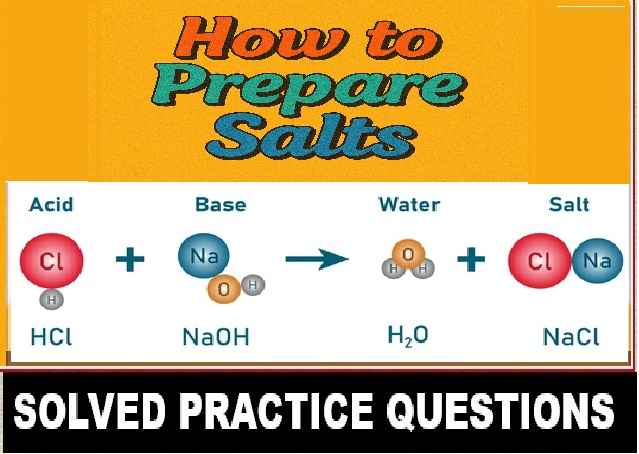
Acids Bases and Salts Exe-3(B) Concise Class-10 ICSE Chemistry Selina Solutions Chapter-3
| Board | ICSE |
| Book / Publication | Concise / Selina |
| Subject | Chemistry |
| Class | 10th |
| Writer | Dr SP Singh |
| Chapter-3 | Acids Bases and Salts |
| Topics | Exe-3(B) |
| Edition | 2025-2026 |
Exe-3(B) Questions on Acids Bases and Salts
Page-56
Que-1: Define the following and give two examples in each case:
(a) a normal salt, (b) an acid salt, (c) a mixed salt.
Ans: (a) A normal salt:
Normal salts are the salts formed by the complete replacement of the ionizable hydrogen atoms of an acid by a metallic or an ammonium ion.
(b) An acidic salt:
Acid salts are formed by the partial replacement of the ionizable hydrogen atoms of a polybasic acid by a metal or an ammonium ion.
(c) A mixed salt:
Mixed salts are those salts that contain more than one basic or acid radical.
Examples:
(a) A Normal salt: Na2SO4 , NaCl
(b) An acid salt: NaHSO4 , Na2HPO4
(c) A mixed salt: NaKCO3 , CaOCl2
Que-2: Answer the following questions related to salts and their preparations:
(a) What is a salt?
(b) What kind of salt is prepared by precipitation?
(c) Name a salt prepared by the direct combination. Write an equation for the reaction that takes place in preparing the salt you have named.
(d) Name the procedure used to prepare a sodium salt such as sodium sulphate.
Ans:
(a) Salt is a compound formed by the partial or total replacement of the ionizable hydrogen atoms of an acid by a metallic ion or an ammonium ion.
(b) An insoluble salt can be prepared by precipitation.
(c) A salt prepared by direct combination is Iron(III) chloride.
Reaction:
2Fe +3Cl2 2FeCl3
(d) By neutralizing sodium carbonate or sodium hydroxide with dilute sulphuric acid:
Na2CO3 + H2SO4 → Na2SO4 + H2O + CO2
2 NaOH + H2SO4 → Na2SO4 + 2H2O
Que-3: Explain the following method with example
(a) Direct combination
(b) Displacement method
(c) Double Decomposition (precipitation)
(d) neutralisation of insoluble salt
(e) Neutralisation of alkali (titration)
Ans:
(a) Direct combination
A reaction in which two or more substances combine. together to form a single substance is called a combination reaction
Fe + S —–FeS
(b) Displacement method
Reactions in which the more reactive element displaces the less reactive element from its compound are called displacement reactions.
For example:
Zinc displaces copper in copper sulphate to form zinc sulphate.
Zn(s) + CuSO4 (aq) → ZnSO4 (aq) + Cu(s)
Zinc Copper sulphate Zinc sulphate Copper
(c) Double Decomposition (precipitation)
Reactions in which ions of the reactants exchange places to form two new compounds, are called double displacement reactions.
For example:
Sodium hydroxide reacts with hydrochloric acid to form sodium chloride and water.
NaOH(aq) + HCl(aq) → NaCl(aq) + H2O(l)
(d) neutralisation of insoluble salt
- An insoluble salt can be prepared by a precipitation method through a double decomposition reaction.
- In this method two aqueous solutions of two different soluble salts are mixed together to form the insoluble salt. The insoluble salt is formed as a precipitate and can be obtained by filtration.
- (a) The first solution must have a soluble salt which contains the cation of the insoluble salt.
(b) The second solution must have a soluble salt which contains the anion of the insoluble salt.
(e) Neutralisation of alkali (titration)
The concentration of an acid or alkali can be calculated by carrying out an experiment called a titration.
Materials: The apparatus needed includes:
- a pipette to accurately measure a certain volume of acid or alkali
- a pipette filler to use the pipette safely
- a conical flask to contain the liquid from the pipette
- a burette to add small, measured volumes of one reactant to the other reactant in the conical flask
Apparatus needed to carry out a titration
Method:
This is an outline method for carrying out a titration in which an acid is added to alkali.
- Use the pipette and pipette filler to add 25 cm3 of alkali to a clean conical flask.
- Add a few drops of indicator and put the conical flask on a white tile.
- Fill the burette with acid and note the starting volume.
- Slowly add the acid from the burette to the alkali in the conical flask, swirling to mix.
- Stop adding the acid when the end-point is reached (the appropriate colour change in the indicator happens). Note the final volume reading.
- Repeat steps 1 to 5 until you get concordant readings (see explanation below).
The same method works for adding an alkali to an acid – just swap around the liquids that go into the conical flask and burette.
Que-4: How would you prepare :
(a) Copper sulphate crystals from mixture of charcoal and black copper oxide,
(b) Zinc sulphate crystals from Zinc dust (powered Zinc and Zinc oxide)
(c) sodium hydrogen carbonate crystals
(d) Calcium sulphate from calcium carbonate
Ans:
(a) Copper sulphate crystals from a mixture of charcoal and black copper oxide:
The carbon in the charcoal reduces the black copper oxide to reddish-brown copper. The lid must not be removed until the crucible is cool or the hot copper will be re-oxidized by air.
Take dilute sulphuric acid in a beaker and heat it on wire gauze. Add cupric oxide in small quantities at a time, with stirring till no more of it dissolves and the excess compound settles to the bottom.
Filter it hot and collect the filtrate in a china dish. Evaporate the filtrate by heating to the point of crystallization and then allow it to cool and collect the crystals of copper sulphate pentahydrate.
Reaction: CuO + H2SO4 CuSO4 + H2O
CuSO4 + 5H2O CuSO4. 5H2O
(b) Zinc sulphate crystals from Zinc dust:
Take dilute sulphuric acid in a beaker and heat it on wire gauze. Add some granulated zinc pieces with constant stirring. Add till the Zinc settles at the base of the beaker. Effervescences take place because of the liberation of hydrogen gas. When effervescence stops, it indicates that all the acid has been used up. The excess of zinc is filtered off. Collect the solution in a china dish and evaporate the solution to get crystals. Filter, wash them with water and dry them between the folds of paper. The white needle crystals are of hydrated Zinc sulphate.
Reaction: Zn + H2SO4 ZnSO4 + H2
ZnSO4 +7 H2O ZnSO4. 7 H2O
(c) Lead sulphate from metallic lead:
Metallic lead is converted to lead oxide by oxidation. Then lead sulphate is prepared from insoluble lead oxide, by first converting it into soluble lead nitrate. Then the lead nitrate solution is treated with sulphuric acid to obtain white ppt. of Lead sulphate.
Reaction:
PbO +2HNO3 Pb(NO3)2 + H2O
Pb(NO3)2 + H2SO4 PbSO4 + 2HNO3
(d)Sodium hydrogen carbonate crystals:
Dissolve 5 grams of anhydrous sodium carbonate in about 25 ml of distilled water in a flask. Cool the solution by keeping the flask in a freezing mixture. Pass carbon dioxide gas in the solution. Crystals of sodium bicarbonate will precipitate out after some time. Filter the crystals and dry it in folds of filter paper.
Reaction: Na2CO3 + CO2 + H2O 2NaHCO3
Que-5: The following is the list of methods for the preparation of salts.
A-Direct combination of two elements.
B-reaction of dilute acid with a metal.
C-reaction of dilute acid with an insoluble base.
D-Titration of dilute acid with a solution of soluble base.
E- reaction of two solutions of salts to form a precipitate.
Choose from the above list A to E , the best method of preparing the following salts by giving a suitable equation in each case:
- Anhydrous ferric chloride,
- Lead chloride,
- Sodium sulphate,
- Copper sulphate.
Ans:
1. Anhydrous ferric chloride — A. (Direct combination of two elements)
2Fe + 3Cl2 ⟶ 2FeCl3
2. Lead chloride — E. (Reaction of two solutions of salts to form a precipitate)
Pb(NO3)2 + 2NaCl ⟶ PbCl2 + 2NaNO3
3. Sodium sulphate — D. (Titration of dilute acid with a solution of soluble base)
2NaOH + H2SO4 ⟶ Na2SO4 + 2H2O
4. Copper sulphate — C. (reaction of a dilute acid with an insoluble base)
Cu(OH)2 + H2SO4 ⟶ CuSO4 + 2H2O
Que-6: Name:
(a) A chloride which is insoluble in cold water but dissolves in hot water,
(b) A chloride which is insoluble,
(c) Two sulphates which are insoluble,
(d) A basic salt,
(e) An acidic salt,
(f) A mixed salt,
(g) A complex salt,
(h) A double salt,
(i) a salts whose solubility increases with temperature,
(j) A salt whose solubility decreases with temperature.
Ans:
(a) Lead chloride
(b) Silver chloride
(c) Barium sulphate and lead sulphate
(d) Basic lead chloride
(e) Sodium hydrogen sulphate
(f) Sodium potassium carbonate
(g) Sodium argentocyanide
(h) Potash alum
(i) Potassium bromide and potassium chloride
(j) Calcium sulphate
Que-7: Fill in the blanks with suitable words:
An acid is a compound which when dissolved in water forms hydronium ions as the only …………… ions. A base is a compound which is soluble in water and contains …………….. ions. A base reacts with an acid to form a …………….. and water only. This type of reaction is known as …………….
Ans: An acid is a compound which when dissolved in water forms hydronium ions as the only positively charged ions. A base is a compound which is soluble in water and contains hydroxide ions. A base reacts with an acid to form a salt and water only. This type of reaction is known as neutralisation.
Que-8: What would you observe when:
(a) Blue litmus is introduced into a solution of hydrogen chloride gas.
(b) Red litmus paper is introduced into a solution of ammonia in water
(c) Red litmus paper is introduced in Caustic soda solution?
Ans:
(a) Blue litmus will turn into red which will indicate the solution to be acidic.
(b) No change will be observed.
(c) Red litmus will turn into blue will indicate the solution to be basic.
Que-9: Explain why:
(a) It is necessary to find out the ratio of reactants required in the preparation of sodium sulphate.
(b) Fused calcium chloride is used in the preparation of FeCl3.
(c) Anhydrous FeCl3 cannot be prepared by heating hydrated iron (III) chloride.
Ans:
(a) Since sodium hydroxide and sulphuric acid are both soluble, an excess of either of them cannot be removed by filtration. Therefore it is necessary to find out on small scale, the ratio of solutions of the two reactants.
(b) As iron chloride is highly deliquescent, so it is kept dry with the help of fused calcium chloride.
(c) On heating the hydrate, HCl acid is released and basic salt (FeOCl) or ferric oxide remains. Hence, anhydrous ferric chloride cannot be prepared by heating the hydrate.
Que-10: Match the salts given in column A to their methods of preparation in column B. Write a balanced equation for each preparation.
| Column A | Column B |
|---|---|
| Zinc sulphate | Precipitation |
| Ferrous sulphide | Oxidation |
| Barium sulphate | Displacement |
| Ferric sulphate | Neutralisation |
| Sodium sulphate | Synthesis. |
Ans:
Zinc Sulphate — Displacement
Zn + H2SO4 ⟶ ZnSO4 + H2
Ferrous sulphide — Synthesis
Fe + S ⟶ FeS
Barium sulphate — Precipitation
Na2SO4 + BaCl2 ⟶ BaSO4 ↓ + 2NaCl
Ferric Sulphate — Displacement
Fe + H2SO4 ⟶ FeSO4 + H2
Sodium sulphate — Neutralisation
2NaOH + H2SO4 ⟶ Na2SO4 + 2H2O
Que-11:
(a) Give the pH value of pure water. Does it change if common salt is added to it?
(b) Classify the following solutions as acids, bases or salts. Ammonium hydroxide, barium chloride, sodium chloride, sodium hydroxide, H2SO4 and HNO3
Ans:
(a) pH of pure water is 7 at 25oC. No, the pH does not change when common salt is added.
(b) Acids: H2SO4 and HNO3
Bases: Ammonium hydroxide and sodium hydroxide.
Salts: Barium chloride and sodium chloride.
Que-12: Complete the following table and write one equation for each to justify the statement:
| Reactants | Products | Method |
| Soluble base + Acid (dil) | Salt + water | Neutralisation
Titration |
| Metal + Non-metal | Salt (soluble/insoluble) | …………… |
| Insoluble base + | Salt (soluble) + water | ……………. |
| Active metal + Acid (dil) | ………… + ………… | ……………. |
| Soluble salt solution (A) + | Precipitated salt + | ……………. |
| Soluble salt solution (B) | Soluble salt | ……………. |
| Carbonate/ bicarbonate + Acid (dil) | Salt + ………. + ………… | Decomposition of carbonate |
| Chlorides/nitrates + Acid (conc) | …………. + ………… | Decomposition of chlorides and nitrates |
Ans: Completed table along with the equations is given below:
| Reactants | Products | Method |
| Soluble base + Acid (dil) | Salt + water | Neutralisation Titration |
| Metal + Non-metal | Salt (soluble/insoluble) | Direct Combination |
| Insoluble base + | Salt (soluble) + water | ……………. |
| Active metal + Acid (dil) | Salt + Hydrogen | Displacement |
| Soluble salt solution (A) + Soluble salt solution (B) | Precipitated salt + Soluble salt | Precipitation |
| Carbonate /bicarbonate + Acid (dil) | Salt + Water+ Carbon dioxide | Decomposition of carbonate |
| Chlorides/nitrates + Acid (conc) | Acid salt + HCl/HNO3 | Decomposition of chlorides and nitrates |
Que-13: Write the balanced equation for the preparation of the following salts in the laboratory:
(a) A soluble sulphate by the action of an acid on an insoluble base,
(b) An insoluble salt by the action of an acid on another salt,
(c) An insoluble base by the action of a soluble base on a soluble salt
(d) A soluble sulphate by the action of an acid on a metal.
Ans:
(a) CuO + H2SO4 ⟶ CuSO4 + H2O
(b) AgNO3 + HCl ⟶ AgCl ↓ + HNO3
(c) FeCl3 + 3NaOH [base] ⟶ 3NaCl + Fe(OH)3 ↓
(d) Zn + H2SO4 ⟶ ZnSO4 + H2↑
Que-14: You are provided with the following chemicals:
NaOH,Na2CO3,H2O,Zn(OH)2,CO2,HCl,Fe,H2SO4,Cl2,Zn
Using suitable chemicals from the given list only, state briefly how you would prepare:
(a) Iron(III) chloride,
(b) Sodium sulphate,
(c) Sodium zincate,
(d) Iron(II) sulphate,
(e) Sodium chloride.
Ans: (a) Iron (III) Chloride: By synthesis i.e., direct combination of elements.
2Fe + 3Cl2 ⟶ 2FeCl2
(b) Sodium sulphate: By neutralisation of an alkali (caustic soda) with acid (dilute sulphuric acid)
2NaOH + H2SO4 ⟶ Na2SO4 + 2H2O
(c) Sodium zincate: By the action of metals with alkalis
Zn + 2NaOH ⟶ Na2ZnO2 + H2
(d) Iron (II) sulphate: Method of Simple Displacement by the action of dilute acid (H2SO4) on an active metal (iron).
Fe + H2SO4 (dil.) ⟶ FeSO4 + H2
(e) Sodium chloride: By the neutralisation reaction of strong acid (HCl) with strong base (NaOH) also known as titration NaOH + HCl ⟶ NaCl + H2O
Que-15: For each of the salt: A, B, C and D, suggest a suitable method of its preparation.
(a) A is a sodium salt.
(b) B is an insoluble salt.
(c) C is a soluble salt of copper.
(d) D is a soluble salt of zinc.
Ans:
(a) By neutralisation:
NaOH + HCl → NaCl + H2O
(b) By precipitation:
Pb(NO3)2 + 2NaCl → PbCl2 + 2NaNO3
(c) CuCO3+ H2SO4→ CuSO4 + H2O + CO2
(d) Simple displacement:
Zn + H2SO4→ ZnSO4 + H2
Que-16: Choosing only substances from the list given in the box below, write equations for the reactions which you would use in the laboratory to obtain:
(a) Sodium sulphate
(b) Copper sulphate
(c) Iron(II)sulphate
(d) Zinc carbonate
| Dilute
sulphuric acid |
Copper | Copper carbonate |
| Iron | Sodium carbonate | |
| Sodium | ||
| Zinc |
Ans:
(a) Na2CO3 + H2SO4 (dil.) ⟶ Na2SO4 + H2O + CO2↑
(b) CuCO3 + H2SO4 (dil.) ⟶ CuSO4 + H2O + CO2↑
(c) Fe + H2SO4 (dil.) ⟶ FeSO4 + H2↑
(d) Zn + H2SO4 (dil.) ⟶ ZnSO4 + H2↑
ZnSO4 + Na2CO3 ⟶ ZnCO3 + Na2SO4
Que-17: From the formula listed below, choose one, in each case, corresponding to the salt having the given description: AgCl, CuCO3, CuSO4.5H2O, KNO3, NaCl, NaHSO4, Pb(NO3)2, ZnCO3, ZnSO4.7H2O.
(a) an acid salt
(b) an insoluble chloride
(c) on treating with concentrated sulphuric acid, this salt changes from blue to white
(d) on heating, this salt changes from green to black
(e) this salt gives nitrogen dioxide on heating
Ans:
(a) NaHSO4
(b) AgCl
(c) CuSO4.5H2O
(d) CuCO3
(e) Pb(NO3)2
Que-18:
(a) Ca(H2PO4)2is an example of a compound called _______ (acid salt/basic salt/normal salt).
(b) Write the balanced equation for the reaction of: A named acid and a named alkali.
Ans:
(a) acid salt
(b) NaOH+ HCl → NaCl + H2O
Que-19: State the terms defined by the following sentences:
(a) A soluble base.
(b) The insoluble solid formed when two solutions are mixed together.
(c) An acidic solution in which there is only partial ionisation of the solute molecules.
Ans:
(a) Alkali
(b) Precipitate
(c) Weak acid
Que-20: Which of the following methods, A, B, C, D or E is generally used for preparing the chlorides listed below from (i) to (v). Answer by writing down the chloride and the letter pertaining to the corresponding method. Each letter is to be used only once.
A Action of an acid on a metal
B Action of an acid on an oxide or carbonate
C Direct combination
D Neutralisation of an alkali by an acid
E Precipitation (double decomposition)
(i) Copper (II) chloride
(ii) Iron (II) chloride
(iii). Iron (III) chloride
(iv) Lead (II) chloride
(v) Sodium chloride
Ans:
(i) Copper (II) chloride – B
(ii) Iron (II) chloride – A
(iii). Iron (III) chloride – C
(iv) Lead (II) chloride – E
(v) Sodium chloride – D
Que-21: From the list given below, which one is:
[SO2, SiO2, Al2O3, CO, MgO, Na2O]
(a) A covalent oxide of a metalloid
(b) An oxide which when dissolved in water form acid.
(c) A basic oxide
(d) An amphoteric oxide
Ans:
(a) Silicon is a metalloid. The covalent oxide is SiO2
(b) Acidic oxide – gives acid with water – SO2
SO2 + H2O —-> H2SO3
(c) Basic oxide – gives base with water – Na2O
Na2O + H2O —–> 2 NaOH
(d) An amphoteric oxide – Shows both acidic and basic property
Al2O3
—: End of Acids Bases and Salts Exe-3(B) Concise Class-10 ICSE Chemistry Selina Solutions : –
Return to:- Concise Selina Chemistry for ICSE Class-10 Solutions
Please Share with Your Friends if Helpful
Thanks