Alcohol Organic Chemistry Class-10 Concise Exe-12E ICSE Selina Solutions. We Provide Step by Step Answer of Exe-12(E) Questions on Alcohol in Organic Chemistry for ICSE Class-10. The given Solutions is according to the Latest editions. Visit official Website CISCE for detail information about ICSE Board Class-10.
Alcohol Organic Chemistry Class-10 Concise Exe-12E ICSE Selina Solutions Ch-12
| Board | ICSE |
| Book / Publication | Concise / Selina |
| Subject | Chemistry |
| Class | 10th |
| Writer | Dr SP Singh |
| Chapter-12 | Organic Chemistry |
| Exe-12E | Alcohol |
| Edition | 2025-2026 |
Questions on Alcohol in Organic Chemistry with Answer
Page-217
Que-1:
(a) What are alcohols? State their sources.
(b) Give general formulae of monohydric alcohol.
Ans:
(a) Alcohols are the hydroxyl derivatives of alkanes and are formed by replacing one or more hydrogen atoms of the alkane with OH group.
Methanol is obtained from destructive distillation of wood while ethanol is obtained from fermentation of sugar.
(b) General formula of monohydric alcohol:
CnH2n+ 1OH
Que-2: Give the
(a) Dot diagram of first member of alcohol,
(b) Abbreviated formula of third member of alcohol
(c) Structure of second member of the alcohol group
(d) Structure of alcohol with 4 carbon atoms
Ans:
(a) Dot diagram

(b) Abbreviated formula
C2H5OH
(c) Structure:

Que-3: State the method of preparation of ethanol:
(a) By hydrolysis of ethene
(b) By hydrolysis of ethyl bromide
Ans:
(a) By hydrolysis of ethene: When concentrated sulphuric acid is added to ethene at a temperature of 80oC and pressure of 30 atm. ethyl hydrogen sulphate is produced. Ethyl hydrogen sulphate on hydrolysis with boiling water gives ethanol.
C2H4 +H2SO4 → (80ºC) C2H5HSO4
C2H5HSO4 + H2O → C2H5OH +H2SO4
(b) By hydrolysis of alkyl halide: Alcohols can be prepared by the hydrolysis of alkyl halide with a hot dilute alkali.
C2H5Cl + KOH → (boil) C2H5OH +KCl
Que-4: Halo alkanes react with alkalies to produce alcohol. Give the equation for the preparation of the second member of the homologous series of alcohol. State under what condition the reaction occurs.
Ans: When an aqueous solution of a strong alkali like NaOH is treated with chloroethane, it gives ethyl alcohol.

Que-5:
(a) How do the boiling point and melting point change in the homologous series of alcohols?
(b) Name the product formed when ethanol reacts with acetic acid. Give an equation
(c) What is the name given to this type of reaction?
Ans:
(a)The melting and boiling point of the successive members of the homologous series of alcohols increase with the increase in molecular mass.
(b)When ethanol reacts with acetic acid ethyl acetate is formed.
C2H5OH + CH3COOH → (Conc. H2SO4) CH3COOC2H5 + H2O
(c) This reaction is known as esterification reaction.
Que-6: Complete and balance the following equations. State the conditions wherever necessary.
(a) CH CH + H2 → _________+ H2
  ________
(b) C2H4 + Cl2 → __________
(c) C2H4 + HCl → _________
(d) CaC2 + H2O → _________
(e) C2H2 + Br2 → __________
(f) C2H5OH → (K2Cr2O7) ________
Ans:
(a) CH CH +H2 → (Ni) (200ºC) CH2=CH2 +H2 → (Ni) (200ºC) CH3-CH3
(b) C2H4 + Cl2 → CH2(Cl)-CH2(Cl)
(c) C2H4 + HCl → CH3-CH2Cl
(d) CaC2 + 2H2O → C2H2+Ca(OH)2
(e) C2H2 + Br2 → H(Br)C=C(Br)H
(f) C2H5OH → (K2Cr2O7) CH3CHO
Que-7: What is the effect of ethanol on human body?
Ans: Ethanol affects that part of the brain which controls our muscular movements and then gives temporary relief from tiredness. But it damages the liver and kidney too.
Que-8: How are the following obtained
(a) Absolute alcohol
(b) Spurious alcohol
(c) Methylated spirit?
Ans:
(a) Absolute alcohol: Absolute alcohol may be obtained by distilling moist alcohol with benzene. The mixture of water and benzene distills off and anhydrous alcohol is left behind.
(b) Spurious alcohol: It is made by improper distillation. It contains large portions of methanol in a mixture of alcohols.
(c) Methylated spirit: Methylated spirit or denatured alcohol is ethyl alcohol with 5%methyl alcohol, a coloured dye and some pyridine.
Que-9: Name the products formed and give appropriate chemical equations for the following:
(a) Sodium reacting with ethyl alcohol
(b) Ethanol oxidized by acidified potassium dichromate
Ans:
(a) Sodium reacting with ethyl alcohol:
2C2H5OH + 2Na → 2C2H5ONa + H2
When sodium reacts with ethyl alcohol hydrogen is evolved with formation of sodium ethoxide.
(b) Ethanol oxidized by K2Cr2O7:
C2H5OH → [O] CH3CHO+H2O → [O] CH3COOH
Alcohols gets oxidized and get converted into ethanal and then into acetic acid.
Que-10: Give the trivial (common) names and IUPAC names of the following:
(a) C3H6
(b) C2H4
(c) C2H2
(d) CH3OH
(e) C2H5OH
Ans:
| S No | Formula | Common Name | IUPAC |
| 1 | C3H6 | Propylene | Propene |
| 2 | C2H4 | Ethylene | Ethene |
| 3 | C2H2 | Acetylene | Ethyne |
| 4 | CH3OH | Methyl alcohol | Methanol |
| 5 | C2H5OH | Ethyl alcohol | Ethanol |
Que-11: Ethanol can be oxidized to Ethanoic acid. Write the equation and name the oxidizing agent.
Ans:
C2H5OH → [O] CH3CHO+H2O → [O] CH3COOH
The oxidizing agents that can be used are potassium dichromate and potassium permanganate.
Que-12: Name an Organic compound which is:
(a) Used for illuminating country houses
(b) Used for making a household plastic material
(c) Called ‘wood spirit’
(d) Poisonous and contain OH group
(e) Consumed as a drink
(f) Made from water gas
(g) solvent for ethanol.
(h) Dehydrated to produce ethene
Ans:
(a) Used for illuminating country houses : Ethyne
(b) Used for making a household plastic material: ethyne
(c) Called ‘wood spirit’ : Methanol
(d) Poisonous: Methanol
(e) Consumed as a drink: Ethanol
(f) Made from water gas: Methanol
(g) Methanol
(h) Ethanol or ethyl alcohol can be dehydrated to produce ethene
Que-13: Ethanol can be converted into ethene which can be changed into ethane. Choose the correct
word or phrase from the brackets to complete the following sentences.
(a) The conversion of ethanol into ethene is an example of ___________
(b) Converting ethanol into ethene requires the use of ___________
(c) The conversion of ethene into ethane is an example of ___________
(d) The catalyst used in the conversion of ethene into ethane is commonly ___________
Ans:
(a) The conversion of ethanol into ethene is an example of Dehydration.
(b) Converting ethanol into ethene requires the use of Conc. H2SO4.
(c) The conversion of ethene into ethane is an example of hydrogenation.
(d) The catalyst used in the conversion of ethene into ethane is commonly nickel.
Que-14: Write the equation of the following laboratory preparations
(a) Ethane from sodium propionate
(b) Ethene from iodoethane
(d) Methanol from Iodomethane.
Ans:
(a) Ethane from sodium propionate


(b) Ethene from iodoethane

(c) Ethyne from Calcium carbide
CaC2 +2H2O → Ca(OH)2 + C2H2
(d) Methanol from Iodomethane.
CH3 I+ H2O → CH3 OH + HI
Que-15: Name the compound prepared by each of the following reactions:
(i) C2H5COONa + NaOH ⟶
(ii) CH3I + 2H ⟶
(iii) C2H5Br + KOH (alcoholic solution)⟶
(iv) CO + 2H2 (Zinc oxide catalyst) ⟶
(v) CaC2 + 2H2O ⟶
Ans:
(i) Ethane

(ii) Methane

(iii) Ethene [ethylene]

(iv) Methanol

(v) Ethyne [Acetylene]

Que-16: Write the equation for the following reaction:
(a) Calcium carbide and water
(b) Ethene and water (steam)
(c) Bromoethane and an aqueous solution of sodium hydroxide
Ans:
(a) Calcium carbide and water
CaC2 + 2H2O → Ca(OH)2 + C2H2
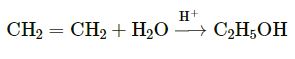
(b) Ethene and water (steam)
(c) Bromoethane and an aqueous solution of sodium hydroxide
C2H5Br +NaOH → C2H5OH +NaBr
—: End of Alcohol Organic Chemistry Class-10 Concise Exe-12E ICSE Selina Solutions : –
Return to:- Concise Selina Chemistry for ICSE Class-10 Solutions
Please Share with Your Friends if Helpful
Thanks