Alkynes Organic Chemistry Class-10 Concise Exe-12D ICSE Chemistry Selina Solutions Ch-12. We Provide Step by Step Answer of Alkynes Questions in Hydrocarbons for ICSE Class-10. The given Solutions is according to the Latest editions. Visit official Website CISCE for detail information about ICSE Board Class-10.
Alkynes Organic Chemistry Class-10 Concise Exe-12D ICSE Chemistry Selina Solutions Ch-12
| Board | ICSE |
| Book / Publication | Concise / Selina |
| Subject | Chemistry |
| Class | 10th |
| Writer | Dr SP Singh |
| Chapter-12 | Organic Chemistry |
| Exe-12D | Alkynes in Hydrocarbons |
| Edition | 2025-2026 |
Alkynes in Hydrocarbons
Organic Chemistry Class-10 Concise Exe-12D ICSE Chemistry Selina Solutions Ch-12
Page-217
Que-1: What are the sources for alkynes? Give the general formula of alkynes.
Ans: Natural gas and Petroleum are sources for alkynes.
The general formula of alkynes are:
CnH2n-2
Que-2: Give an example of isomers shown by triple bond hydrocarbon (alkynes) and write its IUPAC name.
Ans: Butyne is an example, its isomers are:
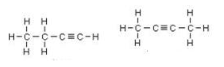
IUPAC name: But-2-yne But-1-yne
Que-3: How is ethyne prepared in the laboratory?
(a) Draw diagram
(b) Give equation
(c) How is pure dry gas collected?
Ans:
(a) Diagram of acetylene preparation:
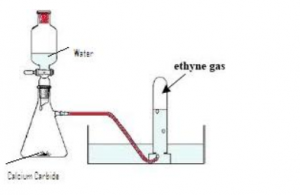
(b) CaC2 +2H2O → Ca(OH)2 +C2H2
(c) The pure dry gas is collected by downward displacement of water, since it is insoluble in water.
Que-4: Give the method of preparation of ethyne by 1,2-dibromoethene.
Ans: When 1,2 -dibromoethane is boiled with alcoholic potassium hydroxide ,ethyne is formed.
Que-5: Name the hydrocarbon which:
(a) Is a tetrahedral molecule
(b) Is a planar molecule
(c) Is a linear molecule
(d) Forms a red precipitate with ammoniacal solution of copper (I) chloride
(e) Is known as paraffin
(f) Is known as olefin
(g) A compound which will give acetylene (ethene) gas when treated with water.
Ans:
(a) The hydrocarbon which is tetrahedral is Methane.
(b) The hydrocarbon which is planar molecule is ethene.
(c) The hydrocarbon which is a linear molecule is Ethyne.
(d) The hydrocarbon which forms a red precipitate with ammoniacal solution of copper chloride is acetylene.
(e) Alkanes are also called as paraffin.
(f) Alkenes are also called olefin.
(g) Calcium carbide
Que-6: Classify the following compounds as alkanes, alkenes and alkynes.
C3H4,C3H8, C5H8, C3H6
Ans:
The following compounds can be classified as:
C3H4:- Alkynes
C3H8:- Alkanes
C5H8:- Alkynes
C3H6:- Alkenes
Que-7: Give a chemical test to distinguish between
(a) Saturated and unsaturated compounds.
(b) Ethane and ethene
(c) Ethene (ethylene) and ethyne (acetylene)
Ans:
(a) On adding few drops of alkaline potassium permanganate (purple colour) to the hydrocarbons, no change is seen in saturated hydrocarbons whereas the purple colour fades in case of unsaturated hydrocarbons.
(b) Ethane and ethene:
| S.No. | Test | Ethane | Ethene |
| 1. | On adding a few drops of bromine solution in carbon tetrachloride to the hydrocarbon | No change is observed | The reddish brown colour gets decolorized |
| 2. | On adding a few drops of alkaline potassium permanganate (purple colour) to the hydrocarbon | No change is observed | The purple colour fades. |
(c) Ethene and ethyne:
| S.No. | Test | Ethene | Ethyne |
| 1. | On adding a few drops of ammonical cuprous chloride to the hydrocarbon | No change is observed | Red precipitate of copper acetylide is formed |
| 2. | On adding ammonical silver nitrate | No observation | White precipitate of silver acetylide is formed. |
Que-8: Compound X bubbled through bromine dissolved in CCl4
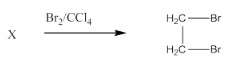
(a) Draw the structure of X.
(b) State your observation during the reaction.
Ans:
(a) HC≡CH
(b) Brown colour of CCl4 disappeared due to formation of addition product, i.e. 1, 2-dibromo ethane.
Que-9: Give balanced equations for the following conversations.
(a) An alkene to an alkane
(b) An alkene to an alcohol
(c) An alkyne to a alkene
Ans:
(a) An alkene to an alkane
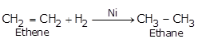
(b) An alkene to an alcohol

(c) An alkyne to an alkene

Que-10: Name the products formed and write an equation when ethyne is added to the following in an inert solvent:
(a) Chlorine
(b) Bromine
(c) Iodine
(d) hydrogen
(e) excess of hydrochloric acid
Ans:
(a) Ethyne in an inert solvent of carbon tetrachloride adds chlorine to change into 1,2-dichloro ethene with carbon-carbon double bond, and then to an 1,1,2,2-tetrachloro ethane with carbon-carbon single bond.
C2H2 → (Cl2) C2H2 Cl2 → (Cl2) C2H2Cl4
1,2-dichloro ethene1,1,2,2 -tetrachloro ethane
(b) Ethyne in an inert solvent of carbon tetrachloride adds bromine to change into 1,2-dibromo ethene and then to 1,1,2,2 -tetrabromo ethane .
C2H2 → (Br2) C2H2 Br2 → (Br2) C2H2Br4
(c) Iodine reacts slowly in the presence of alcohol to form di-iodo ethene
CH ≡ CH +I2 → ICH=CHI
1,2-di-iodoethene
(d) In the presence of nickel, platinum or palladium ethyne change to ethene and then to ethane.
CH ≡ CH → (H2) CH2=CH2 → (H2) CH3-CH3
(e) Excess of hydrochloric acid.
Chloro ethene and then 1,1-dichloro ethane will be formed.
C2H2 (Ethyne) → (+HCl) C2H3Cl (chloro ethene) → (+HCl) C2H4 Cl2 (1,1-dichloro ethane)
Que-11: Substitution reactions are characteristic reactions of ………( alkynes /alkenes/ alkanes )
Ans: Substitution reactions are characteristic reactions of Alkanes.
Que-12:
(a) Write an equation for the laboratory preparation of
(i) An unsaturated hydrocarbon from calcium carbide.
(ii) Alcohol from ethyl bromide.
(b) What would you see, when ethyne is bubbled through a solution of bromine in carbon tetrachloride?
(c) Name the addition product formed between ethene and water
Ans: (a)
(i) and (ii)
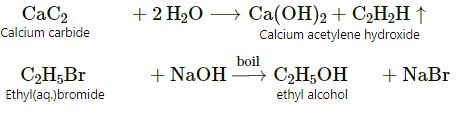
(b) When bromine in carbon tetrachloride is added to ethyne, the orange colour of the bromine disappears due to the formation of the colourless ethylene bromide.
(c) Water reacts with ethene to form ethanol.

Que-13: Give reason
(a) ethyne is more reactive than ethene ?
(b) Ethene is more reactive then ethane.
(c) Hydrocarbons are excellent fuels.
Ans:
(a ) Ethyne is a highly reactive compound than ethene because of the presence of a triple bond between its two carbon atoms.
(b) Ethene is a highly reactive compound than ethane because of the presence of a double bond between its two carbon atoms.
(c) Hydrocarbons such as alkanes undergo combustion reactions with oxygen to produce carbon dioxide and water vapour. Alkanes are flammable which makes them excellent fuels.
Methane, for example, is the principal component of natural gas.
CH4 + 2O2 → CO2 + 2H2O
Que-14:
(a) Write a balanced equation:
(i) When butane is burnt in oxygen.
(ii) Preparation of ethylene from ethyl alcohol.
(b) (i) Convert ethane to acetic acid
(ii) Convert ethyne to ethane
Ans:
(a) (i) 2C4H10 + 13O2 → 8CO2 + 10H2O
(ii) 
(b) (i) Convert ethane to acetic acid
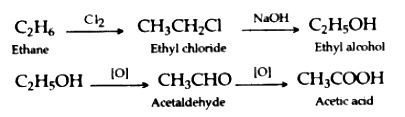
(ii) Convert ethyne to ethane
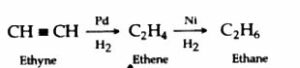
Que-15:
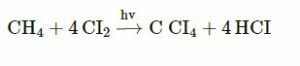
(a) Write the equation for the preparation of carbon tetrachloride from methane.
(b) Draw the structure formula of ethyne
(c) How is the structure of alkynes different from that of alkenes?
Ans:
(a)
(b) H – C ≡ C – H
(c) Alkynes contain a triple bond whereas alkenes contain a double bond.
—: End of Alkynes Organic Chemistry Class-10 Concise Exe-12D ICSE Chemistry Selina Solutions : –
Return to:- Concise Selina Chemistry for ICSE Class-10 Solutions
Please Share with Your Friends if Helpful
Thanks