Ammonia Long Ans Concise Class-10 ICSE Chemistry Selina Solutions Chapter-9. We Provide Step by Step Answer of Long Ans Questions of Exercise-9 for ICSE Class-10. The given Solutions is according to the Latest editions. Visit official Website CISCE for detail information about ICSE Board Class-10.
Ammonia Long Ans Concise Class-10 ICSE Chemistry Selina Solutions Chapter-9
| Board | ICSE |
| Book / Publication | Concise / Selina |
| Subject | Chemistry |
| Class | 10th |
| Writer | Dr SP Singh |
| Chapter-9 | Study of Compounds – Ammonia |
| Topics | Long Ans |
| Edition | 2025-2026 |
Long Answer Questions on Ammonia
Page-166
Que-1:
(a) Is ammonia more dense or less dense than air?
(b) What property of ammonia is demonstrated by Fountain Experiment? (c)Write the balanced equation for the reaction between ammonia and sulphuric acid.
(c) Write the balanced equation for the reaction between ammonia and sulphuric acid.
Ans:
(a) Ammonia is less dense than air. By Fountain Experiment, we demonstrate the high solubility of ammonia gas in water.
(b) The high solubility of ammonia gas in water
(c) The balanced equation for the reaction between ammonia and sulphuric acid is:
2NH3 + H2SO4 → (NH4)2SO4
Que-2: Ammonia solution in water gives a blue precipitate when it combines with a solution of copper salt. The blue precipitate further dissolves in excess of ammonia solution to give azure blue solution. Explain with equation.
Ans: Equation:
CuSO4 +2NH4OH → Cu(OH)2 ↓ + [NH4]2SO4
pale blue, Ammonia solution in water gives a blue precipitate when it combines with a solution of copper salt.
The pale blue precipitate of copper hydroxide dissolves in excess of ammonium hydroxide forming tetraamine copper[II] sulphate, an azure blue(deep blue)soluble complex salt.
Cu(OH)2 +(NH4)2SO4 +2NH4OH → [Cu(NH3)4]SO4 + 4H2O
Que-3: Give chemical equation (s) to prove that NH3 contains nitrogen and hydrogen.
Ans: Ammonia dissociates into nitrogen and hydrogen at high temperature or by electric sparks
2NH3 ⇌ N2 + 3H2
Ammonia burns with a yellowish flame. It produces water vapour and nitrogen. This shows that ammonia contains nitrogen and hydrogen.
Que-4: When an ammonium salt is warmed with sodium hydroxide solution, ammonia gas is evolved. State three ways in which you can identify this gas.
Ans: Three ways in which ammonia gas can be identified is:
- It has a sharp characteristic odour
- When a glass rod dipped in HCl is brought in contact with the gas white colour fumes of ammonium chloride are formed
- It turns moist red litmus blue, moist turmeric paper brown and phenolphthalein solution pink.
Que-5: A gas ‘A ‘reacts with another gas ‘B’ in the presence of a catalyst to give a colourless gas ‘C’. The gas ‘C’ when comes in contact with air produces a brown gas ‘D’. The solution of ‘A’ in water turns red litmus blue. Explain the observations.
Ans: As the ‘A’ turns red litmus blue it is a base. Now the gas ‘A’ combines with ‘B’ in presence of Catalyst to give colourless gas Nitrogen monoxide. It reacts with oxygen to give brown gas which is Nitrogen dioxide.
A= NH3
B= O2
C=NO
D=NO2
Reactions:
4NH3 + 5O2 PL → (800ºC) 4NO + 6H2O + Heat
2NO + O2 → 2NO2
NH3 in water forms NH4OH which turns red litmus blue.
Que-6:
(a) Name the common refrigerant .How does it deplete ozone layer?
(b) What is the alternative of chlorofluorocarbon?
(c) State the advantages and dis advantages of using ammonia as refrigerant?
Ans:
(a) The main refrigerants used are Freon chlorofluorocarbons (CFC). They deplete ozone layer. The chlorofluorocarbons are decomposed by ultraviolet rays to highly reactive chlorine which is produced in the atomic form.
CF2Cl2 → (Ultraviolet) CF2Cl + Cl[free radical]
The free radical [Cl] reacts with ozone and chlorine monoxide is formed.
Cl + O3 [ozone] → ClO + O2
This causes depletion of ozone layer and chlorine monoxide so formed reacts with atomic oxygen and produces more chlorine free radicals.
ClO + O → Cl + O2
Again this free radical destroys ozone and the process continues thereby giving rise to ozone depletion.
(b) Liquid ammonia can be used as a refrigerant, as an alternative for chlorofluorocarbons.
(c) Advantages of ammonia as refrigerant:
(i) Ammonia is environmentally compatible. It does not deplete ozone layer and does not contribute towards global warming.
(ii) It has superior thermodynamic qualities as a result ammonia refrigeration systems use less electricity.
Dis advantages of ammonia as refrigerant:
Ammonia has a recognizable odour and so leaks are not likely to escape.
Que-7:
(a) Which feature of ammonia molecule leads to the formation of the ammonium ion when ammonia dissolves in water?
(b) Name the other ion formed when ammonia dissolves in water.
(c) Give one test that can be used to detect the presence of the ion produced in (b).
Ans:
(a) It is the basic nature of ammonia molecule.
(b) Hydroxyl ion (NH3 +H2O  NH4+ + OH–)
(c) The red litmus paper turns blue in the solution.
Que-8:
(a) Of the two gases, ammonia and hydrogen chloride, which is more dense? Name the method of collection of this gas.
(b) Give one example of a reaction between the above two gases which produce a solid compound.
Ans:
(a) HCl gas is more dense [V.D.=18.25,V.D. of ammonia =8.5] and it is collected by the upward displacement of air.
(b) NH3 + HCl → NH4Cl
Que-9: Study the flow chart given and give balanced equations to represent the reactions A, B and C.
Mg3N2 → NH3 B ⇔ C NH4Cl
Ans:
A : Mg3N2 + 6H2O ⟶ 3Mg(OH)2 + 2NH3 [g]
B: NH3 + HCl ⟶ NH4 Cl [dense white fumes]
C: 2NH4Cl + Ca(OH)2 ⟶ CaCl2 + 2H2O + 2NH3↑
Que-10: With respect to the manufacture of ammonia, answer the following:
(a) Name the process involved.
(b) State the ratio of the reactants taken.
(c) State the catalyst used.
(d) Give the equation for the manufacture of the gas – ammonia.
Ans:
(a) Haber’s Process
(b) Nitrogen (N2) and hydrogen (H2) in the ratio 1:3 by volume
(c) Finely divided iron (Fe)
(d) N2 + 3H2 ⇌ 2NH3 + Δ
Que-11: The following questions are based on the preparation of ammonia gas in the laboratory:
(i) Explain why ammonium nitrate is not used in the preparation of ammonia.
(ii) Name the compound normally used as a drying agent during the process.
(iii) How is ammonia gas collected? Explain why it is not collected over water.
Ans:
(i) Ammonium nitrate is a highly explosive substance and cannot be heated.
(ii) Quicklime/CaO
(iii) By the downward displacement of air or upward delivery as it is lighter than air.
It is not collected over water because it easily dissolves in water.
Que-12: The diagram below shows the setup for the laboratory preparation of a pungent alkaline gas.
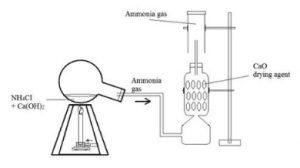
(i) Name the gas collected in the jar.
(ii) Give a balanced equation for the above preparation.
(iii). State how the above gas is collected.
(iv) Name the drying agent used.
(v) State how you will find out that the jar is full of the pungent gas.
Ans:
(i) Ammonia
(ii) 2NH4Cl + Ca(OH)2 ⟶ CaCl2 + 2H2O + 2NH3
(iii) By downward displacement of air
(iv) Quicklime/CaO
(v) Bring a moist red litmus paper to the mouth of the inverted jar if it immediately turns blue.
Or
Bring a glass rod dipped in hydrochloric acid to the mouth of the inverted jar. If it produces dense white fumes, then the jar is full of gas.
Que-13: Answer the following questions with respect to the given figure.
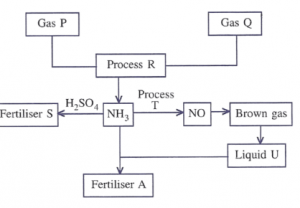
(a) Identify gas P and gas Q.
(b) Give a balanced equation to convert ammonia into gas P by a method other than decomposition. State the property of ammonia used in carrying out the conversion.
(c) Name fertiliser S and give a balanced equation for its preparation.
(d) Name process T and state the conditions that enable conversion of ammonia to nitric oxide.
(e) Give a balanced equation for the conversion of brown gas to liquid U.
(f) Name fertiliser A.
(g) Name process R.
Ans:
(a) Gas P — Nitrogen [N2] and Gas Q — Hydrogen [H2]
(b) 2NH3 + 3CuO ⟶ 3Cu + 3H2O + N2 (g)
Ammonia acts as a reducing agent reducing copper oxide to copper and itself is oxidised to nitrogen gas.
(c) Fertiliser S is Ammonium sulphate
2NH3 + H2SO4 ⟶ (NH4)2 SO4
(d) Process T is Ostwald’s process Conditions that enable conversion of ammonia to nitric oxide are 800°C temperature and platinum as catalyst.
(e) 4NO2 (g) + H2O (l) + O2 (g) ⟶ 4HNO3 (aq.)
(f) Fertiliser A is Ammonium nitrate.
(g) Process R is the Haber’s process.
Que-14: The diagram given below describes the manufacturing process of a gas.
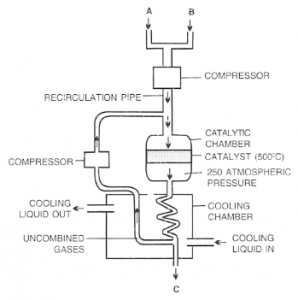
(a) Name the process.
(b) Identify A, B and C.
(c) State the ratio of A and B
(d) Write the equation involved with their respective conditions.
(e) How is the product separated from unreacted reactants ?
Ans:
(a) Haber’s process
(b)
A : Nitrogen
B : Hydrogen
C : Liquid ammonia
(c) Ratio of A and B is 1:3
(d) Reaction: N2 + 3H2 ⇌ 2NH3 + heat
Conditions:
| Temperature | 450-500°C |
|---|---|
| Pressure | Above 200 atm |
| Catalyst | Finely divided iron |
| Promoter | Traces of molybdenum or Al2O3 |
(e) Product is separated from unreacted reactants by Liquification. Ammonia is liquified easily as compared to nitrogen and hydrogen.
—: End of Study of Compounds-Ammonia Long Ans Concise Class-10 ICSE Chemistry Selina Solutions : –
Return to:- Concise Selina Chemistry for ICSE Class-10 Solutions
Please Share with Your Friends if Helpful
Thanks