Ammonia MCQs Concise Class-10 ICSE Chemistry Selina Solutions Chapter-9. We Provide Step by Step Answer of MCQs Questions of Exercise-9 for ICSE Class-10. The given Solutions is according to the Latest editions. Visit official Website CISCE for detail information about ICSE Board Class-10.
Ammonia MCQs Concise Class-10 ICSE Chemistry Selina Solutions Chapter-9
| Board | ICSE |
| Book / Publication | Concise / Selina |
| Subject | Chemistry |
| Class | 10th |
| Writer | Dr SP Singh |
| Chapter-9 | Study of Compounds – Ammonia |
| Topics | MCQs |
| Edition | 2025-2026 |
MCQs on Ammonia Class 10 ICSE
Page-163
Que-1: The catalyst used in Haber’s process is:
(a) Molybdenum
(c) Platinum
(c) Nickel
(d) Iron
Ans: (d) Iron
Hint: The catalyst used in haber’s process of manufacture of ammonia is Finely divided iron.
Que-2: Nitrogen gas can be obtained by heating :
(a) Ammonium nitrate
(b) Ammonium nitrite
(c) Magnesium nitride
(d) Ammonium chloride
Ans: (b) Ammonium nitrite
Que-3: Ammonia can be obtained by adding water to:
(a) NH4Cl
(b) Mg3N2
(c) Mg (NO3) 2
(d) (NH4)2 SO4
Ans: (b) Mg3N2
Hint: Ammonia can also be obtained by the action of warm water on nitride of metal like magnesium.
Mg2N2 + 6H2O ⟶ 3Mg(OH)2 + 2NH3 ↑
Que-4: The gas collected by downward displacement of air is
(a) HCl
(b) NH3
(c) CO2
(d) H2S
Ans: (b) NH3
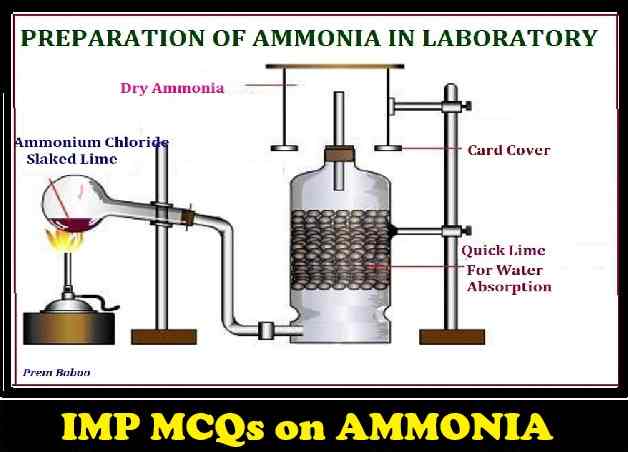
Hint: Ammonia (NH3) gas is collected in inverted gas jars by downward displacement of air because it is lighter than air.
Que-5: In the Haber’s process, the ratio of reactants nitrogen and hydrogen is:
(a) 2 : 3
(b) 3 : 2
(c) 1 : 3
(d) 3 : 1
Ans: (c) 1 : 3
Hint: In the Haber’s process, the ratio of reactants nitrogen and hydrogen is 1 : 3. One volume of nitrogen (from liquid air) and three volume of hydrogen (water gas from Bosch process).
Que-6: When ammonia reacts with an excess of chlorine, the main product formed is:
(a) NH4Cl
(b) NCl3
(c) Cl2
(d) HCl
Ans: (b) NCl3
Hint: When ammonia reacts with an excess of chlorine, products formed are hydrogen chloride and yellow coloured highly explosive liquid nitrogen trichloride.
NH3 + 3Cl2 ⟶ 3HCl + NCl3
Que-7: Ammonia is used in:
(a) Contact process
(b) Haber’s process
(c) Ostwald process
(d) Bayer’s process
Ans: (c) Ostwald process
Hint: Ammonia is used as a starting material for manufacturing nitric acid using ostwald process.
Que-8: In the following set up for burning ammonia in oxygen, ammonia tube is fitted higher and oxygen tube is kept lower because ?
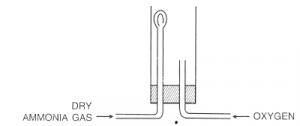
P — Oxygen is lighter than ammonia.
Q — Ammonia is lighter than oxygen.
R — Ammonia and oxygen mixture is explosive and by keeping them in this position, limited oxygen will react with ammonia.
Which of the following is true ?
(a) Only P
(b) Only Q
(c) Only R
(d) Both P and Q
Ans: (c) Only R
Hint: Ammonia burns in oxygen with greenish yellow fumes. This reaction is explosive and dangerous. Hence, by keeping ammonia tube higher than oxygen tube, limited oxygen will react with ammonia.
The following questions are Assertion-Reason based questions. Choose the answer based on the codes given below.
1. Both A and R are true and R is the correct explanation of A.
2. Both A and R are true but R is not the correct explanation of A.
3. A is true but R is false.
4. A is false but R is true.
Que-9:
Assertion (A): Ammonia does not conduct electricity in gaseous or liquid state.
Reason (R): Ions in ammonia gas or liquid ammonia are not free to move.
(a) (1)
(b) (2)
(c) (3)
(d) (4)
Ans: (c) (3) A is true but R is false.
Explain why: Pure ammonia (NH3) in its gaseous or liquid form is covalent and does not contain free ions to conduct electricity. Hence, the assertion (A) is true.
Que-10:
Assertion (A): Ammonia is dried by passing through a drying tower containing CaO.
Reason (R): Ammonia being basic in nature reacts with other drying agents.
(a) (1)
(b) (2)
(c) (3)
(d) (4)
Ans: (a) (1) Both A and R are true and R is the correct explanation of A.
Explain why: Ammonia is dried by passing it through a drying tower containing lumps of quicklime (CaO). Hence, the assertion (A) is true.
Other drying agents like conc. sulphuric acid, phosphorous pentoxide and anhydrous calcium chloride are not used, as ammonia is basic in nature, reacts with other drying agents. Hence, the reason (R) is true and it is the correct explanation of assertion (A).
Que-11:
Assertion (A): Ammonia and its compounds do not occur in minerals.
Reason (R): Ammonia is not soluble in water.
(a) (1)
(b) (2)
(c) (3)
(d) (4)
Ans: (c) (3) A is true but R is false.
Explain why: Ammonia and ammonium compounds do not occur as minerals because they are highly soluble in water. Hence, the assertion (A) is true. Ammonia is highly soluble in water. Hence, the reason (R) is false.
Que-12:
Assertion (A): In the preparation of ammonia, hydrogen is obtained by Bosch process.
Reason (R): Hydrogen and nitrogen are used in the ratio 1:3.
(a) (1)
(b) (2)
(c) (3)
(d) (4)
Ans: (c) (3) A is true but R is false.
Explain why: In the Haber’s process of manufacturing ammonia, nitrogen and hydrogen are used as reactants. Where, hydrogen is obtained as water gas from Bosch process. Hence, the assertion (A) is true.
Que-13:
Assertion (A): Haber’s process is used to manufacture ammonia.
Reason (R): The catalyst used in this process is vanadium oxide or platinum.
(a) (1)
(b) (2)
(c) (3)
(d) (4)
Ans: (c) (3) A is true but R is false.
Explain why: Haber’s process is used to manufacture ammonia. Hence, the assertion (A) is true.
The catalyst used in Haber’s process is finely divided iron. Hence, the reason (R) is false.
Que-14:
Assertion (A): Ammonia is recovered by liquification process in Haber’s process.
Reason (R): Nitrogen and hydrogen liquify with difficulty as compared to ammonia.
(a) (1)
(b) (2)
(c) (3)
(d) (4)
Ans: (a) (1) Both A and R are true and R is the correct explanation of A.
Explain why: Ammonia obtained from Haber’s process is separated from the unreacted nitrogen and hydrogen by liquification process. Hence, the assertion (A) is true.
Ammonia is recovered by liquification process because ammonia is liquified easily as compared to Nitrogen and Hydrogen. Hence, the reason (R) is true and it is the correct explanation of assertion (A).
Que-15:
Assertion (A): Liquid ammonia is used as a refrigerant in ice plants.
Reason (R): CFC, the main refrigerant, causes global warming.
(a) (1)
(b) (2)
(c) (3)
(d) (4)
Ans: (b) (2) Both A and R are true but R is not the correct explanation of A.
Explain why: Liquid ammonia is used as a refrigerant in ice plants because anhydrous ammonia is a clear, colourless liquid under pressure. It evaporates rapidly and produces cooling effect. This makes ammonia a good refrigerant. Hence, the assertion (A) is true. CFC, the main refrigerant, decompose by ultraviolet rays to form free chlorine radicals. These free radicals contribute to global warming and ozone depletion. Hence, the reason (R) is true.
Since, reason (R) doesn’t explain why liquid ammonia is used as refrigerant in ice plants, it is not the correct explanation of assertion (A).
—: End of Study of Compounds-Ammonia MCQs Concise Class-10 ICSE Chemistry Selina Solutions : –
Return to:- Concise Selina Chemistry for ICSE Class-10 Solutions
Please Share with Your Friends if Helpful
Thanks