Ammonia Short Ans Concise Class-10 ICSE Chemistry Selina Solutions Chapter-9. We Provide Step by Step Answer of Short Ans Questions of Exercise-9 for ICSE Class-10. The given Solutions is according to the Latest editions. Visit official Website CISCE for detail information about ICSE Board Class-10.
Ammonia Short Ans Concise Class-10 ICSE Chemistry Selina Solutions Chapter-9
| Board | ICSE |
| Book / Publication | Concise / Selina |
| Subject | Chemistry |
| Class | 10th |
| Writer | Dr SP Singh |
| Chapter-9 | Study of Compounds – Ammonia |
| Topics | Short Ans |
| Edition | 2025-2026 |
Short Answer Questions on Ammonia
Page-164
Que-1: Pick the odd member from the list giving reasons:
(a) Ammonia, sulphur dioxide, Hydrogen chloride, carbon dioxide.
(b) Copper oxide, Aluminium oxide, sodium oxide, Magnesium oxide.
Ans:
(a) Ammonia is basic in nature.
(b) Copper oxide because CuO is less reactive can be reduced by C, CO or by hydrogen whereas Al2O3, Na2O, MgO are reduced by electrolysis.
Que-2: A gas ‘P’ gives dense white fumes with chlorine. Its aqueous solution gives a blue colour with copper (II) hydroxide. (a) Name the gas P. (b) Give its formula. (c) Give three uses of P.
Ans:
(a) The gas is ammonia.
(b) The formula is NH3.
(c) Uses of ammonia:
Ammonia is used in the industrial preparation of nitric acid by Ostwald process.
The ammonia used in the manufacture of fertilizers such as ammonium sulphate, ammonium nitrate, ammonium phosphate.
It manufacture sodium carbonate by Solvay process ammonia is used.
NaCl + NH3 + CO2 + H2O  NaHCO3 +NH4Cl
Que-3: Copy and complete the following equations:
(a) AlN + H2O →
(b) 2NH3 + 3PbO →
(c) NH3 +3Cl2→
(d) NH3 + CO2→
(i) Which property of ammonia is illustrated by equation (c)?
(ii) What important fertilizer is prepared from equation (d)? State the conditions
Ans:
(a) AlN + 3H2O → Al(OH)3 +NH3
(b) 2NH3 + 3PbO → 3Pb + 3H2O + N2
(c) 8NH3 +3Cl2 → N2 + 6NH4Cl
(d) 2NH3 + CO2 → NH2CONH2 + H2O
(i) Ammonia act as reducing agent is explained by equation (c).
(ii) Urea the nitrogenous fertilizer is prepared from equation (d).
Que-4:
(a) What do you observe when ammonium hydroxide is added to the aqueous solution of:
(i) FeSO4
(ii) Iron(III)Chloride
(iii) Lead nitrate
(iv) Zinc nitrate?
(b) write balance equation of Q-8(a)
Ans:
(a) (i) Dirty green ppt. of Ferrous hydroxide is formed which is insoluble in excess of NH4OH.
FeSO4 + 2NH4OH → [NH4]2SO4 + Fe(OH)2
(ii) Reddish brown ppt. of ferric hydroxide is formed which is insoluble in ammonium hydroxide.
FeCl3 + 3NH4OH → 3NH4Cl + Fe(OH)3
(iii) White ppt. of lead hydroxide is formed which is insoluble in NH4OH.
Pb(NO3)2 + 2NH4OH → 2NH4NO3 + Pb(OH)2
(iv) White gelatinous ppt. of Zinc hydroxide is formed which is soluble in NH4OH.
Zn(NO3)2 + 2NH4OH → 2NH4NO3 + Zn(OH)2
(b) (i) FeSO4 + 2NH4OH → [NH4]2SO4 + Fe(OH)2
(ii) FeCl3 + 3NH4OH → 3NH4Cl + Fe(OH)3
(iii) Pb(NO3)2 + 2NH4OH → 2NH4NO3 + Pb(OH)2
(iv) Zn(NO3)2 + 2NH4OH → 2NH4NO3 + Zn(OH)2
Que-5: When ammonium hydroxide is added to solution B, a pale blue precipitate is formed. This pale blue precipitate dissolves in excess ammonium hydroxide giving an inky blue solution. What is the cation (positive ion) present in solution B? What is the probable colour of solution B.
Ans: CuSO4 + 2NH4OH (NH4)2SO4 +Cu(OH)2 [Pale blue]
The cation present in solution B is Copper (Cu+2).
The colour of solution B is Blue.
The pale blue precipitate of copper hydroxide dissolves in excess of ammonium hydroxide forming tetraamine copper[II] sulphate, an azure blue(deep blue) soluble complex salt.
Cu(OH)2 + (NH4)2SO4 +2NH4OH → [Cu(NH3)4]SO4 + 4H2O
Que-6: Write the equation for the action of heat on:
(a) Ammonium chloride
(b) Ammonium nitrate
State whether each reaction is an example of thermal decomposition or thermal dissociation.
Ans:
(a) Ammonium chloride NH4Cl ⇔ NH3 +HCl
(b) Ammonium nitrate NH4NO3 ⇔ N2O +2H2O
Both are examples of Thermal dissociation.
Que-7: Name two gases which can be used to study the fountain experiment. State the common property demonstrated by the fountain experiment.
Ans:
(i) Ammonia and hydrogen chloride gas
(ii) High solubility of gases in water
Que-8: Name the other ion formed when ammonia dissolves in water. Give one test that can be used to detect the presence of the ion produced.
Ans:
(i) Hydroxyl (OH–) ion other than ammonium ion
(ii) Red litmus turns blue, methyl orange turns yellow and phenolphthalein turns pink.
Que-9: State the conditions required for: Catalytic oxidation of ammonia to nitric oxide.
Ans: In the presence of platinum catalyst at 800°C.
Que-10: Give reason for the following
(a) Liquid ammonia is used as a refrigerant in ice plants.
(b) Aqueous solution of ammonia is used for removing grease stains from woolen clothes
(c) Aqueous solution of ammonia gives a pungent smell.
(d) Aqueous solution of ammonia conducts electricity.
Ans:
(a) Liquid ammonia takes a lot of energy to vaporize. This heat is taken from the surrounding bodies which are consequently cooled down. Thus it is used as a refrigerant in ice plant.
(b) Ammonia emulsifies or dissolves fats, grease so it is used to remove grease from woolen clothes.
(c) Ammonia is formed by bacterial decomposition of urea, so ammonia has a pungent smell.
(d) An aqueous solution of ammonia is a weak electrolyte. It dissociates partially to give hydroxyl ions, and ions conduct electricity. So an aqueous solution of ammonia conducts electricity.
Que-11: Write balanced chemical equation for the following:
(a) Ammonium hydroxide is added to ferrous sulphate solution.
(b) Magnesium nitride is treated with warm water.
(c) Ammonium chloride is heated with sodium hydroxide.
(d) Chlorine reacts with excess of ammonia.
(e) Ammonia and Oxygen in the presence of a catalyst.
(f) Reduction of hot copper (II) oxide to copper using Ammonia gas.
(g) To illustrate the reducing nature of ammonia.
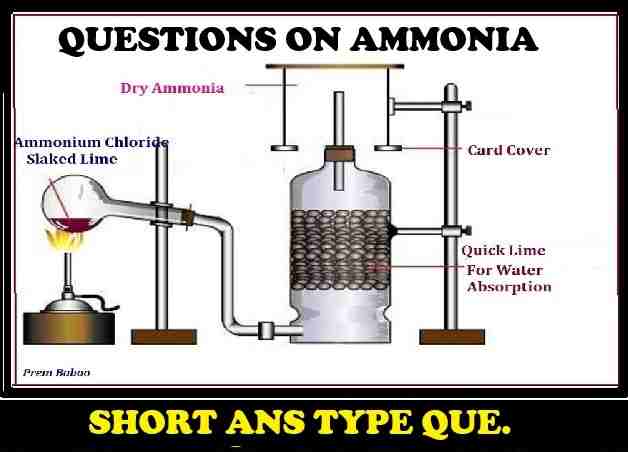
(h) Lab. preparation of ammonia using an ammonium salt.
(i) Reaction of ammonia with excess of chlorine.
(j) Reaction of ammonia with sulphuric acid.
(k) When excess of ammonia is treated with chlorine.
Ans:
(a) FeSO4 + 2NH4OH ⟶ (NH4)2SO4 + Fe(OH)2 ↓
(b) Mg3N2 + 6H2O ⟶ 3Mg(OH)2 + 2NH3↑
(c) NH4Cl + NaOH ⟶ NaCl + H2O + NH3
(d) 8NH3 [excess] + 3Cl2 ⟶ 6NH4Cl + N2
(e) 4NH3 + 5O2 ⟶ 6H2O + 4NO↑ + Δ
(f) 2NH3 + 3CuO ⟶ 3Cu + 3H2O + N2 [g]
(g) 2NH3 + 3CuO ⟶ 3Cu + 3H2O + N2 [g]
(h) 2NH4Cl + Ca(OH)2 ⟶ CaCl2 + 2H2O + 2NH3↑
(i) NH3 + 3Cl2 [excess] ⟶ 3HCl + NCl3
(j) 2NH3 + H2SO4 (dil.) ⟶ (NH4)2SO4
(k) 8NH3 [excess] + 3Cl2 ⟶ 6NH4Cl + N2
Que-12: Write the balanced equation for a reaction in which ammonia is oxidized by:
(i) A metal oxide
(ii) a gas which is not oxygen
Ans: Balanced equation:
(a) 2NH3 +3CuO → 3Cu +3H2O +N2
(b) 2NH3 +3Cl2 → N2 + 6HCl
Que-13: Write a relevant equation to show that ammonia acts as a reducing agent.
Ans: 2NH3 + 3CuO ⟶ 3Cu + 3H2O + N2 [g]
Que-14: Rewrite the correct statement with the missing word/s: Magnesium nitride reacts with water to liberate ammonia.
Ans: Magnesium nitride reacts with boiling water to liberate ammonia.
Que-15: Distinguish between the following (using ammonia solution) :
(a) Calcium chloride and zinc chloride.
(b) Ferric salt and ferrous salt
(c) Zinc nitrate and lead nitrate
Ans:
(a) When we add ammonium hydroxide solution to both the given salt solutions, Zinc Chloride reacts to form a gelatinous white precipitate of Zinc Hydroxide (ZnOH), whereas, no such observations i.e no precipitate will form in case of Calcium Chloride solution because ammonium hydroxide is a weak base and it cannot react with calcium salts to precipitate the hydroxide of calcium.
ZnCl2 + 2NH4OH ⟶ Zn(OH)2 + 2NH4Cl
(b) On reaction with ammonium hydroxide, Iron [II] sulphate (ferrous salt) forms a dirty green ppt whereas iron [III] sulphate (ferric salt) forms a reddish brown ppt. Hence, the two can be distinguished easily.
FeSO4 + 2NH4OH ⟶ (NH4)2SO4 + Fe(OH)2 ↓
Fe2(SO4)3 + 6NH4OH ⟶ 3(NH4)2SO4 + 2Fe(OH)3 ↓
(c) When zinc nitrate is treated with ammonium hydroxide, white gelatinous ppt. of Zinc hydroxide is formed which is soluble in excess of NH4OH.
Zn(NO3)2 + 2NH4OH ⟶ 2NH4NO3 + Zn(OH)2 ↓
when lead nitrate is treated with ammonium hydroxide, white ppt. of lead hydroxide is formed which is insoluble in excess of NH4OH
Pb(NO3)2 + 2NH4OH ⟶ 2NH4NO3 + Pb(OH)2 ↓
Que-16: Give the balanced equations for the following conversions:
(a) Ammonia to nitrogen using an acidic gas
(b) Ammonia to brown gas
(c) Ammonia to nitrogen trichloride
(d) Ammonia solution to an amphoteric hydroxide
(e) A nitride of a trivalent metal to ammonia
(f) Lead oxide to lead
Ans: Balanced equations :
(a) 8NH3 + 3Cl2 → N2 + 6NH4Cl
(b) 4NH3 + 5O2 → (800ºC) 4NO +6H2O +Heat
2NO+O2 → 2NO2
Brown gas
(c) NH3 +3Cl2 → 3HCl +NCl3
(d) AlCl3 +3NH4OH → 3NH4Cl + Al(OH)3
(e) AlN + 3H2O → Al(OH)3 + NH3
(f) 3PbO +2NH3 → 3Pb + 3H2O +N2
Que-17: State two relevant observations for: Ammonium hydroxide solution is added to zinc nitrate solution slowly and then in excess.
Ans:
(i) When added in small quantity, it forms a gelatinous white ppt.
(ii) When added in excess, it dissolves to form a complex salt.
Que-18: Copy and complete the following table relating to important industrial process:
| Name of the process | Temperature | Catalyst | Equation for the catalysed reaction |
| Haber’s process |
Ans:
| Name of the process | Temperature | Catalyst | Equation for the catalysed reaction |
| Haber’s process | 450-500°C | Finely divided iron (Fe) | N2 + 3H2 ⇌ 2NH3 + Δ |
Que-19: Distinguish between the following pairs of compounds using the test given in bracket :
(a) Iron [II] sulphate and iron [III] sulphate [using ammonium hydroxide]
(b) A lead salt and a zinc salt [using excess ammonium hydroxide]
Ans: (a) On reaction with ammonium hydroxide, Iron [II] sulphate forms a dirty green ppt whereas iron [III] sulphate forms a reddish brown ppt. Hence, the two can be distinguished easily.
FeSO4 + 2NH4OH ⟶ (NH4)2SO4 + Fe(OH)2 ↓
Fe2(SO4)3 + 6NH4OH ⟶ 3(NH4)2SO4 + 2Fe(OH)3 ↓
(b) A lead salt gives a chalky white ppt. on reaction with ammonium hydroxide that is insoluble in excess of ammonium hydroxide.
Pb(NO3)2 + 2NH4OH ⟶ 2NH4NO3 + Pb(OH)2 ↓
On the other hand, zinc salt forms a white gelatinous ppt. which dissolves when excess of ammonium hydroxide is added. Hence, the two can be distinguished.
ZnSO4 + 2NH4OH ⟶ (NH4)2SO4 + Zn(OH)2 ↓
[Zn(OH)2] + (NH4)2SO4 + 2NH4OH ⟶ [Zn(NH3)4]SO4 + 4H2O
Que-20: State relevant observation for the following:
(e) Excess of chlorine gas is reacted with ammonia gas.
(f) Calcium hydroxide is heated with ammonium chloride crystals.Ans: (a) Black copper [II] oxide is reduced to brown copper.
2NH3 + 3CuO ⟶ 3Cu + 3H2O + N2 [g]
(b) Green or greenish yellow flame is seen when ammonia gas is burnt in an atmosphere of oxygen. The reaction of combustion of Ammonia is:
4NH3 + 3O2 ⟶ 2N2 + 6H2O
(c) Ammonium hydroxide if first added in small quantity and then in excess to a solution of copper sulphate, a pale blue ppt. of copper hydroxide is formed which dissolves in excess of ammonium hydroxide forming a soluble complex salt.
CuSO4 + 2NH4OH ⟶ (NH4)2SO4 + Cu(OH)2 ↓
Cu(OH)2 + (NH4)2SO4 + 2NH4OH ⟶ [Cu(NH3)4]SO4 + 4H2O
(d) When Al metal is burnt in a jar of nitrogen gas, its nitride i.e., AlN is formed. When warm water is added to AlN, it undergoes hydrolysis and is decomposed by warm water to give pungent smelling ammonia gas. The corresponding insoluble metal hydroxide (i.e., Al(OH)3) is precipitated out. The reactions are shown below:
2Al + N2 ⟶ 2AlN
AlN + 3H2O ⟶ Al(OH)3 + NH3 [g]
(e) Colourless ammonia gas reacts with greenish yellow excess chlorine giving a yellow explosive liquid (Nitrogen trichloride).
NH3 + 3Cl2 [excess] ⟶ 3HCl + NCl3
(f) Pungent smelling gas (ammonia) is given out.
2NH4Cl + Ca(OH)2 ⟶ CaCl2 + 2H2O + 2NH3
—: End of Study of Compounds-Ammonia Short Ans Concise Class-10 ICSE Chemistry Selina Solutions : –
Return to:- Concise Selina Chemistry for ICSE Class-10 Solutions
Please Share with Your Friends if Helpful
Thanks