Angle Between Two Lines Class 12 OP Malhotra Exe-23D ISC Maths Solutions Ch-23 Three Dimensional Geometry. In this article you would learn How to find angle between two line in three dimensional geometry problems with solutions. Visit official Website CISCE for detail information about ISC Board Class-12 Mathematics.

Angle Between Two Lines Class 12 OP Malhotra Exe-23D ISC Maths Solutions Ch-23 Three Dimensional Geometry
| Board | ISC |
| Publications | S Chand |
| Subject | Maths |
| Class | 12th |
| Chapter-23 | Three Dimensional Geometry |
| Writer | OP Malhotra |
| Exe-23(d) | Angle Between Two Lines |
How to find angle between two line in three dimensional geometry problems / questions with solutions / answer
Three Dimensional Geometry Class 12 OP Malhotra Exe-23D Solutions
Que-1: Find the angle between the following pairs of lines:
(i) x+4/3 = y−1/5 = y+3/4;
x+1/1 = y−4/1 = z−5/2
(ii) x−2/3 = y+3/−2, z = 5 ; x+1/1 = 2y−3/3 = z−5/2
Sol: (i) Given lines are and
x+4/3 = y−1/5 = z+3/4
x+1/1 = y−4/1 = z−5/2
Let b1→ and b2→ be the vectors || to line (1) and (2).
Then b1→ = 3î + 5ĵ + 4k̂;
b2→ = î + ĵ + 2k̂
Let θ be the angle between given line
Then
Then cosθ = b1→b2/→|b1→||b2→|
= (3î+5ĵ+4k̂)(î+ĵ+2k̂)/ √9+25+16 √1+1+4
⇒ cosθ = 3(1)+5(1)+4(2)/√50√6
∴ cosθ = 16/10√3 = 8/5√3
∴ θ = cos-1 (8/5√3)
(ii) Given lines are x−2/3
= y+3/−2
= z−5/0
and
x+1/1 = (y−(3/2))/(3/2)
= z−52 i.e. x+1/2 = (y−(3/2))/3 = z−5/4
Let b1→ and b2→ be the vectors parallel to given lines.
then b1→ = 3î – 2ĵ + 0k̂;
b2→ = 2î + 3ĵ + 4k̂
Let θ be the angle between given lines and hence θ be the angle between b1→ and b2→
∴ cosθ = b1→⋅b2/→|b1→||b2→|
= (3î−2ĵ+0k̂)(2î+3ĵ+4k̂)/√9+4+0√4+9+16
= 3(2)−2(3)+0/√13√29 = 0
⇒ θ = π/2
Que-2: Find the angle between the following pairs of lines:
(i) r→ = 4î – ĵ + λ(î + 2ĵ – 2k̂) ; r→ =î – ĵ + 2k̂ – µ(2 î + 4ĵ – 4k̂)
(ii) r→ = 3î + 2ĵ – 4k̂ + λ(î + 2ĵ + 2k̂); r→ = 5î – 2ĵ + µ(3î + 2ĵ + 6k̂)
(iii)r→ =λ(î + ĵ + 2k̂) ; r→ = 2ĵ + µ[( – 1)î – (√3+ 1)ĵ + 4k̂]
Sol: (i) Given eqns. of lines are
r→ = (4î – ĵ) + λ(î + 2ĵ – 2k̂)
r→ = î – ĵ + 2 k^ – µ(2î + 4ĵ – 4k̂)
Let m1−→ and m2−→ vectors parallel to line (1) and (2).
m1→= î + 2ĵ – 2k̂ ;
m2→ = 2î + 4ĵ – 4k̂
Let θ be the angle between given line
∴ θ be also the angle between m⃗ 1 and m⃗ 2
Then
Then cosθ = m1→⋅m2/→|m1→||m2→|
= (î+2ĵ−2k̂)(2î+4ĵ−4k̂)/√1+4+4√4+16+16
⇒ cosθ = 1(2)+2(4)−2(−4)/3×6
= 18/18 = 1
Thus θ = 0° ∴ given pair of lines are parallel.
(ii) The given pair of lines are
and
r→ = 3 î + 2ĵ – 4k̂ + λ(î + 2ĵ + 2k̂)
and r→ = 5ĵ – 2k̂ + µ(3î + 2ĵ + 6k̂)
Here, b→ = î + 2ĵ + 2k̂
∴|b→ | = √1²+2²+2²
= 3 and d→ = 3î + 2ĵ + 6k̂
∴ |d→ | = √3²+2²+6² = 7 and b⃗ d⃗ = 13 + 2 2 + 2 6
= 3 + 3 + 12 = 19
If θ be the required angle then
cosθ = b→ ⋅d→/ |b→ ||d→ |
= 19/3×7 = 19/21
∴ θ = cos-1 (19/21)
(iii) Given lines are
r→ = λ(î + ĵ + 2k̂)
r→ = 2 ĵ + µ{(√3 – 1)î – (√3 + 1)ĵ + 4k̂
Let b⃗ 1 and b2→ be the vectors parallel to line (1) and line (2)
∴ b⃗ 1 = î +ĵ + 2k̂;
b2→ = (√3 – 1)î – (√3 + 1)ĵ + 4k̂
Let θ be the angle between given lines then θ be the angle between b1→ and b2→
∴ cos θ = b1→⋅b2/→|b1→||b2→|
= (î+ĵ+2k̂)⋅[(√3 – 1)î−(√3 + 1)ĵ+4k̂]/√1+1+4 √(√3 – 1)²+(√3+1)²+16
= √3−1−√3−1+8/√6√(3+1−2√3+3+1+2√3+16)
∴ cosθ = 6/√6√24 = 6/√144 = 6/12 = 1/2
Thus
θ = π/3
Que-3: Find the angle between the pairs of lines with direction ratios:
(i) 2, 2, 1 and 4, 1, 8
(ii) 1, 2, -2 and -2, 2, 1.
Sol: (i) Here a1 = 2 ; b1 = 2 ; c1 = 1 and a2 = 4 ; b2 = 1 ; c2 = 8
Let θ be the angle between given pair of lines.
Then
cosθ = a1a2+b1b2+c1c2/√(a2)²+(b2)²+(c2)²√(a1)²+(b1)²+(c1)²
= 2(4)+2(1)+1(8)/√4+4+1√16+1+64 = 18/3×9
= 2/3
θ = cos-1 (2/3)
(ii) Here a1 = 1 ; b1 = 2 ; c1 = -2 ; a2 = -2 ; b2 = 2 ; c2 = 1
Let θ be the angle between given pairs of lines.
Then
cosθ = a1a2+b1b2+c1c2/√(a2)²+(b2)²+(c2)²√(a1)²+(b1)²+(c1)²
= 1(−2)+2(2)−2(1)/√1+4+4√4+4+1 = 0
Thus, θ = π/2
Que-4: Prove that the two lines x/1 = y/2 = z/1 and x/1 = y/−1 = z/1 are at right angles.
Sol: Given lines are
x/1 = y/2 = z/1
x/1 = y/−1 = z/1
and
∴ D ratios of line (1) and (2) are < 1, 2, 1> and < 1, -1, 1 >
Here, a1 = 1 ; b1 = 2 ; c1 = 1 and a2 = 1 ; b2 = -1 ; c1 = 1
Now, a1a2+ b1b2 + c1c2 = 1(1) + 2(-1) + 1 1 = 0
Thus both lines (1) and (2) are at right angles.
Que-5: P, Q, R, S are the points (-2, 3, 4), (-4, 4, 6), (4, 3, 5) and (0, 1, 2). Show that P Q is perpendicular to R S.
Sol: Here, D ratios of line PQ be < -4 + 2, 4 – 3, 6 – 4 >
i.e., < -2, 1, 2 > and D ratios of line RS be < 0 – 4, 1 – 3, 2 – 5 >
i.e., < -4, -2, -3 >
Here, a1a2+ b1b2 + c1c2 = (-2)(-4) + 1(-2) + 2(-3) = 0
Thus line PQ is ⊥ to line RS.
Que-6: (i) Determine the value of k so that the line joining the points A(k, -1, -1), B(2, 0, 2 k) is perpendicular to the line joining the points C(4, 2 k, 1) and D(2, 3, 2).
(ii) For what value of p will the line through (4, 1, 2) and (5, p, 0) be perpendicular to the line through (2, 1, 1) and (3, 3, -1) ?
Sol: (i) D ratios of line joining the points A(k, -1, -1) and B(2, 0, 2 k) be < 2 – k, 0 + 1, 2 k + 1 > and D ratios of line joining the points C(4, 2 k, 1) and D(2, 3, 2) be < 2 – 4, 3 – 2 k, 2 – 1 > i.e., < -2, 3 – 2 k, 1 >
Here, a1 = 2 – k ; b1 = 1 ; c1 = 2 k + 1 and a2 = -2 ; b2 = 3 – 2 k ; c2 = 1 Since, it is given that, line AB is ⊥ to line CD.
∴ a1a2+ b1b2 + c1c2 = 0
⇒ (2 – k)(-2) + 1(3 – 2 k) + (2 k + 1) 1 = 0
⇒ -4 + 2 k + 3 – 2 k + 2 k + 1 = 0
⇒ 2 k = 0
⇒ k = 0
(ii) Direction ratios of the line through A(4, 1, 2) and B(5, p, 0) be given by < 5 – 4, p – 1, 0 – 2 > i.e., < 1, p – 1, -2 >
and direction ratios of the line through the points C(2, 1, 1) and D(3, 3, -1) be < 3 – 2, 3 – 1, -1 – 1 > i.e., < 1, 2, -2 >
Since it is given that, line AB is ⊥ to line CD.
∴ a1a2+ b1b2 + c1c2 = 0 ⇒ 1(1)+(p-1) 2+(-2)(-2) = 0
⇒ 1 + 2 p – 2 + 4 = 0
⇒ 2p = -3
⇒ p =−3/2
Que-7: Find the value of A, so that the following lines are perpendicular to each other :
(i) x−5/5λ+2 = 2−y/5 = 1−z/−1;
x/1 = 2y+1/4λ = 1−z/−3
(ii) 1−x/3 = 7y−14/2λ = 5z−10/11;
7−7x/3λ = y−5/1 = 6−z/5
Sol: (i) Given lines can be written as
x−5/5λ+2 = 2−y/5 = 1−z/−1;
x/1 = 2y+1/4λ = 1−z/−3
and
x/1 = (y+(1/2))/2λ = z−1/3
Direction ratios of line (1) are proportional to, < 5 λ + 2, -5, 1 >
i.e. a1 = 5λ + 2 ; b1 = -5 ; c1 = 1
and D’ ratios of line (2) be proportional to < 1, 2λ, 3 >
Here a2 = 1 ; b2 = 2λ ; c2 = 3 lines (1) and (2) are perpendicular to each other
∴ a1a2+ b1b2 + c1c2=0
⇒ (5λ + 2) 1 – 5(2λ) + 1(3) = 0
⇒5λ + 2 – 10λ + 3 = 0
⇒ -5λ + 5 = 0 ⇒ λ = 1
(ii) eqn. of given lines are; 1−x/3 = 7y−14/2λ
= 5z−10/11
i.e., x−1/−3 = 7(y−2)/2λ = 5(z−2)/11
i.e., x−1/−3 = (y−2)/(2λ/7) = z−2/(11/5)
∴ Direction ratios of line (1) are < -3, 2λ/5, 11/5 >
and eqn. of given line be 7−7x/3λ = y−5/1
= 6−z/5
⇒ −7(x−1)/3λ = y−5/1 = z−6/−5
i.e., x−1/(3λ/−7) = y−5/1 = z−6/−5
∴ D ratios of line (2) are < −3λ/7, 1, -5 >
Now lines (1) and (2) are ⊥ to each other
∴ (-3)(3λ/7) + (2λ/7) 1 + 11/5(-5) = 0
⇒ 9λ/7 + 2λ/7 – 11 = 0
⇒ 11λ – 77 = 0
⇒ λ = 7
Que-8: Find the values ofp and q so that the line joining the points (7, p, 2) and (q, -2, 5) may be parallel to the line joining the points (2, -3, 5) and (-6, -15, 11).
Sol: Given direction ratios of the line joining the point A(7, p, 2) and B(q, -2, 5) be
< q – 7, -2 – p, 5 – 2 > i.e., < q – 7, -2 – p, 3 >
and direction ratios of the line joining the points C(2, -3, 5) and D(-6, -15, 11) are
< -6 – 2, -15 + 3, 11 – 5 >
i.e., < -8, -12, 6 > i.e., < 4, 6, -3 >
Since line AB is || to line CD.
∴ direction ratios of both lines are proportional
∴ q−7/4 = −2−p/6
= 3/−3
⇒ q−7/4 = p+2/−6 = -1
⇒ q−7/4 = -1
⇒ q – 7 = -4 ⇒ q = 3
and p+2/−6 = -1
⇒ p + 2 = 6
⇒ p = 4
Que-9: Find the equations of the line passing through the point (2, 1, 3) and perpendicular to the lines x−1/1 = y−2/2 = z−3/3 and x/−3 = y/2 = z/5
Sol: Let the direction ratios of the required line be proportional to a, b, c.
Since the required line is ⊥ to two given lines
a + 2 b + 3 c = 0
-3 a + 2 b + 5 c = 0
On solving eqn. (1) and (2) by cross multiplication method, we have
a/10−6 = b/−9−5 = c/2+6
⇒ a/4
= b/−14 = c/8
i.e. a/2 = b/−7 = c/4
∴ direction ratio’s of required line are proportional to 2, -7, 4.
Hence the eqn. of required line which passes through (2, 1, 3) and having direction ratios proportional to < 2, -7, 4 > is given by
x−2/2
= y−1/7
= z−3/4
Que-10: Find the equations of the line passing through the point A(-1, 3, 7) and perpendicular to the lines r⃗ = 2 î – 3 j^ + λ(2î + 3 j^ + k^) and r⃗ = î – j^ + k^ + µ(7 j^ – 5 k^).
Sol: The required eqn. of line through the point A(-1, 3, 7) and having direction ratios < a, b, c > be given by
x+1/a = y−3/b = z−7/c
and equs of given lines are (in cartesian form)
x−2/2 = y+3/3 = z−0/1
and
x−1/0 = y+1/7 = z−1/−5
Now, line (1) is ⊥ to lines (2) and (3).
Then
2 a + 3 b + c = 0
0 a + 7 b – 5 c = 0
and
0 a + 7 b – 5 c = 0
on solving eqn. (4) and eqn. (5) ; by using cross-multiplication method, we have
a/−15−7 = b/0+10 = c/14−0
i.e., a−2/2 = b/10 = c/14
i.e., a/+11 = b/−5 = c/−7
∴ from (1); required eqn. of line be ; x+1/11 = y−3/−5 = z−7/−7
Que-11: Find the equations of the line passing through the point (1, -1, 1) and perpendicular to the lines joining the points (4, 3, 2),(1, -1, 0) and (1, 2, -1),(2, 1, 1).
Sol: Let the direction ratios of the required line be proportional to < a, b, c >.
Since the required line is ⊥ to given two line whose direction ratios are proportional to
< 1 – 4, -1 – 3, 0 – 2 > and < 2 – 1, 1 – 2, 1 + 1 >
i.e. < -3, -4, -2 > and < 1, -1, 2 >
Thus -3 a – 4 b – 2 c = 0
⇒ 3 a + 4 b + 2 c = 0
and
a – b + 2 c = b
By cross multiplication method, we have
a/10 = b/−4 = c/−7
Hence the required line passing through the point (1, -1, 1) and having direction ratio proportional to < 10, -4, -7 > is given by
x−1/10 = y+1/−4 = z−1/−7
Que-12: Find the coordinates of the foot of the perpendicular from (1, 1, 1) on the line joining (5, 4, 4) and (1, 4, 6).
Sol:
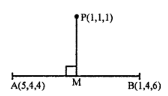
x−5/1−5 = y−4/4−4 = z−4/6−4
i.e., x−5/−4
= y−4/0 = z−4/2 = t (say)
any point on line (1) be M(-4 t + 5, 4, 2 t + 4)
Let this point M be the foot of ⊥ drawn from P on A B. Then P M ⊥ A B
Now direction ratios of line PM are
< -4 t + 5 – 1, 4 – 1, 2 t + 4 – 1 >
i.e., < -4 t + 4, 3, 2 t + 3 >
and direction ratios of line AB are < 1 – 5, 4 – 4, 6 – 4 >
i.e., < -4, 0, 2 >.
∴ from (2); we have
(-4 t + 4)(-4) + 3 × 0 + 2(2 t + 3) = 0
⇒ 16 t – 16 + 4 t + 6 = 0
⇒ 20 t – 10 = 0
⇒ t = 1/2
Thus the coordinates of point are (-2 + 5, 4, 1 + 4) i.e., M(3, 4, 5)
Hence the required coordinates of foot of ⊥ are (3, 4, 5).
Que-13: Find the foot of the perpendicular from (0, 2, 7) on the line x+2/−1 = y−1/3 = z−3/−2
Sol: Let L be the foot of perpendicular drawn from P(0, 2, 7) on given line.
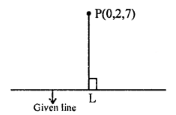
So any point on given line be given by
x+2/−1 = y−1/3
= z−2/−2 = t (say)
i.e. x = -t – 2 ; y = 3 t + 1 ; z = -2 t + 3
Thus the coordinates of point L are (-t – 2, 3 t + 1, -2 t + 3)
∴ The direction ratios of line PL are proportional to
-t – 2 – 0, 3 t + 1 – 2, -2 t + 3 – 7
i.e. -t – 2, 3 t – 1,-2 t – 4
Also the D’ ratios of given line are proportional to < -1, 3, -2 >
Since line PL is ⊥ to given line.
∴(-t – 2)(-1) + (3 t – 1) 3 + (-2 t – 4)(-2) = 0
⇒ t + 2 + 9 t – 3 + 4 t + 8 = 0
⇒ 14 t = -7
⇒ t = −12
Thus, the coordinates of L i.e. foot of ⊥ are
(−1/2 – 2, −3/2 + 1, (-2) (−1/2) + 3)
i.e. (−5/2, −1/2, 4)
Que-14: A(0, 6, -9), B(-3, -6, 3) and C(7, 4, -1) are three points. Find the equation of the line A B. If D is the foot of perpendicular drawn from C to the line A B, find coordinate of the point D.
Sol: Now D’ratios of given line A B are proportional to < -3 – 0, -6 – 6, 3 + 9 >
i.e. < -3, -12, 12 >
i.e. < 1, -4, -4 >
Thus eqn. of line AB which passes through A(0, 6, -9) and B(-3, -6, 3) is given by
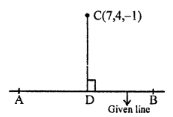
x−0/1 = y−6/4 = z+9/−4
Any point on given line be given by
x−0/1 = y−6/4 = z+9/−4 = t
i.e. x = t, y = 4 t + 6 ; z = -4 t – 9
∴ The coordinates of point D are (t, 4 t + 6, -4 t – 9)
Thus the direction ratios of line CD are proportional to < t – 7, 4 t + 2, -4 t – 8 >
also the direction ratios of given line are proportional to, < 1, 4, -4 >
Since C D ⊥ A B.
∴(t – 7) + (4 t + 2) 4 + (-4 t – 8)(-4) = 0
⇒ t – 7 + 16 t + 8 + 16 t + 32 = 0
⇒ 33 t = -33
⇒ t = -1
Thus the required coordinates of D are (-1, 2, -5) and the required eqn. of C D be given by
x−7/−1−7 = y−4/2−4
= z+1/−5+1
i.e. x−7/−8 = y−4/−2 = z+1/−4
i.e. x−7/4 = y−4/1
= z+1/2
Que-15: Find the distance of (1, 0, 0) from the line through (1, -1, -10) whose d.c’s are proportional to 2, -3, 8.
Sol: Let L be the foot of ⊥ drawn from P(1, 0, 0) on given line. any point on given line is given by
x−1/2 = y+1/−3 = z+10/8 = t
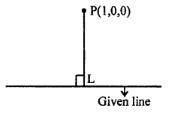
i.e. x = 2 t + 1 ; y = -3 t – 1 ; z = 8 t – 10
∴ The coordinates of point L be (2 t + 1, -3 t + 1, 8 t – 10)
Now the direction ratios of line PL are proportional to
< 2 t + 1 – 1, -3 t – 1, 8 t – 10 > i.e. < 2 t, -3 t – 1, 8 t – 10 >
Now direction ratio of given line be proportional to < 2, -3, 8 >
Since P L ⊥ to given line.
∴ 2(2 t) + (-3 t – 1)(-3) + (8 t – 10) 8 = 0
⇒ 4 t + 9 t + 3 + 64 t – 80 = 0
⇒ 77 t – 77 = 0
⇒ t = 1
∴ The coordinates of point L i.e. foot of ⊥ are (3, -4, -2) and required ⊥ distance = |PL|
= √(3−1)²+(−4−0)²+(−2−0)²
= √4+16+4 = 2√6 units
Que-16: Find the perpendicular distance of the point (2, 3, 4) from the line 4−x/2 = y/6 = 1−z/3. Also find the coordinates of the foot of the perpendicular.
Sol: Let P(2, 3, 4) be the given point and M be the foot of ⊥ from P on given line AB.
x−4/−2 = y/6 = z−1/−3 = t (say)
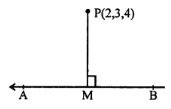
Any point on given line be M(-2 t + 4, 6 t, -3 t + 1)
∴ D’ratios of line PM are < -2 t + 2, 6 t – 3, -3 t – 3 > Now line AB is ⊥ to line PM.
∴ (-2 t + 2)(-2) + (6 t – 3) 6 + (-3 t – 3)(-3) = 0
⇒ 4 t – 4 + 36 t – 18 + 9 t + 9 = 0
⇒ 49 t = 13 ⇒ t = 13/49
∴ foot of ⊥ is given by M ( −26/49 + 4, 78/49, −39/49 + 1)
i.e. M (170/49, 78/49, 10/49)
∴ length of ⊥=|PM| = √(170/49−2)²+(78/49−3)²+(10/49−4)²
= √9(576+529+3844)/49
= 3/49√49×101
= 3/7 √101 units
Que-17: Find the image of the point (3, 5, 3) in the line x/1 = y−1/2 = z−2/3
Sol: Let P be the given point, i.e., P}(3,5,3) and AB} be the given line,
i.e., x/1 = y−1/2 = z−2/3 = t (say)
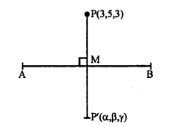
So, any point on line (1) be M(t, 2 t + 1, 3 t + 2)
Now, let M be the foot of ⊥ drawn from P on AB ∴ PM ⊥ AB
Further produe PM to P
S.t PM = MP then P be the image of P in AB.
D ratios of line PM are
< t – 3, 2 t + 1 – 5, 3 t + 2 – 3 >
i.e., < t – 3, 2 t – 4, 3 t – 1 >
D ratios of line AB are < 1, 2, 3 >
Since, PM ⊥ AB
∴(t – 3) 1 + (2 t – 4) 2 + (3 t – 1) 3 = 0
⇒ t – 3 + 4 t – 8 + 9 t – 3 = 0
⇒ 14 t – 14 = 0 ⇒ t = 1
∴ Coordinates of point M be (1, 3, 5)
Also, M be the mid point of PP and let coordinates of P be (α, β, γ).
∴ α+3/2 = 1;
β+5/2 = 3 and γ+3/2 = 5
i.e., α = -1 ; β = 1 ; γ = 7
Hence required coordinates of image of P(3, 5, 3) in given line are (-1, 1, 7)
Que-18: Find the image of the point (2, -1, 5) in the line r⃗ = (11î – 2ĵ – 8k̂) + λ(10î – 4ĵ – 11k̂)
Sol: Let P(2, -1, 5) be the given point and eqn. of line in cartesian form be given by
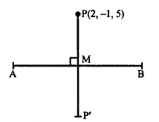
x−11/10 – y+2/−4 = z+8/−11 = t (say)
From P, drawn PM ⊥ AB and produce PM to P then P be the image of P in AB when PM = MP
any point on line (1) be M(10 t + 11, -4 t – 2, -11 t – 8)
∴ direction ratios of line PM are
< 10 t + 11 – 2, -4 t – 2 + 1, -11 t – 8 – 5 >
i.e., < 10 t + 9, -4 t – 1, -11 t – 13 >
Also direction ratios of line AB are < 10, -4, -11 >
Since PM is ⊥ to AB.
∴(10 t + 9) 10 + (-4 t – 1)(-4) + (-11 t – 13)(-11) = 0
⇒ 100 t + 90 + 16 t + 4+ 121 t + 143 = 0
⇒ 237 t + 237 = 0 ⇒ t = -1
Thus the coordinates of M are (-10 + 11, 4 – 2, 11 – 8)
i.e., M(1, 2, 3)
Let P(α, β, γ) be the image P then M be mid point of PP.
Thus, α+2/2 = 1 ;
β−1/2 = 2 ;
γ+5/2 = 3
i.e, α = 0 ; β = 5 and γ = 1
–: End of Angle Between Two Lines Class 12 OP Malhotra Exe-23D ISC Maths Solutions :–
Return to :- OP Malhotra ISC Class-12 S Chand Publication Maths Solutions
Please share with your friends
Thanks