Applications Of Derivatives Class 12 OP Malhotra Exe-11B ISC Maths Solutions Ch-11 Solutions. In this article you would learn about approximations . Step by step solutions of latest textbook has been given as latest syllabus. Visit official Website CISCE for detail information about ISC Board Class-12 Mathematics.
Applications Of Derivatives Class 12 OP Malhotra Exe-11B ISC Maths Solutions Ch-11
| Board | ISC |
| Publications | S Chand |
| Subject | Maths |
| Class | 12th |
| Chapter-11 | Applications Of Derivatives |
| Writer | OP Malhotra |
| Exe-11(B) | approximations |
Exercise- 11B
Applications Of Derivatives Class 12 OP Malhotra Exe-11B Solution.
Que-1: Using differentials, find the approximate value of each of the following upto 3 places of decimal.
(i) √37
(ii) (15)1/4
(iii) (255)1/4
(iv) (81.5)1/4
(v) (0.0037)1/2
(vi) (0.6)1/2
(vii) (26.57)1/3
(viii) (0.009)1/3
(ix) loge = 4.04, it being given that
log104 = 0.6021 and log10 e = 0.4343
(x) loge = 10.02, it being given that
loge 10 = 2.3026.
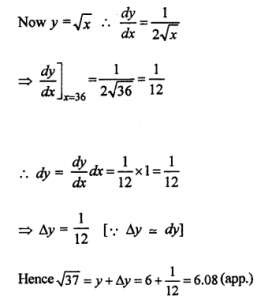
Sol: (i) Let y = f(x) = √x
Take x = 36, x + ∆x = 37 so that
∆x = 37 – 36 = 1
When x = 36 then y = √36 = 6
Let ∆x = dx = 1
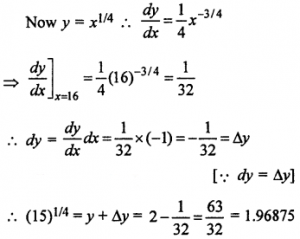
(ii) Let y = f (x) = x1/4
Take x = 16 ⇒ x + ∆x = 15
⇒ ∆x = – 1
when x = 16 then y = (16)1/4 = 2
Let ∆x = dx = – 1
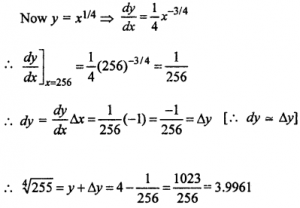
(iii) Let y = f (x) = x1/4
Take x = 256 so that x + ∆x = 255
∴ ∆x = – 1
when x = 256 then y = (256)1/4 = 4,
Let dx = ∆x = – 1
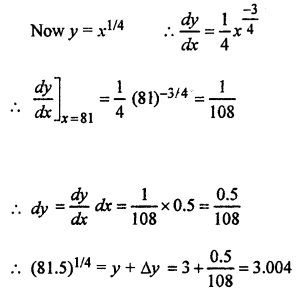
(iv) Let y = f (x) = x1/4
Take x = 81, x + ∆x = 81.5 ⇒ ∆x = 0.5
when x = 81, then y = (81)1/4 = 3,
Let dx = ∆x = 0.5
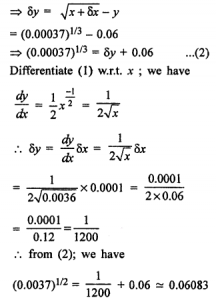
(v) Let y = f(x) = √x… (1)
Let x = 0.0036 and
let x + δx = 0.0037
∴ δx = 0.0037 – 0.0036 = 0.0001
∴ from (1) ; y + δy = √(x+δx)
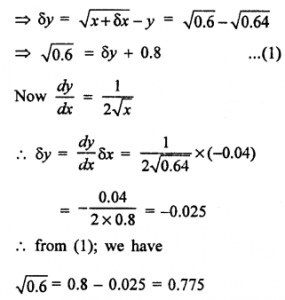
(vi) Let y = f(x) = √x…(1)
Let x = 0.64 & let x + δx = 0.6
∴ δx = 0.6 – 0.64 = – 0.04
∴ from (1); y + δy = √(x+δx)
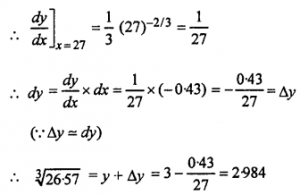
(vii) Let y = f (x) = x1/3
Take x = 27, x + ∆x = 26.57
⇒ ∆x = 26.57 – 27 = – 0.43
When x = 27 then y = (27)1/3 = 3,
Let dx = ∆x = – 0.43
Now y = x1/3 ⇒ dy/dx = 1/3 x-2/3
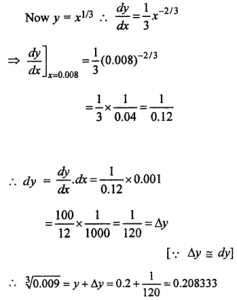
(viii) Let y = f (x) = x1/3
Take x = 0.008, x + ∆x = 0.009
⇒ ∆x = 0.001
when x = 0.008 then y = (0.008)1/3 = 0.2
Let dx = ∆x = 0.001
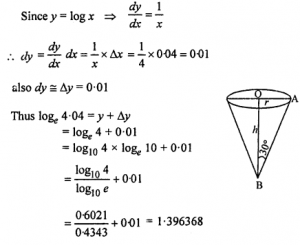
(ix) Let us consider the function y = logex = f(x)
Let x = 4 and x + ∆x = 4.04
∴ ∆x = dx = 4.04 – 4 = 004
at x = 4 ; y = log10 4 = 0.6021
(x) Let us consider the function y = loge x
Let x = 10 and x + ∆x = 10.02
∴ ∆x = 10.02 – 10 = 0.02
Let ∆x = dx = 0.02
at x = 10; y = loge 10
since y = loge x ⇒ dy/dx = 1/x
∴ dy = ∆y = dy/dx dx = 1/x x ∆x
at x = 10 ; dy = ∆y = 1/10 x 0.02 = 0.002
Thus, loge 10.02 = y + ∆y = loge 10 + 0.002 = 2.3026 + 0.002 = 2.3046
Que-2: If f (x) = 3x² + 15x + 5, then the approximate value of f(3.02) is
(a) 47.66
(b) 57.66
(c) 67.66
(d) 77.66
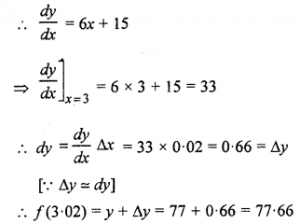
Sol: Given f (x) = y = 3x² + 15x + 5
Take x = 3, x + ∆x = 3.02 ⇒ ∆x = 0.02
When x = 3 then y = 3.3² + 15.3 + 5
⇒ y = 27 + 45 + 5 = 77,
Let ∆x = dx = 0.02
Now = 3x² + 15x + 3
Que-3: The volume of a sphere, radius r cm is 4/3 πr³ cm³. Find the approximate decrease in volume of a sphere when the radius decreases from 3 to 2.98 cm.
Sol: Given V = 4/3πr³
Differentiate both sides w.r.t. r; we have
dN/dr = 4/3 π(3r²) = 4π²
Since the radius r decrease from 3 to 2.98 cm
∴ r = 3; r + δr = 2.98
∴ δr = 2.98 – 3 = – 0.032
Thus dV = dV/dr x δr [∵ dr≅δr]
= 4π²δr = 4π x 3² x (-0.02)
= – 0.72π; cm³
Hence the required decrease in volume of sphere be 0.72π cm³
Que-4: Find the approximate change in 1/x when x = 1, δ δx = 0.2.
Sol: Let y = 1/x; given x = 1; δx = 0.2
∴ y + δy = 1/x+δx
∴ dy/dx = -1/x²
Thus δy = dy/dx δx = -1/x² δx
= -1/1² x 0.2 = – 0.2
∴ approximate change in y = δy = – 0.2
Que-5: A sphere of radius 10 cm shrinks to radius 9.8 cm. Find approximately the decrease in (i) volume, and (ii) surface area.
Sol: Let x be the radius of sphere
Then V = volume of sphere = 4/3 πr³
Here x = 10 and x + ∆x = 9.8
∴ ∆x = – 0.2 = dx
dV/dx = 4/3 x 3x² = 4πx²
∴ dV = dV/dx dx = 4πx² x (- 0.2)
= – 0.8 πx²
at x = 10 ; dV = – 0.8 π x 10² = – 80 π
Thus, dV ≅ ∆AV = – 80 π
Thus, approximate decrease in volume = ∆V = 80 π cm³
(ii) Let S = surface area of spherical balloon = 4πx²
∴ dS/dx = 8πx
∴ dS = dS/dx dx = 8πxdx = 8π x 10 x (- 0.2) dx
⇒ dS = – 16π = ∆S
Thus approximate decrease in surface area = ∆S = 16π cm²
Que-6: A circular plate expands when heated from a radius of 5 cm to 5.06 cm. Find the approximate increase in area.
Sol: Let A be the area of circle with radius r
Then A = πr²
∴ dA/dr = 2πr
Given r = 5; r + δr = 5.06
⇒ δr = 0.06
Thus, dA = dA/dr δr = 2πrδr
= 2π x 5 x 0.06 = 0.6π cm²
∴ approximate increase in area = 0.6π cm²
Que-7: If the side of a cube is 10.01 cm, find approximately the volume of the cube.
Sol: Let x be the side of cube
Then V = volume of cube = x³
Let x = 10 & x + δx = 10.01
∴ at x = 10; V = (10)³ = 1000
∴ dV/dx = 3x²
∴ dV = dV/dx dx ⇒ δV = dV/dx δx
⇒ dV = 3x² x 8x = 3 x 10² x 0.01 = 3
Thus required volume = V + δV
= (10)³ + 3 = 1003 cm³
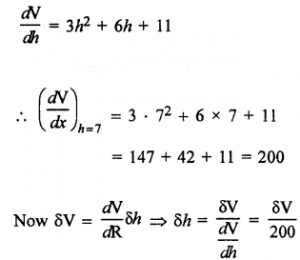
Que-8: The shape of a bowl is such that V = h³ + 3h² + 11 h where V cm³ is the volume of water in the bowl and h cm the depth of the water. If, when h = 7, an additional small volume δV cm³ of water is poured into the bowl, prove that the level of the water rises approximately δV/200 cm.
Sol: Given V = h³ + 3h² + 11 h
Differentiate both sides w.r.t. h; we have
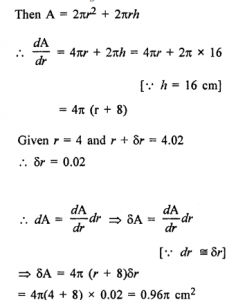
Que-9: A closed circular cylinder has height 16 cm, and radius r cm. The total surface area is A cm². Prove that dA/dr = 4π(r + 8).Hence, calculate an approximate increase in area if the radius increases from 4 to 4.02 cm, the height remaining constant (you may leave your answer in terms of n).
Sol: Let h be the height and r be the radius of cylinder also, A be the total surface area of cylinder
–: End Applications Of Derivatives Class 12 OP Malhotra Exe-11B ISC Math Ch-11 Solution :–
Return to :- OP Malhotra ISC Class-12 S Chand Publication Maths Solutions
Thanks
Please share with your friends