Applications Of Derivatives Class 12 OP Malhotra Exe-11C ISC Maths Solutions Ch-11 Solutions. In this article you would learn about differential coefficient as a rate measurer . Step by step solutions of latest textbook has been given as latest syllabus. Visit official Website CISCE for detail information about ISC Board Class-12 Mathematics.

Applications Of Derivatives Class 12 OP Malhotra Exe-11C ISC Maths Solutions Ch-11
| Board | ISC |
| Publications | S Chand |
| Subject | Maths |
| Class | 12th |
| Chapter-11 | Applications Of Derivatives |
| Writer | OP Malhotra |
| Exe-11(c) | differential coefficient as a rate measurer |
Exercise- 11C
Applications Of Derivatives Class 12 OP Malhotra Exe-11C Solution.
Que-1: If y² = Ax, find the rat/at which y is changing with respect to x, when x = 4.
Sol: Given y² = 4x …(1)
When x = 4
∴ from (1); we have
y² = 16 ⇒ y = ±4
Differentiate both sides of eqn. (1) w.r.t. x; we have
2y dy/dx = 4 ⇒ dy/dx =2/y
At y = ±4; dy/dx = ±2/4 = ±1/2
Que-2: If the radius of a circle increases trom 3 to 3.01 cm, find the increase in the area.
Sol: Let r be the radius of circle
Then A = area of circle = πr²
∴ dA/dr = 2πr
Thus δA = dA/dr δr … (1)
Now r = 3; r + δr = 3.01
∴ δr = 0.01
∴ from (1); δA = 2πrδr
= 2π x 3 x 0.01 = 0.06π cm²
Que-3: The height of a right circular cylinder is 5 cm and remains constant. The cylinder is closed at both ends. The radius r cm of the base is decreasing at a constant rate of 0.04 cm s-1.
Find the rate at which the total surface is decreasing when the radius is 2 cm, giving your answer correct to 3 significant figures. (Take π to be 3.142).
Sol: Given h = height of right circle cylinder = 5 cm
also dr/dt = – 0.04 cm s-1 & r = 2 cm
Let S be the total surface area of the right circular cylinder
Then S = 2πr² + 2πrh = 2πr² + 10πr
= 4π x 2 x (-0.04) + 10π x (- 0.04)
= – 0.32π – 0.40π
= – 0.7271
= – 0.72 x 3.142
= – 2.26 cm² s-1
Thus the total surface area is decreasing at the rate of 2.26 cm² s-1.
Que-4: A balloon contains a certain mass of gas whose volume is Fcm³ and whose pressure is p newton per square centimetre, and it is known that p and v obey the law pV = 1000. If the volume increases at the rate of 50 cm per minute, find the rate of change of p when v = 40.
Sol: Given pV = 1000 is ρ ⇒ 1000/V … (1)
& V = 40 cm³
differentiating eqn. (1) both sides w.r.t. x we have;
dp/dt = -1000/V² dN/dt
= -1000/(40)² × 50 = -50000/1600
= -125/4 = 31 1/4 N cm²/min
Hence the rate of change of ρ is decreasing 31 1/4 N cm²/min
Que-5: The stone dropped into still water produces a series of continually enlarging concentric circles; it is required to find the rate per second at which the area of one of them is enlarging when its diameter is 12 cm supposing the wave to be then receding from the centre at the rate of 3 cm s-1.
Sol: Let r be the radius of one circle
Then A = area of circle = πr²
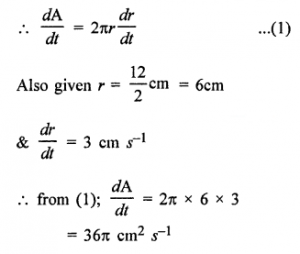
Hence the rate per second at which area of one of circle is enlarging be 36π cm² s-1
Que-6: The volume of a cube is increasing at a constant rate. Prove that the surface increase varies inversely as the length of the edge.
Sol: Let x units be the length of edge of cube
Then V = volume of cube = x³
Differentiate w.r.t. ‘t’ ; we have
dV/dt = 3x² dx/dt … (1)
Also, it is given that dV/dt = constant = k (say)
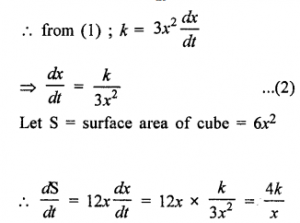
Thus the rate at which surface area of cube is increasing varies inversely as length of the edge.
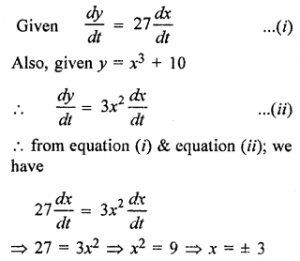
Que-7: In the function y = x³ + 10, what is the value of x, when y increases 27 times as fast as x.
Sol:
Que-8: A man 1.6 m high walks at the rate of 50 metres per minute away from a lamp which is 4 m above the ground. How fast is the man’s shadow lengthening?
Sol: Let AB be the lamp post where A be the position of the lamp then AB = 4 cm.
Let CD be the position of girl at any time t and x be the distance of girl from lamp post. Let y be the length of the shadow of girl.
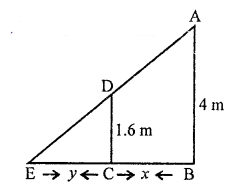
Thus ∆ECD and ∆EBA are similar ∆’s. In similar ∆’s ECD and EBA, we have
EC/EB = CD/BA
⇒ y/y+x = 16/4
⇒ y/x+y = 16/40 = 2/5
⇒ 5y = 2x + 2y
⇒ 3y = 2x … (1)
Diff. eqn. (1) both sides w.r.t. t, we have
3 dy/dt = 2 dx/dt
But given, dx/dt = 50 m/min
∴ dy/dt = (2/3 × 50) m/min = 100/3 m/min
Thus the length of girl’s shadow is increasing at the rate of 33 1/3 m/min.
Que-9:I f water is poured into an inverted hollow cone whose semi-vertical angle is 30°, so that its depth (measured along the axis) increases at the rate of 1 cm s-1, find the rate at which the volume of water is increasing when the depth is 24 cm.
Sol: Let r be the radius and h be the depth of inverted hollow cone.
Then V = Volume of Cone
= π/3 r²h
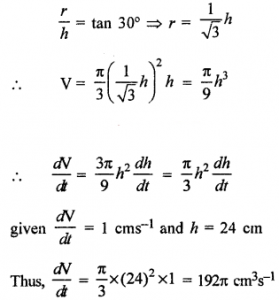
Hence, the rate at which the volume of water is increasing be 192π cm³s-1
Que-10: The area of a circle is increasing at the uniform rate of 5 cm² per minute. Calculate the rate, in centimetre per minute, at which the radius is increasing when the circumference of the circle is 40 cm.
Sol: Let r be the radius of circle
Thus A = area of of circle = πr²
∴ dA/dt = 2πr dr/dt … (i)
It is given that dA/dt = 5 cm²/min
∴ from (i); 5 = 2πr dr/dt
⇒ dA/dt … (ii)
given circumference of circle = 2πr = 40 cm
∴ from (ii); dr/dt = 5/40 = 1/8 cm/min
hence the rate at which radius is increasing be 1/8 cm/min.
Que-11: A kite is 112 metres above the ground and has 130 metres string out. If the kite is travelling horizontally at 8 m/s directly away from the boy who is flying it, at what rate is the string out?
Sol: Let the kite is at a distance of x m horizontally from the boy at time t. Also let s be the lenght of string
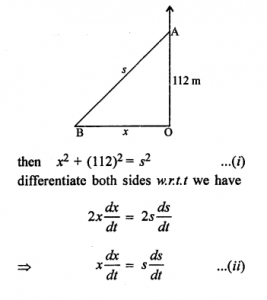
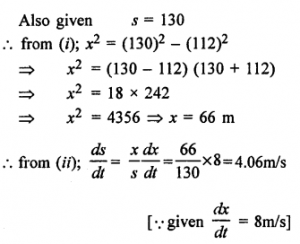
hence the required rate at which string is out be 4.06 m/s.
Que-12: A ladder 5 m long is leaning against a wall. The bottom of the ladder is pulled along the ground, away from the wall, at the rate of 2 m/sec. How fast is its height on the wall decreasing when the foot of the ladder is 4 m away from the wall ?
Sol: Let the foot of ladder is at a distance of x metre from the wall and y metre be the height of ladder on mill at any time t.
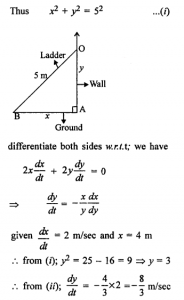
Thus, the height of the ladder on the wall is descreasing at the rate of 8/3 m/sec.
Que-13: Water is dripping out from a conical funnel, at the uniform rate of 2 cm³/s through a tiny hole at the vertex of the bottom. When the slant height of the water is 4 cm, find the rate of decrease of the slant height of the water given that the vertical angle of the funnel is 60°.
Sol: Let r be the radius and h be the depth of conical funnel & let l be the slant height
given l = 4 cm; h/l = cos 30°
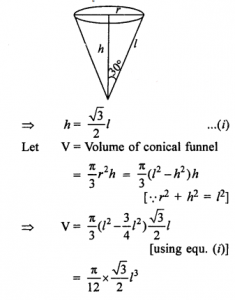
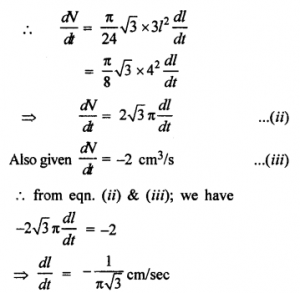
Thus, the slant height of conical funnel is descreasing at the rate of -1/π√3 m/sec.
Que-14: (i) The side of an equilateral triangle is a cm long and is increasing at the fate of k cm/hr. How fast is the area increasing?
(ii) The sides of an equilateral triangle are increasing at the rate of 2 cm/sec. Find the rate at which the area increases, when the side is 10 cm.
Sol: (i) Given side of equilateral triangle be a cm
Then A = area of equilateral triangle = √3/4 a²
∴ dA/dt = √3/4 (2a) da/dt = √3/2 a da/dt … (i)
Also it is given that da/dt = k cm/hr
∴ from (i); dA/dt = √3/2 ak cm²/hr
Thus area of the equilateral triangle is increasing at the rate of √3/2 cm²/hr
(ii) Let a be the side of equilateral triangle
Then A = area of equilateral triangle = √3/4 a²
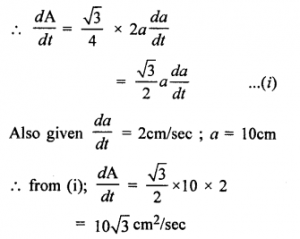
Thus, area of equilateral triangle is increasing at the rate 10√3 cm²/sec.
Que-15: The diameter and altitude of a right circular cylinder are found at a certain instant to be 10 cm and 20 cm respectively. If the diameter is increasing at the rate of 2 cm per sec, what change in the altitude will keep the volume constant ?
Sol: Let x be the diameter and h be the alttitude of right circular cylinder.
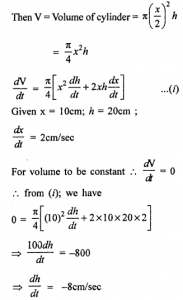
Thus the rate at which altitude is decreasing be 8cm/sec.
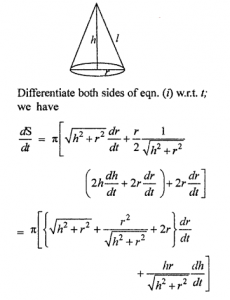
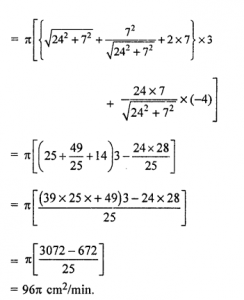
Que-16: The radius of the base of a certain cone is increasing, at the rate of 3 cm per minute and the altitude is decreasing at the rate of 4 cm per minute. Find the rate of change of total surface of the cone when the radius is 7 cm and the altitude is 24 cm.
Sol: Let r be the radius and h be the altitude of cone.
Then total surface area of curve = S = πr + πrl
⇒ S = πr√(h²+r²) + πr² … (i)
Given dr/dt = 3cm/min; dh/dt = – 4cm/min
r = 7 cm and h = 24 cm
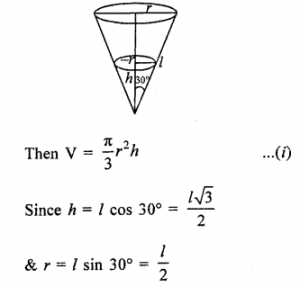
Que-17: Water is dripping out at the steady rate of 1 c.c. per second through a tiny hole at the vertex of a conical vessel whose axis is vertical. When the slant height of the water in the filter is 4 cm, find the rate of decrease of (i) the slant height of water, (ii) the area of the water surface, given that the vertical angle of the vessaf is 60°.
Sol: (i) Let r the radius and h be the height of the surface of water at time t and V be the volume of water in the cone.
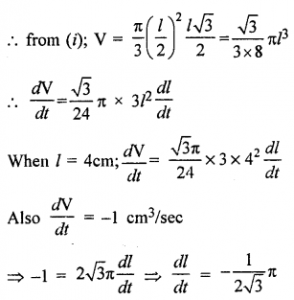
Then the rate at which slant being be is decreasing at the rate of 1/2√3 π cm/sec.
(ii) Let A = area of the mater surface = πr² cm²/sec
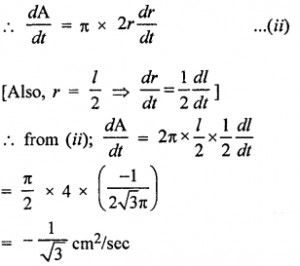
Thus the area of metre surface is decreasing at the rate of 1/2 cm²/sec.
Que-18: If the area of circle increases at a uniform rate, show that the rate of increase of the perimeter varies inversely as the radius.
Sol: Let r be the radius of circle
Then A = area of circle = πr²
∴ dA/dt = 2πr dr/dt … (i)
Let P = perimeter of circle = 2πr
∴ dp/dt = 2π dr/dt … (ii)
∴ from (i) & eqn. (ii); we have
dP/dt = 1/r dA/dt … (iii)
it is given that dA/dt = k
∴ from (iii); dP/dt = k/r
dP/dt ∝ 1/r
Thus, the rate of increase of perimeter of circle is varies inversely as the radius.
–: End Applications Of Derivatives Class 12 OP Malhotra Exe-11C ISC Math Ch-11 Solution :–
Return to :- OP Malhotra ISC Class-12 S Chand Publication Maths Solutions
Thanks
Please share with your friends