Applications Of Derivatives Class 12 OP Malhotra Exe-11D ISC Maths Solutions Ch-11 Solutions. In this article you would learn about sign of the derivative and monotonocity of functions . Step by step solutions of latest textbook has been given as latest syllabus. Visit official Website CISCE for detail information about ISC Board Class-12 Mathematics.
Applications Of Derivatives Class 12 OP Malhotra Exe-11D ISC Maths Solutions Ch-11
| Board | ISC |
| Publications | S Chand |
| Subject | Maths |
| Class | 12th |
| Chapter-11 | Applications Of Derivatives |
| Writer | OP Malhotra |
| Exe-11(d) | sign of the derivative and monotonocity of functions |
Sign of the Derivative and Monotonocity of Functions
Applications Of Derivatives Class 12 OP Malhotra Exe-11D Solution.
Que-1: Show that the function f(x) = 3/x + 7 is decreasing for x ∈ R (x ≠ 0).
Sol: Given f(x) = 3/x + 7
∴ f (x) = – 3/x² < 0 ∀ x ∈ R, x ≠ 0 [∵ x² > 0 ∀ x ∈ R]
Thus f(x) is decreasing for all x ∈ R, x ≠ 0
Que-2: Show that the function x + 1/x, x ≥ 1 is increasing.
Sol: Let f(x) = x + 1/x
∴ f’ (x) = 1 – 1/x²
for x ≥ 1 ⇒ x² > 1
⇒ 1/x² ≤ 1 ⇒ – 1/x² ≥ – 1
⇒ 1 – 1/x² ≥ 1 – 1 = 0
⇒ f'(x) > 0
Thus f(x) is descreasing for all x > 1.
Que-3: State when a function is said to be increasing function of [a, b]. Test whether the function f (x) = x³ – 8 is increasing on [1, 2].
Sol: If f'(x) > 0 at each point x∈(a, b)
Thus f is increasing on [a, b]
given f(x) = x³ – 8
∴ f(x) = 3x²
since x ∈ (1, 2)
⇒ 1 < x < 2 ⇒ 1< x² < 4
⇒ 3 < 3x² < 12
⇒ 3 < f'(x) < 12 Thus f(x) > 0 ∀ x ∈ (1, 2)
Therefore f(x) is increasing on [1, 2]
Que-4: Prove that the function
f(x) = x³ – 6x² + 12x – 18 is increasing on R
Sol: Let f(x) = x³ – 6x² + 12x – 18
∴ f(x) = 3x² – 12x + 12
= 3(x² – 4x + 4)
= 3(x – 2)² > 0 ∀ x ∈ R
Thus f(x) is increasing on R.
Que-5: Determine the values of x for which f (x) = x-2/x+1 ,x≠−1 is increasing or decreasing.
Sol: Given f(x) = x-2/x+1 ; x ≠ -1
∴ f'(x) = (x+1)×1-(x-2)×1/(x+1)²
= 3/(x+1)² > 0 ∀ x ∈ R ; x ≠ -1
Thus f (x) is increasing on R – (-1}
Que-6: For which values of x, the function x
f(x) = x/x²+1 is increasing and for which values of x, it is decreasing?
Sol: Given f (x) = x/x²+1 …(1)
Diff. both sides w.r.t. x ; we have
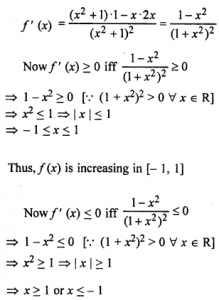
Thus, the function f (x) is decreasing in (- ∞, – 1] ∪ [1, ∞).
Let (x1, y1) be any point on given curve
![Thus, the function f (x) is decreasing in (- ∞, – 1] ∪ [1, ∞). Let (x1, y1) be any point on given curve](https://icsehelp.com/wp-content/uploads/2025/08/q6-part-2-235x300.png)
Hence the required points on graph of function at which tangent is || to x-axis be
(1, 1/2) and (-1, – 1/2)
Que-7: Show that f(x) = sin x is an increasing function on {-π/2, π/2).
Sol: Given f (x) = sin x
∴ f’ (x) = cos x
Now for – π/2 < x < π/2 ⇒ cos x > 0 ⇒ f'(x) > 0
Thus f (x) is increasing on (- π/2,π/2).
Que-8: Show that f (x) = cos x is a decreasing function on (0, π).
Sol: Given f (x) = cos x
f’ (x) = – sin x
For x ∈ (0, π) ⇒ 0 < x < π ⇒ sin x > 0
⇒ – sin x < 0 ⇒ f’ (x) < 0
Hence f(x) is decreasing function on (0, π).
For x ∈ (- π, 0) ⇒ – π < x < 0 ⇒ sin x < 0 ⇒ – sin x > 0
⇒ f’ (x) > 0
Hence f(x) is increasing function on (- π, 0)
Thus f (x) is neither increasing nor decreasing on (- π, π).
Que-9: Show that f(x) = tan x is an increasing function on {-π/2, π/2).
Sol: Given, f (x) = tan x
∴ f'(x) = sec²x
when x ∈ (- π/2,π/2) ⇒ sec² x > 0
⇒ f'(x) > 0
∴ f(x) is strictly increasing on (-π/2,π/2)
Find the intervals in which the following functions are increasing or decreasing.
Que-10: f (x) = 2x³ – 9x² + 12x + 15
Sol: Given f (x) = 2x³ – 9x² + 12x + 15
∴ f’ (x) = 6x² – 18x + 12 = 6 (x² – 3x + 2) = 6 (x – 1) (x – 2)
For f (x) to be increasing, we must have
f’ (x) > 0
∴ (x – 1) (x – 2) > 0
⇒ (x – 1) (x – 2) > 0
⇒ x > 2 or x < 1
⇒ x ∈ (- ∞, 1) ∪ (2, ∞)
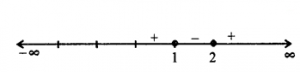
signs of f'(x) for different values of x Thus, f(x) is increasing on (- ∞, 1) ∪ (2, ∞)
For f (x) to be decreasing we must have f'(x) < 0
6 (x – 1) (x – 2) < 0
⇒ (x – 1) (x – 2) < 0
⇒ 1 < x < 2 ⇒ x ∈ (1, 2) Thus, f(x) is decreasing on (1, 2).
Que-11: f(x) = 2x³ – 15x² + 36x + 1
Sol: Given f (x) = 2x³ – 9x² + 12x – 5
∴ f’ (x) = 6x² – 18x + 12
= 6 (x² – 3x + 2)
= 6 (x – 1) (x – 2)
For f (x) to be increasing, we must have f’ (x) > 0
∴ 6 (x – 1) (x – 2) > 0
⇒ (x – 1) (x – 2) > 0
⇒ x > 2 or x < 1
⇒ X ∈ (- ∞, 1) u (2, ∞)

signs off’ (x) for different values of x
Thus, f (x) is increasing on (- ∞, 1) ∪ (2, ∞)
For f (x) to be decreasing we must have f’ (x) < 0
6 (x – 1) (x – 2) < 0
⇒ (x – 1) (x – 2) < 0
⇒ 1 < x < 2
⇒ x ∈ (1, 2)
Thus, f(x) is decreasing on (1, 2).
Que-12: f(x) = 6 + 12x – 3x² – 2x³
Sol: Given f(x) = 6 + 12x – 3x² – 2x³
f'(x) = 12 – 6x – 6x²
= – 6(x² + x – 2)
= – 6 (x – 1) (x + 2)
For f(x) is to be increasing iff f'(x) > 0
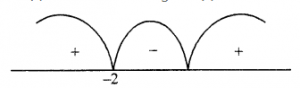
⇒ – 6 (x – 1) (x + 2) > 0
⇒ (x – 1) (x + 2) < 0
⇒ x ∈ (-2, 1)
Thus f(x) is increasing in (-2, 1).
For f(x) is to be decreasing iff f'(x) < 0
⇒ – 6 (x – 1) (x + 2) < 0
⇒ (x – 1) (x + 2) > 0
⇒ x ∈ (- ∞, – 2) ∪ (1, ∞)
Thus, f(x) is decreasing in (- ∞, – 2) ∪ (1, ∞)
Que-13: f(x) = x4-x³/3
Sol: Given f(x) = x4-x³/3
∴ f'(x) = 4x³ – x²
= x²(4x – 1) = 4x²(x – 1/4)
For f(x) is to be increasing iff f'(x) > 0
i.e., 4x²(x – 1/4) > 0
⇒ x – 1/4 > o (∵ x² ≥ 0 [x ∈ 0)
⇒ x > 1/4
Thus f(x) is increasing in (1/4, ∞).
For f(x) is to be decreasing iff f(x) < 0
i.e. 4x²(x – 1/4) < 0
⇒ x – 1/4 < 0
⇒ x < 1/4
Thus f(x) is decreasing in (- ∞,1/4).
Que-14: f(x) = 20 – 9x + 6x² – x³
Sol: Given f(x) = 20 – 9x + 6x² – x³
∴ f'(x) = -9 + 12x – 3x²
= – 3(x² – 4x + 3)
= – 3(x – 1) (x – 3)
Since critical points are given by putting f'(x) = 0 ⇒ x = 1, 3
For f (x) is to be increasing iff f’(x) > 0
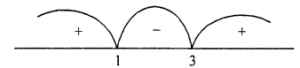
i.e. – 3(x – 1) (x – 3) > 0
⇒ (x – 1) (x – 3) < 0
⇒ X ∈ (1, 3)
Thus f(x) is increasing in (1, 3).
∴ f(x) is decreasing iff f'(x) < 0
⇒ – 3(x – 1) (x – 3) < 0
⇒ (x – 1) (x – 3) > 0
⇒ x ∈ ( ∞, 1) ∪ (3, ∞)
Thus f(x) is decreasing in (-∞, 1) ∪ (3, ∞).
Que-15: f(x) = 3/10 x4 – 4/5 x³ -3 x² + 36/5 + 11.
Sol: f (x) = 3/10 x4 – 4/5 x³ -3 x² + 36/5 + 11
∴ f'(x) = 6/5 x³ -12/5 x² – 6x +36/5
= 6/5 [x³ – 2x² – 5x + 6]
= 6/5(x – 1)(x² – x – 6)
⇒ f'(x) = 6/5(x – 1) (x + 2) (x – 3)
For f'(x) = 0 ⇒ x = 1, – 2, 3
Hence we shall discuss four cases:
Case I: When x < – 2
∴ f'(x) = (-ve) (-ve) (-ve) = -ve
∴ f'(x) is strictly decreasing in (-∞, -2).
Case II: when -2 < x < 1
∴ f'(x) = (-ve) (+ve) (-ve) = +ve
∴ f (x) is strictly increasing in (-2, 1).
Case III: When 1 < x < 3
∴ f'(x) = (+ve) (+ve) (-ve) = -ve
∴ f (x) is strictly decreasing in (1, 3)
Case IV: when x > 3
∴ f'(x) = (+ve) (+ve) (+ve) = +ve
∴ f (x) is strictly increasing in (3, ∞).
on combining all four cases, f(x) is strictly
increasing in (-2, 1) ∪ (3, ∞) and strictly
decreasing in (-∞, -2) ∪ (1, 3).
Que-16: f(x) = sin 3x – cos 3x, 0 < x < π
Sol: Given f(x) = sin 3x – cos 3x, 0 < x < π
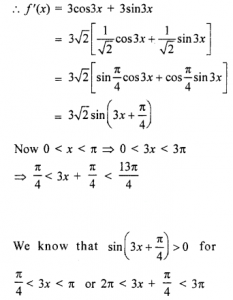
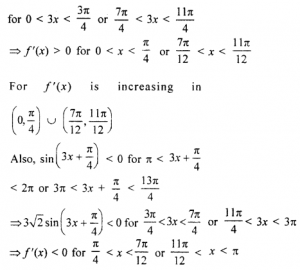
Thus f(x) is decreasing in (π/4 , 7π/12) ∪ (11π/12 , π)
Que-17: Determine the values of x for which the function f(x) = x² – 6x + 9 is increasing or decreasing. Also, find the coordinates of the point on the curve y = x² – 6x + 9, where the normal is parallel to the line y = x + 5.
Sol: Given f (x) = x² – 6x + 9
∴ f’ (x) = 2x – 6
Now f(x) is to be increasing so
We must have f’ (x) > 0
∴ 2x – 6 > 0 ⇒ x > 3 ⇒ x ∈ (3, ∞),
Thus f(x) is increasing on (3, ∞).
Now f (x) is to be decreasing so we must have f’ (x) < 0
∴ 2x – 6 < 0 ⇒ x < 3
⇒ x ∈ (- ∞, 3)
Thus, f(x) is decreasing on (- ∞, 3).
given eqn. of curve be y = x² – 6x + 9 …(1)
Let the required point on eqn. (1) be (x1, y1)
Then y1 = x1² – 6x1 + 9 …(2)
∴ dy/dx = 2x – 6 ⇒ (dy/dx) (x1, y1)= 2x1 – 6
Since the normal is parallel to given line x – y + 5 = 0
∴ slope of normal at (x1, y1) = slope of line x – y + 5 = 0
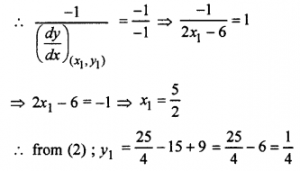
Thus the coordinates of required point be (5/2,1/4).
Que-18: Determine the intervals in which the function f (x) = (x – 1) (x + 2)² is increasing or decreasing. At what points are the tangents to the graph of the function parallel to the x-axis ?
Sol: Given f(x) = (x – 1) (x + 2)²
∴ f'(x) = (x – 1) 2(x + 2) + (x + 2)² x 1
= (x + 2) (2x – 2 + x + 2) = 3x(x + 2)
The critical points are given by f(x) = 0
⇒ x = 0, – 2
For f(x) is to be increasing iff f'(x) > 0
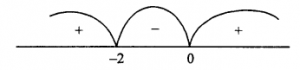
i.e. 3x (x + 2) > 0
⇒ x(x + 2) < 0
⇒ x ∈(-2, 0)
Thus f(x) is decreasing (- 2, 0)
Since the tangent is parallel to x-axis
∴ slope of tangent to curve = 0
⇒ (dy/dx) (x, y) = 0
⇒ 3x(x + 2) = 0
⇒ x = 0, – 2
When x = 0
∴ y = f(x) = (0 – 1) (0 + 2)² = – 4
When x = – 2
∴ y = f(x) = (- 2 – 1) (- 2 + 2)² = 0
Thus, required points are (0, – 4) & (- 2, 0).
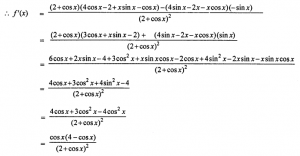
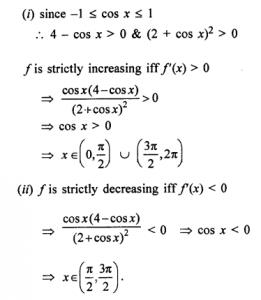
Que-19: Find the intervals in which the function f(x) = 4sin x -2x – xcos x / 2+cos x , 0 ≤ x ≤ 2π is
(i) increasing
(ii) decreasing.
Sol: Given f(x) = 4sin x -2x – xcos x / 2+cos x
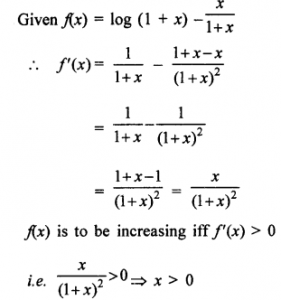
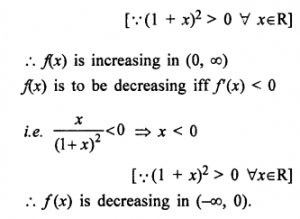
Que-20: Find the intervals in which the following function is increasing or decreasing :
f(x) = log(1 + x) – x/1+x
Sol:
–: End Applications Of Derivatives Class 12 OP Malhotra Exe-11D ISC Math Ch-11 Solution :–
Return to :- OP Malhotra ISC Class-12 S Chand Publication Maths Solutions
Thanks
Please share with your friends