Area Between Two Curves Class 12 OP Malhotra Exe-25B ISC Maths Solutions Ch-25 Application of Integrals. In this article you would learn How to find area between two curves practice questions/ example / problems with solutions / answer. Visit official Website CISCE for detail information about ISC Board Class-12 Mathematics.
Area Between Two Curves Class 12 OP Malhotra Exe-25B ISC Maths Solutions Ch-25 Application of Integrals
| Board | ISC |
| Publications | S Chand |
| Subject | Maths |
| Class | 12th |
| Chapter-25 | Application of Integrals |
| Writer | OP Malhotra |
| Exe-25(b) | Area Between Two Curves |
How to Find Area Between Two Curves
Application of Integrals Class 12 OP Malhotra Exe-25B Solutions
Que-1: Find the area of the region enclosed by the following curves or lines.
(a) y = 2x, y = x 2
(b) y2 = 8x, x2 = 8y
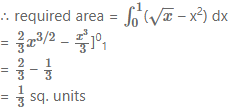
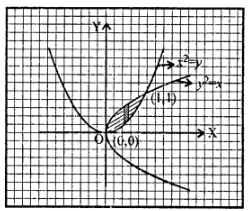
(c) y2 = x,x2 = y
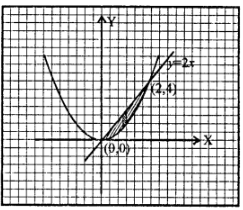
Sol: (a) The eqns. of given curves are:
y = 2x
and y = x2
eqn. (2) represents an upward parabola with vertex (0,0)
and the line (2) and intersects parabola when 2x = x2 =
=> x(x-2) = 0
=> x = 0, 2
When x = 0 ∴ from (1); y = 0
When x = 2 ∴ from (1); y = 4
i. e. points of intersection are (0, 0) and (2, 4).
∴ Required area of shaded region
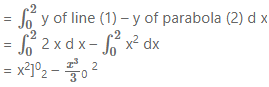
= 4 – 8/3
= 4/3 sq.units
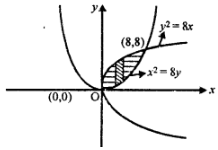
(b) Given eqns. of parabolas are
x² = 8y …..(1)
and y² = 8x …(2)
both parabolas intersects when (x28)2 = 8x
=> x4 – 512x = 0
=> x(x3 – 512) = 0
=> x = 0, 8
∴ from (1); y = 0, 8
Thus the points of intersection of both curves are (0, 0) and (8, 8). Divide the region into vertical strips with lower end on x² = 8y and upper end on y² = 8x and this rectangle move from x = 0 to x = 8
(c) The given eqns. of curves are;
y2 = x
and x2 = y
eqn. (1) represents a right handed parabola with vertex (0, 0). eqn. (2) represents an upward parabola with vertex (0, 0). Both curves intersects when x4 = x
=> x(x3 – 1) = 0
=> x = 0, 1
when x = 0 ∴ from (2) ; y = 0
when x = 1 ∴ from (2) ; y = 1
∴ both curves intersects at (0, 0) and (1,1) Divide the shaded region into vertical strips. Each vertical strip has lower end on curve (1) and upper end on curve (1).
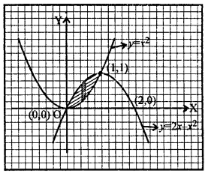
Que-2: Find the area of the figure bounded by the graphs of the functions y = x2, y = 2x – x2.
eqn. (1) represents an upward parabola.
Sol: Given eqns of curves are y = x2 ….. (1)
and y = 2x – x2 ……. (2)
eqn. (1) represents an upward parabola.
With vertex at (0, 0).
eqn. (2) can be written as x2 – 2x = -y
x2 – 2x + l – l = -y
=> (x- l)2 = – (y – 1)
Clearly represents a downward parabola with vertex at (1, 1).
Both parabolas (1) and (2) intersects when x2 = 2x – x2.
2x2 – 2x = 0
=> 2x (x – 1) = 0
=> x = 0, 1
When x = 0 from(l) ; y = 0
When x = 1 from (1) ; y = 1
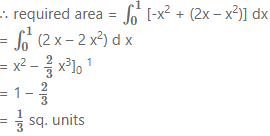
i.e. points of intersection are (0, 0) and (1,1). Divide the shaded region into vertical strips. Each vertical strip is having lower end on curve (1) and upper end on curve (2).
Que-3: (i) Find the area bounded by the curve x2 = 4y and the straight line x = 4y – 2.
(ii) Find the area cut off from the para- bola 4y = 3 × 2 by the line 2y = 3x + 12.
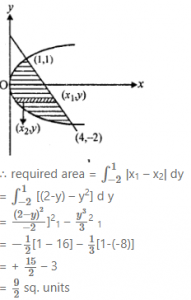
(iii) Find the area of the region included between the parabola y2 = x and the x + y = 2.
Sol: (i) Given curve x2 = 4y be an upward parabola with vertex (0,0). The given line x = 4y – 2 meets x-axis at (- 2, 0) and y-axis at (0,1/2)
Both curves and line intersects when (4y – 2)2 = 4y
=> 16y2 – 16y + 4 = 4y
=> 16y2 – 20y + 4 = 0
=> 4y2 – 5y + 1 = 0
=> (y-1)(4y-1) = 0
=> y = 1,1/4
When y = 1 ; x = 2 and
When y = 1/4
∴ x = -1
Thus points of intersection are (2, 1) and
(-1,1/4)
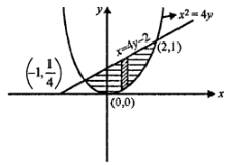
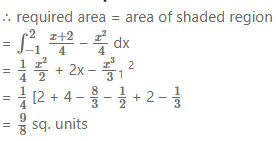
(ii) The given curve be 4y = 3x2
=> x2 = 4/3y …….(1)
and eqn. of given line be 2y = 3x + 12 …(2)
Curve (1) represents on upward parabola with vertex at (0,0). Line (2) meets x-axis at (- 4,0) and (0, 6).
Thus line (2) meets parabola (1)
When x2 = 4/3 ((3x+12)/2)
=> x2 = 2 (x + 4)
=> x2 – 2x – 8 = 0
=> (x – 4) (x + 2) = 0
=> x= 2, -2
When x = 4 ∴ from (2) ; y = 12
When x = -2 from (2) ; y = 3
Divide the region into vertical strips with ever vertical strip is having lower end on curve (1) and upper end on curve (2).
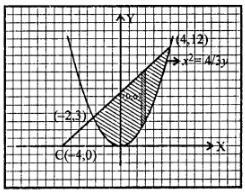

(iii) We want to find the area of the region included between given two curves
y2 = x …(1) and
x + y = 2 ……. (2)
Now eqn. (1) is a parabola with axis x-axis and vertex (0, 0). eqn. (2) represents a line having intercepts on coordinate axes are (2, 0) and (0, 2). eqn. (1) and (2) intersects when y2 = 2 – y
=> y2 + y – 2= 0
=> y = 1,-2
When y= 1 => x = 2 – 1 = 1
When y = – 2 => x = 4
Thus the points of intersection are (1, 1) and (4, – 2).
We divide the shaded region into horizontal strips. Each horizontal strip is having left end on curve y2 = x and right end on line x + y = 2.
∴ the approximating rectangle was length |X1 – x2| land width dy
Que-4: Find the area of the region bounded by the curves y = x2 + 2, y = x, x = 0 and .v = 3. Also, sketch the region bounded by these curves.
Sol: Given curves are y = x2 + 2 …(1)
y = x …(2)
and x = 0, x = 1
eqn. (1) represents a parabola with vertex (0, 2).
eqn. (1) and (2) intersects when x = x2 + 2 => x2 – x + 2 = 0
∴ x does not gives real values.
Thus the line y = x does not meet the parabola y = x2 + 2.
Clearly x = 1 meets y = x2 + 2 at (1,3).
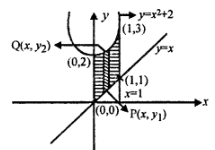
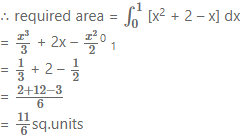
Divide the shaded region into vertical strips. Each vertical strips has lower end on y = x and upper end on y = x2 + 2.
length of approximating rectangle = |y2 – y1| and width dx.
Clearly it moves from x = 0 to x = 1
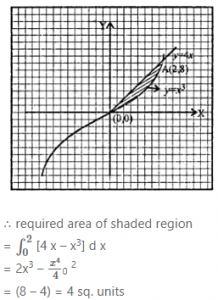
Que-5: Find the point of intersection of the liney = 4x with the curve y = x3 If A is that point of intersection which lies in the first quadrant and O is the origin, calculate the area between line OA and the curve.
Sol: The eqn. of given line be y = 4x …(1)
and eqn. of given curve be y = x3 …….(2)
both curves (1) and (2) intersects when 4x = x3
When x = 0 ∴ from (1); y – 0
When x = ± 2 ∴ from (1); y = ± 8
Since the point of intersection of given line and curve lies in the first quadrant.
∴ Coordinates of A are (2, 8).
Divide the shaded region into vertical strips. Each vertical strip is having lower end on curve (2) and upper end on line (1).
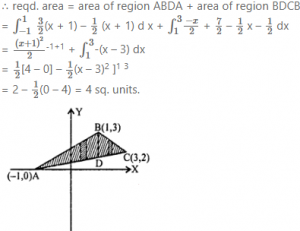
Que-6: Using integration, find the area of the mangle, whose vertices are
(i) (-1,0), (1,3) and (3,2)
(ii) (2, 5), (4, 7) and (6,2)
Sol: (i) LetA (-1,0),B (l,3)andC (3,2) are the vertices of ∆ABC
eqn. of line AB be given by, y – 0 = (3−0)/(1+1)(x + 1) => y = 3/2(x + 1)
eqn. of line AB be given by, y – 0 = (2−0)/4 => y = 1/2 (x – 1)
eqn. of line AB be given by, y – 3 = ((2−3)/(3−1))(x – 1)
=> y – 3 = –1/2 (x – 1)
=> = −x/2 + 7/2
(ii) Let the given vertices of ∆ABC are A (2, 5), B (4, 7) and C (6, 2)
eqn. of line AB be given by
y – 5 = ((2−7)/(6−4))(x – 2)
=> y – 5 = x – 2
=> y = x + 3
eqn. of line BC be given by
y – 7 = ((2−7)/(6−4))(x- 4)
=> y – 7 = –5/2 (x- 4)
=> 2y – 14 = -5x + 20
=> 2y + 5x = 34
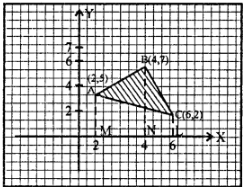
eqn. of line AC be given by
y – 5 = ((2−5)/(6−2)) (x – 2)
=> y – 5 = −3/4 (x – 2)
=> 4y – 20 = -3x + 6
=> 4y + 3x = 26
∴ area of shaded ∆ABC = area of region AMNB + area of region BNLC area of region AMLC
Que-7: Using integration, find the area of the region bounded by the triangle whose sides are y = 2x + l,y = 3x + l and x = 4.
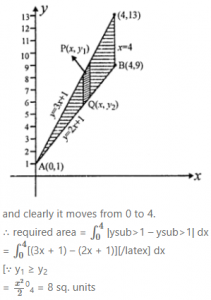
Sol: To find the area of triangular region bounded by curves given as under
y = 2x + 1 …..(1)
y = 3x + 1 …..(2)
and x = 4 …..(3)
On solving (1) and (2); we have 2x + 1 = 3x + 1
=> x = 0
∴ y = 1
Thus line (1) and (2) intersects at (0, 1). eqn. (1) and (3) intersects at (4, 13). and eqn. (1) and (3) intersect at (4, 9). required area = area of ∆ABC.
Divide the region into vertical strips. Each vertical strip has lower end on liney = 2x + 1 and upper end on line y = 3x + 1.
So length of approximating rectangle = |y1 – y2| and width = dx
Que-8: Find the area of the region enclosed between two circles x2 + y2 = 4 and (x- 2)2 + y2 = 4.
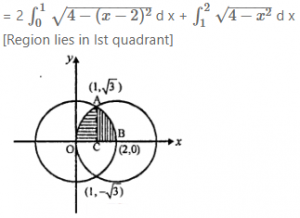
Sol: The given circles are x2 + y2 = 4 …(1)
and (x – 2)2 + y2 = 4 …(2)
eqn. (1) represents a circle with centre at (0, 0) and radius 2 and eqn. (2) represents a circle with centre (2, 0) and radius 2.
Now eqn. (1) and (2) intersects
when (x – 2)2 – x2 = 0
i.e x2 – 4x + 4 – x2 = 0 i.e x = 1
∴ y = ±√3
∴ pts. of intersections are (1,±√3).
∴ Required area = 2 [area OACO + area ABCA]
Que-9: Sketch the region common to the circle x2 + y2 = 16 and the parabola X2 = 6y. Also find the area of the region using integration.
Sol: Given region be {(x, y): x2 + y2 ≥ 16 ; x2 ≤ 6y}
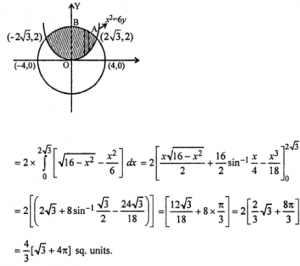
given eqn. of circle be JC2 +y2 = 16 which represents a circle with centre (0, 0) and radius 4. eqn. of given parabola be x2 = 6y
which represents an upward parabola with vertex at (0, 0). both curves eqn. (1) and eqn. (2) intersects y2 + 6y – 16 = 0
(y – 2) (y + 8) = 0
=> y = 2,-8
when y = 2 ∴ from (2); x = ±2√3
Thus both curves intersects at (±2√3, 2)
and y = -8 does not gives any real values of x required area = 2 x area of OABO
Que-10: Find the area given by x + y ≤ 6, x2 + y2 <, 6y and y² ≤ 8x.
Sol: The eqns. of given curves are
x + y = 6 …(1)
x22 + y2 = 6y …(2)
and y2 = 8x
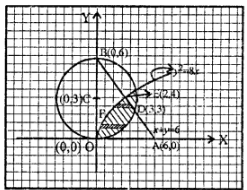
lines (1) meets coordinates axes at A (6, 0) and B (0, 6). eqn. (2) represents a circle with centre C (0, 3) and radius 3. eqn. (3) represents a right handed parabola with vertex at O (0, 0). line (1) and circle (2) intersects when (6 – y)2 + y2 = 6y
=> 2y2 – 18y + 36 = 0
=> y2 – 9y + 18 = 0
=> (y – 3) (y – 6) = 0
=> y = 3, 6
when y = 3 ∴ from (1) ; X = 3
when y = 6 ∴ from (1) ; X = 0
i.e. points of intersection are (2, 4) and (18, – 12)
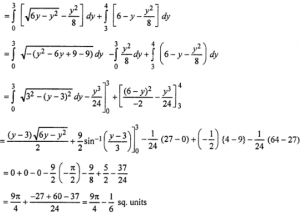
Divide the region into horizontal strips.
∴ required area = area of region OFDO + area of region EFDE
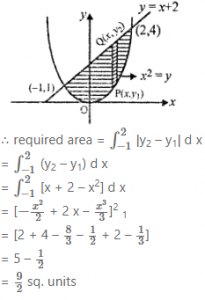
Que-11: Indicate the region bounded by the curve x2 = y, y = x + 2 and X-axis and obtain the area enclosed by them.
Sol: Given eqns. of curves are, x2 = y …..(1)
and y = x + 2 …..(2)
eqn. (1) represents a upward parabola with vertex (0, 0).
The line (2) meets coordinate axes at (- 2, 0) and (0, 2).
eqn. (1) and (2) intersects when
x2 – x – 2 = 0
(x – 2) (x + 1) = 0 => x = -l, 2
When x = – 1 ∴ from (2); y = 1
When x = 2 ∴ from (2); y = 4
∴ points of intersection are (- 1, 1) and (2, 4).
Divide the region into vertical strips with upper end on line and lower end on parabola.
The length of approximating rectangle = |y2 – y1| and width = dx
Clearly the rectangle moves from x = – 1 to x = 2.
Que-12: Using integration, find the area of the triangle formed by positive x-axis and tangent and normal to the circle x2 + y2 = 4 at (1, √3).
Sol: Given eqn. of circle be x2 + y2 = 4 with centre (0, 0) and radius 2 . Diff. given eqn. w.r.t. x; we have
2 x + 2 y dy/dx = 0
⇒ dy/dx = −x/y
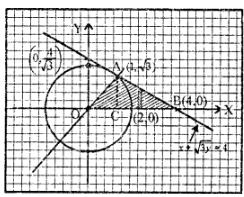
∴ slope of tangent to given circle at (1, √3)
= −1/√3
Thus, eqn. of tangent to given circle at (1, √3) is given by
y – √3 = −1/√3(x – 1)
⇒ x + √3y = 4 …………..(1)
∴ slope of normal to given circle at (1, √3)
= √3
∴ eqn. of normal to given circle at point (1, 3–√) be given by
y – √3 = √3(x – 1)
⇒ √3x – y = 0
line (1) meets coordinate axes at (4, 0) and (0, 4/√3).
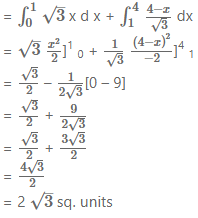
∴ required area = area of region OACO + area of region ACBA
–: End of Area Between Two Curves Class 12 OP Malhotra Exe-25B ISC Maths Solutions :–
Return to :- OP Malhotra ISC Class-12 S Chand Publication Maths Solutions
Please share with your friends
Thanks