Average and Marginal Revenue Class 12 OP Malhotra Exe-26C ISC Maths Solutions Ch-26 Application of Calculus in Commerce and Economics. In this article you would learn to solve problems / questions on average and marginal revenue with example and practice questions. Visit official Website CISCE for detail information about ISC Board Class-12 Mathematics.
Average and Marginal Revenue Class 12 OP Malhotra Exe-26C ISC Maths Solutions Ch-26 Application of Calculus in Commerce and Economics
| Board | ISC |
| Publications | S Chand |
| Subject | Maths |
| Class | 12th |
| Chapter-26 | Application of Calculus in Commerce and Economics |
| Writer | OP Malhotra |
| Exe-26(c)A | Average and Marginal Revenue |
Average and Marginal Revenue
Application of Calculus in Commerce and Economics Class 12 OP Malhotra Exe-26C Solutions
Que-1: The demand for a certain product is represented by the equation p = 20 + 5x – 3x2 where x is the number of units demanded and;? is the price per unit. Find
(i) Total revenue
(ii) The marginal revenue
(iii) The marginal revenue when 2 units are sold.
Sol: Given p = 20 + 5x – 3x2
(i) ∴ Total revenue function R(x) = p × x = 20x + 5x2 – 3x3
(ii) Marginal revenue function (MR) = d/dx R(x) = 20 + 10x – 9x2
(iii) (MR)x=2= 2 0 + 10 ×2 – 9 × 22 = 40 – 36 = 4
Que-2: (i) The demand function of a monopolist is given by p = 100 – x – x2. Find (a) the revenue function, (b) marginal revenue function.
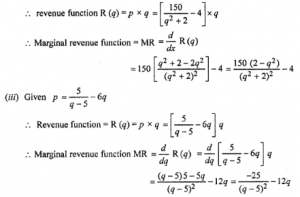
(ii) If p=150/q²+2 – 4 represents the demand function for a product, where p is the price per unit for q units. Determine the marginal revenue function.
(iii) If p=5/q-5 – 6q represents the demand function for a product, where p is the price per unit of q units, find the marginal revenue.
Sol: (i) Given demand function p = 100 – x – x2
(a) ∴ revenue function R(x) = px = 100x – x2 – x3
(b) Marginal revenue function MR =d/dx R(x) = 100 – 2x – 3(x2)
(ii) Given p=150/q²+2 − 4
Que-3: The total revinue received from the sale of x units of a product is given by R(x) = 36x + 3x2 + 5 Find .
(i) the average revenue
(ii) the marginal revenue
(iii) the marginaXand average revenue when x = 5
(iv) the actual revenue from selling 50 th item.
Sol: Given total revenue function R(x) = 36x + 3x2 + 5
(i) ∴ average revenue function (AR) = R(x)/x = 36 + 3x + 5/x
(ii) Marginal revenue function (MR) = d/dx R(x) = 36 + 6x
(iii) (AR)x = 5 = 36 + 15 + 5/5 = 36 + 15 + 1 = 52 and MRx = 5 = 36 + 6 × 5 = 66
(iv) Required actual revenue from selling 50 th item = R(50) – R(49)
= 36 × 50 + 3 × 502 + 5 – 36 × 49 – 3 × 492 – 5
= 36 × (50 – 49) + 3 × (50 – 49)(50 + 49)
= 36 + 297 = 333
Que-4: The demand function for a monopolist is given by x = 100 – 4 p. Find
(i) total revenue function
(ii) average revenue function
(iii) marginal revenue function
(iv) price and quantity at which MR =0
Sol: Given demand function x = 100 – 4p ⇒ 4p = 100 – x ⇒ p = 25 – x/4
(i) ∴ Total revenue function = p × x = 25x – x²/4 = R(x)
(ii) average revenue function = R(x)/x = 25 – x/4
(iii) Marginal revenue function = MR = d/dx R(x) = 25 – 2x/4 = 25 – x/2
(iv) When MR = 0 ⇒ 25 – x/2 = 0 ⇒ x = 50 units
∴ required price p = 25 – x/4 at x = 50; p = 25 – 50/4 = 25/2 = ₹ 12.5
Que-5: A monopolists demand function for one of its products is p(x) = ax + b. He knows that $b$ can sell 1400 units when the price is ₹ 4 per unit and he can sell 1800 units at a price of ₹? per unit. Find the total average and marginal revenue functions. Also find the price unit when the marginal revenue is zero.
Sol: Given demand function p(x) = ax + b …(1)
given x = 1400 when p = ₹ 4 ∴ from (1); 4 = 1400 a + b …(2)
When x = 1800; p = ₹ 2 ∴ from (1); 2 = 1800 a + b ….(3)
eqn. (3) – eqn. (2); we have
-2 = 400 a ⇒ a = –1/200
∴ from (2); 4 = -7 + b ⇒ b = 11
∴ from (1); p(x) = –x/200 + 11
∴ revenue function = R(x) = p(x) × x = –x²/200
Thus Average revenue function AR = R(x)/x = – x/200 + 11
Marginal revenue function MR = d/dx R(x) = −2x/200 + 11 = −x/100 + 11
When MR = 0 ⇒ −x/100 + 11 = 0 ⇒ x = 1100
∴ from (1); p = −1100/200 + 11 = ₹ 5.50
Que-6: Suppose the consumers will demand 40 units of a product when the price is ₹ 12 per unit and 25 units when the price is ₹ 18 each. Find the demand function, assuming that is linear. Also, determine the total revenue function, the average revenue function and the marginal revenue function.
Sol: Let the demand function be x = ap + b …(1)
Where p is the price per unit when x units are demanded
given when x = 40; p = 12 ∴ from (1); 40 = 12a + b ….(2)
when x = 25; p = 18 ∴ from (1); 25 = 18a + b …(3)
eqn. (3) – eqn. (2) gives; – 15 = 6 a ⇒ a = −15/6 = −15/6
∴ from (3); 25 = – 45 + b ⇒ b = 70
∴ from (1); x = −5/2 p + 70
∴ p = (70 – x) 2/5 = 28 – (2/5) x
Thus total revenue function = R(x) = px = 28x – (2/5)x²
average revenue function = AR = R(x)/x = 28 – 2/5x
and Marginal revenue function (MR) = d/dx R(x) = 28 – (4/5)x
Que-7: A firm knows that the demand function for one of its products is linear. It also knows that it can sell 1000 units when the price is ₹ 4 per unit, and it can sell 1500 units when the price is ₹ 2 a unit. Determine
(i) the demand function,
(ii) the total revenue function,
(iii) the average revenue function,
(iv) the marginal revenue function.
Sol: (i) Let the required demand function be
x =a p + b ..(1)
where p is the price per unit when x units are demanded.
When x=1000 ; p = 4 ∴ from (1); 1000 =4a + b
When x = 1500; p = 2 ∴ from (1); 1500 = 2a + b
eqn. (3) – eqn. (2) gives ; 500 = – 2a ⇒ a = – 250
∴ from (2); 1000 = -1000 + b ⇒ b = 2000
Thus eqn. (1) becomes; x = – 250p + 2000
∴ 250p = 2000 – x ⇒ p = 2000/250 – x/250 ⇒ p = 8 – x/250
(ii) Therefore total revenue function R(x) = p × x = 8x – x²/250
(iii) Average revenue function AR = R(x)/x = 8 – x/250
(iv) Marginal revenue function MR = d/dx R(x) = 8 – x/125
Que-8: Find the relationship between the slopes of marginal revenue curve and the average revenue curve, for the demand function p =a – bx.
Sol: Given demand function p = a – bx
∴ Revenue function = R(x) = p × x = ax – bx²
∴ Average revenue function AR = R(x)/x = a – bx
Thus slope of AR curve = d/dx (AR) = -b
Marginal revenue function MR = d/dx R(x) = a – 2bx
∴ slope of MR curve = d/dx MR = -2b
Thus slope of MR curve is twice the slope of AR curve.
Que-9: In the production unit of a firm it is found that the total number of unites produced is dependent upon the number of workers and is obtained by the relation x = 25 n(n3 + 36)-1/2. The demand function of the product is p =250/(x+15). Determine the marginal revenue when n = 4.
Sol: Given demand function p = 250/(x+15)
∴ Total revenue function = R(x) = p × x = 250/(x+15)
∴ Marginal revenue function MR = d/dx R(x) = 250 [x+15−x/(x+15)²] = 250×15/(x+15)² …(1)
given x = 25n (n³ + 36)-1/2
When n = 4 ∴ x = 25 × 4 (64 + 36)-1/2 = 100 × (100)-1/2
⇒ x = 100/√100 = 100/10 = 10
When x = 10 units ∴ from (1); we have MR = 250×15/(25)² = 150/25 = 6
Que-10: For the demand function p=a/x+b − c, where ab > 0, show that the narginal revenue decreases with the increase of x.
Sol: Given demand function p=a/x+b − c
∴ revenue function = R(x) = px = [a/x+b − c]x
Thus marginal revenue function (MR) = d/dx R(x) = a[x+b−x/(x+b)²] – c = ab/(x+b)² – c
∴ d/dx (MR) = d/dx [ab/(x+b)² − c] = – 2ab/(x+b)³ < 0 ∀ x > 0 [∵ ab > 0]
Thus, marginal revenue decreases with the increase of x.
–: End of Average and Marginal Revenue Class 12 OP Malhotra Exe-26C ISC Maths Solutions Ch-26 :–
Return to :- OP Malhotra ISC Class-12 S Chand Publication Maths Solutions
Please share with your friends
Thanks