Basic Concepts of Points and their Coordinates Class 11 OP Malhotra Exe-15B ISC Maths Solutions Ch-15 Solutions. In this article you would learn about Distance Formula and Conversion Problem. Step by step solutions of latest textbook has been given as latest syllabus. Visit official Website CISCE for detail information about ISC Board Class-11 Mathematics.
Basic Concepts of Points and their Coordinates Class 11 OP Malhotra Exe-15B ISC Maths Solutions Ch-15
| Board | ISC |
| Publications | S Chand |
| Subject | Maths |
| Class | 11th |
| Chapter-15 | Basic Concepts of Points and their Coordinates |
| Writer | O.P. Malhotra |
| Exe-15(B) | Distance Formula and Conversion Problem. |
Distance Formula and Conversion Problem.
Basic Concepts of Points and their Coordinates Class 11 OP Malhotra Exe-15B Solution.
Que-1: Find the mid-points of the lines joining
(i) (5, 8),(9, 11);
(ii) (0, 0),(8, -5);
(iii) (-7, 0),(0, 10);
(iv) (-4, 3),(6, -7)
Sol: We know that, mid-point of the line joining the points (x1, y1) and (x2, y2) be
[{(x1+x2)/2} {(,y1+y2)/2}]
(i) ∴ Mid-point of the line joining the points (5, 8) and (9, 11) be
[{(5+9)/2}, {(8+11)/2}] i.e. (7, 19/2).
(ii) The mid-point of the line joining the points (0, 0) and (8, -5) be given by
[{(0+8)/2}, {(0−5)/2}] i.e. (4, −5/2)
(iii) The mid-point of the line joining the points (-7, 0) and (0, 10) be given by [{(−7+10)/2}, {(0+10)/2}] i.e. (−72,5).
(iv) The mid-point of the line joining the points (-4, 3) and (6, -7) be given by [{(−4+6)/2}, {(3−7)/2}] i.e. (1,−2).
Que-2: Find the mid-points of the sides of a triangle whose vertices are A(1, -1), B (4, – 1), C (4, 3).
Sol: The mid-point of side BC of △ABC be given by [{(4+4)/2}, {(−1+3)/2}] i.e. (4,1)
The mid-point of side CA of △ABC be given by [{(1+4)/2}, {(−1+3)/2}] i.e. (5/2,1).
The mid-point of side AB of △ABC be given by [{(1+4)/2}, {(−1−1)/2}] i.e. (5/2,−1).
Que-3: Find the centre of a circle if the end points of a diameter are A(-5, 7) and B (3, – 11).
Sol: Clearly centre C of circle be the mid-point of diameter AB
using mid-point formula, we have coordinates of centre C are
[{(−5+3)/2}, {(7−11)/2}] i.e. (−1,−2).
Que-4: If M is the mid-point of AB, find the coordinates of :
(i) A if the co-ordinates of M and B are M(2, 8) and B(-4, 19) and
(ii) B if the co-ordinates of A and M are (-1, 2), M(-2, 4).
Sol: (i) Given coordinates of M and B are M(2, 8) and B(-4, 19)
Let the coordinates of point A are (α, β) since M be the mid-point of AB
∴ (2,8) = [{(−4+α)/2}, {(19+β)/2}]
i.e. 2 = (−4+α)/2 ⇒ 4 = – 4 + α
⇒ α = 8
and 8 = (19+β)/2 ⇒ 16 = 19 + β
⇒ β = -3
Thus the coordinates of A are (8, -3).
(ii) Given coordinates of A and M are A(-1, 2) and M(-2, 4)
Let the coordinates of point B are (α, β).
∴ Mid-point of AB be M [{(−1+α)/2}, {(2+β)/2}]
also coordinates of M are (-2, 4)
∴ -2 = (−1+α)/2 ⇒ – 1 + α = – 4
⇒ α = – 3
and 4 = (2+β)/2 ⇒ 2 + β = 8 ⇒ β = 6
Thus the required coordinates of B are (-3, 6).
Que-5: Find the distance between each of the following pairs of points :
(i) (7, 9),(4, 5);
(ii) (15, 11),(3, 6);
(iii) (4, – 5), (0, 0);
(iv) (2, – 11), (-4, – 3)
Sol: (i) Distance between the points A (7, 9) and B (4, 5)
= |AB| = √{(4−7)²+(5−9)²}
= √(9+16) = 5
(ii) Distance between the points C (15, 11) and D (3, 6)
= |CD| = √{(3−15)²+(6−11)²}
= √(144+25) = √169 = 13
(iii) Distance between the points L (4, -5) and M (0, 0)
= |LM| = √{(0−4)²+(0+5)²}
= √(16+25) = √41
(iv) Distance between the points P(2, – 11) and Q(-4, – 3)
= |PQ| = √{(−4−2)²+(−3+11)²}
= √(36+64) = √100 = 10
Que-6: Find the radius of the circle that has its centre at (0, -4) and passes through (√13, 2)
Sol: Clearly distance between the centre C and any point A on circle gives the required radius of circle
∴ radius of circle = |CA|
= √{(√13−0)²+(2+4)²} = √(13+36)
= √49 = 7
Que-7: Find the lengths of the sides of the triangle whose vertices are A(3, 4), B(2, -1) and C(4, -6).
Sol: |AB| = √{(2−3)2+(−1−4)2} = √(1+25)
= √26
|BC| = √{(4−2)2+(−6+1)2} = √(4+25)
= √29
|AC| = √{(4−3)2+(−6−4)2} = √(1+100)
= √101
Que-8: The vertices of △ABC are A(-1, 3), B(1, 1) and C(5, 1). Find the length of the median to (i) AB, (ii) AC, (iii) BC.
Sol: (i) Let D be the mid-point of AB
∴ Coordinates of D are [{(−1+1)/2}, {(3+1)/2}]
i.e. D(0, 2)
Thus length of median to AB = |CD|
= √{(5−0)2+(1−2)2}
= √(25+1) = √26
(ii) Let E be the mid-point of AC
∴ Coordinates of E are [{(−1+5)/2}, {(3+1)/2}] i.e. E(2, 2)
Thus, length of median to AC = |BE|
= √{(2−1)2+(2−1)2}
= √(1+1) = √2
(iii) Let F be the mid-point of side BC of △ABC
∴ Coordinates of F are [{(1+5)/2}, {(1+1)/2}]
i.e. F(3, 1)
Thus, length of median to BC = |AF|
= √{(3+1)2+(1−3)2} = √(16+4)
= √20 = 2√5
Que-9: A circle has its centre at the origin and a radius of √12. State whether each of the following points is on, outside or inside the circle : (1, √7),(3, 5),(2, 2√2).
Sol: Let the given points are
P(1, –√7), Q(3, 5) and R(2, 2√2)
Here, |CP| = √{(1−0)²+(−√7−0)²} = √(1+7)
= √8 = 2√2 < √12
∴ point P(1, – √7) lies inside the circle. |CQ| = √{(3−0)²+(5−0)²} = √(9+25)
= √34 > √12 = r
Thus point Q(3, 5) lies outside the circle.
|CR| = √{(2−0)²+(2√2−0)²} = √(4+8) = √12 = r
Thus the point R(2, 2√2) lies on given circle.
Que-10: A line is of length 10, and one end is at the point (-3, 2). If the ordinate of the other end be 10, prove that the abscissa will be 3 or -9 .
Sol: Let x be the abscissa of other end of line.
∴ Coordinates of other end of line be Q(x, 10). Also coordinates of one end of line be P(-3, 2) s.t |PQ| = 10
⇒ √{(x+3)²+(10−2)²} = 10;
on squaring both sides; we have
(x + 3)2 + 64 = 100 ⇒ (x + 3)2 = 36
⇒ x + 3 = ± 6 ⇒ x = ± 6 – 3 = 3, – 9
Hence the abscissa of other end will be 3 or -9.
Que-11: Find the coordinates of the point which divides internally the join of the points
(i) (8, 9) and (-7, 4) in the ratio 2 : 3;
(ii) (1, -2) and (4, 7) in the ratio 1 : 2.
Sol: (i) Let the point P divides the line segment AB in the ratio 2 : 3 internally.
Then by section’s formula, we have coordinates of P are
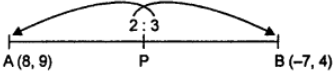
[{2×(−7)+3×8}/(2+3)], [{2×4+3×9}/(2+3)]
i.e. P(10/5, 35/5) i.e. P(2,7).
(ii) Let the point Q divides the line segment AB in the ratio 1 : 2 internally.
Then by Section’s formula, we have coordinates of Q are
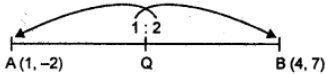
[{1×4+2×1}/(1+2)], [{8×7+2×(-2)}/(1+2)]
i.e., [(6/3), (3/3)] i.e. (2, 1).
Que-12: Find the coordinates of the point which divides externally the join of the points
(i) (-4, 4) and (1, 7) in the ratio 2 : 1;
(ii) (3, 4) and (-6, 2) in the ratio 3 : 2.
Sol: (i) Let point P divides line segment AB in the ratio 2 : 1 externally i.e. 2 : – 1 internally
Coordinates P are
[{2×1+(-4)×(-1)/(2-1)], [{2×7+(-1)×4}/(2-1)]
i.e. (6, 10)
Then by section formula,
coordinates of P are
[{2×(-4)+1×(-1)}/(2-1)], [{2×4+(-1)×7}/(2-1)]
i.e. P (-9,1)
(ii) Let point P divides line segment AB in the ratio 3 : 2 externally i.e. 3 : – 2 internally.
Then by Section formula,
coordinates of P are
[{3×(-6)+3×(-2)}/(3-2)], [{3×2+4×(-2)}/(3-2)]
i.e. P (-24,-12)
Then by Section formula, coordinates of P are
[{3×3+(-6)×(-2)}/(3-2)], [{3×4-2×3}/(3-2)]
i.e. (21,8).
Que-13: Find the coordinates of the points of trisection of the line joining the points (2, 3) and (6, 5).
Sol: Let P and Q are the points of trisection of line segment AB.
So P divides line segment AB in the ratio 1 : 2 internally. Then by section formula, we have, Coordinates of P are
[{1×6+2×2}/(1+2)], [{1×5+2×3}/(1+2)]
i.e. (10/3, 11/3)
Further point Q divides line segment AB in the ratio 2 : 1 internally.
Then by section formula, we have coordinates of Q are
[{2×6+1×2}/(1+2)], [{2×5+1×3}/(2+1)] i.e. (14/3, 13/3).
Hence the points of trisection of given line segment are (10/3, 11/3) and (14/3, 13/3)
Que-14: The line joining the points (3, 2) and (6, 8) is divided into four equal parts, find the coordinates of the points of section.
Sol: Let the line segment joining the points A (3, 2) and B(6, 8) is divided into four equal parts at P, Q and R
s.t AP = PQ = QR = RB
Thus point P divides the line segment AB in the ratio 1 : 3 internally.
Then by Section formula, we have coordinates of point P are
[{1×6+3×3}/(1+3)], [{1×8+3×2}/(1+3)]
i.e. (15/4, 14/4) i.e. (15/4, 7/2)
The point Q be the mid-point of line segment AB.
∴ Coordinates of Q are
[{(3+6)/2}, {(2+8)/2}] i.e. Q(9/2, 5)
Further point R divides line segment AB in the ratio 3 : 1 internally.
Then by section formula, we have Coordinates of R are
[{3×6+1×3}/(3+1)], [{3×8+1×2}/(3+1)]
i.e. R^(21/4, 13/2).
Hence the points section are
(15/4, 7/2); (9/2, 5); (21/4, 13/2).
Que-15: In what ratio does the point (1, −7/2) divide the join of (-2, -4) and (2,−10/3)?
Sol: Let the point P divides the line segment AB in the ratio k : 1 internally.
Then by section formula, we have
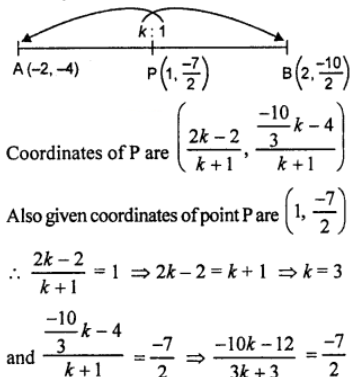
= -20k – 24 = -21k – 21
= k = 3.
Thus both eqn.’s yield the same value of k.
Hence the required ratio be k : 1 i.e. 3 : 1.
Que-16: In what ratio is the line joining the points
(i) (2, -3) and (5, 6) divided by the x-axis ;
(ii) (3, -6) and (-6, 8) divided by the y-axis?
Sol: (i) Let the point P divides the line segment AB in the ratio k : 1
Then by Section formula, we have
Coordinates of P are [{(5k+2)/(k+1)}, {(6k−3)/(k+1)}]
Since it is given that line segment AB is divided by x-axis.
∴ Ordinate of point P is 0 .
Thus {(6k−3)/(k+1)} = 0 ⇒ 6k = 3 ⇒ k = 1/2
Thus required ratio be k : 1 i.e. 1/2 : 1
i.e. 1 : 2
(ii) Let the point P divides the line segment AB in the ratio k : 1
Then by section formula, we have
coordinates of [{(−6k+3)/(k+1)}, {(8k−6)/(k+1)}]
Further it is given that line segment AB is divided by y-axis.
Therefore abscissa of point P is 0 .
Thus, {(−6k+3)/(k+1)} = 0 ⇒ 6k = 3 ⇒ k = 1/2
Therefore required ratio be k : 1 i.e. 1/2 : 1
i.e. 1 : 2.
Que-17: Find the ratio in which the axes divide the line joining the points (2, 5) and (1, 9).
Sol: Let the point P divides the line segment AB in the ratio k : 1 internally.
Then by Section formula, we have coordinates of [{(k+2)/(k+1)}, {(9k+5)/(k+1)}]
It is given that line segment AB is divided by x-axis.
∴ ordinate of point P is 0 .
⇒ (9k+5)/(k+1) = 0 ⇒ 9k = -5 ⇒ k = −5/9
Thus required ratio be k : 1 i.e. -5 : 9 i.e. 5 : 9 externally.
Further, it is given that line segment AB is divided by y-axis.
∴ abscissa of point P is 0 .
i.e. {(k+2)/(k+1)} = 0 ⇒ k + 2 = 0 ⇒ k = – 2
Thus required ratio be k : 1 i.e. – 2 : 1 internally i.e. 2 : 1 externally.
Que-18: Show by using section formula that the point (3, -2 ),(5, 2) and (8, 8) are collinear.
Sol: Let the given points are A(3, – 2), B(5, 2) and C(8, 8)
and let point B divide the line segment AC in the ratio k : 1.
Then by section formula, Coordinates of B are [{(8k+3)/(k+1)}, {(8k−2)/(k+1)}]
Also given coordinates of B are (5, 2).
{(8k+3)/(k+1)} = 5 ⇒ 8k + 3 = 5k + 5
⇒ 3k = 2 ⇒ k = 2/3
and {(8k−2)/(k+1)} = 2 ⇒ 8k – 2 = 2k + 2
⇒ 6k = 4 ⇒ k = 2/3
Hence both eqns. gives same value of k.
Thus the point B divide AC in the ratio k : 1
i.e. 2:3. Therefore A, B, C are lies on same line and hence collinear.
Que-19: Find the centroid of the triangle whose angular points are (-4, 6),(2, – 2) and (2, 5) respectively.
Sol: We know that the centroid of △ABC having vertices are A(x1, y1), B(x2, y2) and C(x3, y3) be given by
G [{(x1+x2+x3)/3}, {(y1+y2+y3)/3}]
Thus centroid of ΔABC be
[{(-4+2+2)/3}, {(6-2+5)/3}]
i.e. G (0,3)
Que-20: If (x1, y1) = (2, 3); x2 = 3 and y3 = – 2 and G is (0, 0), find y2 and x3.
Sol: Given (x1, y1) = (2, 3); x2 = 3, y3 = – 2 and centroid G be (0, 0)
We know that, centroid of △ABC are given by
G [{(x1+x2+x3)/3}, {(y1+y2+y3)/3}] i.e. G [{(2+3+x3)/3}, {(3+y2−2)/3}]
Also coordinates of centroid G be G(0, 0).
i.e. 0 = {(2+3+x3)/3} ⇒ x3 = – 5
and 0 = {(3+y2−2)/3} ⇒ y2 = – 1
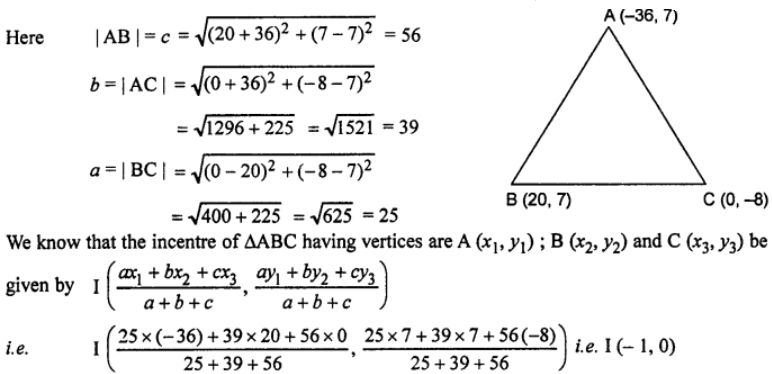
Que-21: Find the coordinates of the in-centre of the triangle whose vertices are (-36, 7) and (20, 7) and (0, – 8 ).
Sol:
–: End of Basic Concepts of Points and their Coordinates Class 11 OP Malhotra Exe-15B ISC Maths Ch-15 Solutions. :–
Return to :- OP Malhotra ISC Class-11 S Chand Publication Maths Solutions
Thanks
Please share with your friends