Bernoulli’s Trials and Binomial Distribution Class 12 OP Malhotra Exe-20C Maths Solutions Ch-20. In this article you would learn about Bernoulli’s trials and Binomial Distribution. Step by step solutions of latest textbook has been given as latest syllabus. Visit official Website CISCE for detail information about ISC Board Class-12 Mathematics.
Bernoulli’s Trials and Binomial Distribution Class 12 OP Malhotra Exe-20C Maths Solutions
| Board | ISC |
| Publications | S Chand |
| Subject | Maths |
| Class | 12th |
| Chapter-20 | Theoretical Probability Distribution |
| Writer | OP Malhotra |
| Exe-20(c) | Bernoulli’s Trials and Binomial Distribution |
Bernoulli’s Trials and Binomial Distribution
Theoretical Probability Distribution Class 12 OP Malhotra Exe-20C Solutions
Que-1: (i) What is the probability of gettting one head in six tossings of a coin?
(ii) Six coins are tossed simultaneously. Find the probability of getting
(a) 3 heads
(b) no heads
(c) at least one head.
Sol: (i) p = prob. of getting head = 1/2
∴ q = 1 – p = 1 – 1/2
= 1/2
Here n = 6, since X denotes the no. of heads in six tosses of a coin and trials are independent. Thus by binomial distribution, we have
P(X = r) = nCr pr qn-r
= 6Cr (1/2)r (1/2)p6-r
∴ P(X = 1) = 6C1 (1/2)1 (1/2)5
= 6/26
= 6/64
= 3/32
(ii) p= prob. of getting head in a single toss of a coin = 1/2
∴ q = 1 – p = 1 – 1/2
= 1/2;
n = 6 Let X denotes the no. of heads in 6 tosses of a coin.
Since trials are independent
∴ X is a binomial variate with parameters n = 6 and
p = 1/2 By binomial distribution, we have
P(X = r) = nCr pr qn-r
= 6Cr (1/2)r (1/2)6-r
(a) required probability = P(X = 3) =6C3 (1/2)3 (1/2)3
= 6×5×4/6 × 1/26
= 20/64
= 5/16
(b) required probability = P(X = 0)
= 6C0 ( 1/2)²
= 1/64
(c) required probability = P(X > 1) = 1 – P(X = 0)
= 1 – 1/64
= 63/64
Que-2: Calculate the probabilities of various number of sixes when three (fair) dice are rolled simultaneously.
Sol: Let p = prob. of getting a six in single toss of a die = 1/6
∴ q = 1 – p = 1 – 1/6
= 5/6 and n = 3 Here all the three trials are independent.
Thus X is a binomial variate with parameters n = 3 and p = 1/6
where X denotes the no. of times 6 occurs in three tosses of a die.
Thus by binomial distribution, we have
P(X = r) = nCr pr qn-r
= 3Cr(1/6)r (5/6)3-r
P(X = 0) = 3C0(1/6)0 (5/6)³
= 125/216
P(X = 1) = 3C1(1/6)1 (5/6)²
= 3×25/216 = 75/216
P(X = 2) = 3C2(1/6)² (5/6)
= 15/216 and P(X = 3)
= 3C3(1/6)³ (5/6)
= 1/216
Que-3: In tossing 10 coins, what is their probability of having exactly 5 heads ?
Sol: Let p= prob. of getting a head in single toss of a coin = 1/2
∴ q = 1 – p = 1 – 1/2
= 1/2; n = 10
Let X denotes the no. of heads obtained in 10 tosses of a single coin. Thus X is a binomial variate with n = 10 and p = 1/2
Thus by binomial distribution, we have
P(X = r) = nCr pr qn-r
= 10Cr (1/2)r (1/2)10-r
= 10Cr (1/2)10
∴ required probability = P(X = 5)
= 10C5 (1/2)10
= 10×9×8×7×6/5×4×3×2×1 × 1/210
= 36×7/210
= 63/256
Que-4: A bag contains 10 balls each marked with one of the digits 0 to 9 . If 4 balls are drawn successively with replacement from the Mg, what is the probability that none is marked with the digit 0 ?
Sol: Let p = prob. of success = prob. of getting ball marked with 0 = 1/10
∴ q = 1 – p = 1 – 1/10
= 9/10;
n = 4
Thus by binomial distribution, we have
P(X = r) =nCr pr qn-r
= 4 Cr (1/10)r (9/10)4-r
∴ required probability = P(X = 0)
= 4 C0 (1/10)0 (9/10)4
= (9/10)4
Que-5: The incidence of occuppy viral disease in an industry is such that the workmen have a 20 % chance of suffering from it. What is the probability that out of six workmen, 4 or more will contract the disease?
Sol: p = prob. of success = probability that workman contract the disease = 20 %
= 20/100
= 1/5
∴ q = prob. of failure = 1 – p
= 1 – 1/5
= 4/5; n = 6
Thus by binomial distribution, we have
P(X = r) = nCr pr qn-r
= 6 Cr (1/5)r (4/5)6-r
∴ required probability = P(X = 4) + P(X = 5) + P(X = 6)
= 6C4 (1/5)4 (4/5)2 + 6C5(1/5)5 4/5 + 6C6(1/5)6 (4/5)0
= (1/5)6 [ (6×5)/2 × 16 + 6 × 4 + 1]
= 265/15625
Que-6: A coin is tossed 7 times. What is the probability that tail appears an odd number of times?
Sol: p = prob. of success = prob. of getting tail in single toss of coin = 1/2
∴ q = 1 – p = 1 – 1/2 = 1/2; n = 7
Let X denote the no. of tails appeared in 7 tosses of coin.
Then X is binomial variate with n = 7 and p = /12
Thus by binomial distribution, we have
P(X = r)
= nCr pr qn-r
= 7 Cr (1/2)r (/12)7-r
= 7 C1 (1/2)7
∴ required prob. = P(X = 1) + P(X = 3) + P(X = 5) + P(X = 7)
= 7C2(1/2)7 + 7C3(1/2)7 + 7C5(1/2)7 + 7C7(1/2)7
= (1/2)7 [7 + (7×6×5)/6 + (7×6)/2 + 1]
= (7+35+21+1)/128
= 64/128
= 1/2
Que-7: A die is thrown 6 times. If “getting an odd number” is a success, what is the probability of
(i) 5 successes
(ii) at least 5 successes
(iii) at most 5 successes
(iv) at least one success
(v) no success ?
Sol: p = prob. of success = prob. of getting an odd number in single toss of die
= 3/6
= 1/2
∴ q = 1 – p = 1 – 1/2
= 1/2;
n = 6
Let X denotes the no. of successes in 6 tosses of a die.
Thus X is a binomial variate with parameters n = 6 and p = 1/2.
Thus, by binomial distribution, we have
P(X = r) = nCr pr qn-r
= 6Cr (1/2)r (1/2)n-r
=6Cr (1/2)6
(i) required probability of getting 5 successes = P(X = 5)
=6C5(1/2)6
= 6/64
= 3/32
(ii) required probability = P(X > 5)
= P(X = 5) + P(X = 6)
= 6C5(1/2)6 + 6C6(1/2)6
= (6 + 1) 1/64
= 7/64
(iii) required prob. = P(X > 5)
= 1 – P(X = 6)
= 1 – 6C6(1/2)6
= 1 – 1/64
= 63/64
(iv) ∴ required prob. = P(X < 1)
= 1 – P(X = 0)
= 1 – 6C0 (1/2)2
= 1 – 1/64
= 63/64
(v) Required probability = P(X = 0)
= 6C0(1/2)6
= 1/64
Que-8: A coin is tossed 7 times. Find the probability of obtaining at least 5 tails.
Sol: Let p = prob. of success = prob. of getting tail in single toss of coin
= 1/2
∴ q = 1 – p
= 1/2 and n = 7
Let X denotes the no. of tails obtained in 7 tosses of a coin. Thus X is a binomial variate with parameters n = 7 and p = 1/2
∴ by binomial distribution, we have
P(X = r) = nCr pr qn-r
= 7Cr (1/2)r (1/2)7-r
= 7Cr (1/2)7
∴ required probability = P(X > 5) = P(X = 5) + P(X = 6) + P(X = 7)
= 7C5 (1/2)7 + 7C6(1/2)7 + 7C7(1/2)7
= (1/2)7 [(7×6)/’2 + 7 + 1]
= 29/128
Que-9: A die is thrown 6 times. If ‘getting a multiple of 3’ is “success”, what is the probability of at most 5 successes?
Sol: Let p = prob. of success = prob. of getting a multiple of 3 in single toss of die
∴ p = 2/6 = 1/3 and
q = 1 – p = 1 – 1/3 = 2/3 and n = 6
Let X denotes the no. of successes in 6 tosses of a dice.
Then X is a binomial variate with parameters n = 6 and p = 1/3
Thus by binomial distribution, we have P(X = r) = nCr pr qn-r
= 6Cr(1/3)r (2/3)6-r
∴ required probability = P(X < 5)
= 1 – P(X = 6)
= 1 – 6C6 (1/3)6 (2/3)0
= 1 – 1/729
= 728/729
Que-10: A pair of dice is thrown 7 times. If getting a total of 9 is considered a success, what is the probability ofat most 6 successes ?
Sol: Let p = prob. of success = prob. of getting a total of 9 in two tosses of a dice.
⇒ p = 4/36 = 1/9
[Here favourable cases are {(3,6),(4,5),(5,4),(6,3)}]
∴ q = 1 – p = 1 – 1/9
= 8/9 and n = 7
Let X denote the no. of successes in 7 tosses of pair of dice.
∴ X is a binomial variate with parameters n = 7 and p = 1/9
Thus by binomial distribution, we have
P(X = r) = nCr pr qn-r
= 7Cr (1/9)r (8/9)7-r
∴ required probability
= P(X < 6) = 1 – P(X = 7)
= 1 – 7C7 ( 1//9)7 (8/9)0
= 1 – 1/97
Que-11: If the probability of a typhoid case proving fatal is 1 / 100, calculate the probability that the next typhoid case to arrive at a certain hospital will be fatal; that the next two cases to arrive will both be fatal; that the next ten cases to arrive will all be fatal; that at least one of the next five cases to arrive will be fatal.
Sol: Given prob. of typhoid case proving fatal = 1/100 = p
∴ prob. of tyhpid case not proving fatal = 1 – 1/100 = 99/100 = q
Thus required prob. that next two cases to arrive will both be fatal = p × p
= (1/100)²
= 1/104
∴ required probability that next 10 cases to arrive will be fatal = p10
= (1/100)10
= 1/1020
∴ required prob. = 1 – q5
= 1 – (1 – 1/100)5
= 1 – (0.99)5
Que-12: (i) Calculate the probability of obtaining a six at least once by throwing a die four times.
(ii) Calculate the probability of obtaining a double six at least once by throwing two dice twenty-four times.
(iii) Calculate the probability of obtaining a double six at least once by throwing two dice r times. Hence, calculate the least value of r in order that it should be safe to bet evens on a double six in r consecutive throws. (Problem proposed to Pascal by the gambler Chevalier de mere).
Sol: (i) p = prob. of obtaining a six in single throw of die = 16
∴ q = 1 – p = 1 – 1/6 = 5/6; n = 4
Let X denotes the no. of sixes obtained in four tosses of a die.
∴ X is a binomial variate with parameters n = 4 and p = 1/6
Thus by binomial distribution, we have
P(X = r) = nCr pr qn-r
= 4Cr(1/6)r (5/6)4-r
∴ required probability = P(X > 1) = 1 – P(X = 0)
= 1 – 4C0(1/6)0 (5/6)4
= 1 – (5/6)4 = 0.52
(ii) p = prob. of success = prob. of obtaining double six in a single toss of two dice = 1/36
∴ q = 1 – p = 1 – 1/36 = 35/36 and n = 24
Let X denote the no. of double six in 24 tosses of pair of dice thus X is a binomial variate with two parameters n = 24 and p = 1/36
Thus by binomial distribution, we have
P( X = r) = nCr pr qn-r
= 24Cr(1/36)r (35/36)24-r
∴ required probability = P(X > 1) = 1 – P(X = 0)
= 1 – {24}C0 (1/36)0 (35/36)24
= 1 – (35/36)24
(iii) Let p = prob. of obtaining double six in single toss of 2 dice = 1/36
∴ q = 1 – p = 1 – 1/36
= 35/36; n = r
Thus by binomial distribution, we have
P(X = R) = rCR pR qn-R
= rCR (1/36)R (35/36)r-R
∴ required prob. = P(X > 1) = 1 – P(X = 0)
= 1 – rC0 (1/36)0 (35/36)r
= 1 – (35/36)r
Now it would be safe to bet evens if 1 – (35/36)r
= 1/2 or (35/36)r
= 1/2 arrow r = 24.6
Hence the least value of r be 25 .
Que-13: A pair of dice is thrown two times. If getting a doublet is considered a success, find the probability of getting (i) 4 successes (ii) no success.
Sol: When two dice are thrown
Total no. of outcomes = 6² = 36
For getting doublet, favourable cases = {(1,1),(2,2),(3,3),(4,4),(5,5),(6,6)}
Let p = prob. of success = prob. of getting a doublet with pair of dice = 6/36 = 1/6
∴ q = 1 – p = 1 – 1/6 = 5/6; n = 10
Let X denote the no. of doublets obtaining in 10 throws of pair of dice.
Thus X is binomial variate with parameters n = 10 and p = 1/6
∴ by binomial distribution, we have
P(X = r) = nCr pr qn-r
= 10Cr(1/6)r (5/6)10-r
(i) ∴ required probability = P(X = 4)
= 10C4(1/6)4 (5/6)6
= 10×9×8×7/24 (1/6)4 (5/6)6
= 210 (1/6)4 (5/6)6
(ii) required probability = P(X = 0)
= 10C0 (1/6)0 (5/6)10
= (5/6)10
Que-14: Past experience shows that 80 % of the operations performed by a doctor are successful. If he performs four operations in a day, what is the probability that at least three operations will be successful?
Sol: Let p= probability that operation done by doctor is successful = 80 %
= 80/100
= 4/5
∴ q = 1 – p = 1 – 4/5
= 1/5; n = 4
Let X denote the no. of successful operations done by doctor.
∴ X is a binomial variate with parameters n = 4 and p = 4/5
Thus by binomial distribution, we have
P(X = r) = nCr pr qn-r
= 4 Cr (4/5)r (1/5)4-r
∴ required probability = P(X > 3)
= P(X = 3) + P(X = 4)
= 4C3 (4/5)3 (1/5) + 4Cr(4/5)4
= 4 × 64/625 + 256/625
= 512/625
Que-15: Five dice are thrown simultaneously. If the occurrence of an even number on a single die is considered a success, find the probability of getting at the most 3 successes.
Sol: Let p = probability of getting an even number in a single throw of die
= 3/6
= 1/2
∴ q = 1 – p = 1 – 1/2
= 1/2 and n = 5
Let X denote the occurrence of even number on single die in five tosses of a die. Since all the trials are independent. Thus X is a binomial variate with parameters n = 5 and p = 1/2 Thus by binomial distribution, we have
P(X = r) = 5Cr pr qn-r
= 5Cr (1/2)r (1/2)5-r
⇒ P(X = r) = 5Cr (1/2)5
∴ required probability = P(X < 3) = 1 – P(x = 4) – P(X = 5)
= 1 – 5C4(1/2)5 – 5C5(1/2)5
= 1 – 5/32 – 1/32
= 1 – 6/32
= 26/32
= 13/16
Que-16: A box contains 100 tickets each bearing one of the numbers from 1 to 100 . If 5 tickets are drawn successively from the box, find the probability that all the tickets bear numbers divisible by 10 .
Sol: Here, total no. of outcomes =100
Now favourable cases are {10, 20, 30, 40, 50, 60, 70, 80, 90, 100}
Let p = prob. of getting a ticket which bear a number which is divisible by 10 = p 10/100 = 1/10
∴ q = 1 – p = 1 – 1/10 = 9/10; n = 5
Thus by binomial distribution, we have
P(X = r) = nCr pr qn-r
= 5Cr (1/10)r (9/10)5-r
∴ required probability = P(X = 5)
= 5C5 (1/10)r (9/10)0
= (1/10)5
Que-17: A man takes a step forward with probability 0.4 and backward with probability 0.6 . Find the probability that at the end of eleven steps he is just one step away from the starting point.
Sol:
Let p = probability that the man take a step forward = 0.4
q = prob. that the man takes a step backward = 0.6
Let X} denote the no. of steps taken in the forward direction.
Since all the steps independent of each other.
Thus X is a binomial variate with parameters n = 11 and p = 0.4
Thus by binomial distribution, we have
P(X = r) = nCr pr qn-r
= 11Cr (0.4)r (0.6)11-r
Since the man is just one step away from starting point.
i.e. man is either one step a head or one step behind the starting point.
∴ required probability = P[(X = 5) or (X = 6)]
= P(X = 5) + P(X = 6)]
= 11C5(0.4)5(0.6)6 + 11C6(0.4)6(0.6)5
= (0.4)5 (0.6)5 11C5 × 0.6 + 11C6 × 0.4
= (0.24)5 [(11×10×9×8×7)/120 × 0.6 + (11×10×9×8×7)/120 × 0.4]
= (0.24)5 [277.2 + 184.8]
= 462 × (0.24)5
Que-18: An urn contains 13 balls, marked 1 through 13. If even number is considered a ‘success’ and two balls are drawn, with replacement from the bag, find the probability of getting (i) 2 successes, (ii) exactly one success (iii) at least one success (iv) no success (v) at most one success.
Sol: Let p = probability of success = prob. of getting ball marked with even numbers
= 6/13{2,4,6,8,10,12}
∴ q = 1 – p = 1 – 6/13 = 7/13; n = 2
Let X denote the no. of successes in two draws.
Since the balls are drawing with replacement.
∴ X is a binomial variate with parameters n = 2 and p = 6/13.
Thus, by binomial distribution, we have
P(X = r) = nCr pr qn-r
= 2Cr (6/13)r(7/13)2-r;
r = 0,1,2
(i) required probability = P(X = 2)
= 2C2 (6/13)2 (7/13)0
= 36/169
(ii) required probability = P(X = 1)
= 2C1 (6/13)(7/13)
= 84/169
(iii) required probability = P(X > 1)
= 1 – P(X = 0)
= 1 – 2C0 (6/13)0 (7/13)2
= 1 – 49/169
= 120/169
(iv) Required probability = P(X = 0)
= 2C0 (6/13)0 (7/13)2
= 49/169
(v) Required probability = P(X < 1)
= 1 – P(X = 2)
= 1 – 2C2 (6/13)2 (/713)0
= 1 – 36/169
= 133/169
Que-19: There are 5 per cent defective items in a large bulk of items. What is the probability that a sample of 10 items will include not more than one defective item?
Sol: Let p = prob. of getting a defective item = 5 %
= 5/100
= 1/20
∴ q = 1 – p = −1/20 = 19/20; n = 10
Let X denote the no. of defective items of 10 items.
Since all the trials are independent of each other.
Thus X is a binomial variate with parameters n = 10 and p = 1/20.
Thus by binomial distribution, we have
P(X = r) = nCr pr qn-r
= 10Cr (1/20)r (19/20)10-r
∴ required probability = P(X = 0) + P(X = 1) = 10C0 (1/20)0 (19/20)10 + 10C1(1/20) (19/20)9
= (19/20)10 + 10/20 (19/20)9
= (19/20)9 [19/20 + 10/20]
= 29/20 (19/20)9
Que-20: p is the probability that a man aged x will die in a year. Find the probability that out of n men A1, A2,……, An each aged x, A1 will die in a year and be the first to die.
Sol: Given the probability that a man dies in a year = p
The probability that a man does not die in a year = q = 1 – p
∴ The prob. that atleast one man dies in a year = (p+q)n – qn = 1 – (1-p)n
[∵ p + q = 1] given, the probability that A1 dies first out of n = 1/n
Hence the required probability A1 will die in a year and he is the first to die = 1/n × [1-(1-p)n ]
Que-21: (i) The probability of a man hitting a target is 1 / 4. How many times must he fire so that the 2 probability of his hitting the target at least once is greater than 23?
(ii) The probability of a man hitting a target is 12. How many times must he fire so that the probability of hitting the target atdeast once is more than 90 % ?
(iii) The probability of a man hittiijg a target is 14, if he fires 7 times, what is the probability of his hitting the target at least fwice?
Sol: (i) Let p = probability of a man hitting a target = 1/4
∴ q = 1 – p = 1 – 1/4
= 3/4
Let n be the required no. of times he fires so that P(X > 1) >; 2/3 …..(1)
By binomial distribution, we have
P(X = r) = nCr pr qn-r
= nCr (1/4)r (3/4)4-r
∴ P(X > 1)
= 1 – P(X = 0)
= 1 – nC0 (1/4)0 (3/4)n
= 1 – (3/4)n
∴ from (1);
1 – (3/4)n; > 2/3
⇒ (3/4)n < 1/3 ………..(1)
Clearly when n = 4, 5, 6 ………………… eqn. (1) is satisfied.
Hence he must fires at least 4 times.
(ii) Let p = probability of a man hitting a target = 1/2
∴ q = 1 – p = 1 – 1/2
= 1/2
Let n be the required no. of times he fires so that P(X > 1) > 90/100 ………..(1)
Also by binomial distribution, we have
P(X = r) = nCr pr qn-r
= nCr (1/2)r (1/2)n-r
= nCr(1/2)n
Now P(X > 1) = 1 – P (X = 0)
= 1 – nC0 (1/2)n
= 1 – 1/2n
∴ from (1); 1 – 1/2n > 90100
= 9/10
⇒ 1/2n
⇒ 2n > 10
Thus the least value of n for which eqn. (2) satisfied is n = 4.
Hence the man must fires atleast 4 times.
(iii) Let p = probability of a man hitting a target = 1/4
∴ q = 1 – p = 1 – 1/4
= 3/4 and n = 7
Let X denote the no. of times the man hitting the target in 7 tries. So all the trials are independent of each other.
∴ X is a binomial variate with parameters n = 7 and p = 1/4
Thus by binomial distribution, we have
P(X = r) = nCr pr qn-r
= 7Cr (1/4)r (3/4)7-r
∴ required probability = P(X > 2) = 1 – P(X = 0) – P(X = 1)
= 1 – 7C0 (1/4)0 (3/4)7 – 7C1 (1/4) (3/4)6
= 1 – (3/4)7 – 7/4 (3/4)6
= 1 – (3/4)6 [3/4 + 7/4]
= 1 – 5/2 (3/4)
= 1/3
Que-22: The items produced by a company contain 10 % defective items. Show that the probability of getting 2 defective items in a sample of 8 items is (28×96)/108.
Sol: Let p= probability of getting defective item = 10 % = 1/10
∴ q = 1 – p = 1 – 1/10
= 9/10 and n = 8
Let X denotes the no. of defective items out of 8 items and all the trials are independent of each other.
So X is a binomial variate with parameters n = 8 and p = 1/10
Thus by binomial distribution, we have
P(X = r) = nCr pr qn-r
= 8Cr (1/10)r (9/10)8-r
∴ required probability = P(X = 2)
= 8C2 (1/10)2 (9/10)6
= (8×7)/2 × 96/108
= 28×96/108
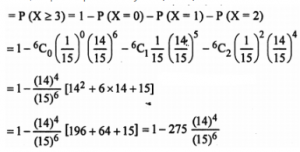
Que-23: Assume that on an average one telephone number out of 15 called between 2 P.M. and 3 P.M. on week days is busy, what is the probability that of six randomly selected telephone numbers are called at least three of them will be busy?
Sol: Let p= prob. that telephone number between 2 P.M and 3 P.M on week days is busy = 115
∴ q = 1 – p = 1 – 1/15
= 14/15 and n = 6
Let X denote the no. of telephone calls busy out of 6 selected telephone numbers since all the trials are independent of each other thus X is a binomial variate with parameters n = 6 and
p = 1/15
Thus by binomial distribution, we have
P(X = r) = nCr pr qn-r
= 6Cr (1/15)r (14/15)6-r
Thus, required probability = P(X > 3)
Que-24: If getting a ‘ 5 ‘ or a ‘ 6 ‘ in a throw of an unbiased die is a ‘success’ and the random variable X denotes the numbei of successes in six throws of the dice, find P(r)[X > 4].
Sol: Let p = probability of success i.e. prob. of getting 5 or 6 in a single throw of die = 2/6
= 1/3
∴ q = 1 – p = 1 – 1/3
= 2/3 and n = 6
Given X be the random variable denote the no. of successes in 6 throws of a die and all the trials are independent of each other.
∴ X is a binomial variate with parameters n = 6 and p = 1/3
Thus by binomial distribution, we have
P(X = r) = nCr pr qn-r
= 6Cr (1/3)r (2/3)6-r
∴P(X > 4) = P(X = 4) + P(X = 5) + P(X = 6)
= 6C4 (1/3)4 (2/3)2 + 6C5(1/3)5 (2/3) + 6C6 (1/3)6 (2/3)0
= 1/36 [(6×5)/2 × 4 + 6 × 2 + 1]
= 7336
Now
P(X = 4) = 6C4(1/3)4 (2/3)2
= (6×5)/2 × 4/36
= 60/36
= 20/243
and
P(X = 5) = 6C5 (1/3)5 (2/3)
= 6×2/36
= 4/243
Que-25: A student is given a true-false examination with 8 questions. If he gets 6 or more correct answers, he passes the examination. Given that he guesses at the answer to each question, compute the probability that he passes the examination.
Sol: Let p = prob. of getting correct answer = 1/2
∴ q = 1 – p
= 1 – 1/2
= 1/2; n = 8
Let X be the random variable denotes the no. of correct answers out of 8 questions. Since all the trials are independent of each other. Thus X is a binomial variate with parameters n = 8 and
p = 1/2
Thus by binomial distribution, we have
P(X = r) = nCr pr qn-r
= 8Cr (1/2)r (1/2)8-r
= 8Cr (1/2)8
∴ required probability = P(X = 6)+ P(X = 7) + P(X = 8)
= 8C6 (1/2)8 + 8C7 (1/2)8 + 8C8 (1/2)8
= [(8×7)/2 + 8 + 1] 1/28
= 37/256
Que-26: Two fair dice, each with faces marked 1,2,3,4,5,6 are thrown simultaneously. The two scores are then added together. Calculate the probability that the sum is
(i) 7
(ii) a multiple of 4
(iii) If the operation is repeated 5 times, calculate the probability that the sum will be seven exactly four times.
Sol: When two fair dice are thrown simultaneously
Then Sample space S = {(1,1),(1,2),(1,3),(1,4),(1,5),(1,6),(2,1),(2,2),(2,3),(2,4),(2,5), (2,6),(3,1),(3,2),(3,3),(3,4),(3,5),(3,6),(4,1),(4,2),(4,3),(4,4),(4,5),(4,6),(5,1), (5,2),(5,3),(5,4),(5,5),(5,6),(6,1),(6,2),(6,3),(6,4),(6,5),(6,6)}
∴ Total no. of outcomes = 6² = 36
(i) Let E: event that sum is 7 = {(1,6),(2,5),(3,4),(4,3),(5,2),(6,1)}
∴ required probability = 6/36 = 1/6
(ii) Let F : event that sum of scores on both dice is multiple of 4 = {(1,3),(3,1),(2,6),(4,4), (6,2),(3,5),(5,3),(6,6),(2,2)}
∴ No. of favourable cases = 9
Thus required probability = 9/36 = 1/4
(iii) Here by part (i); p = 1/6;
q = 1 – p = 1 – 1/6 = 5/6; n = 5
Let X denote the no. of times 7 obtained in four throws of pair of dice.
Since all the trials are independent of each other.
∴ X is a binomial variate with parameters n = 5 and p = 1/6
Thus by binomial distribution, we have
P(X = r) = nCr pr qn-r
= 5Cr(1/6)r (5/6)5-r
∴ required probability = P (X = 4)
= 5C4 (1/6)4 (5/6)
= 5×5/65
= 25/63
= 25/7776
Que-27: Six dice are thrown 729 times. How many times do you expect at least three dice to show a five or six?
Sol: Let p = probability of getting 5 or 6 in a single throw of die = 2/6
= 1/3
∴ q = 1 – p = 1 – 1/3
= 2/3
Let X be the random variable denotes the no. of dice showing 5 or 6 in a set of six dice.
Thus X be a binomial variate with parameters n = 6 ;
p = 1/3
Thus by binomial distribution, we have
P(X = r) = nCr pr qn-r
= 6Cr (1/3)r (2/3)6-r ;
r = 0,1,…………..6
Thus required frequency = N.P (X = r) = 729 P(X = r)
∴ required frequency = 729 P(X > 3)
P(X > 3) = 1 – P(X = 0) – P(X = 1) – P(X = 2)
= 1 – 6C0(1/3)0 (2/3)6 – 6C1 1/3(2/3)5 – 6C2 (1/3)2 (2/3)4
= 1 – 24/36 [1 × 4 + 6 × 2 + 15]
= 1 – (31×24)/36
= 729−496/729
= 233/729
∴ from (1); we have
Required frequency = 729 × 233/729 = 233
Que-28: There are 2 0% chances for a worker of an industry to suffer from an occupational disease. 50 workers were selected at random and examined for the occupational disease. Find the probability that (i) only one worker is found suffering from the disease (ii) more than 3 are suffering’from the disease, (iii) none is suffering from the disease.
Sol:
Let p = probability that worker suffer from occupational disease = 20% = 20100 = 1/5
∴ q = 1 – p = 1 – 1/5 = 4/5
Let X be the random variable denotes the no. of workers to suffer from an occupational disease out of 50 workers. Since all the 50 trials are independent of each other.
∴ X is a binomial variate with parameters n = 50 and p = 1/5
Thus by binomial distribution, we have
P(X = r) = nCr pr qn-r
= 50Cr (1/5)r (4/5)50-r ;
r = 0,1,2,………., 50
(i) Required probability = P(X = 1) = 50C1 (1/5) (4/5)49
= 10(4/5)49
(ii) Required probability = P(X > 3) = 1 – P(X = 0) – P(X = 1) – P(X = 2) – (X = 3)
= 1 – 50C0 (1/5)0 (4/5)50 – 50C1 1/5 (4/5)49 – 50C2(1/5)2 (4/5)48 – 50C3(1/5)3 (4/5)47
= 1 – 447/5050 [50C0 × 64 + 50C1 × 16 + 50C2 × 4 + 50C3]
= 1 – 447/5050[64 + 50 × 16 + (50×49)/2 × 4 + (50×49×48)6]
= 1 – 447/5050[64+800+4900+19600]
= 1 – 25634(447/5050)
(iii) Required probability = P(X = 0)
= 50C0(1/5)0 (4/5)50
= (4/5)50
–: End of Bernoulli’s Trials and Binomial Distribution Class 12 OP Malhotra Exe-20C Maths Solutions :–
Return to :- OP Malhotra ISC Class-12 S Chand Publication Maths Solutions
Please share with your friends
Thanks