Binomial Theorems Class 11 OP Malhotra Exe-13A ISC Maths Solutions Ch-13 Latest editions. In this article you would learn about Development of Binomial Expansion. Step by step solutions of latest textbook has been given as latest syllabus. Visit official Website CISCE for detail information about ISC Board Class-11 Mathematics.
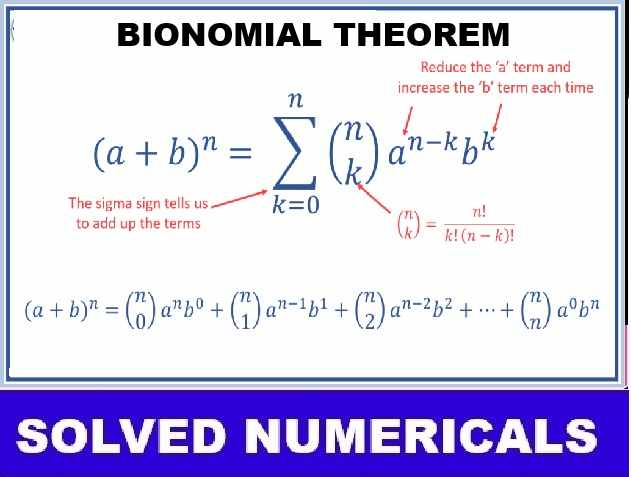
Binomial Theorems Class 11 OP Malhotra Exe-13A ISC Maths Solutions Ch-13
| Board | ISC |
| Publications | S Chand |
| Subject | Maths |
| Class | 11th |
| Chapter-13 | Binomial Theorems |
| Writer | OP Malhotra |
| Exe-13(A) | Development of Binomial Expansion. |
Development of Binomial Expansion.
Binomial Theorems Class 11 OP Malhotra Exe-13A ISC Maths Solutions Ch-13
Que-1: What is the number of terms in the expansion of each of the following?
(i) [(x -2y)3]3
(ii) (5a + 7b)^8
(iii) [6x−(1/x³)]^17
(iv) (4x2 + 12xy + 9y2)9
(v) (3 + 2√5)18 – (3 – 2√5)18
(vi) (5 + 7x)15 + (5 – 7x)15
(vii) (a + bx)17 – (a – bx)17
Sol: (i) [(x – 2y)3]3 = (x – 2y)9
Thus number of terms in the expansion of [(x – 2y)3]3 be (9 + 1) i.e. 10.
(ii) The no. of terms in the expansion of (5a + 7b)8 be (8 + 1) i.e. 9
(iii) The number of terms in the expansion of [6x−(1/x³)]^17 is (17 + 1) i.e. 18.
(iv) Now (4x2 + 12xy + 9y2)9 = [(2x + 3y)2]9 = (2x + 3y)18
Thus, the no. of terms in given expansion be 18 + 1 i.e. 19.
(v) We know that, the no. of terms in the expansion of (a + b)n – (a – b)n be (n/2) if n be even.
The number of terms in the expansion of (3 + 2√5)18 – (3 – 2√5)18 be (18/2) i.e. 9 [Here n = 18]
(vi) We know that the no. of terms in the expansion of (a + b)n + (a – b)n be {(n+1)/2} if n is odd.
Thus the no. of terms in the expansion of (5 + 7x)15 + (5 – 7x)15 be {(15+1)/2} i.e. 8 .
(vii) We know that the number of terms in the expansion of (a + b)n – (a – b)n be {(n+1)/2}if n be odd. Hence, the no. of terms in the expansion of (a + bx)17 – (a – bx)17 be {(17+1)/2} i.e. 9 .
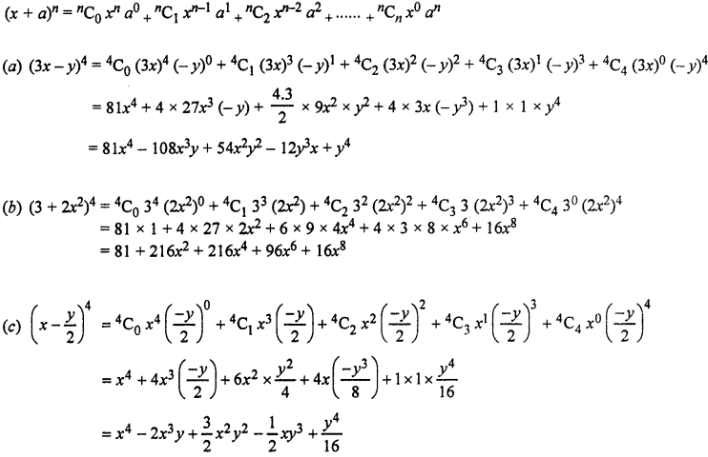
Que-2: Write out the expansions of the following:
(a) (3x – y)4
(b) (3 + 2x2)4
(c) (x−(y/2))^4
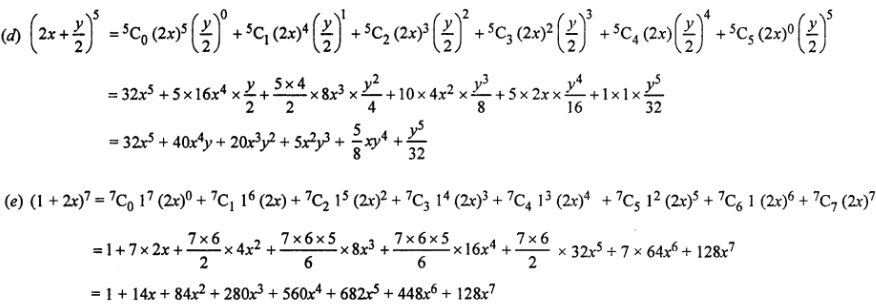
(d) (2x+(y/2))^5
(e) (1 + 2x)^7
Sol: We know that binomial theorem for positive integral index be given by
Que-3: Using binomial theorem, expand [(x + y)5 + (x – y)5] and hence find the value of [(√3 + 1)5 – (√3 – 1)5].
Sol: By binomial theorem, we have
(x + y)5 = 5C0 x5 y0 + 5C1 x4 y1 + 5C2 x3y2 + 5C3x2y3 + 5C4 xy4 + 5C5 x0y5
= x5 + 5x4y + 10x3y2 + 10x2y3 + 5xy4 + y5 …(1)
Similarly (x – y)5 = x5 – 5x4y + 10x3 y2 – 10x2 y3 + 5x y4 – y5 …(2)
On adding eqn. (1) and eqn. (2); we have
(x + y)5 + (x – y)5 = 2x5 + 20x3 y2+10xy4 …(3)
putting x =√3 and y = 1 in eqn. (3); we have
(√3 + 1)5 + (√3 – 1)5 = 2(√3)5 + 20(√3)3(1)2 + 10 × √3(1)4
= 18√3 + 60√3 + 10√3 = 88√3
Subtracting eqn. (2) from eqn. (1); we have
(x + y)5 – (x – y)5 = 10x4y + 20x2y3 + 2y5 …(4)
putting x = √3 and y = 1 in eqn. (4); we have
(√3 + 1)5 – (√3 – 1)5 = 10(√3)4 × 1 + 20(√3)2 × 13 + 2 × 15 = 10 × 9 + 20 × 3 + 2 = 152
Que-4: Expand (2 + x)5 – (2 – x)5 in ascending powers of x and simplify your result.
Sol: Now (2 + x)5
= 5C0 25 x0 + 5C1 24 x1 + 5C2 23 x2 + 5C3 23 x2 + 5C3 22x3 + 5C4 2x4 + 5C5 20 x5
= 32 + 5 × 16x + {(5×4)/2} × 8x2 + 10 × 4x3 + 5 × 2 × x4 + x5
= 32 + 80x +80x2 + 40x3 + 10x4 + x5 …(1)
Similarly (2 – x)5 = 32 – 80x + 80x2 – 40x3 + 10x4 – x5 …(2)
eqn. (1) – eqn. (2) gives ; (2 + x)5 – (2 – x)5 = 160x + 80x3 + 2x^5
Que-5: Evaluate the following :
(i) (2 + √5)5 + (2 – √5)5
(ii) (√3 + 1)5 – (√3 – 1)5
Hence, show in (ii), without using tables, that the value of (√3 + 1)5 lies between 152 and 153.
Sol: We know that (x + a)n = nCo xn ao + nC1 xn – 1 a1 + …. + nCn x0 an
(i) (2 + √5)5 = 5C0 25 (√5)0 + 5C1 24 √5 + 5C2 23 (√5)2 + 5C3 22 (√5)3 + 5C4 21 (√5)4 + 5C5 20 (√5)5 …(1) and (2 – √5)5 = 5C0 25 (- √5)0 + 5C1 24 (- √5) + 5C2 23 (- √5)2 + 5C3 22 (- √5)3 + 5C4 21 (- √5)4 + 5C5 20 (- √5)5
= 5C0 25 (√5)0 – 5C1 24 √5 + 5C2 23 (√5)2 – 5C3 22 (√5)3 + 5C4 2 (√5)4 – 5C5 (√5)5 …(2)
on adding eqn. (1) and eqn. (2); we have
(2 + √5)5 + (2 – √5)5 = 2 C0 25 (√5)0 + 2 × 5C2 23 (√5)2 + 2 × 5C4 × 2 (√5)4
= 2 × 1 × 32 + {(2×5×4)/2} × 8 × 5 + 2 × 5 × 2 × 25 = 64 + 800 + 500 = 1364
(ii) (√3 + 1)5 = 5C0 (√3)5 + 5C1 (√3)3 + 5C3 (√3)2 + 5C4 √3 + 5C5 …(1)
and (√3 – 1)5 = 5C0 (√3)5 – 5C1 (√3)4 + 5C2 (√3)3 – 5C3 (√3)2 + 5C4 √3 – 5C5 …(2)
eqn. (1) – eqn. (2) gives ;
(√3 + 1)5 – (√3 – 1)5 = 2 × 5C1 (√3)4 + 2 × 5C3 (√3)2 + 2 × 5C5
= 2 × 5 × 9 + 2 × {(5×4)/2} × 3 + 2 × 1 = 90 + 60 + 2 = 152 …(3)
Now from (3); (√3 + 1)5 – (√3 – 1)5 = 152
⇒ (√3 + 1)5 = 152 + (√3 – 1)5 > 152
[∵ (√3 – 1)5 > 0]
Also (√3 + 1)5 = 152 + (√3 – 1)5 < 153
[∵ (√3 – 1)5 < 1]
Hence (√3 + 1)5 lies between 152 and 153.
Que-6: If the first three terms in the expansion of (1 + ax)n in ascending powers of x are 1 + 12x + 64x2, find n and a.
Sol: By binomial Theorem, we have
(1 + ax)n =nC0 1n (ax)0 + nC1 (ax) + nC2 1n – 2(ax)2 + ….
= 1 + nax + [{n(n-1)/2] a2x2 + ….
Also given first three terms of (1 + ax)n are 1 + 12x + 64x2
∴ na = 12 …(1)
and [{n(n-1)/2] a2 = 64 …(2)
On squaring eqn. (1); we have
n2 a2 = 144 …(3)
On dividing eqn. (2) by eqn. (3); we have
[n(n−1)]/2n² = 64/144
⇒ {(n−1)/2n} = 4/9
⇒ 9n – 9 = 8n ⇒ 9n – 8n = 9 ⇒ n = 9
∴ from (1); 9a = 12
⇒ a = 4/9
Que-7: Find the first three terms in the expansion of [2 + x(3 + 4x)]5 in ascending powers of x.
Sol: [2 + x(3 + 4x)]5 = [2 + 3x + 4x2]5 =(y + 4x2)5; where y = 2 + 3x
= 5C0 y5 (4x2)0 + 5C1 y4 (4x2)2 + 5C3 y2 (4x2)3 + 5C4 y(4x2)4 + 5C5 (4x2)5
= 5C0 (2 + 3x)5 + 5C1 (2 + 3x)4 (4x)2 + ….
= [5C0 25 + 5C1 24 × 3x + 5C2 23 × (3x)2 + 5C3 22 (3x)3 + 5C4 2 (3x)4 + 5C5 (3x)5] + 20x2 {4C0 24 + ….}
= [32 + 240x + 720x2 + …] + 20x2 {4C0 24 + …} + …..
= 32 + 240x + 1040x2 + ….
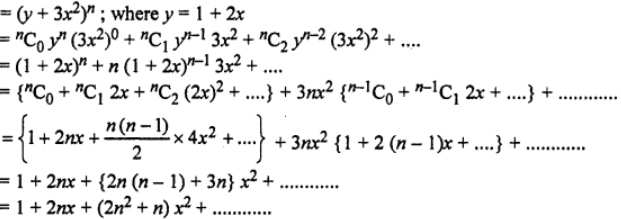
Que-8: Expand (1 + 2x + 3x2)n in a series of ascending powers of x up to and including the term in x2.
Sol: Given : (1 + 2x + 3x2)n
Que-9: Write down the expansion by the binomial theorem of [3x-(y/2)]^4. By giving x and y suitable values, deduce the value of (29.5)4 correct to four significant figures.
Sol: Given : [3x-(y/2)]^4
![Que-9: Write down the expansion by the binomial theorem of [3x-(y/2)]^4. By giving x and y suitable values, deduce the value of (29.5)4 correct to four significant figures.](https://icsehelp.com/wp-content/uploads/2025/07/e.png)
Putting x = 10 and y = 1 in eqn. (1); we get
(30 – 0.5)4 = (29.5)4 = 81 × 104 – 54 × (10)3 × 1 + (27/2)× 102 × 12 – (3/2) × 10 × 13 + (1/16)
= 810000 – 54000 + 1350 – 15 + (1/6)
= 757300 [correct to 4 significant figures.]
Que-10: Using binomial theorem, evaluate : (999)3.
Sol: (999)3 = (1000 – 1)3
= 3C0 (1000)3 (-1)0 + 3C1(1000)2 (-1)1 + 3C2(1000) (-1)2 + 3C3 (1000)0 (-1)3
=1000000000 – 3000000 + 3000 – 1 = 997002999
Que-11: Write down in terms of x and n, the term containing x3 in the expansion of [1-(x/n)]^n by the binomial theorem. If this term equals (7/8) when x = -2, and n is a positive integer, calculate the value of n.
Sol: By binomial theorem, we have
![Que-11: Write down in terms of x and n, the term containing x3 in the expansion of [1-(x/n)]^n by the binomial theorem. If this term equals (7/8) when x = -2, and n is a positive integer, calculate the value of n.](https://icsehelp.com/wp-content/uploads/2025/07/1-12.png)
Que-12: (i) Obtain the binomial expansion of (2 – √3)6 in the form a + b√3, where a and b are integers. State the corresponding result for the expansion (2 + √3)6 and
(ii) show that (2 – √3)6 is the reciprocal of (2 +√3)6.
Sol: (i) By binomial Theorem, we have
(2 – √3)6 = 6C0 26 (- √3)0 + 6C1 25 (- √3) + 6C2 24 (-√3)2 + 6C3 23 (-√3)3 + 6C4 22 (-√3)4 + 6C5 21 (-√3)5 + 6C6 20 (-√3)6
= 1 × 64 + 6 × 32 (- √3) + {(6×5)/2} × 16 × 3 + {(6×5×4)/6} × 8 × (-3√3) + {(6×5)/2} × 4 × 9 + 6 × 2 × (-9√3) + 1 × 1 × 27
= 64 = 192√3 + 720 – 480√3 + 540 – 108√3 + 27
∴ (2 – √3)6 = 1351 – 780√3
Similarly (2 + √3)6 = 64 + 192√3 + 720 + 480√3 + 540 + 108√3 + 27 = 1351 + 780√3
(ii) Thus, (2 – √3)6 (2 + √3)6 = (1351 – 780√3)(1351 + 780√3) = (1351)2 – (780)2 × 3 = 1825201 – 1825, 200 = 1
⇒ (2 – √3)6 = 1/(2 + √3)6
Thus, (2 – √3)6 is the reciprocal of (2 + √3)6.
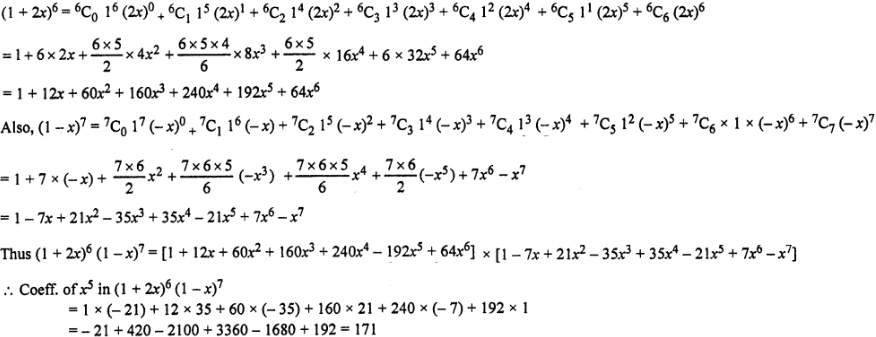
Que-13: Find the coefficient of x5 in the expansion of (1 + 2x)6 (1 – x)7.
Sol: Now using binomial theorem, we have
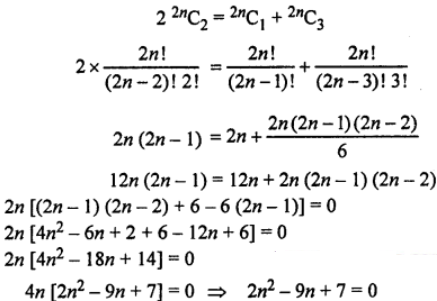
Que-14: If the coefficients of second, third and fourth terms in the expansion of (1 + x)2n are in A.P., show that 2n2 – 9n + 7 = 0.
Sol: By binomial theorem, we have
(1 + x)2n =2nC0 12n x0 + 2nC11 12n – 1 x + 2nC2 12n – 2 x2 + 2nC3 12n – 3 x3 + …..
∴ Coeff. of 2nd term = 2nC1
Coeff. of 3rd term = 2nC2
and Coeff. of 4 th term = 2nC3
Since it is given that coefficients of 2nd, 3rd and 4th terms in the expansion of (1 + x)2n are in A.P
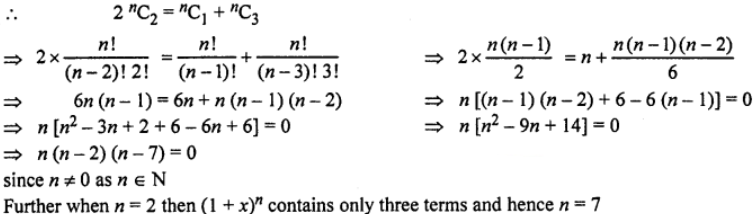
Que-15: Let n be a positive integer. If the coefficients of 2nd, 3rd, 4th terms in the expansion of (1 + x)n are in A.P., then find the value of n.
Sol: By binomial theorem, we have
(1 + x)n = nC0 1nx0 + nC1 1n – 1 x + nC2 1n – 2 x2 + nC3 1n – 3 x3 + …. + nCn 10 xn
∴ Coefficient of 2nd term = nC1
Coeff. of 3rd term = nC2
and Coeff. of 4th term = nC3
Since it is given that coefficients of 2nd, 3rd and 4th terms in the expansion of (1 + x)n are in A.P.
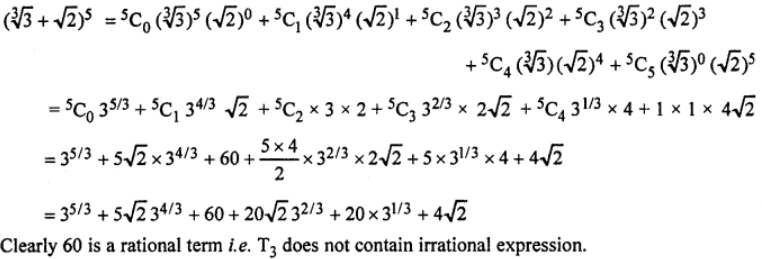
Que-16: In the binomial expansion of (√3+√2)^5 find the term which does not contain Irrational expression.
Sol: Using binomial theorem, we have
–: End of Binomial Theorems Class 11 OP Malhotra Exe-13A ISC Maths Ch-13 Solutions. :–
Return to :- OP Malhotra ISC Class-11 S Chand Publication Maths Solutions
Thanks
Please share with your friends