Binomial Theorems Class 11 OP Malhotra Exe-13B ISC Maths Solutions Ch-13 Latest editions. In this article you would learn about General, Middle and from the end Term. Step by step solutions of latest textbook has been given as latest syllabus. Visit official Website CISCE for detail information about ISC Board Class-11 Mathematics.
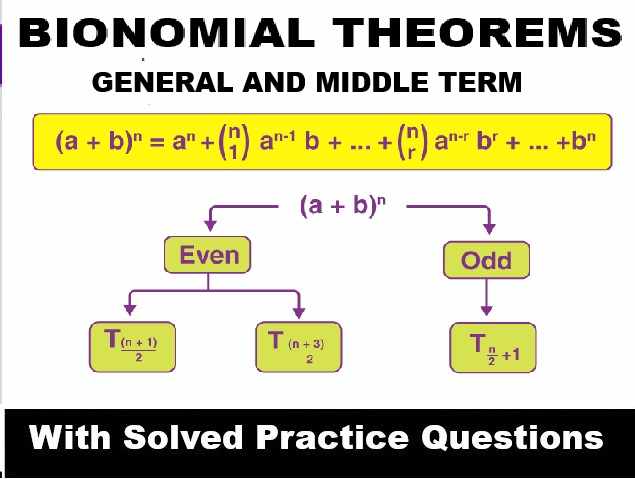
Binomial Theorems Class 11 OP Malhotra Exe-13B ISC Maths Solutions Ch-13
| Board | ISC |
| Publications | S Chand |
| Subject | Maths |
| Class | 11th |
| Chapter-13 | Binomial Theorems |
| Writer | OP Malhotra |
| Exe-13(B) | General, Middle and from the end Term. |
Exercise- 13B
Binomial Theorems Class 11 OP Malhotra Exe-13B Solution.
Que-1: Find the specified term of the expression in each of the following binomials :
(i) Fifth term of (2a + 3b)^12. Evaluate it when a = (1/3), b = (1/4).
(ii) Sixth term of [2x−(1/x²)]^7
(iii) Middle term of [2x−(1/y)]^8
(iv) Middle term of [(x^4)−(1/x³)]^11
(v) Middle term of [(x²/4)−(4/x²)]^10
Sol: (i) On comparing (2a + 3b)12 with (x + a)n
we have ‘x’ = 2a; ‘a’ = 3b; n = 12
We know that general term in the expansion of (x + a)n = Tr+1 = nCr xn – r dr
∴ general term in the expansion of (2a + 3b)12 = 12Cr (2a)12-r (3b)r …(1)
For fifth term, putting r = 4 in eqn. (1); we have
∴ T5 = 12C4(2a)12 – 4 (3b)4 = 12!/(8!4!) × (2a)8 (3b)4 = {(12×11×10×9)/(4×3×2×1)} × 28 a4 × 34 b4 = 495 × 28 × 34 a4 b4
when a = 1/3 and b = 1/4
∴ T5 = 495 × 28 × 34 × (1/3)^4 × (1/4)^4
Thus T5 = 495
![Que-1: Find the specified term of the expression in each of the following binomials : (ii) Sixth term of [2x−(1/x²)]^7 (iii) Middle term of [2x−(1/y)]^8](https://icsehelp.com/wp-content/uploads/2025/07/6-4.png)
(iv) On comparing [(x^4)−(1/x³)^11 with (x + a)^n; we have
‘x’ = x4; ‘a’ = –1/x³ and n = 11
Here no. of terms = n + 1 = 11 + 1 = 12
So there are two middle terms i.e.
![Que-1: Find the specified term of the expression in each of the following binomials : (iv) Middle term of [(x^4)−(1/x³)]^11 (v) Middle term of [(x²/4)−(4/x²)]^10](https://icsehelp.com/wp-content/uploads/2025/07/7-2.png)
Que-2: Find the term independent of x in the expansion of the following binomials :
(i) [x−(1/x)]^14
(ii) [(√x/3)−(√3/2x)]^12
(iii) [2x²−(1/x)]^12 what is its value?
Sol: (i) on comparing [x−(1/x)]^14 with (x + a)n; we have
‘x’ = x; ‘a’ = (-1/x) and n = 14
We know that, general term = Tr+1 = nCn xn-r dr
i.e. Tr+1 = 14Cr x14-r (-1/4)^r = 14Cr x14-2r (-1)r …(1)
Let Tr+1 be the term independent of x so we put exponent of x be equal to 0.
i.e. 14 – 2r = 0 ⇒ r = 7
Putting r = 7 in eqn. (1); we have
T8 = 14C7x0(-1)7 =14!/(7!7!)
= -(14×13×12×11×10×9×8)/(7×6×5×4×3×2) = -3432
![Que-2: Find the term independent of x in the expansion of the following binomials : (ii) [(√x/3)−(√3/2x)]^12](https://icsehelp.com/wp-content/uploads/2025/07/8-2.png)
Let (r + 1) th term be the term independent of x.
So putting exponent of x be equal to 0 .
i.e. (12−3r)/2 = 0 ⇒ r = 4
putting r = 4 in eqn. (1); we have
T5 = 12C4 (1/3)^4 (-√3/2)^4
= 12!/(8!4!) {1/(3^4)} × {(3^2)/(2^4)}
= {(12×11×10×9)/(4×3×2×1)} × {1/3²×16)
= 5516
(iii) on comparing [2x²−(1/x)]^12 with (x + a)n; we have
‘x’ = 2x2; ‘a’ = (-1/x) and n = 12
we know that, general term = Tr+1 = nCr xn-r dr
i.e. Tr+1 = 12Cr (2x2)^(12-r) (−1/x)^r 12Cr 212-r (-1)r x24-2r-2 = 12Cr 212-r (-1)r x24-3r …(1)
Let Tr+1 be the term independent of x i.e. putting exponent of x be equal to 0.
i.e. 24 – 3r = 0 ⇒ r = 8
Putting r = 8 in eqn. (1); we have
T9 = 12C8 212-8 (-1)8 = 12!/(8!4!) × (2^4)
= {(12×11×10×9)/24} × 16
= 7920
Que-3: Find the coefficient of
(i) a6b3 in the expansion of [2a−(b/3)]^9
(ii) x7 in the expansion of [x²+(1/x)]^11
(iii) {1/(x^17)} in the expansion of [(x^4)−(1/x³)]^15
(iv) x4 in the expansion of [(x/2)−(3/x²)]^10
Sol: (i) comparing [2a−(b/3)]^9 with (x + a)^n ; we have
‘x’ = 2a; ‘a’ = –b/3; n = 9
We know that general term = Tr + 1 = nCr xn-r dr
∴ Tr + 1 = 9Cr (2a)^(9-r) (-b/3)…(1)
Let Tr + 1 contain term involving a6 b3
For this, we put r = 3
∴ from (1); T4 = 9C3 (2a)6 (-b/3)³ = {9!/(6!3!)} 26 a6 × (-b³/3³)
= {(9×8×7)/6} × 64 × {(−1)³a^6 b³}/27 = −1792/9 a^6 b³
∴ Coeff. of a^6 b³ in the expansion of {2a−(b/3)}^9 be −1792/9.
(ii) Comparing (x^2+(1/x))^11 with (x + a)^n; we have ‘x’ = x^2; ‘a’ = 1/x and n = 11
We know that general term = Tr+1 = nCr xn-r dr
∴ Tr+1 = 11Cr (x^2)^11-r (1/x)^r = 11Cr x^(22-3r) …(1)
For term containing x^7, we put 22 – 3r = 7 ⇒ r = 5
putting r = 5 in eqn. (1); we have
T6 = 11C5 x7
∴ Coeff. of x7 in the expansion of (x^2+(1/x))^11 = 11C5 = 11!/5!6!
= (11×10×9×8×7)/(5×4×3×2 = 462
(iii) Comparing (x^4−(1/x^3))^15 with (x + a)^n; we have
‘x ‘ = x^4; ‘a’ = –1/x^3; n = 15
We know that, General term = Tr+1 = nCr x^(n-r) n^r
∴ Tr+1 = 15Cr (x^4)C^(15-r) (−1x/3)^r = 15Cr (-1)^r x^(60-7r) …(1)
Let Tr+1 containing term involving x^-17
For this we put 60 – 7r = – 17 ⇒ r = 11
putting r = 11 in eqn. (1); we have
∴ T12 = 15C11 (-1)^11 x^-17
∴ coeff. of x^-17 i.e. 1/x^17 = 15C11 (-1)^11
= – 15!/(11!4!) = – (15×14×13×12)/24
= – 1365
(iv) Comparing [(x/2)−(3/x^2)^10 with (x + a)^n; we have
‘x’ = x/2; ‘a’ = −3/x^2 and n = 10
We know that, Tr+1 = nCr x^(n-r) d^r
= 10Cr(x/2)^(10−r) (−3/x^2)^r = 10Cr (1/2)^(10−r) (-3)^r x^(10-3r) ….(1)
For term containing x4 in the Expansion of [(x/2)−(3/x^2)]^10; we put 10 – 3r = 4 ⇒ r = 2
∴ from (1); T3 = 10C2 (1/2)^8 (-3)^2 x^4
∴ coeff of x^4 = 10C2 (1/2)^8 (-3)^2
= 10!/(8!2!) × (1/2^8) × 9
= {(10×9)/2} × (9/2^8) = 405256
Que-4: If the coefficients of x2 and x3 in the expansion of (3 + ax)9 are the same, find the value of a.
Sol: On comparing (3 + ax)9 with (x + a)n; we have
‘ x’ = 3; ‘a’ = ax and n = 9
We know that, General Term = Tr + 1 = nCr xn-r dr
∴ Tr + 1 = 9Cr 39-r (ax)r = 9Cr 39-r dr xr
For term containing x2, we put r = 2 in eqn. (1); T3 = 9C2 37 a2 x2
∴ Coeff. of x2 = 9C2 37 . a2
For term containing x3, we put r = 3 in eqn. (1) ; T4 = 9C3 36 a3 x3
∴ Coeff. of x3 = 9C3 36 . a3
According to given condition, we have
9C2 37 . a2 = 9C3 36 . a3 ⇒ {9!/(2!7!)} 3. a2 = {9!/(6!3!)} a³
⇒ {(9×8)/2} × 3 . a² = {(9×8×7)/6} a³
⇒ 108a² = 84a³ ⇒ 12 a² (7a – 9) = 0 ⇒ a = 0, 9/7
When a = 0 the given expansion no longer binomial.
∴ a = 9/7
Que-5: Write down the fourth term in the binomial expansion of [px+(1/x)]. If this term is independent of x, find the value of n. With this value of n, calculate the value of p given that the fourth term is equal to 5/2
Sol: On comparing [px+(1/x)]^n with (x + a)n; we have
‘x’ = px; ‘a’ = (1/x) n = n
We know that, general term = Tr+1 = nCr xn-r dr
⇒ Tr+1 = nCr (px)n-r (1/x)^r = nCr Pn-r xn-2r …(1)
For T4; we put r = 3 in eqn. (1); we get
T4 = nC3 Pn – 3 xn – 6 …(2)
For term independent of x, we put n – 6 = 0 ⇒ n = 6
∴ from (2); T4 = 6C3 P3 x^0
Also, given T4 = 5/2
![Que-5: Write down the fourth term in the binomial expansion of [px+(1/x)]. If this term is independent of x, find the value of n. With this value of n, calculate the value of p given that the fourth term is equal to 5/2](https://icsehelp.com/wp-content/uploads/2025/07/1-13.png)
p = 1/2
Que-6: The expansion by the binomial theorem of [2x+(1/8)]^10 is 1024 x10 + 640x9 + ax8 + b x7 + ……. Calculate
(i) the numerical value of a and b;
(ii) coefficient of x8 in (3x – 2) [2x+(1/8)]^10
(iii) the value of x, for which the third and the fourth terms in the expansion of [2x+(1/8)]^10 are equal
Sol: On comparing [2x+(1/8)]^10 with (x + a)n; we have
‘x’ = 2x ; ‘a’ = 1/8 and n = 10
We know that, general term = Tr+1 = nCr xn-r dr
∴ Tr+1 = 10Cr (2x)10-r (1/8)^r
For term containing x8 we put r = 2 in eqn. (1); we get
T3 = 10C2(2x)8 (1/8)² = {10!/(8!2!)} (2^8) × (1/8²) × (x^8)
∴ Coeff. of x^8 = {10!/(8!2!)} × {(2^8)/(2^6)}
= {(10×9)/2} × 4 = 180Thus a = 180
For term containing x7, we put r = 3 in eqn. (1); we have
T4 = 10C3 (2x)^7 (1/8)³
∴ Coeff. of x7 = 10C3 27 × = {10!/(7!3!)} × {(2^7)/(2^9)}
= ({(10×9×8)/6} × 14 = 30
Thus b = 30
(ii) Coefficient of x8; in (3x – 2) [2x+(1/8)]^10
= 3 × coeff. of x7 in [2x+(1/8)]^10 – 2 × Coeff. of x8 in [2x+(1/8)]^10
= 3 × 30 – 2 × 180 = 90 – 360 = – 270
(iii) For T3 : putting r = 2 in eqn. (1); we have
T3 = 10C2 (2x)8 (1/8)²
For T4 : putting r = 3 in eqn. (1); we have
T4 = 10C3 (2x)7 (1/8)³
according to given condition, T3 = T4
![Que-6: The expansion by the binomial theorem of [2x+(1/8)]^10 is 1024 x10 + 640x9 + ax8 + b x7 + ……. Calculate (iii) the value of x, for which the third and the fourth terms in the expansion of [2x+(1/8)]^10 are equal](https://icsehelp.com/wp-content/uploads/2025/07/2-12.png)
Que-7: Find the coefficient of x7 in [ax²+(1/bx)]^11 and the coefficient of [ax+(1/bx²)]^11. If these coefficients are equal, find the relation between a and b.
Sol: On comparing [ax²+(1/bx)]^11with (x + a)n; we have
‘x’ = ax2; ‘a’ = 1/bx n = 11
We know that general term = Tr+1 = nCr xn-r ar
![Que-7: Find the coefficient of x7 in [ax²+(1/bx)]^11 and the coefficient of [ax+(1/bx²)]^11. If these coefficients are equal, find the relation between a and b.](https://icsehelp.com/wp-content/uploads/2025/07/3-12.png)
For term containing x-7 we put 11 – 3r = -7 ⇒ r = 6
Thus putting r = 6 in eqn. (3); we have
![Que-7: Find the coefficient of x7 in [ax²+(1/bx)]^11 and the coefficient of [ax+(1/bx²)]^11. If these coefficients are equal, find the relation between a and b.](https://icsehelp.com/wp-content/uploads/2025/07/4-9.png)
Que-8: In a binomial expansion, (x + a)n, the first three terms are 1, 56 and 1372 respectively. Find values of x and a.
Sol: General term in the expansion of (x + a)n = Tr+1 = nCr xn-r ar …(1)
put r = 0 in eqn. (1); T1 = nC0 xn a0 = 1 …(2)
put r = 1 in eqn. (2); T2 = nC1 xn-1 a = 56 …(3)
put r = 2 in eqn. (1); T3 = nC2 xn-2 a2 = 1372 …(4)
∴ from (2); xn = 1 …(5)
from (3); nxn – 1 a = 56 …(6)
from (4); {n(n-1)/2} xn – 2a2 = 1372 …(7)
On dividing (3) by (5); we have (nx/2)= 56 …(8)
On dividing (7) by eqn. (6); we have
{(n−1)/2} (a/x) = 1372/56 = 49/2 …(9)
From (8) and (9); we have
{(n−1)/2} × (56/n) = 49/2
{(n−1)/n} = 49/56 = 7/8
⇒ 8n – 8 = 7n ⇒ n = 8
∴ from (5); x8 = 1 ⇒ x = 1
∴ from (8); {(8×a)/1} = 56
⇒ a = 7
Que-9: Write the 4th term from the end in the expansion of [(x³/2)-(2/x³)]^9
Sol: On comparing [(x³/2)-(2/x³)]^9 with (x + a)n; we have
‘x’ = (x³/2) , ‘a’ = (-2/x²); n = 9
We know that, rth term from end = (n – r + 2)th term from beginning
i.e. 4th term from end = (9 – 4 + 2)th i.e. 7 th term from beginning
We know that, general term = Tr+1 = nCr xn-r a1
∴ Tr+1 = 9Cr (x³/2)^(9−r) (−2/x²)^r …(1)
For T7; Putting r = 6 in eqn. (1); we have
T7 = 9C6 (x³/2)³ (−2/x²)^6
= {9!/(6!3!)} {(x^9)/8} × {64/(x^12)}
= {(9×8×7)/6} × (8/x³)
= 672/x³
Que-10: The coefficients of (2r + 1)th and (r + 2)th terms in the expansions of (1 + x)43 are equal. Find the value of r.
Sol: On comparing (1 + x)43 with (x + a)n; we have
‘x’ = 1; ‘a’ = x; n = 43
We know that general term = Tr+1 = nCr xn-r ar
⇒ Tr+1 = 43Cr 143-r xr = 43Cr xr …(1)
For T(2 r+1); we put r = ‘2r ‘ in eqn. (1) ; T2r+1 = 43C2r x2r
∴ Coeff. of T2 r+1 = 43C2r
For Tr+2; we replace r by r + 1 in eqn. (1); we have
Tr+2 = 43Cr+1 xr+1
∴ Coeff. of Tr+2 = 43Cr+1
According to given condition, 43C2r = 43Cr+1
2r = r + 1 or 2r + r + 1 = 43 ⇒ r = 1 or r = 14
Que-11: The coefficient of the middle term in the binomial expansion in powers of x of (1 + αx)4 and of (1 – αx)6 is the same if α equals
(a) −3/10
(b) 10/3
(c) −5/3
(d) 3/5
Sol: On comparing (1 + αx)4 with (x + a)n; we have
‘x’ = 1 ; ‘a’ = αx; n = 4
∴ General term = Tr+1 = nCr xn-r ar = 4Cr 14-r (αx)r
∴ Tr+1 = 4Cr αr xr
Here no. of terms = n + 1 = 4 + 1 = 5 (odd)
∴ there is only one middle term and is given by
For T3: putting r = 2 in eqn. (1); we have
T3 = 4C2 α2 x2
∴ Coeff. of middle term T3 = 4C2 α2
On comparing (1 – αx)6 with (x + a)n; we have
‘x’ = 1; ‘a’ = – αx; n = 6
∴ no. of terms = n + 1 = 7 (odd). So there is only one middle term and is given by
For T4: putting r = 3 in eqn. (2); we have
T3 = –6C3 α3 x3
∴ Coeff. of middle term T4 = –6C3 α3
According to given condition; 4C2 α2 = –6C3 α³
{4!/(2!2!)} α² = {–6!/(3!3!)} α³
⇒ 6α² = – {(6×5×4)/6} α³
⇒ 6a2 + 20α3 = 0
⇒ 2α2 (3 + 10α) = 0
⇒ α = 0,-3/10
Since α ≠ 0 if α = 0then given expansions be no longer binomial ∴ α = -3/10
∴ Ans. (a)
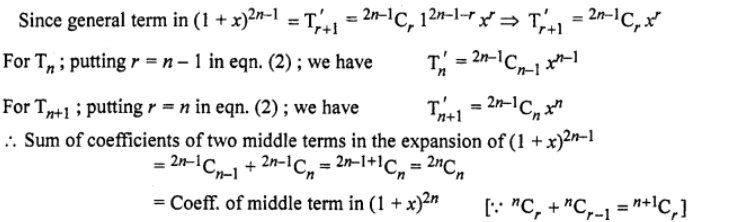
Que-12: Show that the coefficient of the middle term in the expansion of (1 + x)2n is the sum of the coefficients of two middle terms in the expansion of (1 + x)2n – 1.
Sol: On comparing (1 + x)2n with (x + a)n; we have
‘x’ = 1 ; ‘a’ = x; ‘n’ = 2n
We know that, general term = Tr+1 = nCr xn – r ar
∴ Tr+1 = 2nCr 12n – r xr = 2nCr xr …(1)
Here no. of terms = 2n + 1 (odd) ; so their is only one middle term given by T{(2n/2)+1} i.e. Tn+1
putting r = n in eqn. (1); we have
Tn+1 = 2nCn xn
Therefore, coeff. of middle term in (1 + x)2n = 2nCn
On comparing (1 + x)2n – 1 with (x + a)n; ‘x’ = 1; ‘a’ = x ; ‘n’ = 2n – 1
∴ no. of terms = 2n – 1 + 1 = 2n (even)
Thus there are two middle terms given by
Que-13: Show that the middle term in the expansion of (1 + x)2n is [{1.3.5…(2n-1)}/n!].2^n x^n where n ∈ N.
Sol: On comparing (1 + x)2n with (x + a)n; we have
‘x’ = 1 ;’a’ = x ; ‘n’ = 2n
We know that, general term = Tr+1 = nCr xn-r ar
∴ Tr+1 = 2nCr 12n-r xr = 2nCr xr …(1)
Here no. of terms = 2n + 1 = odd
So there is only one middle term given by T[(2n/2)+1] i.e. Tn+1.
So putting r = n in eqn. (1); we have
![Que-13: Show that the middle term in the expansion of (1 + x)2n is [{1.3.5...(2n-1)}/n!].2^n x^n where n ∈ N.](https://icsehelp.com/wp-content/uploads/2025/07/a-1.png)
Que-14: Find the coefficient of x5 in the expansion of 1 + (1 + x) + (1 + x)2 + …. + (1 + x)10.
Sol: Given expansion = 1 + (1 + x) + (1 + x)2 …. + (1 + x)10
it form G.P with first term = 1 and common ratio = 1 + x > 1 and n = 11
= [{(1+x)^11−1}/{1+x−1}] = [{(1+x)^11−1}/x]
So coefficient of x5 in given expansion = Coeff. of x5 in [{(1+x)^11−1}/x]
= Coeff. of x6 in (1 + x)11 – 1 = 11C6
= 11!/(6!5!)
= (11×10×9×8×7)/(5×4×3×2) = 462
Que-15: If xp occurs in the expansion of [x²+(1/x)]^2n, prove that the coefficient is
![Que-15: If xp occurs in the expansion of [x²+(1/x)]^2n, prove that the coefficient is](https://icsehelp.com/wp-content/uploads/2025/07/b-1.png)
Sol: On comparing [x²+(1/x)]^2n with (x + a)n we have, ‘x’ = x2; ‘a’ = 1/x ; ‘n’ = 2n
We know that, General term = Tr+1 = nCr xn-r ar
∴ Tr+1 = 2nCr(x2)2n-r (1/x)^r ⇒ Tr+1 = 2nCr x4n-2r (1/x^r) = 2nCr x4n-3r …(1)
Let xp occurs in (r + 1)th term of [x²+(1/x)]^2n
Therefore from eqn. (1); we have
![Que-15: If xp occurs in the expansion of [x²+(1/x)]^2n, prove that the coefficient is](https://icsehelp.com/wp-content/uploads/2025/07/c-2.png)
Que-16: If P be the sum of odd terms and Q be the sum of even terms in the expansion of (x + a)n, prove that
(i) P2 – Q2 = (x2 – a2)n,
(ii) 4PQ = (x + a)2n – (x – a)2n and
(iii) 2 (P2 + Q2) = (x + a)2n + (x – a)2n.
Sol: We know that, general term in the expansion of (x + a)n = Tr+1 = nCr xn-r ar
∴ (x + a)n = T1 + T2 + T3 + ….
⇒ (x + a)n = (T1 + T3 + T5 + ….) + (T2 + T4 + T6 + ….) = P + Q
⇒ (x + a)n = P + Q …(1)
Also, (x – a)n = T1 – T2 + T3 – T4 + …… = (T1 + T3 + T5 + …..) – (T2 + T4 + T6 + ….)
⇒ (x – a)n = P – Q …(2)
(i) P2 – Q2 = (P – Q)(P + Q) = (x – a)n (x + a)n = [x2 – a2]n
(ii) (x + a)2n = (P + Q)2 …(3)
and (x – a)2n = (P – Q)2 …(4)
Thus, (x + a)2n – (x – a)2n = (P + Q)2 – (P – Q)2 = P2 + Q2 + 2PQ – P2 – Q2 + 2PQ = 4PQ
(iii) On adding (3) and (4); we have
(x+a)2n + (x – a)2n = (P + Q)2 + (P – Q)2 = 2(P2 + Q2)
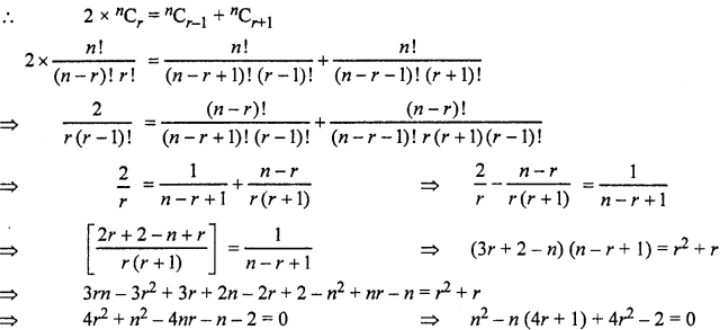
Que-17: If the coefficients of the rth, (r + 1)th and (r + 2)th terms in the expansion of (1 + x)n are in A.P., prove that n2 – n(4r + 1) + 4r2 – 2 = 0.
Sol: We know that, general term = Tr+1 = nCr xn-r ar
[Here x = 1 ; a = x ; n = n]
∴ Tr+1 = nCr 1n-r xr = nCr xr
∴ Coeff. of r th term = nCr – 1 and Coeff. of (r + 2)th term = nCr+1
Coeff. of (r + 1)th term = nCr
Since coefficients of rth, (r + 1)th and (r + 2)th terms in the expansion of (1 + x)n are in A.P.
Que-18: In the expansion of [x²+(1/x)]^n, the coefficient of the fourth term is equal to the coefficient of the ninth term. Find n and the sixth term of the expansion.
Sol: On comparing [x²+(1/x)]^n with (x + a)n; we have
‘ x’ = x2; ‘a’ = (1/x); n = n
We know that, General term = Tr+1 = nCr xn-r ar
⇒ Tr+1 = nCr (x2)n – r (1/x)^r = nCr x2n – 3r …(1)
For T4; putting r = 3 in eqn. (1); we have
T4 = nC3 x2n-9
For T9; putting r = 8 in eqn. (1); we have
T9 = nC8 x2n-24
Given coeff. of T4 = coeff of T9
⇒ nC3 = nC8 ⇒ n = 3 + 8 = 11
[∵ nCr = nCs ⇒ r = s or r + s = n]
For T6; putting r = 5 in eqn. (1); we have
∴ T6 = 11C5 x22 – 15 =11C5 x7 = {11!/(5!6!)}x^7
= (11×10×9×8×7)/(5×4×3×2) x^7 = 462 x^7
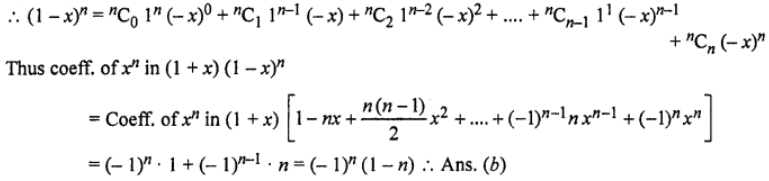
Que-19: The coefficient of xn in the expansion of (1 + x)(1 – x)n is
(a) (- 1)n-1 . (n – 1)2
(b) (-1)n (1 – n)
(c) n – 1
(d) (- 1)n-1.n
Sol: By using binomial theorem, we have
Que-20: If rth and (r+1)th terms in the expression of (p+q)%n are equal, then prove that [{(n+1)q}/{r(p+q)}] = 1
Sol: Given, (p + q)n
∴ General term = Tr + 1 = nCr pn – r qr
∴ rth term = Tr = nCr–1 (p)n – (r – 1) qr – 1
= nCr – 1 pn – r + 1 qr – 1
(r + 1)th term = Tr+1 = nCr pn – r qr
Given, Tr = Tr + 1
⇒ nCr – 1 pn – r + 1 qr – 1 = nCr pn – r q^r
![Que-20: If rth and (r+1)th terms in the expression of (p+q)%n are equal, then prove that [{(n+1)q}/{r(p+q)}] = 1](https://icsehelp.com/wp-content/uploads/2025/07/1-14.png)
Que-21: Find n in the binomial [√2+(1/√3)]^n, if the ratio of the 7th term from the beginning to the 7th term from the end is 1/6.
Sol: In the binomial expansion of [√2+(1/√3)]^n [(n+1)-7+1]th i.e., (n − 5)th term from the beginning is the 7th term from the end.
Now,
![Que-21: Find n in the binomial [√2+(1/√3)]^n, if the ratio of the 7th term from the beginning to the 7th term from the end is 1/6.](https://icsehelp.com/wp-content/uploads/2025/07/2-13.png)
4 – (n/3) = 1
n = 9.
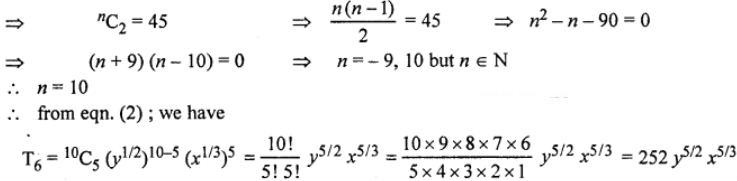
Que-22: Find the sixth term of the expansion of (y1/2 + x1/3)n, if the binomial coefficient of the third term from the end is 45.
Sol: On comparing (y1/2 + x1/3)n with (x + a)n; we have
‘x’ = y1/2; ‘a’ = x1/3; n = n
We know that, general term = Tr+1 = nCr xn-r αr
∴ Tr+1 = nCr (y1/2)n-r (x1/3)r …(1)
For T6; putting r = 5 in eqn. (1); we have
T6 = nC5 (y1/2)n-5 (x1/3)5 …(2)
We know that, rth term from end in (x + a)n = (n – r + 2)th term from beginning in (x + a)n
Thus 3rd term from end = (n – 3 + 2) th i.e. (n – 1) th term from beginning
Replacing r by n – 2 in eqn. (1); we have
Tn – 1 = nCn – 2 (y1/2)n – (n -2) (x1/3)n-2 = nC2 (y1/2)2 (x1/3)n – 2 [∵ nCr = nCn – r]
given coeff. of 3rd term from end = 45
Que-23: (a) If the coefficients of second, third and fourth terms in the expression of (1+x)^2n are in A.P., then show that 2n²-9n+7 = 0
Sol: Given expression = (1 + x )2n
Coefficient of second term = 2nC1
Coefficient of third term = 2nC2
And coefficient of fourth term = 2nC3
As the given condition
2nC1. 2nC2 and 2nC3 are in A.P.
∴ 2nC2 – 2nC1 = 2nC3 – 2nC2
2. 2nC2 = 2nC1 + 2nC3

⇒ n(2n – 1) = n + [{n(2n-1)(2n-2)}/6]
⇒ 2n – 1 = 1 + [{(2n-1)(2n-2)}/6]
⇒ 12n – 6 = 6 + 4n2 – 4n – 2n + 2
⇒ 12n – 12 = 4n2 – 6n + 2
⇒ 4n2 – 6n – 12n + 2 + 12 = 0
⇒ 4n2 – 18n + 14 = 0
⇒ 2n2 – 9n + 7 = 0
Hence proved.
(b) In the expression (1+x)^n, if the coefficients of 2nd, 3rd and 4th terms are in A.P., then find the value of n.
Sol: Given expression is (1 + x)n
(1 + x)n = nC0 + nC1x + nC2x2 + nC3x3 + … nCnxn
Here, coefficient of 2nd term = nC1
Coefficient of 3rd term = nC2
And coefficient of 4th term = nC3
Given that nC1, nC2 and nC3 are in A.P.
∴ 2 . nC2 = nC1 + nC3
⇒ 2 . [{n(n-1)}/2] = n + [{n(n-1)(n-2)}/3.2.1]
⇒ n(n-1) = n + [{n(n-1)(n-2)}/6]
⇒ n – 1 = 1 + [{(n-1)(n-2)}/6]
⇒ 6n – 6 = 6 + n2 – 3n + 2
⇒ n2 – 3n – 6n + 14 = 0
⇒ n2 – 9n + 14 = 0
⇒ n2 – 7n – 2n + 14 = 0
⇒ n(n – 7) – 2(n – 7) = 0
⇒ (n – 2)(n – 7) = 0
⇒ n = 2, 7
⇒ n = 7
Whereas n = 2 is not possible
–: End of Binomial Theorems Class 11 OP Malhotra Exe-13B ISC Maths Ch-13 Solutions. :–
Return to :- OP Malhotra ISC Class-11 S Chand Publication Maths Solutions
Thanks
Please share with your friends