Ch-Test of Coordinates and Graphs of Simultaneous Linear Equations Class 9 OP Malhotra ICSE Maths Solutions 2026-27. We Provide Step by Step Solutions / Answer of Coordinates and Graphs of Simultaneous Linear Equations OP Malhotra Maths. Visit official Website CISCE for detail information about ICSE Board Class-9 Mathematics.
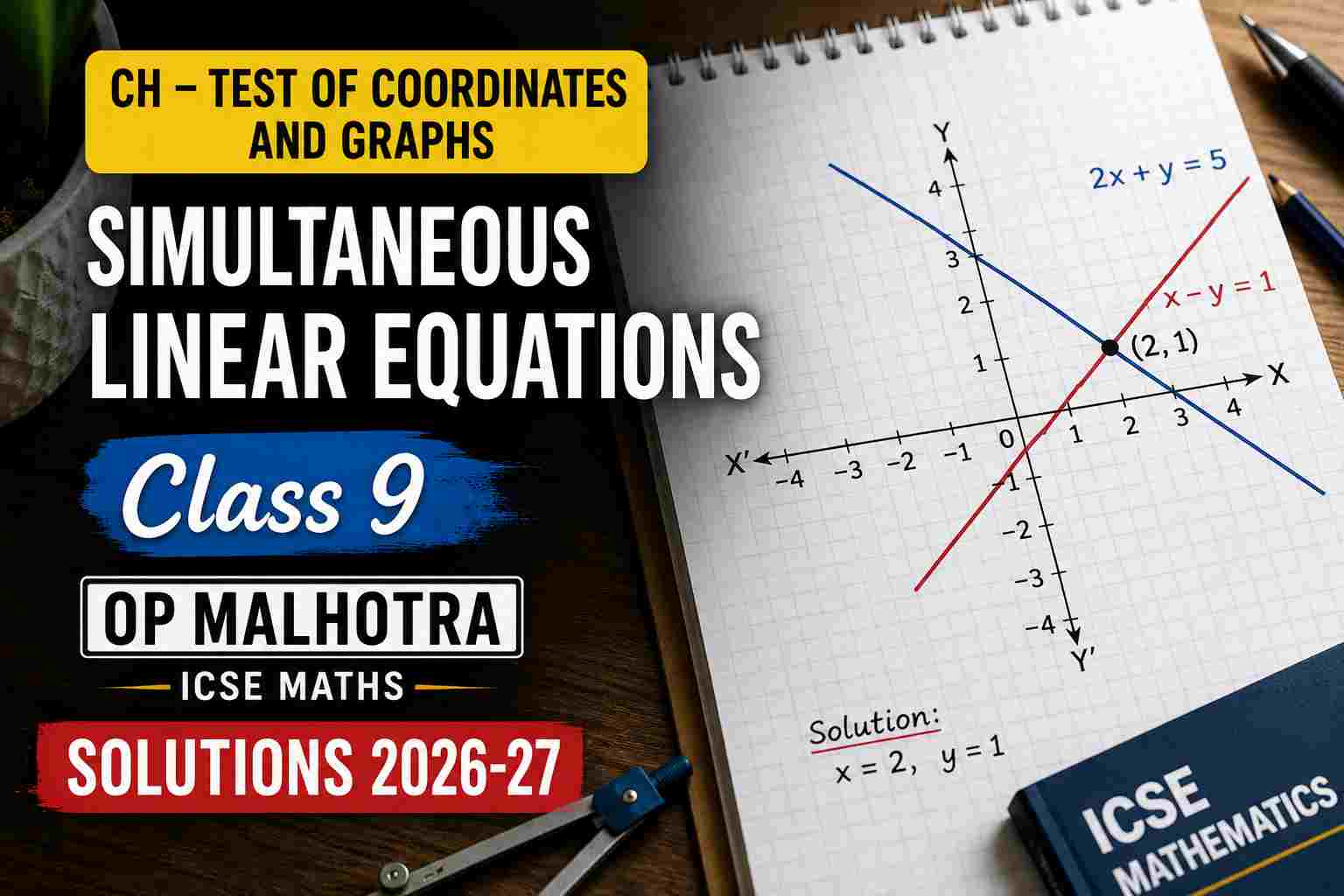
Coordinates and Graphs of Simultaneous Linear Equations Class 9 OP Malhotra Ch-Test ICSE Maths Solutions
| Board | ICSE |
| Publications | S Chand |
| Subject | Maths |
| Class | 9th |
| Chapter-20 | Coordinates and Graphs of Simultaneous Linear Equations |
| Writer | OP Malhotra |
| Ch-Test | Extra Practice Questions |
| Edition | 2026-2027 |
Ch-Test on Coordinates and Graphs of Simultaneous Linear Equations
Coordinates and Graphs of Simultaneous Linear Equations Class 9 OP Malhotra ICSE Maths Solutions 2026-27
Que-1: If (1, 2) and (3, 8) are the extremes of a diagonal of a square, then the area of the square is
(a) 10 sq. units (b) 20 sq. units (c) 15 sq. units (d) 8 sq. units
Sol: (1, 2) and (3, 8) are the end points of a diagonal of a square
∴ Length of diagonal = √{(3−1)²+(8−2)²}
= √(2²+6²) = √(4+36) = √40
∴ Area of square = ( Diagonal )²/2
(√40)²/2 = 40/2 = 20 sq. units (b)
Que-2: If the distance between two points (0, -5) and (x, 0) is 13 units, then x =
(a) 10 (b) ±10 (c) 12 (d) ± 12
Sol: Distance between (0, -5) and (x, 0) = 13
⇒ √{(x−0)²+(0+5)²} = 13
⇒ √(x²+25) = 13
x2 + 25 = 169 ⇒ x2 = 169 – 25 = 144
⇒ x2 = (± 12)2
∴ x = ± 12 (d)
Que-3: If A (x, y) is equidistant from P (-3, 2) and Q (2, -3) then
(a) 2x = y (b) x = -y (c) x = 2y (d) x = y
Sol: A (x, y) is equidistant from P (-3, 2) and Q (2, -3)
Then AP = AQ
⇒ √{(−3−x)²+(2−y)²} = √{(2−x)²+(−3−y)²}
Squaring,
(-3 -x)2 + (2 – y)2 = (2 – x)2 + (-3 -y)2
⇒ 9 + x2 + 6x + 4 + y2 – 4y = 4 + x2– 4x + 9 + y2 + 6y
⇒ 6x – 4y + 13 = 6y – 4x + 13
⇒ 6x + 4x =6y + 4y ⇒ 10x = 10y
∴ x = y
Que-4: The nearest point from the origin is
(a) (2,-3) (b) (6,0) (c) (-2,-1) (d) (3,5)
Sol: Distance between origin (0, 0) is
(a) (2, -3) = √(2²+3²) = √(4+9) = √13
(b) (6, 0) = √(6²+0²) = √36 = 6
(c) (-2, -1) = √{(−2)²+(−1)²} = √(4+1) = √5
(d) (3, 5) = √(3²+5²) = √(9+25) = √34
It is clear that point (-2, -1) is nearest to (0, 0) (c)
Que-5: The coordinates of the vertices of a side of square are (4, -3) and (-1, -5). Its area is
(a) 2√29 sq. units (b) 8√9/2 sq. units (c) 89 sq. units (d) 29 sq. units
Sol: The coordinates of the each of a side of square are (4, -3) and (-1, -5)
∴ Length of side = √{(−1−4)²+(−5+3)²}
= √{ (−5)²+(−2)²}
= √(25+4) = √29
∴ Area of square = (Side)2
= (√29)2 sq. units
= 29 sq. units (d)
Solve by graphing.
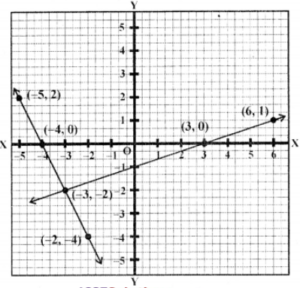
Que-6: 2x + y = -8
y = (1x/3) – 1
Sol: 2x + y = -8
y = (1x/3) – 1
2x + y = -8 ⇒ y = -2x – 8
Giving some different values to x, we get corresponding values of y as given below:

Now plot the points (-2, -4),(-4, 0),(-5, 2) on the graph and join them to get a line Similarly, y = (1x/3) – 1

Plot the points (3, 0),(6, 1) and (-3, -2) on the graph and join them to get another line. We see that these two lines intersect each other at (-3, -2)
∴ x = -3, y = -2
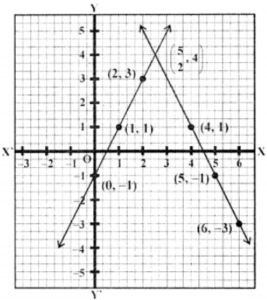
Que-7: Draw the graph of 2x – y – 1 = 0 and 2x + y = 9, on the same axes. Use 2 cm = 1 unit on both axes and plot only 3 points per line. Read the coordinates of their point of intersection.
Sol: 2x – y – 1 = 0 and 2x + y = 9
⇒ x = (y+1)/2

Plot the points (1, 1),(2, 3) and (0, -1) on the graph and join them to get a line.
Similarly 2x + y = 9
y = 9 – 2x

Plot the points (4, 1),(5, -1) and (6, -3) on the graph and join them to get another line.
These two lines intersect each other at point (5/2, 4)
∴ x = 5/2, y = 4
Que-8: Choose the equation whose graph is given here
(a) y = x
(b) x + y = 0
(c) y = 2x
(d) 2 + 3y = 7x
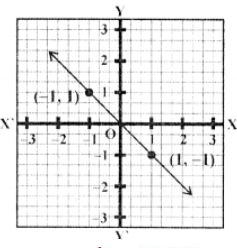
Sol: From the given graph, Two points are given on it whose x and y are equal but in opposite signs
It is through the origin
Equation will be x = -y
⇒ x + y = 0
Que-9: The distance between the point (0, 0) and the intersecting point of the graphs of x = 3 and y = 4 is
(a) 4 units (b) 3 units (c) 2 units (d) 5 units
Sol: The distance between the point (0, 0) and point of intersection of x = 3 and y = 4
i.e., (3, 4) will be = √{(3−0)²+(4−0)²}
= √{3²+4²} = √(9+16)
= √25 = 5 units
Que-10: The points (-4, 0),(4, 0),(0, 3) are the vertices of a
(a) right triangle
(b) isosceles triangle
(c) equilateral triangle
(d) scalene triangle
Sol: The points (-4, 0),(4, 0),(0, 3) are given Now,
AB = √{(4+4)²+(0+0)²} = √{8²+0²} = √64 = 8
BC = √{(0−4)²+(3−0)²} = √{(−4)²+(3)²} = √(16+9) = √25 = 5
AC = √{(0−4)²+(3−0)²} = √{(−4)²+(3)²} = √(16+9) = √25 = 5
∴ BC = AC
∴ The given points are the vertices of an isosceles triangle. (b)
— : End of Coordinates and Graphs of Simultaneous Linear Equations Class-9 OP Malhotra Ch-Test ICSE Maths Solutions :–
Return to :– OP Malhotra S Chand Solutions for ICSE Class-9 Maths
Thanks
Please Share with Your Friends