Chemical Bonding Long Ans Concise Class-10 ICSE Chemistry Selina Solutions. We Provide Step by Step Answer of Long Ans, Exercise-2, ICSE Class-10. The given Solutions is according to the Latest editions. Visit official Website CISCE for detail information about ICSE Board Class-10.
Chemical Bonding Long Ans Concise Class-10 ICSE Chemistry Selina Solutions
| Board | ICSE |
| Book / Publication | Concise / Selina |
| Subject | Chemistry |
| Class | 10th |
| Writer | Dr SP Singh |
| Chapter-2 | Chemical Bonding |
| Topics | Long Ans |
| Edition | 2025-2026 |
Chemical Bonding Long Ans ICSE Class-10 Concise Chemistry Selina Solutions Chapter-2
Page-36
Que-1: Define a coordinate bond and give the conditions for its formation.
Ans: The bond formed between two atoms by sharing a pair of electrons, provided entirely by one of the combining atoms but shared by both is called a coordinate bond.
Conditions for the formation of coordinate bond are:
(i) One of the two atoms must have at least one lone pair of electrons, e.g., ammonia (NH3), water (H2O).
(ii) Another atom should be short of at least a pair of electrons, e.g., Hydrogen ion (H+).
Que-2: Draw an electron dot diagram for the formation of each of the following :
(i) Hydronium ion,
(ii) Ammonium ion,
(iii) Hydroxyl ion.
State the type of bonding present in them.
Ans:
(i) Hydronium ion
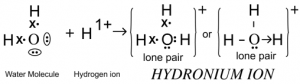
Co-ordinate & Covalent Bond.
(ii) Ammonium ion
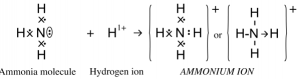
Co-ordinate & Covalent Bond.
(iii) Hydroxyl ion
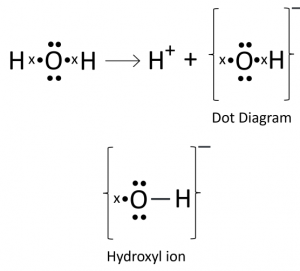
Polar Covalent Bond.
Que-3: (a) How many atoms of each kind are present in the following molecules : calcium oxide, chlorine, water, carbon tetrachloride ?
(b) How many electrons are required or released by each atom mentioned in (a) to attain the nearest noble gas configuration ?
Ans:
(a) Calcium oxide (CaO)
is formed by one calcium and one oxygen atom.
Chlorine (Cl2) molecule is formed by two chlorine atoms.
Water (H2O) is formed by two hydrogen and one oxygen atom.
Carbon Tetrachloride(CCl4) is formed by one carbon and four chlorine atoms.
(b) In Calcium oxide (CaO),
Calcium needs to lose 2 electrons and Oxygen gains that 2 electrons to attain the nearest noble gas configuration.
Chlorine (Cl2) molecule,
each Chlorine atom needs an electron to complete its octet. So, two Chlorine atoms share a pair of electrons to attain the nearest noble gas configuration.
Water (H2O),
each Hydrogen atom needs one electron and one Oxygen atom needs two electrons to complete their duplet and octet respectively. So, each Hydrogen shares a pair of electrons with Oxygen to attain the nearest noble gas configuration.
In Carbon Tetrachloride (CCl4), each Carbon atom needs 4 electrons and each Chlorine atom needs one electron to complete their octet. So, each Chlorine shares a pair of electrons with Carbon to attain the nearest noble gas configuration.
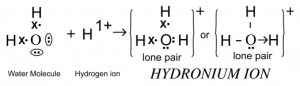
Que-4: Acids dissolve in water and produce positively charged ions. Draw the structure of these positive ions.
Ans: When acids dissolve in water they produce hydronium ion. Structure of hydronium ion is shown below:
Que-5:
(a) Elements Q and S react together to form an ionic compound. Under normal conditions, which physical state will the compound QS exist in ?
(b) Elements Q and S react together to form an ionic compound. Can Q and S, both be metals ? Justify your answer.
Ans:
(a) QS exist in hard solid state.
Hint: As QS is an ionic compound, it consists of ions bond tightly together by strong electrostatic forces between them. Due to this it is a hard solid.
(b) No, Q and S both can’t be metals because Q and S react together to form an ionic compound. It is only possible when one of them is metal and the other one is non-metal.
Que-6: Draw the structural formula of carbon tetrachloride and state the type of bond present in it.
Ans: Structural formula of carbon tetrachloride is given below:
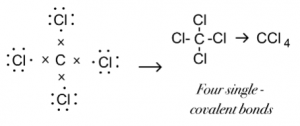
Covalent bond is present in carbon tetrachloride.
Que-7: Compare carbon tetrachloride and sodium chloride with regard to solubility in water and electrical conductivity.
Ans:
| Carbon tetrachloride | Sodium chloride | |
|---|---|---|
| Solubility in water | Insoluble in water | Soluble in water |
| Electrical conductivity | Non Conductor | Good conductors in aqueous state or molten state |
Que-8: Draw an electron dot diagram of hydronium ion. State the type of bonding present in it.
Ans: Electron dot diagram showing the structure of Hydronium ion is given below:
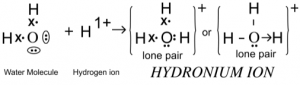
Co-ordinate bond is present in hydronium ion.
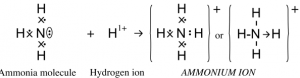
Que-9: By drawing an electron dot diagram, show the lone pair effect leading to the formation of — ammonium ion from ammonia gas and hydrogen ion.
Ans: Electron dot diagram showing the lone pair effect for formation of NH41+ ion from NH3 gas and H1+ is given below:
Que-10: Study the extract of the Periodic table given below and answer the questions that follow. Give the alphabet corresponding to the element in question: DO NOT repeat an element.
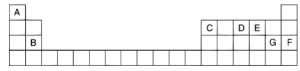
(a) Which element forms an electrovalent compound with G?
(b) The ion of which element will migrate towards the cathode during electrolysis?
(c) Which non metallic element has the valency 2?
(d) Which is the inert gas?
Ans: (a) B
Hint: G is Group 17 halogen atom and it will form electrovalent bond with Group 1 metal B atom.
(b) A
Hint: A is a first group element. when it loses its electron it will form a cation and migrate towards cathode.
(c) E
Hint: E is a non metal which belongs to Group 16. Hence has the valency of 2.
(d) F
Hint: Here F is present in Group 18 and all Group 18 elements are inert gases.
Que-11: The following table shows the electronic configuration of the elements W, X, Y, Z :
| Element | W | X | Y | Z |
| Electronic Configurations |
2, 8, 1 | 2, 8, 7 | 2, 5 | 1 |
Answer the following questions based on the table above:
(i) What type of bond is formed between:
- W and X
- Y and Z
(ii) What is the formula of the compound formed between :
- X and Z
- W and X
Ans: (i) Type of bond formed
(a) W (2,8,1) and X (2,8,7) — Electrovalent bond is formed as W donates 1 electron and X takes up that electron and both attain a stable octet.
(b) Y (2, 5) and Z (1) — Covalent bond as electron sharing takes place between the two elements. The valency of Z element is 1 and that of Y is 3. Z needs one electrons to attain stable duplet structure of nearest noble gas – He [2] and Y needs three electrons to attain stable octet structure of nearest noble gas – Ne [2,8]
One Y atom shares three electron pairs one with each of the three atoms of Z such that Z acquires a duplet configuration and Y attain a stable octet configuration resulting in the formation of three single covalent bonds.
(ii) Formula of the compound formed
(a) X (2,8,7) and Z (1) — XZ as X needs one 1 electron to complete it’s octet and Z needs needs one electron to complete it’s duplet hence, they both share one electron pair and forms ZX compound.
(b) W (2,8,1) and X (2,8,7) — WX as W has the tendency to donate one electron and gain stability whereas X has the tendency to gain one electron to be stable. Hence, W donates one electron and X takes it and form WX compound.
—: End of Chemical Bonding Long Ans Concise Class-10 ICSE Chemistry Selina Solutions Ch-1 : –
Return to:- Concise Selina Chemistry for ICSE Class-10 Solutions
Please Share with Your Friends if Helpful
Thanks