Chemical Bonding Short Ans Concise Class-10 ICSE Chemistry Selina Solutions. We Provide Step by Step Answer of Short Ans, Exercise-2, ICSE Class-10. The given Solutions is according to the Latest editions. Visit official Website CISCE for detail information about ICSE Board Class-10.
Chemical Bonding Short Ans Concise Class-10 ICSE Chemistry Selina Solutions
| Board | ICSE |
| Book / Publication | Concise / Selina |
| Subject | Chemistry |
| Class | 10th |
| Writer | Dr SP Singh |
| Chapter-2 | Chemical Bonding |
| Topics | Short Ans |
| Edition | 2025-2026 |
Chemical Bonding Short Ans ICSE Class-10 Concise Chemistry Selina Solutions Chapter-2
Page-36
Que-1: What do you understand by lone pair of electrons.
Ans: A pair of electrons which is not shared with any other atom is known as the lone pair of electrons.
Que-2: State the type of bonding in the following molecules.
(a) water,
(b) calcium oxide,
(c) hydroxyl ion,
(d) methane,
(e) ammonium ion,
(f) ammonium chloride
Ans:
(a) Polar Covalent Bond,
(b) Ionic Bond,
(c) Polar Covalent Bond,
(d) Non Polar Covalent Bond,
(e) Coordinate & Covalent Bond,
(f) Ionic, Covalent and Co-ordinate Bond.
Que-3: Give reasons :
(a) Hydrogen chloride can be termed as a polar covalent compound.
(b) Covalent compounds can exist as gases, liquids or soft solids.
(c) Carbon tetrachloride does not dissolve in water.
Ans:
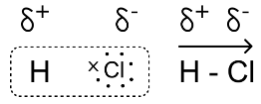
(a) In hydrogen chloride, the strong nuclear charge of the chlorine atom attracts the shared electron pair towards itself, i.e., negative charge shifts towards the chlorine atom thereby developing a slight negative charge on it. The hydrogen atom develops a slight positive charge. Therefore, a polar covalent bond is formed as shown below :
(b) Covalent compounds exist as gases, liquids or soft solids as they have weak force of attraction between their molecules.
(c) Carbon tetrachloride is a non-polar compound and water is a polar compound. Same kind of compounds dissolve in each other that’s why carbon tetrachloride does not dissolve in water.
Que-4: There are three elements E, F, G with atomic numbers 19, 8 and 17 respectively. Give the molecular formula of the compound formed between E and G and state the type of chemical bond in this compound.
Ans: EG is the chemical formula.
The electronic configuration of E is (2,8,8,1) and G is (2,8,7). We observe that E tends to donate one electron and G tends to gain one electron to attain a stable state. Hence, the the two oppositely charged ions attract each other to form an ionic compound EG.
Ionic bond will be formed.
Que-5: A compound is formed between atoms A and B. The electronic configuration of A is 2,8,1 and B is 2,6.
(a) Write the equation of the formation of ions of A and B.
(b) Why do A and B form ions?
(c) Which of the following can form a compound?
(i) A and A (ii) A and B (iii) B and B
Also state the type of bonding present in the compound
(d) If A and B combines, which of them will get oxidised?
(e) Draw an electron dot diagram of the ionic compound formed in part (c).
(f) Write the formula of the compound formed in part (c) which has a
(i) high melting and boiling point
(ii) gaseous compound
(iii) good conductor of electricity in molten state.
Ans:
(a) Atom A loses one electron:
A ⟶ A+ + e–
Atom B gains two electrons
B + 2e– ⟶ B2-
(b) A and B form ions to achieve a stable noble gas configuration:
A loses 1 electron → becomes A⁺ with a configuration of 2,8 (like neon).
B gains 2 electrons → becomes B²⁻ with a configuration of 2,8 (also like neon).
(c) A and B can form a compound, electrovalent bonding will be present in it.
(d) Oxidation is the loss of electrons.
A (sodium) loses 1 electron to form Na+. Hence A gets oxidised
(e) Electron dot diagram is shown below:

(f)
(i) A2B
(As A2B is an ionic compound, hence, it will have high melting and boiling point)
(ii) A and B will not form a gaseous compound.
(iii) A2B
(As A2B is an ionic compound, hence, ions will be free to move when in molten state)
—: End of Chemical Bonding Short Ans Concise Class-10 ICSE Chemistry Selina Solutions Ch-1 : –
Return to:- Concise Selina Chemistry for ICSE Class-10 Solutions
Please Share with Your Friends if Helpful
Thanks