Circle Class 11 OP Malhotra Exe-17A ISC Maths Ch-17 Solutions. In this article you would learn about Equation of a Circle and Diameter Form. Step by step solutions of latest textbook has been given as latest syllabus. Visit official Website CISCE for detail information about ISC Board Class-11 Mathematics.
Circle Class 11 OP Malhotra Exe-17A ISC Maths Solutions Ch-17
| Board | ISC |
| Publications | S Chand |
| Subject | Maths |
| Class | 11th |
| Chapter-17 | Circle |
| Writer | O.P. Malhotra |
| Exe-17(A) | Equation of a Circle and Diameter Form. |
Equation of a Circle and Diameter Form.
Circle Class 11 OP Malhotra Exe-17A ISC Maths Ch-17 Solutions.
Que-1: Find the equation of the circle
(i) whose centre is (4, 5), radius is 7 ;
(ii) whose centre is (0, – 4) and which touches the x-axis ;
(iii) which passes through the origin and cuts off intercepts of length ‘a’, each from positive direction of the axes.
Sol: (i) eqn. of circle having centre (4, 5) and radius 7 is given by
(x – 4)2 + (y – 5)2 = 72 [using centre-radius form]
⇒ x2 + y2 – 8x – 10y – 8 = 0
(ii) Thus required eqn. of circle having centre (0, – 4) and radius 4 is given by
(x-0)2 + (y + 4)2 = 42
⇒ x2 + y2 + 8y = 0
(iii) Thus AB becomes the diameter of circle. Therefore eqn. of circle having extremities of diameter of circle are (a, 0) and (0, a) be given by
(x – a) (x – 0) + (y – 0) (y – a) = 0
⇒ x2 + y2 – ax – ay = 0
Que-2: Find the equation of the circle
(i) whose centre is (a, b) and which passes through the origin ;
(ii) whose centre is the point (2, 3) and which passes through the intersection of the lines 3x – 2y – 1 = 0 and 4x + y – 27 = 0.
Sol: (i) Let r be the radius of circle.
Then eqn. of circle having centre (a, b) and radius r be given by
(x – a)2 + (y – b)2 = r2 …(1)
Now eqn. (1) passes through (0, 0).
∴ (0 – a)2 + (0 – b)2 = r2 ⇒ r2 = a2 + b2
∴ eqn. (1) reduces to ;
(x – a)2 + (y – b)2 = a2 +b2
⇒ x2 + y2 – 2ax – 2by = 0
which is the required eqn. of circle.
(ii) Given eqns. of lines are
3x – 2y – 1 = 0 …(1)
and 4x + y – 27 = 0 …(2)
On solving eqn. (1) and (2); we get
11x – 55 = 0 ⇒ x = 5 and y = 7
∴ required point of intersection of lines (1) and (2) be (5, 7).
∴ radius of required circle = | CA |
= √{(5-2)²+(7-3)²}
= √(9+16) = 5
Hence the required eqn. of circle having centre C(2, 3) and radius 5 be given by
(x – 2)2 + (y – 3)2 = 25
⇒ x2 + y2 – 4x – 6y – 12 = 0
Que-3: Find the equation of the circle which has A(1, 3) and B(4, 5) as opposite ends of a diameter. Find also the equation of the perpendicular diameter.
Sol: The required eqn. of circle having A(1, 3) and B(4, 5) be the extremities of diameter is given by
(x – 1)(x – 4) + (y – 3)(y – 5) = 0
⇒ x2 + y2 – 5x – 8y + 19 = 0
Thus centre of circle be the mid-point of diameter AB.
∴ Coordinates of C are (5/2, 4)
slope of diameter AB = (5−3)/(4−1) = 2/3
∴ slope of ⊥ diameter = –1/(2/3) = 3/2 [∵ m1 m2 = – 1]
Hence the required eqn. of ⊥ diameter passes through the centre (5/2,4) and having slope –3/2 be given by
y – 4 = – (3/2) (x−(5/2))
⇒ 2y – 8 = – 3x + (15/2)
⇒ 6x+ 4y – 31 = 0
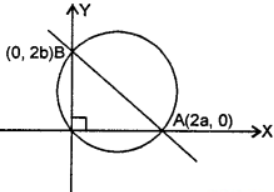
Que-4: Find the equation to the circles which pass through the origin and cut off intercepts equal to (i) 2 and 4 , (ii) 2a and 2b from the x-axis and the y-axis respectively
Sol: (i) Thus AB becomes the diameter of circle having end-points are (3, 0) and (0, 4). using diametrical form, eqn. of circle be given by
(x – 3) (x – 0) + (y – 0)(y – 4) = 0
⇒ x2 + y2 – 3x – 4y = 0
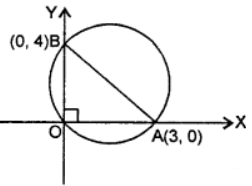
(ii) Thus AB becomes the diameter of circle having end points are A(2a, 0) and B(0, 2b).
using diameter form, eqn. of circle be given by
(x – 2a)(x – 0) + (y – 0)(y – 2b) = 0
⇒ x2 +y2 – 2ax – 2by = 0
Que-5: Find the equation of the circles which touch the axis of x at a distance of 4 from the origin and cut off an intercept of 6 from the axis of y.
Sol:
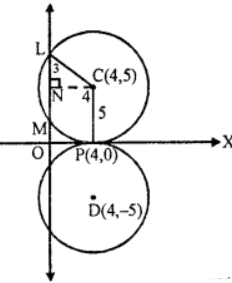
There are four such circles one in each quadrant satisfying the given conditions. Let C and D be the centre of both circles. From C draw CN ⊥ LM. ∴ N be the mid-point of LM. Since LM = 6 units
∴ LN = NM = 3 units and CN = 4 units In right angled △CNL; we have
CL2 = CN2 + LN2 = 42 + 32 = 25
∴ CL = 5 units
∴ CP = 5 units ⇒ ON = 5 units
Thus centre of circles are (4, ± 5).
Hence the required eqns. of circles are
(x – 4)2 + (y ± 5)2 =52
⇒ x2 + y2 – 8x ± 10y + 16 = 0
Similarly two circles one each in 2nd and 3rd quadrant having centre (-4, ± 5).
Thus required eqns. of circles are
(x + 4)2 + (y ± 5)2 = 52
⇒ x2 + y2 + 8x ± 10y + 16 = 0
Que-6: A circle having its centre in the first quadrant touches the y-axis at the point (0, 2) and passes through the point (1, 0). Find the equation of the circle.
Sol: Clearly the circle touches y-axis at A (0, 2). So centre of the circle lies on the line y = 2
∴ Centre of circle be (a, 2).
∴ radius of circle = ⊥ distance drawn from
on x = 0 = | a | = a [∵ a > 0]
∴ required eqn. of circle be given by
(x – a)2 +(y – 2)2 = a2
x2 + y2 – 2ax – 4y + 4 = 0
since eqn. (1) passes through the point B(1, 0).
∴ 1 + 0 – 2a – 0 + 4 = 0 ⇒ a = 5/2
Thus eqn. (1) becomes;
x2 + y2 – 5x – 4y + 4 = 0
be the required eqn. of circle.
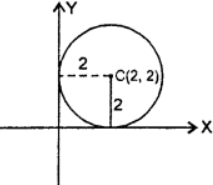
Que-7: Obtain the equation of the circle, radius 2 units, which lies in the positive quadrant and touches both axes of coordinates. Find also the equation of the circle with centre (6, 5) which touches the above circle externally.
Sol: Thus (2, 2) be the centre of required circle. Hence eqn. of required circle having centre (2, 2) and radius 2 is given by
(x – 2)2 + (y – 2)2 = 22
⇒ x2 + y2 – 4x – 4y + 4 = 0
Let r2 be the radius of required circle which touches circle (1) externally.
∴ | C1 C2 | = r1 + r2
⇒ √{(6−2)²+(5−2)²} = 2 + r
⇒ r2 + 2 = 5 ⇒ r2 = 3
Thus the required eqn. of circle having centre (6, 5) and radius 3 be given by
(x – 6)2 + (y – 5)2 = 32
⇒ x2 + y2 – 12x – 10y + 52 = 0
Que-8: Obtain the equation of the circle, centre (1, 0), which passes through the point P [3, {1*(1/2)}]. Find also the equation of the equal circle which touches the given circle externally at P.
Sol: Since the required circle is having centre (1, 0) and passes through the point P [3, {1*(1/2)}]
radius of circle = √[(3-1)²+{(3/2)-0}²]
= √[4+(9/4)] = 5/2
Hence the required eqn. of circle having centre C(1, 0) and radius 5/2 be given by
(x – 1)2 + (y – 0)2 = (5/2)²
⇒ x2 + y2 – 2x + 1 = 25/4
⇒ 4x2 + 4y2 – 8x – 21 = 0
Let C'(h, k) be the required eqn. of circle that touches the circle (1) at point P [3, {1*(1/2)}]
Thus P diameter CC’ in the ratio 1 : 1
∴ Coordinates of P are [{(h+1)/2}, (k/2)]
Also coordinates of P are (3, 3/2)
∴ (h+1)/2 = 3 ⇒ h = 5
and k/2 = 3/2 ⇒ k = 3
Thus (5, 3) be the centre of required circle. Hence using centre radius form, eqn. of required circle is using centre (5, 3) and radius 5/2 be given by
(x-5)² + (y – 3)² = 25/4
⇒ x² + y² – 10x – 6y + 34 = 25/4
⇒ 4 x² + 4y² – 40x – 24y + 111 = 0
Que-9: Calculate the co-ordinates of the foot of the perpendicular from the point (- 4, 2) to the line 3x + 2y = 5.
Find the equation of the smallest circle passing through (- 4, 2) and having its centre on the line 3x + 2y =5.
Sol: Solution:
Let M be the foot of perpendicular eqn. of given line be
3x + 2y – 5 = 0 …(1)
∴ slope of line (1) = -3/2
Thus slope of line PM = −1/(−3/2) = 2/3
Hence the eqn. of line PM i.e. passes through the point P(- 3, 2) and having slope 2/3 be given by
y – 2 = (2/3)(x + 4)
⇒ 2x – 3y + 14 = 0
Clearly M be the point of intersection of lines (1) and (2). On solving eqn. (1) and
eqn. (2) simultaneously
we have, x = -1 and y = 4
Thus the required coordinates of foot of ⊥ are M(- 1, 4)
∴ radius of circle = | PM |
= √{(−1+4)²+(4−2)²}
= √13
Clearly M(- 1, 4) be the centre of required circle.
Hence eqn. of circle be given by
(x + 1)2 + (y – 4)2 = 13
⇒ x2 + y2 + 2x – 8y + 4 = 0
Que-10: The point diametrically opposite to the point P(1, 0) on the circle x2 + y2 + 2x + 4y – 3 = 0 is
(a) (3, – 4) (b) (- 3, 4) (c) (- 3, – 4) (d) (3, 4)
Sol: The eqn. of given circle be
x2 + y 2 + 2x + 4y – 3 = 0 …(1)
For point (3, – 4); putting x = 3 , y =- 4 in L.H.S of (1), we have
32 + (- 4)2 + 2 × 3 + 4× (- 4) – 30 = 9 + 16 + 6 – 16 – 30 = + 12 > 0
For point (- 3, 4); putting x = – 3 and y = 4 in L.H.S of (1)
9 + 16 – 6 + 16 – 3 = 32 > 0
For point (- 3, – 4); putting x = – 3 and y = – 4 in L.H.S of (1)
we have, 9 + 16 – 6 – 16 – 3 = 0
For point (3, 4); putting x = 3 and y = 4 in L.H.S of (1)
we have, 9 + 16 + 6 + 16 – 3 = 44 > 0
For point (1, 0); putting x = 1, y = 0 in L.H.S of eqn. (1)
we have 1 + 0 + 2 + 0 – 3 = 0
Clearly both points P(1, 0) and (- 3, – 4) lies on given circle and are the extremities of diameter of given circle and hence both points lies on opposite sides of centre of circle.
Que-11: Find the equation of a circle whose centre is (3,-1) and which cuts off a chord of length 6 units on the line 2x-5y+18=0.
Sol: Given that: Centre of the circle = (3, – 1)
Length of chord AB = 6 units
CP = |{2×3-5×-1+18}/√{(2)²+(-5)²}|
= |(6+5+18)/√229|
= √29
Now AB = 6 units.
∴ AP = 1/2 AB = (1/2)×6 = 3 units
In ΔCPA, AC2 = CP2 + AP2
= (√29)²+(3)²
= 29 + 9 = 38
∴ AC = 38
So, the radius of the circle, r = 38
∴ Equation of the circle is (x – 3)2 + (y + 1)2 = (√38)²
⇒ (x – 3)2 + (y + 1)2 = 38
⇒ x2 + 9 – 6x + y2 + 1 + 2y = 38
⇒ x2 + y2 – 6x + 2y = 28
Hence, the required equation is x2 + y2 – 6x + 2y = 28.
–: End of Circle Class 11 OP Malhotra Exe-17A ISC Maths Ch-17 Solutions. :–
Return to :- OP Malhotra ISC Class-11 S Chand Publication Maths Solutions
Thanks
Please share with your friends