Circle Class 11 OP Malhotra Exe-17C ISC Maths Ch-17 Solutions. In this article you would learn about Equation of the Tangent at a Point on a Circle. Step by step solutions of latest textbook has been given as latest syllabus. Visit official Website CISCE for detail information about ISC Board Class-11 Mathematics.
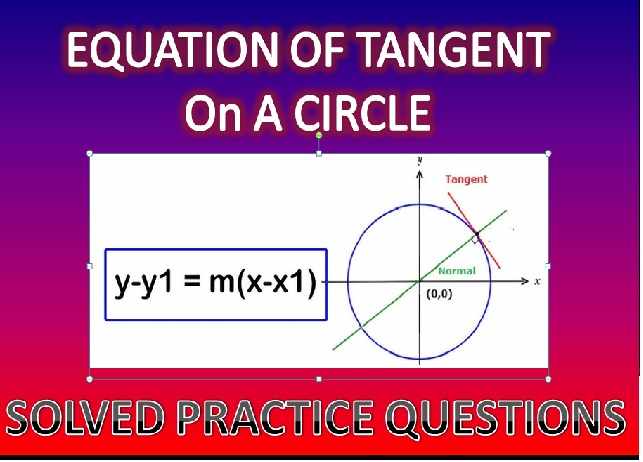
Circle Class 11 OP Malhotra Exe-17C ISC Maths Solutions Ch-17
| Board | ISC |
| Publications | S Chand |
| Subject | Maths |
| Class | 11th |
| Chapter-17 | Circle |
| Writer | O.P. Malhotra |
| Exe-17(C) | Equation of the Tangent at a Point on a Circle. |
Equation of the Tangent at a Point on a Circle.
Circle Class 11 OP Malhotra Exe-17C ISC Maths Ch-17 Solutions.
Points of intersection and length of a chord.
Que-1: The circle 4x2 + 4y2 = 25 cuts the line 3x + 4y – 10 = 0 at A and B. Calculate the coordinates of A and B.
Sol: The eqn. of given line be
3x + 4y – 10 = 0 ⇒ y = (10−3x)/4 …(1)
Substituting the value of y in given circle
4×2 + 4y2 = 25
⇒ 4x² + 4 {(10−3x)/4}² = 25
⇒ 4x² + {(10−3x)²}/4 = 25
⇒ 16x2 + 100 + 9x2 – 60x = 100
⇒ 25x2 – 60x = 0
⇒ 5x (5x – 12) = 0
⇒ x = 0, 12/5
from (1); y = 10/4, [{10−(36/5)}/4]
i.e. y = 5/2 ; 7/10
Hence the required coordinates of A and B are (0,5/2) and (12/5, 7/10).
Que-2: Find the length of the chord x + 2y = 5 of the circle whose equation is x2 + y2 = 9. Determine also the equation of the circle described on the chord as diameter.
Sol: given eqn. of line be x + 2y = 5 ⇒ y = (5−x)/2
putting the value of y in x² + y² = 9; we have
x² + {(5−x)/2}² = 9
⇒ 4x² + (5 – x)² = 36
⇒ 5x² – 10x – 11 = 0
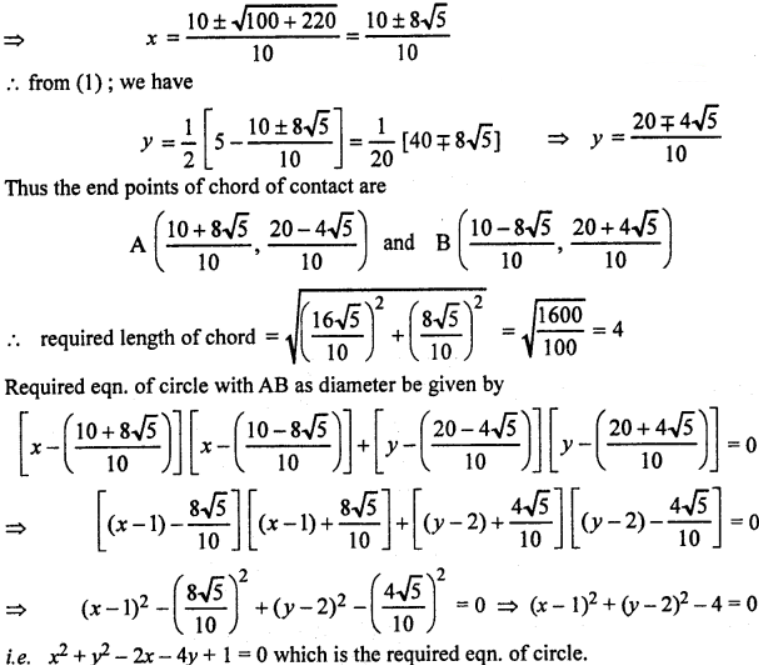
Que-3: Find the intercept made by the circle 4x2 + 4y2 – 24x + 5y + 25 = 0 on the st. line 4x – 2y = 7.
Sol: Given eqn. of circle be
4x2 + 4y2 – 24x + 5y + 25 = 0
⇒ x2 + y2 – 6x + (5/4) y + (25/4) = 0 …(1)
∴ Centre of circle (1) be (3, −5/8)
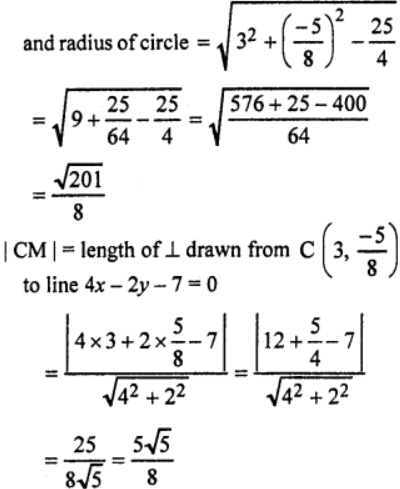
AM² = CA² – CM²
= (201/64) – (125/64) = 76/64
AM = √(76/64)
AM = (2√19)/8
required length of intercept AB = 2AM
= 2 {(2√19)/8} = √19/2
Que-4: Find the equation of each circle satisfying the given conditions.
(i) Centre C(1, – 3) and tangent to 2x – y – 4 = 0.
(ii) Tangent to 2x – 3y – 7 = 0 at (2, – 1) and passes through (4, 1).
(iii) Tangent to 2x – 3y + 3 = 0 at (- 3, 6) and tangent to x + 3y – 7 = 0.
(iv) Tangent to 2x – 3y + 1 = 0 t(1, 1), radius √13.
(v) Tangent to the y-axis at (0, √13) and passes through (- 1, 0).
Sol: (i) Let r be the radius of required circle. eqn. of given tangent to circle be
2x – y – 4 = 0 …(1)
length of ⊥ from C (1,-3) to tangent (1) = radius of circle
r = |{2×1-(-3)-4}|/√(2²-(-1)²)
r = 1/√5
Thus the required eqn. of circle having centre C(1, – 3) and having radius is given by
(x – 1)2 + (y + 3)2 = (1/√5)²
⇒ 5[x2 + y2 – 2x + 6y + 10] = 1
⇒ 5 (x2 + y2) – 10x + 30y + 49 = 0
(ii) slope of line CP = (β+1)/(α−2)
and slope of given line = −2/−3 = 2/3
Since radius of circle is ⊥ to te given tangent.
{(β+1)/(α−2)} (2/3) = -1
⇒ 2β + 2 = – 3α + 6
⇒ 3α + 2β – 4 = 0 …(1)
Also | CP | = | AC | = radius of circle
⇒ (α – 2)2 + (β + 1)2 = (α – 4)2 + (β – 1)2
⇒ – 4α + 2β + 5 = – 8α – 2β + 17
⇒ 4α + 4β – 12 = 0
⇒ α + β – 3 = 0 …(2)
On solving eqn. (1) and eqn. (2) ; we have
α = – 2 and β = 5
Thus centre of required circle be (- 2, 5)
and radius of circle = √{(4+2)²+(1+5)²}
= √52
Hence the required eqn. of circle having centre (- 2, 5) and radius √52 is given by
(x + 2)2 + (y – 5)2 = 52
⇒ x2 + y2 + 4x – 10y – 23 = 0
(iii) Let C(α, β) be the centre of required circle.
eqn. of given tangents are
3x + y + 3 = 0 …(1)
and x + 3y – 7 = 0 …(2)
slope of line CP = (β−6)/(α+3)
and slope of line (1) = −3/1 = – 3
Since radius is ⊥ to the tangent to required circle
∴ [(β−6)/(α+3)] (-3) = -1
⇒ 3β – 18 = α + 3
⇒ α – 3β + 21 = 0 …(3)
Also length of ⊥ from C(α, β) to tangent (1) = length of ⊥ drawn from C(α, β) to tangent (2) = radius of circle
⇒ |3α+β+3| / √10 = |α+3β−7| / √10
⇒ 3α + β + 3 = ± (α + 3β – 7)
Case-I : 3α + β + 3 = α + 3β – 7
⇒ 2α – 2β + 10 = 0 …(4)
On solving eqn. (3) and (4); we have
β = 8, α = 3
Thus radius of circle
= √{(3+3)²+(8−6)²} = √40
Hence required eqn. of circle having centre (3, 8) and radius √40 is given by
(x – 3)2 + (y – 8)2 = 40
⇒ x2 + y2 – 6y – 16y + 33 = 0
Case-II.
When 3α + β + 3 = -α – 3β + 7
⇒ 4α + 4β – 4 = 0
⇒ α + β – 1 = 0 …(5)
On solving eqn. (3) and eqn. (5); we have
– 4β + 22 = 0 ⇒ β = 11/2 and α = –9/2
Thus required eqn. of circle having centre (−9/2, 11/2) and radius √52 is given by (x+(9/2))² + (y−(11/2))² = 5/2
⇒ x²+ y² + 9x – 11y + {(81+121)/4} – (5/2) = 0
⇒ x² + y² + 9x – 11y + 48 = 0
which is the required circle.
(iv) Let C(α, β) be the centre of circle.
slope of CP = (β−1)/(α−1)
and slope of given tangent 2x – 3y + 1 = 0 = −2/−3 = 2/3
Since CP is ⊥ to given tangent
∴ {(β−1)/(α−1)} (2/3) = -1
⇒ 2β – 2 = – 3α + 3
⇒ 3α + 2β – 5 = 0 …(1)
Since the line 2x – 3y + 1 = 0 is tangent to circle with centre (α, β).
∴ length of ⊥ from C(α, β) to given line = radius of circle
|2α−3β+1| / √13 = √13
⇒ 2α – 3β + 1 = ± 13
⇒ 2α – 3β – 12 = 0 …(2)
and 2α -3β + 14 = 0 …(3)
On solving eqn. (1) and simultaneously; we have
α = 3 ; β =- 2
On solving eqn. (1) and (3) simultaneously; we have
α = – 1 and β = 4
Thus required eqns. of circles are given by
(x – 3)2 + (y + 2)2 = 13
and (x + 1)2 + (y – 4)2 = 13
(v) Let C(α, β) be the centre of required circle and eqn. of y-axis be x = 0
Now x = 0 be the tangent to required circle
∴ CP ⊥ the line x = 0
and | CP | = | CA | ⇒ CP² = CA²
⇒ (α – 0)² + (β – √13)² = (α + 1)² + (β – 0)²
⇒ α² + β² – 2√13β + 3 = α² + 2α +1 + β²
⇒ 2α + 2√3β – 2 = 0
α + √3β – 1 = 0 …(1)
putting β = √3 in eqn. (1); we have
α + 3 – 1 = 0 ⇒ α = – 2
Thus (- 2, √3) be the centre of circle and radius of circle
= √{(−1+2)²+(0−√3)²}
= √(1+3) = 2
Hence the required eqn. of circle having centre (- 2, √3) and radius 2 is given
by (x + 2)² + (y – √3)² = 2²
⇒ x² + y² + 4x – 2√3y + 3 = 0
Que-5: Find the length of the chord made by the axis of x, with the circle whose centre is (0, 3a) and which touches the st. line 3x + 4y = 37a.
Sol: Given C(0, 3a) be the centre of circle and 3x + 4y = 37a be the tangent to circle whose centre C(0, 3a).
∴ length of ⊥ drawn from C(0, 3a) to given line 3x + 4y – 37a = 0 = radius of circle
⇒ radius of circle = |0+4×3a−37a|/5 = 5a
Thus the required eqn. of circle having centre (0, 3a) and radius 5a is given by
(x – 0)2 + (y – 3a)2 = 25a2
⇒ x2 + y2 – 6ay – 16a2 = 0
it meets x-axis when y = 0
∴ from (1); x2 – 16a2 = 0 ⇒ x = ± 4a
∴ points of intersection of chord and circle
(1) are (0, 4a) and (0, – 4a).
∴ required length of chord
= √{(−4a−4a)²} = |8a|
Que-6: Find the equation of the circle which has centre C(3, 1) and which touches the line 5x – 12y + 10 = 0.
Sol: eqn. of given line be
5x – 12y + 10 = 0 ……. (1)
Now line (1) is tangent to required circle whose centre C (3, 1).
∴ length of ⊥ drawn from C(3, 1) to line (1) = radius of circle = r
⇒ |5×3−12×1+10| / √{5²+12²} = radius of circle = r
⇒ r = 13/13 = 1
Thus, the required eqn. of circle having centre C(3, 1) and radii 1 be given by
(x – 3)2 + (y – 1)2 = 12
⇒ x2 + y2 – 6x – 2y + 9 = 0
Que-7: Tangents from an external point. Find the equations of the tangents to the circle x2 + y2 = 10 through the external point (4, – 2).
Sol: Given eqn. of circle be
x² + y² = 10 …(1)
Any tangent to circle (1) be given by
y = mx + √10 √(1+m) …(2)
[Here a = √10]
Now eqn. (2) passes through the point (4, – 2).
∴ – 2 = 4m + √10 √(1+m)
On squaring both sides; we have
(2 + 4m)2 = 10(1 + m2)
⇒ 16m2 + 16m + 4 = 10 + 10 m2
⇒ 6m2 + 16m – 6 = 0
⇒ 3m2 + 8m – 3 = 0
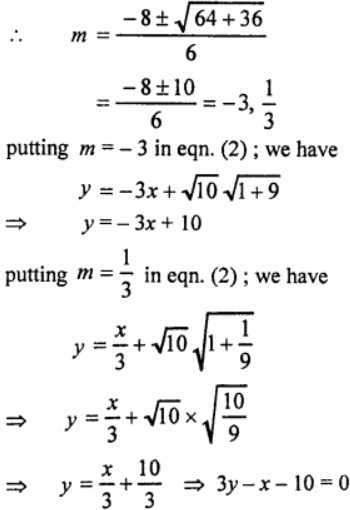
Que-8: Tangent satisfying given condition. Find the equations of the tangents to the circle.
(i) x2 + y2 = 25 inclined at an angle of 60° to the x-axis.
(ii) x2 + y2 + 2x + 2y = 7 inclined at an angle of 45° to the x-axis.
(iii) x2+ y2 = a2 making a triangle of area a2 with the axes.
(iv) x2+ y2 – 6x + 4y = 12 and parallel to the line 4x + 3y + 5 = 0.
(v) x2 + y2 – 22x – 4y + 25 = 0 and perp. to the line 5x + 12y + 9 = 0.
Sol: Here eqn. of given circle be
x2 + y2 = 25
∴ a2 = 25 ⇒ a = 5
and m = tan 60° = √3
Thus required eqns. of tangent to circle be given by
y = √3x ± √{51+(√3)²}
⇒ y = √3x ± 10
(ii) eqn. of given circle be
x2 + y2+ 2x + 2y – 7 = 0
its centre C(- 1, – 1)
and radius of circle (1) = √{(1)²+(1)²+7} = 3
Here slope of tangent = m = tan 45° = 1
Let the eqn. of tangent to circle (1) be y = x + c …(2)
⊥ distance from C (-1,-1) yo tangent (2) = radius of circle
|-1+1+c| / √{1²+(-1)²} = 3
|c|/√2 = 3
c = ±3√2
putting the value of c in eqn. (2) ; we have
x – y ± 3√2 = 0 be the required equations of tangents to given circle.
(iii) eqn. of given circle be
x2 + y2 = a2 …(1)
Let y = m x + c be the eqn. of tangent to circle (1) with centre (0, 0) and radius a.
∴ length of ⊥ from C(0, 0) to line (2) = radius of circle
|c| / √{1+m²} = a
c = ±a√{1+m²} eqn. of coordinate axes are x = 0 …(3)
and y = 0 …(4)
Now eqn. (2), (3) and (4) forms a triangle with area a2.
Now eqn. (2) and (3) intersect at A(0, c) eqn. (3) and (4) intersect at B(0, 0)
and eqn. (2) and (4) intersect at C [-c/m, 0]
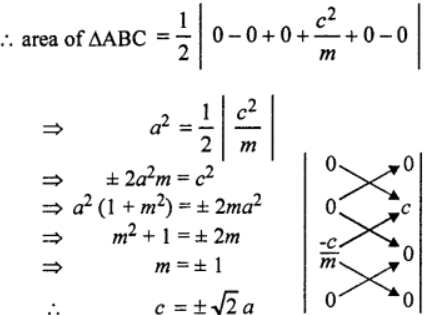
Therefore required eqns. of tangents are
y = ± x ± √2 a
(iv) eqn. of given line be
4x + 3y + 5 = 0 …(1)
Now eqn. of line parallel to line (1) be
4x + 3y + k = 0 …(2)
Now eqn. (2) is tangent to given circle
x2 + y2 – 6x + 4y – 12 = 0
and centre of circle be (3, – 2)
and r = √{(-3)²+22+12} = 5
∴ length of ⊥ drawn from C(3,- 2) to line (2) = radius of circle.
|{4×3+3×(-2)+k}| / √{4²+3²} = 5
|6+k|/5 = 5
6+k = ±25
k = ±25-6
k = 19, -31
putting the value of k in eqn. (2) ; we have
4x + 3y + 19 = 0
and 4x + 3y – 31 = 0
are the required eqns. of tangents.
(v) eqn. of given line be
5x + 12y + 9 = 0 …(1)
∴ eqn. of line ⊥ to line (1) be
12x – 5y + k = 0 …(2)
and eqn. of given circle be
x2 + y2 – 22x – 4y + 25 = 0
its centre be (11, 2)
and r = radius of circle
= √{(−11)²+(−2)²−25} = 10
Now line (2) is tangent to circle (3) if length of ⊥ from C(11, 2) to line (2) = radius of circle .
|{12×11-5×2+k}| / √{12²+(-5)²} = 10
|122+k|/13 = 10
122+k = ±130
k = 8, -252
putting these values of k in eqn. (2); we have 12x – 5y + 8 = 0
and 12x – 5y – 252 = 0
are the required eqns. of tangents to given circle (3).
Que-9: Conditions of tangency. Find the condition that the circle x2 + y2 + 2gx + 2fy + c = 0 may touch
(i) the x-axis,
(ii) the y-axis, and
(iii) the x-axis, at the origin.
Sol: eqn. of given circle be
x2 + y2 + 2gx + 2fy + c = 0 …(1)
centre of circle (1) be (-g, – f)
and radius of circle = √{g2+f2-c}
(i) eqn. of x-axis be y = 0
Now line (2) touches circle (1).
if ⊥ distance from centre C(- g, – f)
to line (2) = radius of circle
|-f|/1 = √{g2+f2-c}
on squaring both sides, we have
f2 = g2 + f2 – c
⇒ c = g2 be the required condition.
(ii) eqn. of x-axis be x = 0 …(3)
Now line (3) touches circle (1).
if length of ⊥ drawn from centre (- g, – f)
to line (3) = radius of circle
⇒ |−g|/1 = √{g2+f2-c}
⇒ g2 =g2 + f2 – c ⇒ c = f2
which is the required condition.
(iii) Now line (2) tangent to circle (1).
if c = g2 …(4)
Further circle (1) passes through (0, 0)
∴ c = 0
∴ g = 0 [using eqn. (4)]
Hence c = g = 0 be the required condition.
Que-10: Find the conditions that the line
(i) y = mx + c may touch the circle x2 + y2 = a2
(ii) lx + my + n = 0 may touch the circle x2 + y2 + 2gx +2fy + c = 0.
Sol: (i) Given eqn. of line be
y = mx + c ⇒ mx – y + c = 0 …(1)
and eqn. of given circle be
x2 + y2 = a2 …(2)
Now centre of circle (2) be (0, 0) and radius a.
Since line (1) touches circle (2).
if length of ⊥ drawn from centre C(0, 0) of circle to line (1) = radius of circle.
|{m×0-0+c}|/√(m²+1) = a
|c| = a √(m²+1)
c² = a² (m²+1)
which is the required condition.
(ii) given eqn. of line be
lx + my + n = 0 …(1)
and eqn. of circle be
x2 + y2 + 2gx + 2fy + c = 0
its centre be (- g, – f)
and radius = √{g2+f2-c}
Now line (1) touches circle (2)
if ⊥ distance from C(- g, – f) to line (1) = radius of circle .
|−lg−mf+n| / √{l²+m²} = √{g2+f2-c}
On squaring both sides; we have
(lg + mf – n)2 = (l2 + m2) (g2 + f2 – c)
which is the required condition.
Que-11:For what value of k will the line 4x + 3y + k = 0 touch the circle 2x2 + 2y2 = 5x?
Sol: The eqn. of given line be
4x + 3y + k = 0 …(1)
given eqn. of circle be
x2 + y2 – (5x/2)= 0 …(2)
∴ Centre of circle be [5/4, 0]
and radius of circle = √{(5/4)²+0²−0} = 5/4
Since line (1) touches circle (2)
if length of ⊥ drawn from centre C(5/4, 0) of circle to line (1) = radius of circle
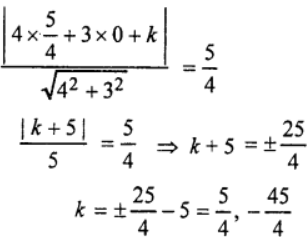
Que-12: Show that 3x – 4y + 11 = 0 is a tangent to the circle x2 + y2 – 8y + 15 = 0 and find the equation of the other tangent which is parallel to the st. line 3x = 4y.
Sol: Given eqn. of line be
3x – 4y + 11 = 0 …(1)
and eq. of circle be
x2 + y2 – 8y + 15 = 0 …(2)
its centre be (0, 4)
and radius of circle = √{0²+16-15}
= 1 = r
Now d = length of ⊥ drawn from centre (0, 4) of circle to line (1)
= |3×0−4×4+11| / √{3²+(−4)²} = 5/5 = 1
∴ d = r
Thus line (1) touches circle (2).
eqn. of line parallel to line 3x = 4y be given by 3x – 4y + k = 0 …(3)
Now line (3) is tangent to circle (2)
if length of ⊥ drawn from C(0, 4) to line (3) = radius of circle
if |3×0−4×4+k| / √{3²+(−4)²}=1
⇒ | k – 16 | = 5 ⇒ k = ± 5 + 16
⇒ k = 21, 11
Thus the required eqn. of other tangent be 3x – 4y + 21 = 0
Que-13: Show that x = 7 and y =8 touch the circle x2 + y2 – 4x – 6y – 12 = 0 and find the points of contact.
Sol: eqn. of given circle be
x2 + y2 – 4x – 6y – 12 = 0 …(1)
putting x = 7 in eqn. (1); we have
72 + y2 – 28 – 6y – 12 = 0
⇒ y2 – 6y + 9 = 0
⇒ (y – 3)2 = 0 …(2)
Thus eqn. (2) which is quadratic in x have equal roots.
∴ line x = 7 touches circle (1).
Thus y = 3 ∴ (7, 3) be the required point of contact.
Further when y = 8; eqn. (1) reduces to ;
x2 + 64 – 4x – 48 – 12 = 0
⇒ (x – 2)2 = 0 …(3)
⇒ x = 2
Thus eqn. (3) has two equal roots.
Therefore line y = 8 touches circle (1) and have one point of contact given by (2, 8).
Que-14: Show that the line 3x + 4y + 20 = 0 touches the circle x2 + y2 = 16 and find the point of contact.
Sol: Given eqn. of line be
3x + 4y + 20 = 0 …(1)
and given eqn. of circle be
x2 + y2 = 16 …(2)
From (1); y = {-20-3x}/4
putting the value of y in eqn. (2); we have
x2 + [{-20-3x}/4]² = 16
⇒ 16x2 + (20 + 3x)2 = 256
⇒ 25x2 + 120x + 144 = 0
⇒ (5x + 12)2 = 0 …(3)
Thus eqn. (3) which is a quadratic in x have equal roots.
∴ line (1) touches circle (2).
∴ x = –12/5 ∴ from (1); we have
−(36/5) + 4y + 20 = 0
⇒ (64/5) + 4y = 0 ⇒ y = −16/5
Hence the required point of contact be (−12/5, −16/5)
Que-15: Length of the tangent. Prove that the length t of the tangent from the point P(x1, y1) to the circle x² + y² + 2gx + 2fy + c = 0 is given by t = √[x²1+yv1+2gx1+2fy1+c]
Hence, find the length of the tangent
(i) to the circle x2 + y2 – 2x – 3y – 1 = 0 from the point (2, 5);
(ii) to the circle x2 + y2 – 6x + 8y + 4 = 0 from the origin ;
(iii) to the circle 3x2 + 3y2 -7x – 6y = 12 from the point (6, – 7);
(iv) to the circle x2 + y2 – 4y – 5 = 0 from the point (4, 5).
Sol: Given eqn. of circle be
x2 + y2 + 2gx + 2fy + c = 0 …(1)
Centre of (1) be C(- g,- f)
and radius of circle = CQ = √{g2+f2-c}
In right angled △CQP, we have
CP2 = CQ2 + t2
⇒ t2 = CP2 – CQ2
= (x1 + g)2 + (y1)2 – (g2 + f2 – c)
= x12 + y12 + 2gx1 + 2fy1 + c
t = √[x²1+y²1+2gx1+2fy1+c]
(i) Required length of tangent to given circle from point (2, 5)
= √{2²+5²−2×2−3×5−1}
= √{4+25−4−15−1} = 3
(ii) Required length of the tangent to given circle from the origin
= √{0²+0²−6×0+8×0+4} = 2
(iii) Given eqn. of circle can be written as
x² + y² – (7/3)x – 2y – 4 = 0
∴ required length of tangent to given circle from point (6, – 7)
= √{6²+(−7)²−(7/3)×6−2×(−7)−4}
= √{36+49−14+14−4} = √81 = 9
(iv) Required length of tangent to given circle from the point (4, 5)
= √{4²+5²−4×5−5} = 4
Que-16: If x = 4 + 5 cos θ and y = 3 + 5 sin θ, show that the locus of the point (x, y) as θ varies, is a circle. Find the centre and radius of the circle.
Sol: Given x = 4 + 5 cos θ
⇒ x – 4 = 5 cos θ …(1)
and y = 3 + 5 sin θ
⇒ y – 3 = 5 sin θ …(2)
To find locus of point (x, y), we eliminate θ from eqn. (1) and eqn. (2).
On squaring and adding (1) and (2); we have
(x – 4)2 + (y – 3)2 = 25(cos2 θ + sin2 θ)
⇒ (x – 4)2 + (y – 3)2 = 25
which is clearly represents a circle with centre (4, 3) and radius 5 .
Que-17: A(1, 0) and B(7, 0) are two points on the axis of x. A point P is taken in the first quadrant such that PAB is an isosceles triangle and PB=5 units. Find the equation of the circle described on PA as diameter.
Sol: Let the coordinates of P are P(α, β).
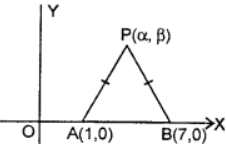
Since △PAB be an isosceles triangle
∴ PA = PB ⇒ PA2 = PB2
⇒ (α – 1)2 + (β – 0)2 = (α – 7)2 + (β – 0)2
⇒ α2 – 2a + 1 + β2 = α2 – 14α + 49 + β2
⇒ 12α = 48 ⇒ α = 4
Also | PB | = 5 units ⇒ PB2 = 25
⇒ (α – 7)2 + (β – 0)2 = 25
⇒ (4 – 7)2 + β2 = 25
⇒ β2 = 25 – 9 = 16
⇒ β = ± 4
but point P lies in first quadrant
∴ coordinates of P are (4, 4).
Hence the required eqn. of circle having PA as diameter be given by
(x – 4) (x – 1) + (y – 4)(y – 0) = 0
⇒ x2 + y2 – 5x – 4y + 4 = 0
Que-18: Find the equation of the circle which touches the line y = 2, passes through the origin and the point where the curve y2 – 2x + 8 = 0 meets the x-axis.
Sol: The eqn. of curve be
y2 – 2x + 8 = 0 …(1)
Now curve (1) meets x-axis when y = 0
∴ 2x = 8 ⇒ x = 4
∴ Curve (1) meets x-axis at (4, 0).
Let (h, k) be the centre of required circle and r be the required of required circle.
Thus the required eqn. of circle be
(x – h)2 + (y – k)2 = r2 …(2)
eqn. (2) passes through (0, 0).
∴ h2 + k2 = r2 …(3)
Further eqn. (2) passes through the point (4, 0).
∴ (4 – h)2 + k2 = r2 …(4)
Also the circle (2) touches line
y – 2 = 0 …(5)
∴ ⊥ distance from C(h, k) to line (5) = radius of circle
|k-2|/1 = r …… (6)
From (3) and (4); we have
h2 + k2 = (4 – h)2 + k2
h2 = h2 – 8h + 16 ⇒ h = 2
Also from eqn. (3) and (6); we have
22 + k2 = (k – 2)2
⇒ 4 + k2 = k2 + 4 – 4k ⇒ k = 0
∴ from (6) ; r = | 0 – 2 | = 2
putting the values of h, k and r in eqn. (2);
We have
(x – 2)2 + (y – 0)2 = 22
⇒ x2 + y2 – 4x = 0
which is the required eqn. of circle.
Que-19: (i) Prove that the line y = 2x touches the circle x2 + y2 + 16x + 12y + 80 = 0 and find the co-ordinates of the point of contact.
(ii) The circle x2 + y2 – 6x – 10y + p = 0 does not intersect or touch either axis and the point (1, 4) is inside the circle. Calculate the range of possible values of p.
Sol: (i) Given eqn. of line be y = 2x …(1)
and eqn. of given circle be
x2 + y2 + 16x + 12y + 80 = 0 …(2)
Substituting the value of y from eqn. (1) in eqn. (2); we have
x2 + 4x2 + 16x + 24x + 80 = 0
⇒ 5x2 + 40x + 80 = 0
⇒ x2 + 8x + 16 = 0
⇒ (x + 4)2 = 0 …(3)
eqn. (3) is a quadratic in x and have equal roots.
∴ line (1) touches circle (2).
∴ from (3) ; x = – 4
and from (1); y = – 8
Thus the required coordinates of point of contact be (- 4, – 8).
(ii) Given eqn. of circle be
x2 + y2 – 6x – 10y + p = 0 …(1)
Its centre be C(3, 5)
and radius of circle (1) = r
= √{9+25−p} = √(34-p)
and also given point be A (1, 4).
Now | CA | = √{(3−1)²+(5−4)²}
= √(4+1) = √5
Since the point A (1, 4) lies inside the circle.
∴ | CA | < r
√5 < √(34-p)
⇒ 5 < 34 – p
⇒ p < 29 …(2) Further circle (1) does not intersect or touch coordinate axes. ∴ d > r [For y-axis]
⇒ 3 > √(34-p)
⇒ 9 > 34 – p
⇒ p > 25 …(3)
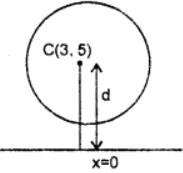
For x-axis ; y = 0 ∴ 5 > √(34-p)
⇒ 25 > 34 – p ⇒ p > 9 …(4)
∴ from eqn. (3) and (4) ; we have
p > 25 …(5)
From eqn. (2) and eqn. (5) ; we have
25 < p < 29
–: End of Circle Class 11 OP Malhotra Exe-17C ISC Maths Ch-17 Solutions. :–
Return to :- OP Malhotra ISC Class-11 S Chand Publication Maths Solutions
Thanks
Please share with your friends