Combination of Lenses and Mirrors Numerical Class-12 Nootan ISC Physics Solution Ch-16 Refraction of Light at Spherical Surfaces : Lenses . Step by step solutions of Kumar and Mittal Physics of Nageen Prakashan as council latest prescribe guideline for upcoming exam. Visit official Website CISCE for detail information about ISC Board Class-12 Physics.
Combination of Lenses and Mirrors Numerical Class-12 Nootan ISC Physics Solution Ch-16 Refraction of Light at Spherical Surfaces : Lenses
| Board | ISC |
| Class | 12 |
| Subject | Physics |
| Book | Nootan |
| Chapter-16 | Refraction of Light at Spherical Surfaces : Lenses |
| Topics | Numericals on Combination of Lenses and Mirrors |
| Academic Session | 2025-2026 |
Numericals on Combination of Lenses and Mirrors
Numerical Class-12 Nootan ISC Physics Solution Ch-16 Refraction of Light at Spherical Surfaces : Lenses
Que-66: A convex lens of focal length 15 cm, has a point-object placed on its principal axis at a distance of 30 cm from it. A plane mirror is placed 20 cm behind the convex lens. Locate the position of image formed by this combination.
Ans- 1/f = 1/v-1/u
=> 1/15 = 1/v – 1/-30
=> 1/v = 1/30
v = 30 cm
(u)mirror = 20 – 30 = -10 cm
(v)mirror = -(u)mirror = 10 cm
Que-67: In the given figure are shown the positions of the object O, image I, two lenses and a plane mirror. The focal length of the convex lens is 20 cm. Calculate the focal length of the other lens.
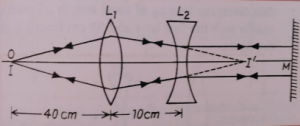
Ans- f = -30 cm
Que-68: A convex lens of focal length 20 cm is placed 10 cm in front of a convex mirror of radius of curvature 15 cm. Where should a point-object be placed in front of the lens so that its image is formed at the position of object itself.
Ans- u = -100
Que-69: An object is placed in front of a double convex lens of focal length 10 cm at a distance 15 cm from it. On placing a convex mirror of radius 20 cm on the image side of the convex lens, it is found that final image is formed at the position of object itself. Find the possible location of the mirror.
Ans- 1/f = 1/v-1/u
=> 1/v = 1/10-1/15
=> v = 30 cm
possible location = 30 – 20 = 10 cm
Que-70: A convex lens and a convex mirror (R = 20 cm) are placed co-axially with the convex mirror placed at a distance of 30 cm from convex lens. For a point-object at a distance 25 cm from the lens, final image due to this combination coincides with the object itself. What is the focal length of the convex lens?
Ans- f = R/2 = 20/2 = 10 cm
v = d + R = 30 + 20 = 50 cm
1/f = 1/ v – 1/u
=> 1/ f = 1/50 – 1/-25
=> f = 50/3 = 16.7 cm
Que-71: A concave lens of focal length f and a concave mirror of focal length 15 cm are placed co-axially 10 cm apart from each other. An incident beam parallel to principal axis is incident on the concave lens, after refraction from the lens rays fall on mirror and retrace their path after reflection. Find the focal length of concave lens.
Ans- 1/f = 1/v – 1/u
=> 1/f = 1/20 – 1/∞
=> f = -20 cm (since it is concave)
Que-72: Calculate the distance ‘d’, so that a real image of an object 0, 30 cm in front of the convex lens of focal length 15 cm can be formed at the same point O. Focal length of the mirror is 10 cm. Will the image be inverted or erect? Draw complete ray diagram.
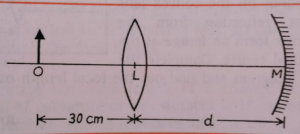
Ans- d = 30 + 20 = 50 cm
the final image will be inverted.
— : End Combination of Lenses and Mirrors Numerical Class-12 Nootan ISC Physics Solution Ch-16 :–
Return to : – Nootan Solutions for ISC Class-12 Physics
Thanks
Please share with your friends