Component of Vector Along Coordinate Axes Class 12 OP Malhotra Exe-21C ISC Maths Solutions Ch-21. In this article you would learn about component of a vector AB along coordinate axes. Step by step solutions of latest textbook has been given as latest syllabus. Visit official Website CISCE for detail information about ISC Board Class-12 Mathematics.

Component of Vector Along Coordinate Axes Class 12 OP Malhotra Exe-21C ISC Maths Solutions Ch-21
| Board | ISC |
| Publications | S Chand |
| Subject | Maths |
| Class | 12th |
| Chapter-21 | Vectors |
| Writer | OP Malhotra |
| Exe-21(c) | Component of a Vector AB Along Coordinate Axes |
Component of a Vector AB Along Coordinate Axes
Vectors Class 12 OP Malhotra Exe-21C ISC Maths Solutions
Que-1: If the position vector of a point (-4, -3) be a→, find | a→ |.
Sol: Given a→ a
= -4î– 3ĵ
⇒ | a→ | = √(−4)²+(−3)²
= √16+9
= √25 = 5
Que-2: If P(-1, 3) and Q(2, -7) express the vector r→ = PQ→ in terms of unit vectors î and ĵ. Also determine the magnitude of r̂
Sol: Given P.V of P= −î + 3ĵ
P.V of Q = 2î – 7ĵ
r→ = PQ→ = P.V of Q – P.V of P
= (2 î – 7ĵ) – (−î + 3ĵ) = 3î – 10ĵ
∴ |r→ | = √3²+(−10)²
= √9+100
= √109
Que-3: If a→ = 3î – 2ĵ and b→ = −î + ĵ, find the magnitude of 2a→– 3b→ .
Sol: Given a→ = 3î– 2ĵ and b→ = −î+ ĵ
2a→ – 3b→ = 2(3î – 2ĵ) – 3(−î + ĵ)
= 9î – 7ĵ
∴ |2a→ – 3b→ | = |9î – 7ĵ|
= √9²+(−7)²= √ 81+49 = √130
Que-4: If a→ , b→ and c→ have components (1, 1) (2, 3) and (-1, 4) respectively, find the components of 2a→ – 3b→ + 5c→ .
Sol: Given a→ = î + ĵ ;
b→ = 2î + 3ĵ and c→ = −î + 4ĵ
∴ 2a→ – 3b→ + 5c→
= 2(î + ĵ) – 3(2î + 3ĵ) + 5(−î + 4ĵ)
= 2î + 2ĵ – 6î – 9ĵ – 5î + 20ĵ
= -9î + 13ĵ
Thus the components of 2a→ – 3b→ + 5c→ are (-9, 13).
Que-5: Find a unit vector parallel to 3î + 4ĵ.
Sol: Let a→ = 3î + 4ĵ
∴|a→ | = √3²+4² = √25 = 5
∴ unit vector parallel to a→
= ± â = ± a→ /| a→ |
= ± (3î+4ĵ)/5
Que-6: Find a unit vector in the direction of î + ĵ.
Sol: Let a→ = î + ĵ
∴ |a→ | = √1²+1² = √2
So unit vector in the direction of a→
= â = a→ | a→ |
= î + ĵ /√2
Que-7: Find a vector of magnitude 5 units which is parallel to the vector 2î – ĵ.
Sol: Let a→ =2î – ĵ
∴|a→ | = √2²+(−1)² = √5
∴ unit vector parallel to the direction of a→
= ± â= ± a→ |a→ |
Thus, vector of magnitude 5 units which is || to a→
= ± 5 â
= ± 5 a→ /|a→ |
= ± 5 (2î – ĵ)/√5
= ± √5(2î – ĵ)
Que-8: If the components of a→ are (1, 2) and b→ =î – ĵ + â , what are components of 2a→– 3b→ ?
Sol: Given a→ = î + 2ĵ
and
b→ = î – ĵ + â
= î – ĵ + î + 2ĵ
= 2î + 2ĵ
Thus, 2a→ – 3b→ = 2(î + 2ĵ) – 3(î + ĵ)
= -4î + ĵ
Therefore the components of 2a→ – 3b→ are (-4, 1).
Que-9: Find the terminal point of the vector PQ → whose initial points is P(1, 2) and whose components along x-axis and y-axis are -2 and 3 respectively.
Sol: Let the terminal point of vector PQ → be Q → and has coordinates (α, β) i.e.
P.V of Q = αî + βĵ
and
P.V of P = î+ 2ĵ
PQ → = P.V of Q – P.V of P
= (αî + βĵ) – ( î+ 2ĵ)
= (α – 1)î + (β – 2)ĵ
Also PQ → = -2î + 3ĵ
∴ (α – 1)î + (β – 2)ĵ = -2î + 3ĵ
Comparing the coefficients of i^ and j^ on both sides, we get
and
α – 1 = -2
⇒ α = -1
β – 2 = 3
⇒ β = 5
Thus the required terminal point be (-1, 5).
Que-10: If the coordinates of the points A and B in a plane are (1, 1) and (1, 2) respectively, find the coordinates of C (in the plane) such that AB → and BC → are equal.
Sol: Given P.V of A =î + ĵ ;
P.V of B = î + 2ĵ
Let the coordinates of C be (α, β).
∴ P.O of C = αî + βĵ
Since AB → =BC →
⇒ P.B of B – P. of A
= P.V of C – P.V of B
⇒ (î + 2ĵ) – (î + ĵ)
= (αî + βĵ) – (î + 2ĵ)
⇒ 0î + ĵ
= (α – 1)î + (β – 2)ĵ
Comparing the coefficients of î and ĵ on both sides, we have
⇒ α-1 = 0 ; β-2 = 1
α = 1 and β = 3
Hence the required coordinates of point C be (1, 3).
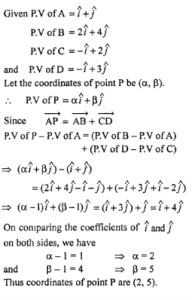
Que-11: If A(1, 1), B(2, 4), C(-1, 2) and D(-1, 3) are the points in a plane, find a point P in the same plane such that AP → = AB →+ CD →.
Sol:
Que-12: Prove (by vectors) that the points (-3, 5), (-2, 3) and (4, -9) are collinear.
Sol: Let the given points be A(-3, 5), B(-2, 3) and C(4, -9) and O be the origin.
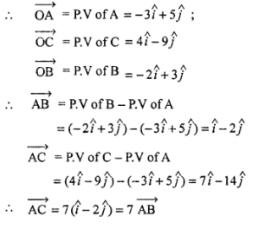
Thus AC →and AB → are parallel vectors. But A be the common point. Hence A, B and C are collinear.
Que-13: If a→ = 7î – 6ĵ and b→ = 3î + 4ĵ, find ⇒ a→ + b→ and determine a unit vector in the direction of the vector a→ + b→ .
Sol: Given a→ = 7î – 6ĵ and b→
= 3î + 4ĵ
∴ a→ + b→
= 7î – 6ĵ + 3î + 4ĵ
= 10î – 2ĵ
⇒ |a→ + b→ |
= √(10)²+(−2)²
= √104 = 2√26
Thus required unit vector in the direction of a→ + b→
= a→ + b→ /|a→ + b→ |
= 10î−2ĵ/2√26
= 5/√26 î − 1/√26 ĵ
Que-14: Prove that the vectors a→ = -4î – ĵ, b→ = î – 4ĵ and c→ = 3î + 5ĵ form a right angled-triangle.
Sol: Given a→ =-4î – ĵ ;
b→ = î – 4ĵ and
c→ = 3î + 5ĵ
Here a→ + b→ + c→
= -4î – ĵ + î – 4ĵ + 3î + 5ĵ
= 0→
∴ a→ , b→ , c→ are the vectors along the sides of ∆ABC.
a = | a→ | =√(−4)²+(−1)² = √17 ;
b = |b→ | = √1²+(−4)² = √17
and c = |c→ | = √3²+5² = √34
∴ a² + b² = c² .
Thus ∆ABC be right angled triangle since pythagoras law holds.
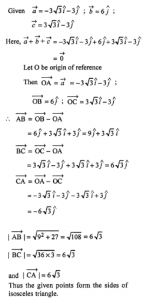
Que-15: Show that the points
a→ = -3√3î – 3ĵ, b→ = 6ĵ,
c→ = -3√3î – 3ĵ
form the sides of an isosceles triangle.
Sol:
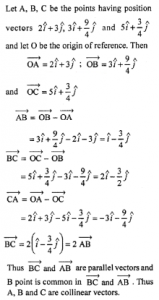
Que-16: Show that the three points with position vectors 2î + 3ĵ, 3î + 9/4ĵ, 5î + 3/4ĵ are collinear.
Sol:
–: End of Vectors Class 12 OP Malhotra Exe-21C Maths Solutions :–
Return to :- OP Malhotra ISC Class-12 S Chand Publication Maths Solutions
Please share with your friends
Thanks
–: End of Component of Vector Along Coordinate Axes Class 12 OP Malhotra Exe-21C ISC Maths Solutions :–
Return to :- OP Malhotra ISC Class-12 S Chand Publication Maths Solutions
Please share with your friends
Thanks