Composition of Functions Class 12 OP Malhotra Exe-2B ISC Maths Solutions Ch-2. In this article you would learn how to solve problems on Composition of Functions. This topic explain with the help of practice questions and solutions. Visit official Website CISCE for detail information about ISC Board Class-12 Mathematics.

Composition of Functions Class 12 OP Malhotra Exe-2B ISC Maths Solutions Ch-2
| Board | ISC |
| Publications | S Chand |
| Subject | Maths |
| Class | 12th |
| Chapter-2 | Functions |
| Writer | OP Malhotra |
| Exe-2(B) | Composition of Functions |
Composition of Functions
The composition of functions is a process where the output of one function becomes the input of another. It combines two functions
Composition of Functions Class 12 OP Malhotra Exe-2B ISC Maths Solutions Ch-2
Que-1: If f : N → R : f (x) = (2x−1)/2 and g : Q → R : g (x) = x + 2 be two functions, then find (fog)(−3/2).
Sol: Given f : N → R defined by
f(x) = (2x−1)/2 ∀x ∈ N
and g : Q → R defined by
g (x) = x + 2 ∀ x ∈ Q
(fog)(−3/2) = f(g(−3/2))
= f{(−3/2)+2} = f(1/2)
= {2×(1/2)−1}/2 = 0
Que-2: (i) If f : R → R and g : R → R are given f(x) = sin x and g(x) = 5x², then find gof (x).
(ii) If f(x) = 27x³ and g(x) = x1/3, then find gof (x).
Sol: (i) Given f : R→ R defined by f(x) = sin x and g : R → R defined by
g(x) = 5x²
Clearly Rf ⊂ Dg
∴ g of exists
Thus, (g) of (x) = g(f(x)) = g (sin x) = 5
(sin x)² = 5 sin²x ∀x∈R
(ii) Given f(x) = 27x³ ; g (x) = x1/3
∴ (gof) (x) = g(f(x) = g(27x³)
= (27x³)1/3 = 3x
Que-3: Find (gof)(3), (fog)(1) and(fof)(0) if
(i) f(x) = 3x – 2, g(x) = x²
(ii) f(x) = |x + 2|, g(x) = – x²
(iii) f(x) = x² – 1, g(x) = √x
Sol: (i) Given f(x) = 3x – 2; g(x) = x²
(gof)(3) = g(f(3)) = g(3 x 3 – 2) = g(7)
= 7² = 49
(fog)(1) = f(g(1)) = f(1²) = f(x)
= 3 – 2 = 1
(fof) (0) = f(f(0)) = f(0 – 2) = f(- 2)
= 3(- 2) – 2 = – 8
(ii) Given f(x)=|x + 2|, g(x) = – x²
(gof)(3) = g(f(3)) = g(|3 + 2|) = g (5)
= – 5² = – 25
(fog)(1) = f(g(1)) = f(- 1²) = f(- 1)
= |- 1 + 2| = 1
(fof) (0) = ff(0)) = f(|0 + 2|)
= f(2) = |2 + 2| = 4
(iii) Given f (x) = x² – 1, g(x) = √x
(gof)(3) = g(f(3)) = g(3² – 1) = g (8)
= √8 = 2√2
(fog) (1) = f(g(1)) = f(√1) = f(1))
= 1² – 1 = 0
(fof) (0) = f(g(1)) = f(0² – 1) = f(- 1) = (- 1²) – 1 = 0
Que-4: If f(x) = x + 5 and g(x) = x² – 3, find the following:
(i) f(g(0)) (ii) g(f (0)) (iii) f(g(x)) (iv) g(f (x)) (v) g(f (x)) (vi) g(g (x)) (vii) f(f (-5)) (viii) g(g (2))
Sol: Given f(x) = x + 5; g(x) = x² – 3
(i) f(g(0)) = f(0² – 3)
= f(-3) = – 3 + 5 = 2
(ii) g(f(0)) = g(0 + 5) = g(5)
= 5² – 3 = 22
(iii) f(g (x)) = f(x² – 3)
= x² – 3 + 5 = x² + 2
(iv) g(f (x)) = g(x + 5)
= (x + 5)² -3 = x² + 10x + 22
(v) f(f (x)) = f(x + 5)
= x + 5 + 5 = x + 10
(vi) g(g (x)) = g(x² – 3)
= (x² – 3)² – 3 = x4 – 6x² + 6
(vii) f(f(- 5)) = f(-5 + 5) = f(0)
= 0 + 5 = 5
(viii) g(g(2)) = g(2² – 3) = g(1)
= 1² – 3 = – 2
Que-5: If u(x) = 4x – 5, v(x) = x² and f(x) = 1/x , find
(i) u (v (f (x)))
(ii) u(f(v(x)))
(iii) f(u(v(x)))
Sol: Given u(x) = 4x – 5, v(x) = x and f(x) = 1/x
(i) u(v(f(x))) = u(v(1/x))
= u(1/x²) = 4x² – 5
(ii) u(f(v(x))) = u(f(x²))
= u(1/x²) = 4x²
(iii) f(u(v(x))) = f(u(x²))
= f(4x² – 5) = 1/(4x²−5)
Que-6: Find the indicated values, where
g(t) = t² – 1 and f(x) = 1 + x
(i) g(f(0)) + f(g(0))
(ii) g(f(2) + 3)
Sol: Given g(t) = t² – 1 and f(x) = 1 + x
∴ f(0) = 1 + 0 = 1 ;
g(0) = 0² – 1 = – 1
(i) Thus g (f (0)) + f (g (0))
= g(1) + f(-1) = (1² – 1) + (1 – 1) = 0 + 0 = 0
(ii) Now f(2) = 1 + 2 = 3
∴ g(f(2) + 3) = g(3 + 3) = g(6)
= 6² – 1 = 35
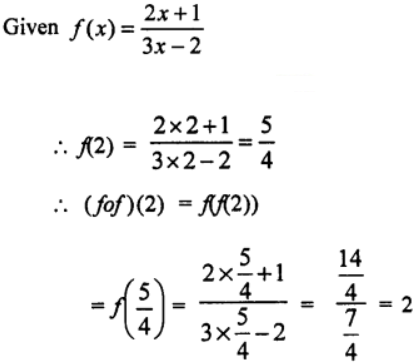
Que-7: If f(x) = (2x+1)/(3x−2) then (fof)(2) is equal to
(a) 1 (b) 2 (c) 3 (d) 4
Sol:
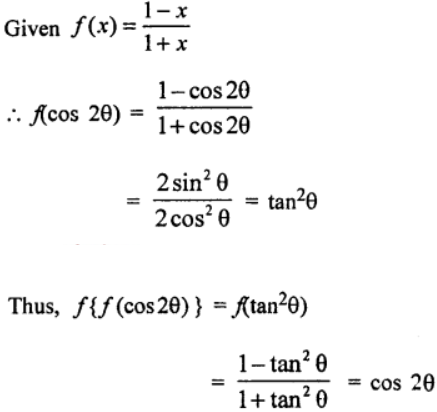
Que-8: If f(x) = (1−x)/(1+x), then f{f(cos2θ) } is equal to
(a) cos 2θ (b) tan 2θ (c) sec 2θ (d) cot 2θ
Sol:
Que-9: Let [x] denote the greatest integer ≤ x. If f(x) = [x] and g(x) = |x|, then the value of f{g(8/5)}−g{f(−8/5)} is
(a) 2 (b) – 2 (c) 1 (d) 0 (e) – 1
Sol: Given f(x) = [x] and g(x) = | x |
∴ g(8/5) = ∣∣8/5∣∣ = 8/5
f(−8/5) = [−8/5] = [- 1, 6]
= [- 1 – 0.6] = [- 2 + 0.4] = – 2
f(g(8/5)) = f(8/5) = [8/5] = 1
and g{f(−8/5)} = g{[−8/5]} = g{[−1.2]}
= g(- 2) = |- 2| = 2
Thus, f{g(−8/5)} − g{f(−8/5)}
= 1 – 2 = – 1
Que-10: If f : R → R and g : R → R are defined by f(x) = x – 3 and g(x) = x² +1, then the values of x for which g(f (x)) = 10 are
(a) 0, – 6 (b) 2, – 2 (c) 1, – 1 (d) 0, 6 (e) 0, 2
Sol: Given f : R → R and g : R → R defined by f(x) = x- 3 and
g(x) = x² +1
Since Rf ⊂ Dg = R
∴ gof exists
Now |gof| (x) = g(f (x)) = g(x – 3)
= (x – 3)² + 1 = x² – 6x + 10 – 10, also
g(f(x)) = 10 (given)
Thus, x² – 6x + 10 = 10
⇒ x² – 6x = 0
⇒ x(x – 6) = 0
⇒ x = 0, 6
Que-11: If f(x) = sin²x and the composite function g[f(x)] = | sinx |, then the function g(x) is equal to
(a) – √x (b) √x (c) √(x-1) (d) √(x+1)
Sol: Given f(x) = sin²x and
g{f(x)} = |sin x| = √sin²x
g(sin²x) = √sin²x
g(x) = √x.
Que-12: If f : R → R and g : R → R are defined respectively as
f(x) = x² + 3x + 1 and g(x) = 2x – 3, find
(a) fog (b) gof.
Sol: Given f : R→ R defined by
f(x) = x² +3x + 1 and g : R → R defined by g (x) = 2x – 3
Since Rf ⊂ Dg
∴ gof exists.
and Rg ⊂ Df
∴ fog exists (g(x))
(i) ∀x ∈ R, (fog) (x) = f(g(x)) = f(2x – 3) = (2x – 3)² + 3(2x – 3) + 1
= 4x² – 12x + 9 + 6x – 9 + 1
= 4x² – 6x + 1
(ii) x ∈ R, (gof) (x) = g(f(x))
= g(x² + 3x + 1)
= 2(x² + 3x + 1) – 3
= 2x² + 6x – 1
Que-13: If f: R → R, f(x) = x²,
g : R→ R, g(x) = cos x ∀x ∈ R, find fog and gof and show that fog ≠ gof
Sol: Given f : R → R defined by
f(x) = x² ∀x ∈ R
and g : R →R defined by
g(x) = cos x ∀x ∈ R
∀x ∈ R, (fog)(x) = f(g(x)) = f(cosx) = cos²x
(gof)(x) = g(f(x) = g(x²) = cos x²
Clearly (fog)(x) ≠ (gof)(x) ∀x ∈ R
⇒ fog ≠ gof
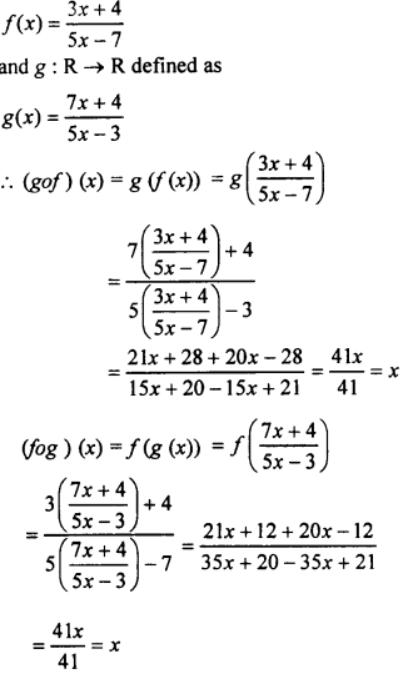
Que-14: If the function f : R → R be defined as f(x) = (3x+4)/(5x−7)(x≠7/5) and g : R → R be defined as g (x) = and g : R → R be defined as g(x) = (7x+4)/(5x−3)(x≠3/5), show that (gof) (x) = (fog) (x).
Sol: Given f : R → R defined as
Que-15: If R → R is given by
f(x) = [{−1, when x is a rational 1}, {when x is irrational}]
then, (fof)(1 – √3) is equal to
(a) 1 (b) – 1 (c) √3 (d) 0
Sol: Given f : R → R defined by
f(x) = [{−1, when x is a rational 1}, {when x is irrational}]
Since (1 – √3) be an irrational number
∴ f(1 – √3) = 1
Now (fof) (1 – √3) = f{f(1 – √3)}
= f(1) = – 1
[∵ 1 be a rational number ∴ f(x) = – 1]
–: End of Composition of Functions Class 12 OP Malhotra Exe-2B ISC Maths Solutions Ch-2 :–
Return to :- OP Malhotra ISC Class-12 S Chand Publication Maths Solutions
Please share with your friend if helpful
Thanks