Compound Microscope Numerical Class-12 Nootan ISC Physics Solution Ch-18 Optical Instruments. Step by step solutions of Kumar and Mittal Physics of Nageen Prakashan as council latest prescribe guideline for upcoming exam. Visit official Website CISCE for detail information about ISC Board Class-12 Physics.
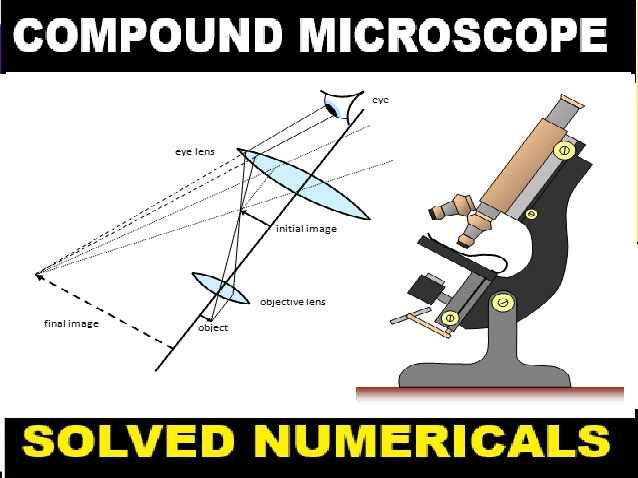
Compound Microscope Numerical Class-12 Nootan ISC Physics Solution Ch-18 Optical Instruments
| Board | ISC |
| Class | 12 |
| Subject | Physics |
| Book | Nootan |
| Chapter-18 | Optical Instruments |
| Topics | Numericals on Compound Microscope |
| Academic Session | 2025-2026 |
Numericals on Compound Microscope
Compound Microscope Numerical Class-12 Nootan ISC Physics Solution
Que-5: A compound microscope has a magnifying power of 30. The focal length of its eye-piece is 5 cm. Assuming the final image to be formed at the least distance of distinct vision (25 cm), calculate the magnification produced by the objective of the microscope.
Ans- m = -mo me
m = – mo (1 + D/fe)
=> 30 = – mo (1 + 25/5)
=> mo = 30/-6 = -5
Que-6: The magnification by the objective of a compound microscope is 8. If the magnifying power of the microscope be 32, then calculate the magnification by the eye-piece.
Ans- M = mo x me
=> 32 = 8 x me
=> me = 32/8 = 4
Que-7: The length of a microscope is 14 cm and for relaxed eye the magnifying power is 25. The focal length of the eye-piece is 5.0 cm. Calculate the distance of the object from the objective and the focal length of the objective.
Ans- L = Vo + fe
=> 14 = Vo + 5
=> Vo = 9
m = mo x me => vo/uo x D/fe
=> vo = 9/5 = 1.8 cm
now fo = vo x uo / vo+uo
=> (9 x 9/5) / (9 + 9/5)
=> 81/54 = 1.5 cm
Que-8: A compound microscope has an objective of focal length 1.0 cm and an eye-piece of focal length 3.0 cm. It forms a sharp image of an object placed at 1.2 cm from its objective at the least distance of distinct vision (25 cm). What is the length of the microscope? Magnifying power?
Ans- uo = 1.2 cm , fo = 1.0 cm
=> 1/f = 1/vo – 1/uo
=> 1/1.0 = 1/vo – 1/-1.2
=> vo = 6 cm
again ve = -25 cm , fe = 3 cm , ue = ?
=> 1/f = 1/-25 -1/ue
=> ue = 2.68 cm
L = uo + ue = 6 + 2.68 = 8.68 cm
m = mo x me
=> – vo/uo x (1 + D/fe)
=> -6/1.2 x (1 + 25/3)
=> -46.7
Que-9: The distance between the microscope and the real objective of a compound image formed by it is 18 cm. If fo 0.4 cm, fe 2.0 cm, then calculate the magnifying power of the microscope for final image formed at the least distance of distinct vision.
Ans- vo = 18 cm , fo = 0.4 cm
=> 1/f = 1/vo – 1/uo
=> 1/0.4 = 1/18 – 1/uo
=> uo = -9/22
again m = mo x me
= vo/uo x (1 + D/fe)
=> -18 x 22/9 (1 + 25/2) = -594
Que-10: A compound microscope has an objective of focal length 2.0 cm and an eye-piece of focal length 6.25cm separated by a distance of 15 cm. Find the location of an object with respect to the objective so that the final image is formed at least distance of distinct vision. What is the magnifying power of the microscope?
Ans- ve = -25 , fe = 6.25 , ue =?
=> 1/fe = 1/-25 – 1/ue
=> 1/6.25 + 1/25 = -1/ue
=> ue = -5 cm
again vo = L – ue => 15-5 = 10 cm
again => 1/fo = 1/vo – 1/uo => 1/2 = 1/10 – 1/uo
=> uo = -2.5 cm
m = -mo x me
=> -vo/uo x (1+D/fe)
=> -10/2.5 x (1 + 25/6.25)
=> -20
Que-11: In a compound microscope, the magnified virtual image is formed at a distance of 25 cm from the eye-piece. The focal length of the objective lens is 2 cm. If the magnification is 90 and the tube length of the microscope is 30 cm, then calculate the focal length of the eye-piece.
Ans- L = vo
vo = 30 cm
=> 1/fo = 1/vo – 1/uo
=> 1/2 = 1/30 – 1/uo
=> uo = -15/7 cm
M = vo/uo = 30/(-15/7) = -14
mo= 14
M = mo x me
=> 90 = 14 x me
=> me = 45/7
Me = 1 + D/fe
=> 45/7 = 1 + 25/fe
=> fe = 5 cm
— : End of Compound Microscope Numerical Class-12 Nootan ISC Physics Solution Ch-18 Optical Instruments. :–
Return to : – Nootan Solutions for ISC Class-12 Physics
Thanks
Please share with your friends