Conditional Probability Class 12 OP Malhotra Exe-18B ISC Maths Solutions Ch-18 Probability. In this article you would learn about the conditional probability. Step by step solutions of latest textbook has been given as latest syllabus. Visit official Website CISCE for detail information about ISC Board Class-12 Mathematics.
Conditional Probability Class 12 OP Malhotra Exe-18B ISC Maths Solutions Ch-18 Probability
| Board | ISC |
| Publications | S Chand |
| Subject | Maths |
| Class | 12th |
| Chapter-18 | Probability |
| Writer | OP Malhotra |
| Exe-18(b) | Conditional Probability |
Conditional Probability
Probability Class 12 OP Malhotra Exe-18B Solutions
Que-1: Given that E and Fare events such that P(E) = 0.6, P(F) = 0.3 and P(E ∩ F) = 0.2, find P(E/F) and P(F/E).
Sol: Given P (E) = 0.6; P (F) = 0.3 ; P (E ∩ F) = 0.2
∴ P(E/F) = P(E∩F)/P(F) =0.2/0.3=2/3 and P(F/E)= P(E∩F)/P(E) = 0.2/0.6 =1/3
Que-2: If A and 5 are two events such that P (A) = 0.5, P (B) = 0.6 and P (A ∪ B) = 0.8, find P (A/B) and P (B/A).
Sol: Given P (A) = 0.5, P (B) = 0.6, P (A ∪ B) = 0.8
We know that P(AuB) = P (A) + P (B) – P (A ∩ B) ⇒ 0.8 = 0.5 + 0.6 – P (A ∩ B)
⇒ P (A ∩ B) = 1.1 – 0.8 = 0.3
∴ P(A/B) = P(A∩B)/P(B)= 0.3/0.6 =1/2
P(B/A) = P(A∩B)/P(A)= 0.3/0.5 =3/5
Que-3: If A and B are two events such that P(A) = 0.3, P(B) = 0.6 and P(B/A) = 0.5, find P(A/B) and P(A ∪ B).
Sol: Given P (A) = 0.3, P (B) = 0.6
P (B/A) = 0.5 ⇒ 0.5 = P(A∩B)/P(A) = 0.5 x 0.3 = 0.15
∴ P (A / B) = P(A∩B)/P(B) = 0.15/0.6 = 1/4
Thus P (A ∪ B) = P (A) + P (B) – P (A ∩ B) = 0.3 + 0.6 – 0.15 = 0.75
Que-4: If P (not A) = 0.7, P (5) = 0.7 and P (B/A) = 0.5, find P (A/B) and P (A ∪ B).
Sol: Given P (not A) = 0.7 ⇒ 1 – P (A) = 0.7 ⇒ P (A) = 0.3
P (B) = 0.7 ; P (B/A) = 0.5
⇒ 0.5 = P(B∩A)/P(A) ⇒ P (B ∩ A) = 0.5 x 0.3 = 0.15
Thus P (A/B) = P(A∩B)/P(B) = 0.15/0.7 = 15/70 =3/14
∴ P(A∪B) = P (A) + P (B) – P (A ∩ B) = 0.3 + 0.7 – 0.15 = 0.85
Que-5: Given that P(X) = 0.8, P (A/B) = 0.8, P(A∩B) = 0.5, find
(i) P(B) (ii) P (B/A) (iii) P(A∪B) (v) P (A ∩ B/A ∪ B) (vi) P [(A ∩ B)/B’] (vii) P(A ∩ B/A)
Sol: Given P (A) = 0.8 ; P (A/B) = 0.8, P (A ∩ B) = 0.5
![Que-5: Given that P(X) = 0.8, P (A/B) = 0.8, P(A∩B) = 0.5, find (i) P(B) (ii) P (B/A) (iii) P(A∪B) (v) P (A ∩ B/A ∪ B) (vi) P [(A ∩ B)/B’] (vii) P(A ∩ B/A)](https://icsehelp.com/wp-content/uploads/2025/09/20-3-300x236.png)
Que-6: A die is rolled. If the outcome is an odd number, what is the probability that it is prime?
Sol: When a die is rolled.
Then S = {1, 2, 3, 4, 5, 6}
A : event that outcome is an odd number = (1, 3, 5}
B : event that outcome is prime = (2, 4, 5}
n (A) = 3 ; n (B) = 3
∴ A ∩ B = {3, 5} ⇒ n ∩ (A ∩ B) = 2
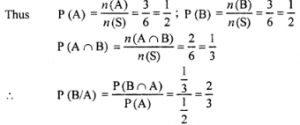
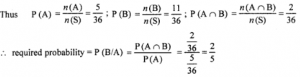
Que-7: A die is thrown twice and the sum of the numbers appearing is observed to be 6. What is the conditional probability that the number 4 has appeared at least once?
Sol: When a dice is thrown twice
Then total no. of outcomes = 62 = 36
A : event that sum of numbers appearing is 6 = {(1, 5), (5, 1), (2, 4), (4, 2), (3, 3)}
B : event that number 4 has appeared atleast once
= {(4, 1), (4, 2), (4, 3), (4, 4), (4, 5), (4, 6), (1, 4), (2, 4), (3, 4), (5, 4), (6, 4)}
Thus n (A) = 5 ; n (B) = 11
∴ A ∩ B = {2, 4), (4, 2)}
∴ (A ∩ B) = 2; n (S) = 36
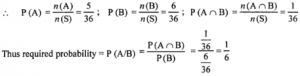
Que-8: Two dice are thrown. Find the probability that numbers appeared have a sum 8, if it is known, that the second die always exhibits 4.
Sol: When two dice are thrown
Then total no. of outcomes = n (S) = 6² = 36
A = event that the numbers appeared have a Sum 8 = {(2, 6), (3, 5), (4, 4), (5, 3), (6, 2)}
B = event that the second die always exhibits 4 = {(1, 4), (2, 4), (3, 4), (4, 4), (5, 4), (6,4)}
∴ A ∩ B = {(4, 4)}
Thus n (A) = 5 ; n (B) = 6 ; n (A ∩ B) = 1
Que-9: Assume that each born child is equally likely to be a boy or a girl. If a family has two children then what is the conditional probability that both are girls ? Given that (i) the youngest is a girl? (ii) at least one is a girl?
Sol: Since the family has two children then S = (BB, BG, GB, GG} ∴ n (S) = 4
A : event that both are girls = {GG}
B : event that youngest is a girl = {BG, GG}
C : event that atleast one is a girl = {BG, GB, GG}
n (A) = 1 ; n (B) = 2 ; n (C) = 3 ; n (S) = 4
A ∩ B = {GG} ; A ∩ C = {GG}
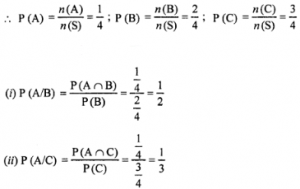
Que-11: In a class 40% students read Statistics, 25% Mathematics and 15% both Mathematics and Statistics. One student is selected at random. Find the probability:
(i) that he reads Statistics, if it is known that he reads Mathematics.
(ii) that he reads Mathematics, if it is known that he reads Statistics.
Sol: Let S : students who read Statistics
M : Students who read Mathematics
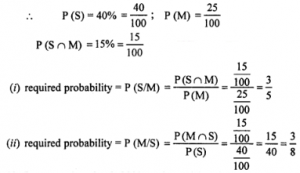
Que-12: In a certain school, 20% students failed in English, 15% students failed in Mathematics and 10% students failed in both English and Mathematics. A student is selected at random. If he failed in English, what is the probability that he also failed in Mathematics?
Sol: Let us define the events as follows :
E : students who failed in English
M : students who failed in Mathematics
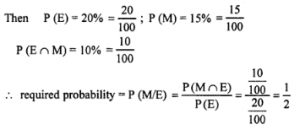
Que-13: One card is drawn from a well-shuffled pack of 52 cards. If E is the event “the card drawn is a king or an ace” and F is the event “the card drawn is an ace or a jack”, then find the probability of the conditional event (E/F).
Sol: Given E : event that the card drawn is a king or an ace
F : event that the card drawn is an arc or a jack
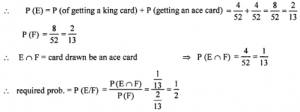
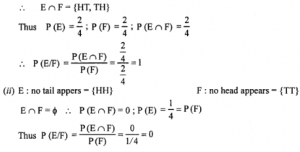
Que-14: Two coins are tossed once, where
(i) E: tail appears on one coin F: one coin shows head
(ii) E; no tail appears F: no head appears. Find P(E/F).
Sol: (i) When two coins are tossed S = {HH, HT, TH, TT}
E : tail appears on once coin = {TH, HT}
F : one coin shows head = {HT, TH}
Que-15: A black and a red die are rolled.
(i) Find the conditional probability of obtaining a sum greater than 9, given that the black die resulted in a 5.
(ii) Find the conditional probability of obtaining sum 8, given that the red die reculted in a number less than 4.
Sol: When a black and a red die are rolled
Then total no. of outcomes = n (S) = 6² = 36
(i) E : event of obtaining a sum > 9 = {(4, 6), (6, 4), (5, 5), (5, 6), (6, 5), (6, 6)}
F : a black die resulted in a 5 = {(5, 1), (5, 2), (5, 3), (5, 4), (5, 5), (5, 6)}
∴ E ∩ F = {(5, 5), (5, 6)}
Thus P(E) = n(E)n( S)=6/36 = 1/6 P(F) = n( F)n( S)= 6/36 = 1/6
P(E ∩ F) = n(E∩F/)n( S) = 2/36
∴ Required probability = P(E/F) = P(E∩F)/P(F) = (2/36)/(1/6) = 2/36×6 = 1/3
(ii) Let G : event of obtaining sum 8 = {(2, 6), (3, 5), (4, 4), (5, 3), 6, 2)}
H : event that a red die resulted in a number < 4 = {(1, 1), (1, 2), (1, 3), (2, 1), (2, 2), (2, 3), (3, 1), (3, 2), (3, 3), (4, 1), (4, 2), (4, 3), (5, 1),
(5, 2), (5, 3), (6, 1), (6, 2), (6, 3)}
∴ n (G) = 5 ; M (H) = 1/8
Thus G ∩ H = {(5, 3), (6, 2)} ⇒ n(G ∩ H) = 2
Thus, required probability = P (G/H) = P(G∩H)/P(H) = (2/36)/(18/36) = 1/9
Que-16: Given that the two numbers appearing on throwing two dice are different, find the probability of the events the sum of numbers on the dice is 4.
Sol: Let us define the events are as follows :
E : events that the sum of numbers on the dice is 4 = {(1, 3), (2, 2), (3, 1)}
∴ n (E) = 3
F : two numbers apearing on throwing two dice are different = {(1,2), (1,3), (1,4), (1, 5), (1,6), (2, 1), (2, 3), (2, 4), (2, 5), (2, 6), (3, 1), (3, 2), (3, 4), (3, 5), (3, 6), (4, i), (4, 2), (4, 3), (4, 5), (4, 6), (5, 1), (5, 2), (5, 3), (5,4), (5, 6), (6, 1), (6, 2), (6, 3), (6,4), (6, 5)}
∴ n (F) = 30
∴ E ∩ F={(1, 3),(3, 1)} ⇒ n(E ∩ F) = 2
Thus required probability = P (E/F) = P(E∩F)/P(F) = (2/36)/(30/36) = 1/15
Que-17: Mother, father and son line up at random for a family picture.
E: son on one end
F: father in the middle
Find P{E/F)
Sol: Sample space = {mfs, msf, fms, fsm, sfm, smf}
∴ n (S) = 6
E : son on one end = {sfm, smf mfs, fms)
⇒ n (E) = 4
F : father in the middle = {mfs, sfm}
∴ n(F) = 2
∴ E ∩ F = {sfm, mfs} ⇒ n (E ∩ F) = 2
Thus required probability = P (E/F) = P(E∩F)/P(F) = 26/26 = 1
Que-18: Consider the experiment of throwing a die, if a multiple of 3 comes up throw the die again and if any other number comes, toss a coin. Find the conditional probability of the event the coin shows a tail, given that at least one die shows a 3.
Sol: Thus Sample space = {(3,1), (3,2), (3,3), (3,4), (3, 5), (3, 6), (6,1), (6, 2), (6,3), (6,4), (6,5), (6, 6), (1, H), (1, T), (2, H), (2, T), (4, H), (4, T), (5, H), (5, T)}
Thus n(S) = 20
E : the coin shows a tail = {(1, T), (2, T), (4, T), (5, T)}
F : atleast one die shows 3 = {(3, 1), (3, 2), (3, 3), (3, 4), (3, 5), (3, 6), (6, 3)}
∴ n (E) = 4 ; n (F) = 7
Thus, required probability = P (E / F) = P(E∩F)P(F)=0/(7/36) = 0
Que-19: One ticket is selected at random from 50 tickets numbered 00, 01, 02,…., 49. Then, the probability that the sum of the digits on the selected ticket is 8, given that the product of these digits is zero, equals
(a) 1/7
(b) 1/14
(c) 1/25
(d) 1/50
Sol: Here Sample space S = {00, 01, 02,49}
∴ n (S) = 50
Let A: event that the sum of the digits on selected ticket is 8 = {08, 17, 26, 35, 44}
∴ n (A) = 5
B : event that the product of the digits on the selected ticket is 0 = {00, 01, 02, 03, 04, 05, 06, 07, 08, 09, 10, 20, 30, 40}
∴ n (B) = 14
∴ A ∩ B = {08} ⇒ n(A ∩B) = 1
Thus required probability = P (A/B) = P(A∩B)/P(B) = (1/50)/(14/50) = 1/14
Que-20: If A and B are events such that P(A/B) = P(B/A), then
(a) A ⊂ B but A ≠ B
(b) A = B
(c) A ∩ B = φ
(d) P(A) = P(B)
Sol: Given P(A/B) = P(B/A) ⇒ P(A∩B)/P(B) = P(B∩A)/P(A) ⇒ P(A) = P(B)
–: End of Conditional Probability Class 12 OP Malhotra Exe-18B ISC Maths Solutions :–
Return to :- OP Malhotra ISC Class-12 S Chand Publication Maths Solutions
Please share with your friends
Thanks