Continuity and Differentiability Class 12 OP Malhotra Exe-7A ISC Maths Solutions Ch-7 Solutions. In this article you would learn about algebra of continuous functions. Step by step solutions of latest textbook has been given as latest syllabus. Visit official Website CISCE for detail information about ISC Board Class-12 Mathematics.
Continuity and Differentiability Class 12 OP Malhotra Exe-7A ISC Maths Solutions Ch-7
| Board | ISC |
| Publications | S Chand |
| Subject | Maths |
| Class | 12th |
| Chapter-7 | Continuity and Differentiability |
| Writer | OP Malhotra |
| Exe-7(A) | algebra of continuous functions |
Exercise- 7A
Continuity and Differentiability Class 12 OP Malhotra Exe-7A Solution.
Que-1: Examine the continuity of the function f(x) = 2x² – 1 at x = 3.
Sol: Given f(x) = 2x² – 1
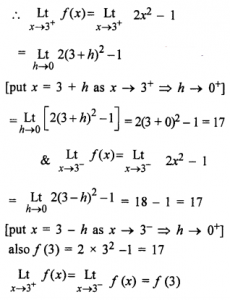
Thus f(x) is continous at x = 3
Que-2: Examine the following functions for continuity:
(a) f(x) = x- 5
(b) f(x) = 1/x-5, x ≠-5
(c) f(x) = x²-25/x+5, x ≠ 5
(d) f(x) = |x – 5|
Sol: (a) Given f (x) = x – 5 ; Df = R
Let c ∈ Dy = be any arbitrary point.
∴Lt(x→c) f(x) =Lt(x→c) x – 5 = c – 5 = f(c)
∴ f is continuous at x = c
but c be any arbitrary point of Df
Thus,/is continuous at every point of its domain
∴ f be a continuous function.
(b) f(x) = 1−5, x ≠ 5
Here, Df = R -{5}
Let c ∈ Df = be any arbitrary point.
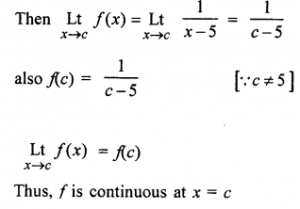
Thus, f is continuous at x = c
and c be any arbitrary point of Df
Therefore f is continuous at every point of its domain
(c) Given x²-25/x+5 x ≠ 5
Here, Df = R -{5}
Let c ∈ Df be any arbitrary point.
∴ c ≠ – 5
Then Lt(x→c) f(x)=Lt(x→c) x²-25/x-5=c²-25/c-5
since c ≠ – 5
∴ f(c) = c²-25/c-5
∴ Lt(x→c)f(x) = f(c)
Thus, f is continuous at x = c
but c be any arbitrary point
Hence f is continuous at every point of its domain.
(d) Given f(x) = |x – 5|
={x-5;x≥5
{-(x-5);x<5
Df = R
So we examine the continuity of function of f at all x ∈ R. Let c ∈ R be any arbitrary point of Df
There cases arises.
Case -I :
when c < 5
Then f(c) = -(c – 5)
∴ Lt(x→c)f(x) =Lt(x→c) 9 (x – 5) = – (c – 5)
Thus, Lt(x→c)f(x) = f(c)
∴ f(x) is continous for all c < 5
Case -II : when c > 5
Then f(c) = c – 5
∴Lt(x→c)f(x) =Lt(x→c) x – 5 = c – 5
Thus, Lt(x→c) f(x) = f(c)
∴ f is continuous for all c > 5
Case -III :
when x = C = 5
Then f(c) = f(5) = 5 – 5 = 0
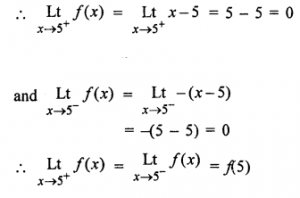
Thus f(x) is continous at x = c = 5
on combining all three cases; function f is continuous for all x ∈ R.
Thus f is continuous at every point of its domain.
Que-3: A function f is defined byf(x) ={x²-4x+3/x²-1,for x≠1
2,for x=1 Test the continuity of the function at x = 1.
Sol: Given
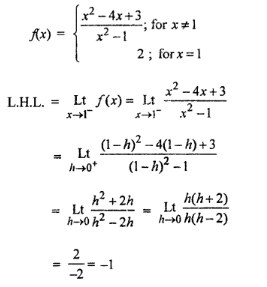
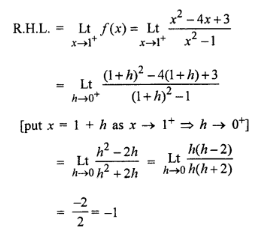
also f(1) = 2
∴ L.H.L = R.H.L = f(1)
Thus f is discontinous at x = 1
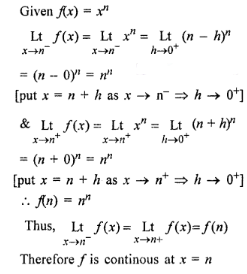
Que-4: Prove that the function f(x) = xn is continuous at x = n, where n is a positive integer.
Sol:
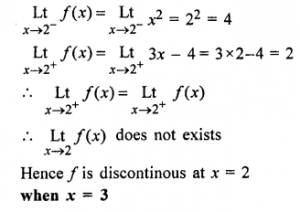
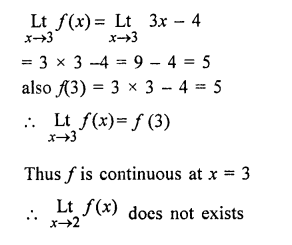
Que-5:Show that the function f(x) ={x² for 1≤x<2 {3x-4 for 2≤x<4 is discontinuous at x = 2 and continuous x = 3.
Sol:
Que-6: (a) Find all points of discontinuity of f where f is defined by
f(x) ={2x+36,if x≤2 {2x-3,if x>2.
(b) Discuss the discontinuity of the function f(x) at x = 0 ,if f(x)={2x-1,if x<0 {2x+1,if x≥0.
(c) Is the function defined by f(x) ={x+5,if x≤1 {x-5,if x>1 , a continuous function?
(d) Show that f(x) ={5x-4, when 0<x≤1 {4x³-3x, when 1<x<2,is continuos at x=1.
Sol: (a) Given f(x) ={2x+36,if x≤2
{2x-3,if x>2.
Here Df = R So we check the continous of f at all points of R. Let c ∈Df be any arbitrary point.
Three cases arises.
Case-I
when c < 2 then f(c) = 2c + 3
Lt(x→c)f(x) =Lt(x→c) 2x + 3 = 2c + 3
Lt(x→c)f(x) = f(c)
Thus f is continous for all c < 2
Case-II
when c > 2 then f(c) = 2c – 3
Lt(x→c) f(x) = Lt(x→c)2x – 3 = 2c – 3
Lt(x→c) f(x) = f(c)
Hence f is continous for all c > 2
Case-III
when c = 2
Lt(x→2+)f(x) = Lt(x→2+) 2x – 3 = 4 – 3 = 1
and Lt(x→2-) f(x) =Lt(x→2-) 2x – 3 = 4 + 3 = 7
Lt(x→2-)≠Lt(x→2+)
Thus f is not continous i.e., discontinous at x = 2. So on contining all these cases, f is continuous at every point of its domain except x = 2.
(b) at x = 0,
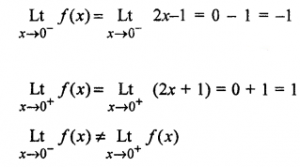
Thus Lt(x→0) does not exists Hence f is discontinuous at x = 0
(c) Given f(x) ={x+5,if x≤1
Hence Df = R so we examine the continuity of f at all points of R.
Let c ∈Df be any arbitrary point so three cases arises.
Case-I
when c < 1 then f(c) = c + 5
Lt(x→c) f(x) =Lt(x→c) x + 5 = c + 5 = f(c)
∴ f is continuous at all c < 1
Case-II
when c > 2.
Then f(c) = c – 5
Lt(x→c) f(x) = Lt(x→c) x – 5 = c – 5 = f(c)
∴ f is continuous at all c < 1
Case-III
when c = 1
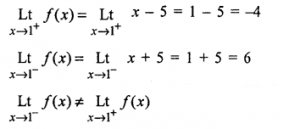
Thus f is discontinous at x = 1
Hence on combining all three cases, f is not continuous at every point of its domain.
∴ f is not a continuous function.
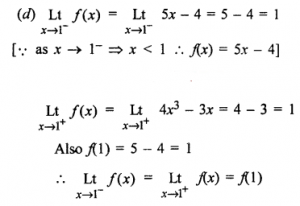
Thus f is continuous at x = 1
Que-7:Examine the continuity for the following functions:
(a) f(x) ={x+1,if x≥1 {x²+1,if x<1
(b) f(x) ={x^1 0-1,if x≤1 {x²,if x>1
Sol:(a) Given f(x) ={x+1,if x≥1
{x²+1,if x<1
Here Df = R. so we examine the continuity of f at all x ∈ R. Let c ∈ R be any real number.
Then three cases arises.
Case-I when c < 1 then f(c) = c² + 1
∴Lt(x→c)f(x) =Lt(x→c)x² + 1 = c² + 1 = f(c)
Thus f is continous at all c < 1
Case-II when c > 1 Then f(c) = c + 1
∴Lt(x→c)=Lt(x→c)x + 1 = c + 1 = f(c)
∴ f is continuous for all c > 1
Case-III when c = 1;
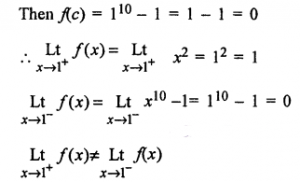
Thus f is continuous at c = 1
So on combining all three cases, f is continuous at every point of its domain
Hence f be a continuous function.
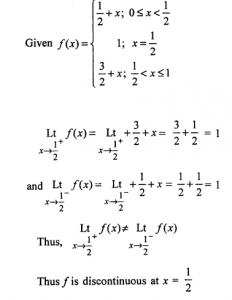
Que-8:Discuss the continuity of the function f(x) at x = 1/2 when f(x) is defined as follows : f(x) ={1/2+x, 0≤x<1/2 {1, x=1/2
{3/2+x,1/2<x≤1
Sol:
Que-9: Examine the continuity of the function f(x) ={-2, if x≤-1 {2x, if -1<x≤1 {2, if x>1
Sol: f(x) ={-2, if x≤-1
Here Df = R
So we examine the continuity of f at all x ∈ R. Let c ∈ Df be any
Case-I
when c < – 1 then f(c) = – 2
Lt(x→c) f(x) =Lt(x→c) – 2 = – 2 = f(c)
∴ f is continuous at all c < – 1
Case-II
when – 1 < c > 1
Then f(c) = 2c
Lt(x→c) f(x) = Lt(x→c)2x = 2c = f(c)
∴ f(x) is continuous at x = c, where – 1 < c > 1
Case-III
when c > 1
Then f(c) = 2
∴ Lt(x→c)f (x) = Lt(x→c)2 = 2 = f(c)
Thus f is continuous for all c > 1
Case-IV
when c = – 1
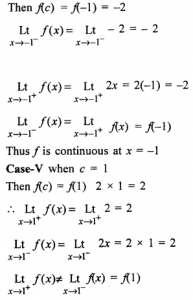
Thus f is continuous at x = 1
Thus on combining all five cases, f is continuous at every point of its domain.. Hence / be a continuous function.
Que-10:A function f (x) is defined as follows: f(x) =xcos(1/x), when x ≠ 0, f(0) = 0. Examine the continuity at x = 0.
Sol:Given f(x) = {xcos(1/x); x≠0
{0; x=0
Let h(x) = x ; g(x) = cos (1/x)
Lt(x→0) h(x) =Lt(x→0) x = 0
Since cos(1/x) is bounded in the deleted x ngd of 0 i.e.,|cos(1/x)| ≤ 1
i.e., cos(1/x) is oscillating between – 1 and 1
∴ g(x) be a bounded function
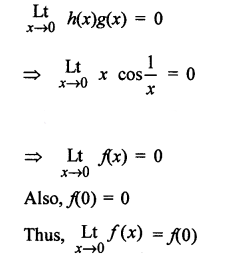
∴ f is continuous at x = 0
Que-11:The function f(x) is defined as follows: f(x) ={(x-a)cos(1/x-a),when x≠a {0, when x=a Examine the continuity, when x = a.
Sol: Given
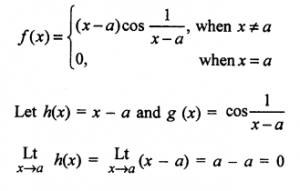
Since cos(1/x-a) is bounded function in the deleted neighbourhood of point x = a
Also, |cos(1/x-a)| ≤ 1
i.e, cos(1/x-a) is oscilating between -1 & 1.
Thus g(x) be a bounded function.
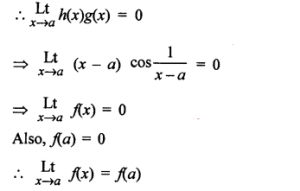
Thus f is continuous at x = a
Que-12:Examine the continuity of the following functions:
(a)f(x)={|x|/x , if x≠0 {0, if x=0 (b)f(x)={x/|x| , if x<0 {-1 , if x≥0
Sol:(a)
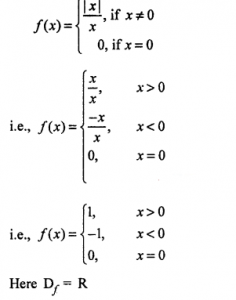
So we examine the continuity of f at all x ∈ R.
Let c ∈ R be any real number
Case-I when c > 0 Then f(c) = 1
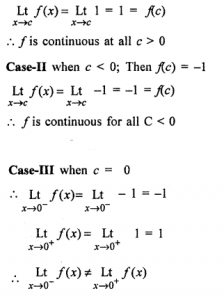
Thus f is discontinuous at x = 1
Therefore on combining all three cases, f is continuous at every point of its domain except at x = 0
(b) Given
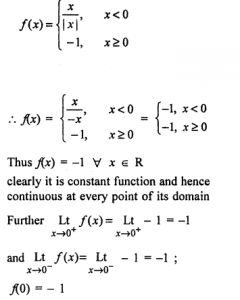
Thus f is continuous at x = 0
Que-13:Examine the continuity at x = 0
(a)f(x)={tan2x/3x , when x≠0
{2/3, when x=0
(b)f(x)=1+|x|/x for x≠0 and f(0)=1
Sol:
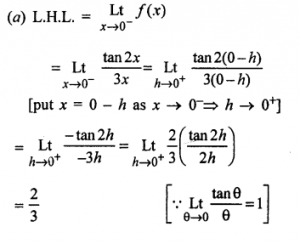
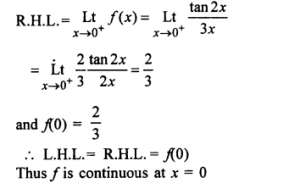
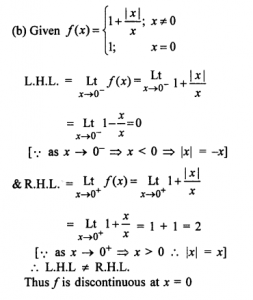
Que-14:Find the value of value of a, if the function f (x) defined by
f(x)={2x-1, x<2
{a, x=2
{x+1, x>2
is continuos at x=2
Sol:
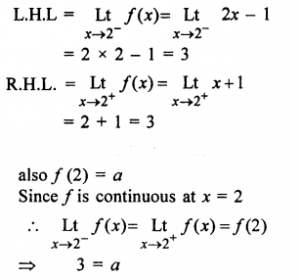
Que-15:Find the relationship between a and 6 so that the function defined by
f(x)={ax+1, if x≤3
{bx+3, if x>3
is continuos at x=3
Sol:Given
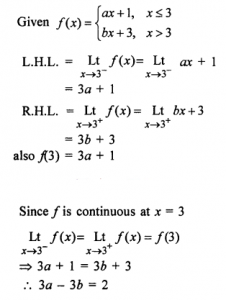
which is the required relation between a & b.
Que-16:For what value of X is the function f(x)={λ(x²-2x), if x≤0 is continuos at x=0?
{4x+1, if x>0
Sol: at x=0
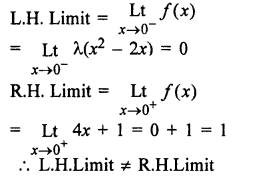
∴ L.H.Limit ≠ R.H.Limit
Thus f is not continuous at x = 0 i.e.
at any real value of λ.
at x = 1 :
Lt(x→1) f(x)= Lt(x→1) 4x+ 1 = 4 + 1 =5 = f(1)
∴ f is continuous at x = 1
Que-17:Find the value of k, so that the function f defined by
f(x)={kx+1, if x≤π
{cosx if x>π is continuous.
Sol:
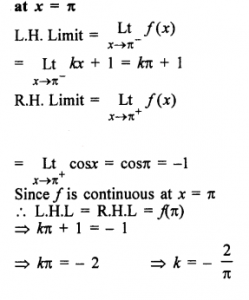
Que-18:Find the value of k, for which f(x)={√1+kx-√1-kx, if -1≤x<0
{2x+1/x-1 , if 0≤x<1 is continuos at x=0.
Sol:at x=0
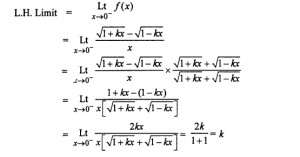
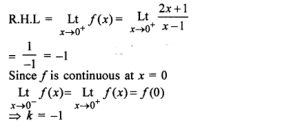
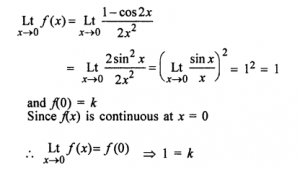
Que-19:If the following function f(x) is continuous at x = 0, then find the value of k.
f(x)={1-cos2x/2x², x≠0
{k, x=0
Sol:
Que-20:Prove that the funciton f(x)={x/|x|+2x², x≠0
{k, x=0
remains discontinuous at x=0, regardless of the choice of k.
Sol:
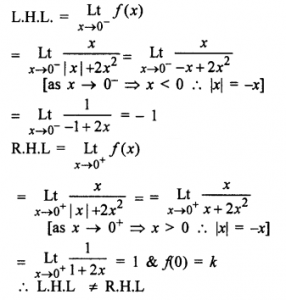
Thus f is remains discontinuous at x = 0 regardless of the choice of k i.e. whatever the real value of k may be. On removable discontinuity;
Que-21:The function f(x) =2x²-8/x-2 is undefined at x = 2. What value should be assigned to f (2) so that f (x) is continuous at x = 2 ?
Sol:
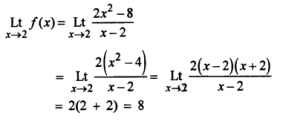
Since f(x) is continuous at x = 2
if Lt(x→2)f(x) = f(2) if 8 = f(2)
Thus required value of f(2) which is assigned be 8.
Que-22:The function f(x) =x²-1/x³-1 at the point x = 1 ; what should be the value of f (1) such that f (x) may be continuous at x = 1?
Sol:
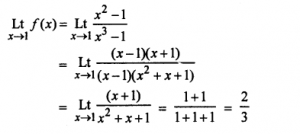
Now f(x) may be continuous at x = 1
if Lt(x→1)f(x) = f(1) if 2/3 = f(1)
Que-23:Is the function f(x)=3x+2sinx/x continuous at x = 0 ? If not, how may the function be defined at x = 0 to make it continuous at that point ?
Sol:Given f(x)=3x+2sinx/x
Since f(o) be indeterminate form i.e. (0/0) form.
Thus f(x) is not defined at x = 0
∴ f(x) is not continuous at x = 0
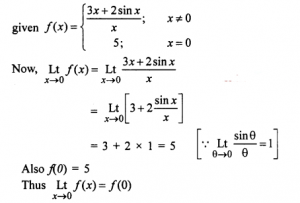
∴ f(x) is continuous at x = 0.
Que-24:Show that the function f(x)=|x – 3|, x ∈ R, is continuous at x = 3 but not differentiable x = 3.
Sol:Given
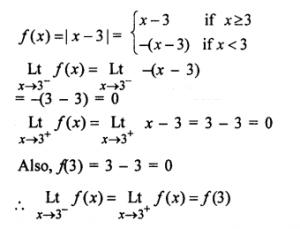
∴ f is continuous at x = 3
∴ f is continuous at x = 30
Differentiability at x = 3
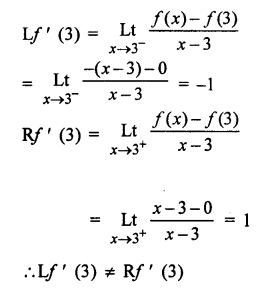
Thus, f is not differentiable x = 3
Hence f is continuous but not differentiable at x = 3
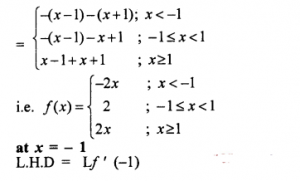
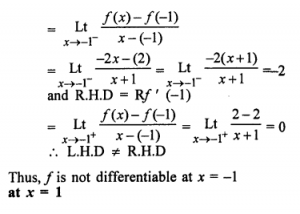
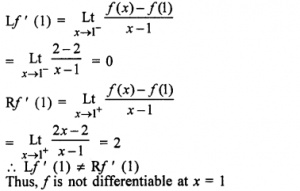
Que-25:Show that the function f(x) = |x-1| + |x + 1| for all x ∈ R, is not differentiable at the points x = – 1 and x = 1.
Sol:f(x) = |x-1| + |x + 1|
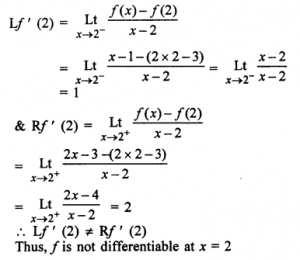
Que-26:Show that the function
f(x) ={x-1, if x<2
{2x-3, if x≥0 is not differentiable at x = 2.
Sol:
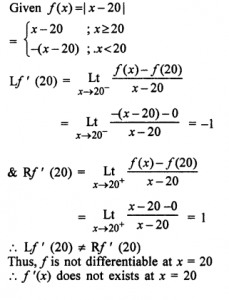
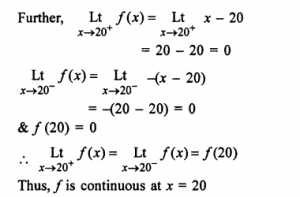
Que-27:Show that f(x) = | x – 20| is continuous at x = 20 but f'(x) does not exist at x=20.
Sol:
–: End Continuity and Differentiability Class 12 OP Malhotra Exe-7A ISC Math Ch-7 Solution :–
Return to :- OP Malhotra ISC Class-12 S Chand Publication Maths Solutions
Thanks
Please share with your friends