Coordinates and Graphs of Simultaneous Linear Equations Class 9 OP Malhotra Exe-20C ICSE Maths Solutions Ch-20. Step by Step Solutions / Answer of Questions on Solving Simultaneous Linear Equations by Graph Method. Visit official Website CISCE for detail information about ICSE Board Class-9 Mathematics
Coordinates and Graphs of Simultaneous Linear Equations Class 9 OP Malhotra Exe-20C ICSE Maths Solutions Ch-20
| Board | ICSE |
| Publications | S Chand |
| Subject | Maths |
| Class | 9th |
| Chapter-20 | Coordinates and Graphs of Simultaneous Linear Equations |
| Writer | OP Malhotra |
| Exe-20C | Solving Simultaneous Linear Equations by Graph |
| Edition | 2025-2026 |
Solving Simultaneous Linear Equations by Graph
Coordinates and Graphs of Simultaneous Linear Equations Class 9 OP Malhotra Exe-20C ICSE Maths Solutions Ch-20
Que-1: 3y – 2x = 7, 5x + 3y = -7
Sol: 3y – 2x = 7
⇒ 3y = 7 + 2x
⇒ y = (7+2x)/3
Giving some different values to x, we get corresponding values of y as given below

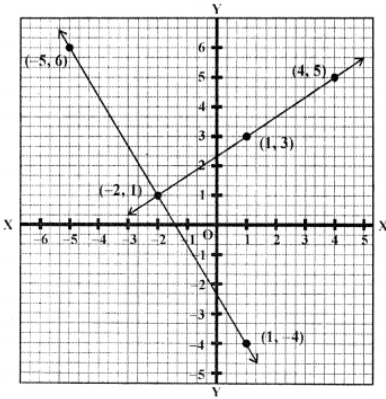
Now plot the points (1, 3),(4, 5) and (-2, 1) on the graph and join them to get a line Similarly in equation,
5x + 3y = -7
⇒ 5x = -7 – 3y
x = (−7−3y)/5
= −((7+3y)/5)

Now plot the points (-2, 1), (-5, 6) and (1, -4) on the graph and join them to get another line. We see that these two lines intersect each other at (-2, 1)
∴ x = -2. y = 1
Que-2: 2x + 3y = 13, 5x – 2y = 4
Sol: 2x + 3y = 13 ⇒ 2x = 13 – 3y
⇒ x = (13−3y)/2
Giving some different values to y, we get corresponding values of x as given below

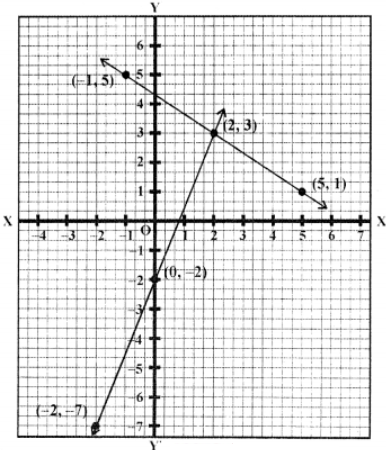
Now plot the points (5, 1), (2, 3) and (-1, 5) on the graph and join them to get a line similarly in equation
5x – 2y = 4
⇒ 5x = 4 + 2y
⇒ x = (4+2y)/5

Now plot the points (2, 3), (0, -2) and (-2, -7) on the graph and join them to get another line
We see that these two lines intersect each other at the point (2, 3)
∴ x = 2, y = 3
Que-3: 5x + y = -3, 2x = 3y – 8
Sol: 5x + y = -3 ⇒ y = -3 – 5x
⇒ y = -(3 + 5x)
Now giving some different values to x, we get the corresponding values of y as given below:

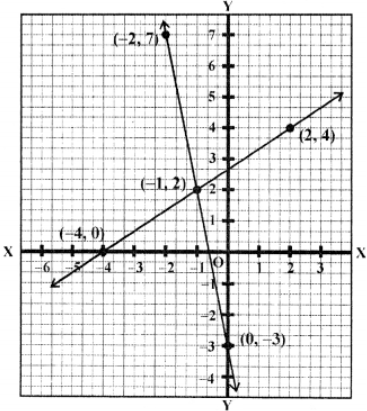
Now plot the points (0, -3), (-1, 2) and (-2, 7) on the graph and join them to get a line Similarly in equation 2x = 4y – 8
⇒ x = (3y−8)/2

Now plot the points (-4, 0), (-1, 2) and (2, 4) on the graph and join them to get another line
We see that these two lines intersect each other at (-1, 2)
∴ x = -1, y = 2
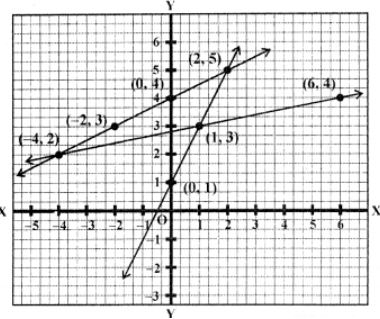
Que-4: Find graphically the vertices of the triangle whose sides have the equations 2y – x = 8, 5y – x = 14 and y – 2x = 1 respectively. Take 1 cm = 1 unit on both the axes.
Sol: 2y – x = 8, 5y – x = 14 and y – 2x = 1
Now 2y = 8 + x
y = (8+x)/2
Giving some different values to x, we get corresponding values of y as given below :

Now plot the points (0, 4), (-2, 3) and (-4, 2) on the graph and join them to get a line Similarly in equation,
5y – x = 14 ⇒ x = 5y – 14

and join them to get another line and in equation
y – 2x = 1 => y = 1 + 2x

Plot the points (0, 1), (1, 3) and (2, 5) on the graph and join them to get third line
Que-5: Using a scale of 1 cm to 1 unit for both the axes, draw the graphs of the following equations :
6y = 5x + 10, y = 5x – 15 From the graphs find :
(i) the coordinates of the point where the two lines intersect ;
(ii) the area of the triangle between the lines and the x-axis.
Sol: 6y = 5x+ 10, y = 5x – 15
6y = 5x + 10
y = (5x+10)/6
Giving some different values to x, we get corresponding values of y as given below :

Now plot the points (4, 5), (10, 10) and (-2, 0) on the graph and join them to get a line
Similarly in the equation,
y = 5x – 15

Now plot the points (2, -5), (3, 0) and (4, 5) on the graph and join them to get another line
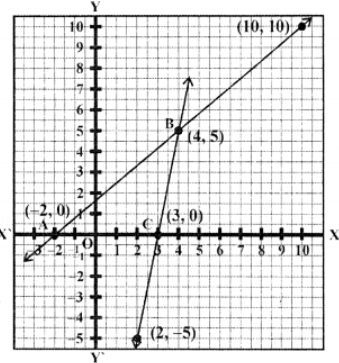
(i) We see that these two lines intersect each other at the point (4, 5)
(ii) ∵ x-axis and the two lines form a triangle ABC whose base AC = 5 units and height = 5
∴ Area = (1/2) × 5 × 5 = 25/2 = 12.5 sq. units
or 12.5 cm²
Que-6: The graph of a linear equation in x and y
Sol: x + y + 3 = 0, and 3x – 2y + 4 = 0
(i) In the equation
x + y + 3 = 0 ⇒ x = -(y + 3)
Given three different values to y, we get the corresponding values of x as shown below :

Now plot these points (-3, 0), (-2, -1) and (-1, -2) on the graph and join them to get a line
Similarly in the equation,
3x – 2y + 4 = 0
⇒ 3x = 2y – 4
⇒ x = (2y−4)/3
Now plot these points (-2, -1), (0, 2) and (2, 5) on the graph and join them to get another line
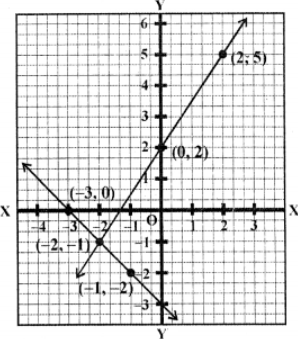
(ii) We see that these two lines intersect each other at the point P (-2, -1)
∴ Co-ordinates of P are (-2, -1)
(iii) Join OP and on measuring OP,
We get OP = 2.2 (approx)
Que-7: Solve graphically the simultaneous equations,
x – 2y = 1; x + y = 4.
Use 2 cm = 1 unit on both axes and plot only three points per line.
Sol: The equations are
x – 2y = 1 and x + y – 4
In the equation x – 2y= 1
⇒ x = 1 + 2y
Giving three different values toy, we get the corresponding values of x as given below :

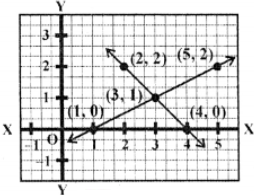
Now plot the points (1, 0), (3, 1), (5, 2) on the graph and join them to get a line Similarly in the equation
x + y = 4 ⇒ x = 4 – y

Now plot these points (4, 0) (3, 1) and (2, 2) on the graph and join them to get another line
We see that these two lines intersect each other at (3, 1)
∴ Solution is x = 3, y = 1
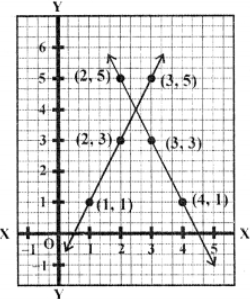
Que-8: Use a graph paper for this question. Draw graph of 2x – y – 1 =0 and 2x + y = 9 on the same axes. Use 2 cm = 1 unit on both axes and plot only 3 points for each line. Write down the coordinates of the point of intersection of the two lines.
Sol: The two equations are 2x – y – 1 – 0 and 2x + y = 9
Now in the equations,
2x – y – 1 = 0
2x = y + 1
x = (y+1)/2
Now giving three different values to y, we get the corresponding values of x as given below:

Now plot there points (1, 2), (2, 3) and (3, 5) on the graph and join them to get a line
Similarly in the equation,
2x + y = 9 ⇒ y = 9 – 2x

Now plot these points (2, 5), (3, 3) and (4, 1) on the graph and join them to get another line
We see that these two lines intersect each other at (2.5, 4)
–: End of Coordinates and Graphs of Simultaneous Linear Equations Class 9 OP Malhotra Exe-20C ICSE Maths Ch-20 Solutions :—
Return to :– OP Malhotra S Chand Solutions for ICSE Class-9 Maths
Thanks
Please Share with Your Friends