Coordinates and Graphs of Simultaneous Linear Equations Class 9 OP Malhotra Exe-20D ICSE Maths Solutions Ch-20. Step by Step Solutions / Answer of Questions of OP Malhotra Maths. Visit official Website CISCE for detail information about ICSE Board Class-9 Mathematics.

Coordinates and Graphs of Simultaneous Linear Equations Class 9 OP Malhotra Exe-20D ICSE Maths Solutions Ch-20
| Board | ICSE |
| Publications | S Chand |
| Subject | Maths |
| Class | 9th |
| Chapter-20 | Coordinates and Graphs of Simultaneous Linear Equations |
| Writer | OP Malhotra |
| Exe-20D | How to Calculate Distanced between two point on Graph |
| Edition | 2025-2026 |
How to Calculate Distanced between two point on Graph
Coordinates and Graphs of Simultaneous Linear Equations Class 9 OP Malhotra Exe-20D ICSE Maths Solutions Ch-20.
Que-1: Find the distance between each of the following pairs of points :
(i) (0, 0), (2, 3)
(ii) (-3, 0), (o, √7)
(iii) (a, 0), (0, a)
(iv) (7, 9), (4, 5)
(v) (-6,-1), (-6, 11)
(vi) (a + b, a – b), (a – b,-a – b)
(vii) (2, -11), (-4, -3)
(viii) (a, b), (2a, b).
Sol: We know that distance between two points P (x1 y1) and Q (x2, y2)
= √[(x2−x1)²+(y2−y1)²]. Therefore
(i) Distance between (0, 0) and (2, 3)
= √[(2−0)²+(3−0)²] = √{2²+3²}
= √(4+9) = √13
(ii) Distance between,(-3, 0) and (0, √7)
= √[[0−(−3)]²+(√7−0)²] = √{(3)²+(√7)²}
= √(9+7) = √16 = 4
(iii) Distance between (a, 0) and (0, a)
= √[(0−a)²+(a−0)²] = √{a²+a²}
= √2a² = a√2
(iv) Distance between (7, 9) and (4, 5)
= √[(4−7)²+(5−9)²] = √{(−3)²+(−4)²}
= √(9+16) = √25 = 5
(v) Distance between (-6, -1), (-6, 11)
= √[−6−(−6)]²+[11−(−1)]²
= √{(−6+6)²+(11+1)²}
= √{0²+12²}
= √12²
= 12
(vi) Distance between (a + b, a – b) and (a – b, -a, -b)
= √[(a−b)−(a+b)]²+[(−a−b)−(a−b)]²
= √[(a−b−a−b)² + (−a−b−a+b)²]
= √{(−2b)²+(−2a)²}
= √(4b²+4a²)
= √{4(a²+b²)}
= 2√{a²+b²}
(vii) Distance between (2, -11) and (-4, -3)
= √[(−4−2)²+[−3−(−11)]²]
= √{(−6)²+(−3+11)²}
= √{(−6)²+(8)²}
= √(36+64)
= √100 = 10
(viii) Distance between (a, b) and (2a, b)
= √[(2a−a)²+(b−b)²]
= √{(a)²+(0)²}
= √a² = a
Que-2: The distance between two points (0, 0) and (x, 3) is 5. Find x.
Sol: We know that distance between two points
= √{(x2−x1)²+(y2−y1)²}
Distance between two points (0, 0) and (x, 3)
= √{(x−0)²+(3−0)²}
= √(x²+3²)
= √(x²+9)
But distance is given = 5
∴ √(x²+9) = 5
Squaring both sides
x² + 9 = 25
⇒ x² = 25 – 9 = 16 = (4)²
∴ x = 4
Que-3: Find the radius of the circle whose
(i) centre is at (0, 0) and which passes through (-6, 8);
(ii) centre is at (2, 0) and which passes through (7, -12).
Sol: (i) Radius = distance between (0, 0) and (-6, 8)
= √[(−6−0)²+(8−0)²]
= √{(−6)²+(8)²}
= √(36+64)
= √100
= 10 units
(ii) Radius = distance between (2, 0) and (7, -12)
= √[(x2−x1)²+(y2−y1)²]
= √{(7−2)²+(−12−0)²}
= √{(5)²+(−12)²}
= √(25+144)
= √169 = 13 units
Que-4: Find the lengths of the sides of the triangle whose vertices are A (3, 4), B (2, -1) and C (4, -6).
Sol: In a △ABC, vertices are
A (3, 4), B (2, -1), C (4, -6)
Length of AB = √{(2−3)²+(−1−4)²}
(Q distance = √{(x2−x1)²+(y2−y1)²})
= √{(−1)²+(−5)²} = √(1+25) = √26
Length of BC = √[(4−2)²+[−6−(−1)]²]
= √{(2)²+(−6+1)²}
= √{(2)²+(−5)²}
= √(4+25) = √29
and CA = √[(4−3)²+(−6−4)²]
= √{(1)²+(−10)²}
= √(1+100) = √101
Que-5: Find the co-ordinates of the points on the x- axis which are at a distance of 10 units from the point (-4, 8).
Sol: Let the point on x-axis be (x, 0) as it lies on
x-axis, therefore its y-coordiantes = 0
∴ d = √[(x2−x1)²+(y2−y1)²]
⇒ 10 = √{(−4−x)²+(8−0)²}
⇒ 10 = √{(−4−x)²+(8)²}
⇒ 10 = √{16+x²+8x+64}
⇒ 10 = √{x²+8x+80}
Squaring both sides,
100 = x2 + 8x + 80
⇒ x2 + 8x + 80 – 100 = 0
⇒ x2 + 8x – 20 = 0
⇒ x2 + 10x – 2x – 20 = 0
⇒ x (x + 10) – 2 (x + 10) = 0
⇒ (x + 10) (x – 2) = 0
Either x + 10 = 0, then x = -10
or x – 2 = 0, then x = 2
∴ The points will be (-10, 0) and (2, 0)
Que-6: What point on the y-axis is equidistant from P (0, 8) and Q (-4, 4)?
Sol: Let point A be the required point which is equidistant from P and Q
∵ It lies on y-axis
∴ It x-coordinate = 0
Let point A be (0, y)
Using distance formula
Distance between AP and AQ are equal
∴ √{(0−0)²+(y−8)²} = √[0−(−4)]²+(y−4)²
= √{0²+(y−8)²} = √{(4)²+(y−4)²}
⇒ √{(y−8)²} = √{16+(y−4)²}
Squaring both sides,
(y – 8)2 = 16 + (y – 4)2
y2 – 16y + 64 = 16 + y2 – 8y – 16
y2 – 16y – y2 + 8y = 32 – 64
-8y = -32
⇒ y = -32/-8 = 4
∴ Point will be (0, 4)
Que-7: A line is of length 10 and one end is at the point (-3, 2). If the ordinate of the other end be 10, prove that the abscissca will be 3 or -9.
Sol: Let length of line AB = 10
One end point A (-3, 2) and let second end point B be (x, 10)
∴ AB = √[x−(−3)]²+(10−2)²}
⇒ 10 = √[(x+3)²+(8)²]
Squaring both sides,
100 = (x + 3)2 + 64
(x + 3)2 + 64 – 100 = 0
x2 + 6x + 9 + 64 – 100 = 0
x2 + 6x – 27 = 0
⇒ x2 + 9x – 3x – 27 = 0
⇒ x (x + 9) – 3 (x + 9) = 0
⇒ (x + 9) (x – 3) = 0
Either x + 9 = 0, then x = -9
or x – 3 = 0, then x = 3
∴ Abscissa = -9 or 3
Hence proved.
Que-8: (i) Show that the points (-5, 1), (1, -1) and (1,-2) are collinear.
(ii) Find the value of p for which the points (-1, 3) (2, p) and (5, -1) are collinear.
Sol: (i) Let A (-5, 1), B (1, -1) and C (1, -2) are the points
If sum of lengths of any two lines is equal to the third line then these points are collinear.
Now, AB = √[(1+5)²+(−1−1)²]
= √{6²+(−2)²} = √(36+4) = √40 = 2√10
BC = √[(1−1)²+(−2+1)²]
= √{0²+(−1)²} = √-1² = √1 = 1
CA = √[(1+5)²+(−2−1)²] = √{6²+(−3)²}
= √(36+9) = √45 = √(9×5) = 3√5
We see that the points are not collinear.
(ii) ∵ Points (-1, 3), (2, p) and (5, -1) are collinear
Let A (-1, 3), B (2,p) and C (5, -1)
Now AB = √[(−1−2)²+(3−p)²]
= √{(−3)²+(3−p)²}
= √{9+9−6p+p²}
= √{p²−6p+18}
BC = √[(2−5)²+(p+1)²]
= √[(−3)²+(p+1)²]
= √{9+p²+2p+1}
= √{p²+2p+10}
and CA = √[(5+1)²+(−1−3)²]
= √[(6)²+(−4)²] = √(36+16) = √52
∵ A, B and C are collinear
∴ BC = AB + CA
√{p²+2p+10} = √{p²−6p+18} + √52
Squaring both sides
p² + 2p + 10 = p² – 6p + 18 + 52 + 2√52
√{p²−6p+18}
p² + 2p + 10 – p² + 6p – 18 – 52 = 2 × 2√13
√{p²−6p+18}
8p – 60 = 4√13 √{p²−6p+18}
2p – 15 = √[13(p²-6p+18)] (Dividing by 4)
Again squaring both sides,
(2p – 15)2 = 13 (p2 – 6p + 18)
⇒ 4p2 – 60p + 225 = 13p2 – 78p + 234
⇒ 13p2 – 78p + 234 – 4p2 + 60p – 225 = 0
⇒ 9p2 – 18p + 9 = 0
⇒ p2 – 2p + 1 = 0 (Dividing by 9)
⇒ (p – 1)2 = 0 ⇒ p – 1 = 0
∴ P = 1
Que-9: Find the value of x such that AB = BC, where the coordinates of A, B and C are (-5, 2), (1, -2) and (x, 4) respectively.
Sol: Points are A (-5, 2), B (1, -2) and C (x, 4)
Now AB = √[(−5−1)²+(2+2)²]
= √[(−6)²+(4)²] = √(36+16) = √52
BC = √[(1−x)²+(−2−4)²]
= √[(1−x)²+(6)²] = √{(1−x)²+36}
∵ AB = BC (given)
∴ √52 = √{(1−x)²+36}
Squaring both sides
52 = (1 – x)2 + 36
⇒ (1 – x)2 = 52 – 36 = 16
⇒ 1 + x2 + 2x = 16
⇒ x2 + 2x + 1 – 16 = 0
⇒ x2 + 2x – 15 = 0
⇒ x2 + 5x – 3x – 15 = 0
⇒ x(x + 5) – 3 (x + 5) = 0
⇒ (x + 5) (x – 3) = 0
Either x + 5 = 0, then x = -5
or x – 3 = 0, then x = 3
Hence x = 3, -5
Que-10: Prove that the triangles whose vertices are P (2, 0), Q (6, 0) and R (4, 4) is an isosceles triangles.
Sol: We know that a triangle is an isosceles if any two sides are equal. Now P (2, 0), Q (6, 0) and R (4, 4)
Now PQ = √[(6−2)²+(0−0)²] = √(4²+0²) = √(16+0) = √16 = 4
QR = √[(6−4)²+(0−4)²] = √{(2)²+(−4)²}
= √(4+16) = √20
RP = √[(4−2)²+(4−0)²] = √{(2)²+(4)²}
= √(4+16) = √20
∵ QR = RP = √20
∴ △PQR is an isosceles triangle.
Que-11: Which of the triangles, having the following vertices, are right-angled triangles ?
(a) A (7, 0), B (6, 3) and C (12, 5)
(b) D (2, 0), E (5, 2) and F (1, 8)
(c) P (-4, 0), Q (-2, 5) and R (4, -1).
Sol: We know that if the square of the longest side of a triangle is equal to the sum of the squares of the other two sides, then the triangle is a right angled triangle. Now
(a) A (7, 0), B (6, 3) and C (12, 5)
Length of AB = √[(x2−x1)²+(y2−y1)²]
= √[(7−6)²+(0−3)²] = √{(1)²+(−3)²}
= √(1+9) = √10
Similarly BC = √[(12−6)²+(5−3)²]
= √{(6)²+(2)²} = √(36+4) = √40
= √(4×10) = 2√10
and CA = √[(12−7)²+(5−0)²]
= √{(5)²+(5)²} = √(25+25)
= √50 = √(25×2) = 5√2
We see that AB² + BC² = (√10)² + (√40)²
= 10 + 40 = 50
and CA² = (√50)² = 50
∴ △ABC is a right angled triangle
(b) D (2, 0), E (5, 2) and F (1, 8)
Length of DE = √[(x2−x1)²+(y2−y1)²]
= √[(5−2)²+(2−0)²] = √{3²+2²}
= √(9+4) = √13
Similarly EF = √[(1−5)²+(8−2)²]
= √{(−4)²+(6)²} = √(16+36) = √52
FD = √[(2−1)²+(0−8)²]
= √{(1)²+(−8)²} = √(1+64) = √65
Here we see that,
DE2 + EF2 = (√13)2 + (√52)2 = 13 + 52 = 65
and FD2 = (√65)2 = 65
∵ DE2 + EF2 = FD2
∴ △DEF is a right angled triangle
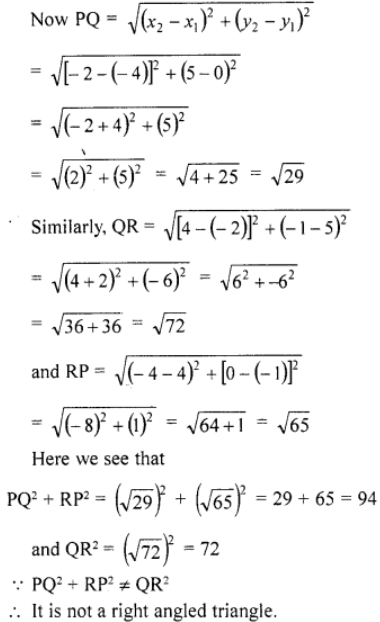
(c) P (-4,0), Q (-2, 5) and R (4,-1)
Que-12: (i) The coordinates of the points A, B, C are (0, 4),(2, 5) and (3, 3) respectively. Prove that it is an isosceles right angled triangle. Also find its area.
(ii) Show that A (3, 5), B (1, 1), C (5, 3) and D (7, 7) are the vertices of a rhombus, is it a square ? Find its area.
Sol: (i) Points are A (0, 4), B (2, 5), C (3, 3)
AB = √[(x2−x1)²+(y2−y1)²]
= √[(2−0)²+(5−4)²] = √{(2)²+(1)²}
= √(4+1) = √5
Similarly BC = √[(3−2)²+(3−5)²]
= √{(1)²+(−2)²} + √(1+4) = √5
and CA = √[(0−3)²+(4−3)²]
= √{(−3)²+(1)²} = √{9+1} = √10
We see that AB = BC = √5
∴ It is an isosceles triangle
and AB² + BC² =(√5)² + (√5)² = 5 + 5 = 10
and CA2 = (√10)² =10
∵ AB² + BC² = CA²
∴ It is an isosceles right angle
Area of △ABC = (1/2) AB × BC
= (1/2) √5 × √5 = 5/2 = 2.5 square units
(ii) Points are A (3, 5), B (1, 1), C (5, 3) and D (7, 7)
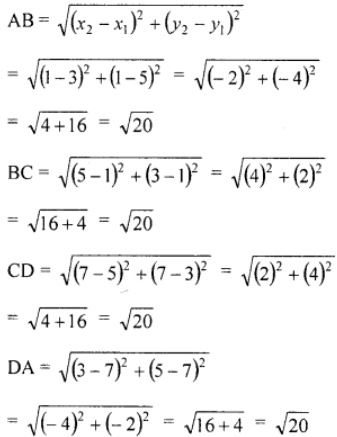
We see that = AB = BC = CD = DA
∴ ABCD is a rhombus or a square
Now diagonal AC = √[(5−3)²+(3−5)²]
= √{(2)²+(−2)²} = √(4+4) = √8
and diagonal BD = √{(7−1)²+(7−1)²}
= √{(6)²+(6)²} = √(36+36) = √72
∵ Diagonals are not equal
∴ It is a rhombus not a square
Now area of rhombus ABCD = 12 product of diagonals
= (1/2)√8 × √72
= (1/2) √576
= (1/2) × 24 = 12 sq. units
Que-13: Show that ABC is an equilateral triangle if A, B, C, have the following coordinates:
(i) A (1, √3), В (3, √3), C (2, 2, √3)
(ii) A (1, 1), B (-1, -1), C (-√3, √3).
Sol: (i) Points are A (1, √3), B (3,√3), C (2, 2, √3)
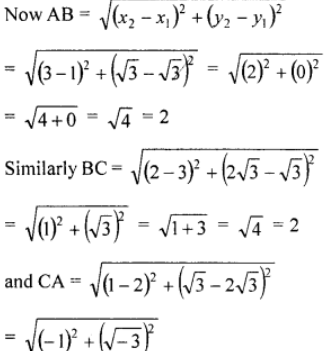
√(1+3) = √4 = 2
We see that = AB = BC = CA = 2
∴ △ABC is an equilateral triangle
(ii) A (1, 1), B (-1, -1), C (-√3, √3)
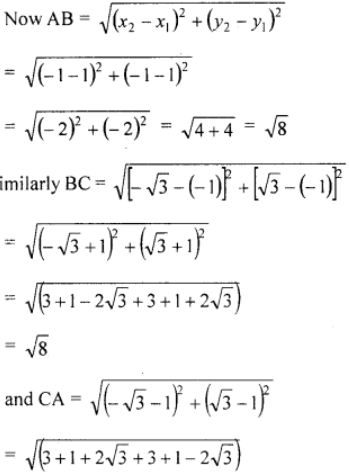
= √8
We see that AB = BC = CA = √8
∴ △ABC is an equilateral triangle.
Que-14: Show that the points (-2, 6),(5, 3), (-1, -11) and (-8, -8) are the vertices of a rectangle.
Sol: Let the vertices be A (-2, 6), B (5, 3), C (-1, -11) and D (-8, -8)
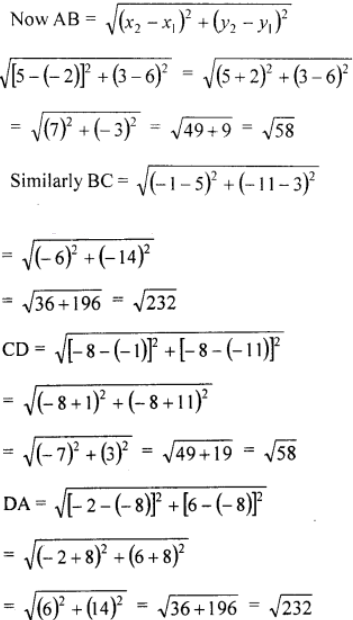
We see that AB = CD and AD = BC
∴ ABCD is a rectangle.
Que-15: The centre of a circle is at the origin and its radius is 10. Tell whether the following points lie (i) on (ii) inside or (iii) outside the circle.
(i) (6, 8)
(ii) (0, 11)
(ii) (-10, 0)
(iv) (7, 7)
(v) (-9, 4)
Sol: Centre of the circle is origin O(0, 0) and length of the radius of the circle = 10 units
(i) Now distance between (0, 0) and (6, 8)
= √[(x2−x1)²+(y2−y1)²]
= √[(6−0)²+(8−0)²]
= √(36+64) = √100 = 10
∴ This point (6, 8) lies on the circle
(ii) Similarly, distance between (0, 0) and (0, 11)
= √[(0−0)²+(11−0)²] = √{(0)²+(11)²}
= √(0+121) = √121 = 11
∵ 11 > 10
∴ This point is outside the circle
(iii) Distance between (0, 0) and (-10, 0)
= √[(−10−0)²+(0−0)²]
= √{(−10)²+(0)²} = √(100+0)
= √100 = 10
∴ This point lies on the circle
(iv) Distance between (0, 0) and (7, 7)
= √[(7−0)²+(7−0)²] = √{(7)²+(7)²}
= √(49+49) = √98
∵ √98 < 10
∴ This point is inside the circle
(v) Distance between (0, 0) and (-9, 4)
= √[(−9−0)²+(4−0)²]
= √[(−9)²+(4)²]
= √(81+16) = √97
∵ √97 < 10
∴ This point is inside the circle.
Que-16: The point P (2, -5) is mapped onto point P’ on reflection in the x-axis and Q(3, 7) is mapped onto the point Q’ on reflection in the origin. Find the length PQ and P’ Q’.
Sol: The point P (2, -5) is mapped onto point P’ in the x-axis
∴ The co-ordinates of P’ will be (2, 5)
∴ The point Q (3, 7) is mapped to Q’ in the origin
∵ Co-ordinates of Q’ will be (-3, -7)
Now length of PQ = √[(x2−x1)²+(y2−y1)²]
= √[(3−2)²+[7−(−5)]²]
= √{(1)²+(7+5)²} = √{(1)²+(12)²}
= √(1+144) = √145 units
and P’Q’ = √[(−3−2)²+(−7−5)²]
= √{(−5)²+(−12)²}
= √(25+144) = √169 = 13 units
Que-17: P and Q have coordinates (4, 1) and (2, 0). Find
(i) the image P’ of P under reflection in the y- axis.
(ii) the image Q’ of Q under reflection in the line PP’.
(iii) the length of P’Q’.
Sol: Co-ordinates of point P and Q are (4, 1) and (2, 0) respectively
(i) P’ is the image of P (4, 1) under reflection in y-axis is
∴ Co-ordiantes of P’ will be (-4, 1)
(ii) The line joining the points P and P’ is parallel to x-axis at a distance of 1 on the positive of side y-axis
∵ Q’ is the image of Q (2, 0) in the line PP’
∴ Co-ordinates of Q’ will be (2, 2x – y) or 2 (2 × 1 – 0) or
(2, 2 – 0) or (2, 2)
(iii) Length of P’Q’ = √[(x2−x1)²+(y2−y1)²]
= √[{2−(−4)}²+(2−1)²]
= √{(2+4)²+(1)²} = √{(6)²+(1)²}
= √(36+1) = √37 units
Que-18: Point A(5, 1) is the centre of a circle with radius 13 units. AB is perpendicular to the chord PQ. B is (2, -3). Calculate the length of (i) AB (ii) PB (iii) PQ.
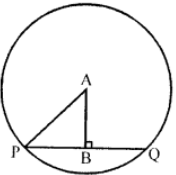
Sol: A (5, 1) is the centre of the circle
Radius of the circle OP = 13 units
AB ⊥ PQ, where PQ is a chord of the circle Co-ordinates of B are (2, -3)
∵ AB ⊥ PQ
∴ B is the mid-point of PQ
(i) Now AB = √[(x2−x1)²+(y2−y1)²]
= √[(2−5)²+(−3−1)²]
= √{(−3)²+(−4)²} = √(9+16)
= √25 = 5 units
(ii) In right △APB,
AP2 = AB2 + PB2 ⇒ (13)2 = (5)2 + PB2
⇒ 169 = 25 + PB2 ⇒ PB2 = 169 – 25 = 144 = (12)2
∴ PB = 12 units
(iii) PQ = 2PB = 2 × 12 = 24 units
–: End of Coordinates and Graphs of Simultaneous Linear Equations Class 9 OP Malhotra Exe-20D :–
Return to :– OP Malhotra S Chand Solutions for ICSE Class-9 Maths
Thanks
Please Share with Your Friends