Coordinates in 3D System in Vector Class 12 OP Malhotra Exe-21D ISC Maths Solutions Ch-21. In this article you would learn about coordinates in 3-dimensional co-ordinate system in Vector Questions . Step by step explain all questions with solutions with the help of formula in vector for 3D. Visit official Website CISCE for detail information about ISC Board Class-12 Mathematics.
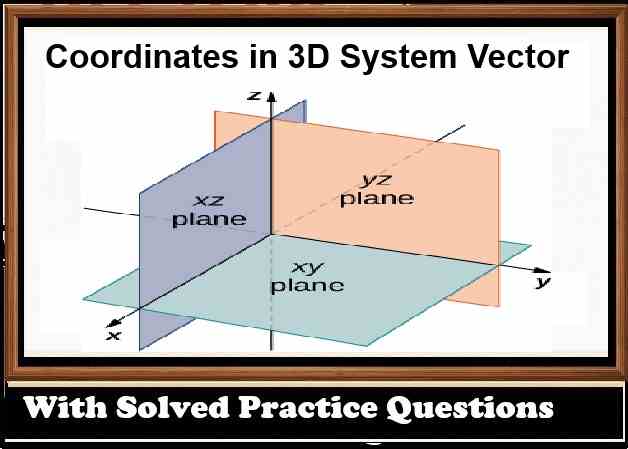
Coordinates in 3D System in Vector Class 12 OP Malhotra Exe-21D ISC Maths Solutions Ch-21
| Board | ISC |
| Publications | S Chand |
| Subject | Maths |
| Class | 12th |
| Chapter-21 | Vectors |
| Writer | OP Malhotra |
| Exe-21(d) | Coordinates in 3D Co-ordinate System |
Coordinates in 3-Dimensional Co-ordinate System in Vector
Vectors Class 12 OP Malhotra Exe-21D Solutions
Que-1: If OA→ = 2î – ĵ + 3k̂ and OB→ = 5î + 2ĵ + 3k̂ , then find the vectors
AB→ and BA→ .
Sol: Given OA→ = 2 î – ĵ + 3k̂ ;
OB→ = 5î + 2ĵ + 3k̂
∴ AB→ = OB→ – OA→
= (5î + 2ĵ + 3k̂) – (2 î – ĵ + 3k̂)
= 3î + 3ĵ
BA→ = OA→ – OB→
= (2 î – ĵ + 3k̂) – (5î + 2ĵ + 3k̂)
= -3î – 3ĵ
Que-2: If a→ = 4 î + ĵ + k̂,
b→ = 2 î +ĵ – 7k̂,
c→ = -3 î – 4 ĵ + 2 k̂
and d→ = î + ĵ +k̂,
then find the value of 3 a→ + 2 b→ – 4 c→ – d→ .
Sol: Given a→ = 4 î + ĵ + k̂ ;
b→ = 2 î +ĵ – 7k̂;
c→ = -3 î – 4 ĵ + 2 k̂
and d→ = î + ĵ + k̂
3 a→ + 2 b→ – 4 c→ – d→
= 3(4 î + ĵ + k̂) + 2(2 î +ĵ – 7k̂)
-4(-3 î – 4 ĵ + 2 k̂) – (î + ĵ + k̂)
= (12 + 4 + 12 – 1)î + (3 + 2 + 16 – 1)ĵ +(3 – 14 – 8 – 1)k̂
= 27î + 20ĵ – 20k̂
Que-3: Find sum of the vectors 3î + 7ĵ – 4k̂ and î – 5ĵ – 8k̂ and hence find the unit vector along the sum of these vectors.
Sol: Let a→ = 3î + 7ĵ– 4 k̂ and b→ = î – 5ĵ – 8k̂
∴ a→ + b→
= (3î + 7ĵ – 4k̂) + (î – 5ĵ – 8k̂)
= 4î + 2ĵ – 12k̂
⇒ |a→ + b→|
= √4²+2²+(−12)²
= √16+4+144
= √164
= 2√41
Thus required unit vector along the sum of two vectors
= a→ + b→ /|a→ + b→ |
= 4î + 2ĵ −12k̂ / 2√41
= 2î + ĵ − 6k̂ / √41
= 2/√41 î + 1/√41 ĵ – 6/√41 k̂
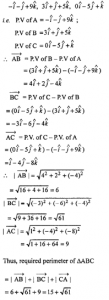
Que-4: Find by vector method the perimeter of the triangle whose vectors are (-1, -1, 9), (3, 1, 5) and (0, -5, 1).
Sol: Let he P.V’s of the vertices A, B and C of ∆ABC are
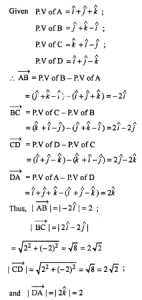
Que-5: If the position vectors of the angular points A, B, C and D of a quadrilateral be î + ĵ + k̂ , ĵ + k̂ – î , k̂ + î – ĵ, and î + ĵ – k̂ respectively, then determine the lengths of its sides.
Sol:
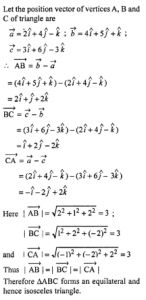
Que-6: Prove by vector method that the triangle whose vertices are (2, 4, -1), (4, 5, 1) and (3, 6, -3) in an isosceles triangle.
Sol:
Que-7: The position vectors of two points A and B are 5î + ĵ + k̂ and 3î + 2 ĵ + k̂ respectively. Find the direction cosines of AB→ and show that AB is parallel to X-Y plane.
Sol: Given P.V of A = 5î + ĵ + k̂
P.V of B = 3î + 2 ĵ + k̂
∴ AB→ = P.V of B – P.V of A
= (3î + 2 ĵ + k̂) – (5î + ĵ + k̂)
= -2î + ĵ + 0 k̂
= -2î + ĵ
∴ direction consines of AB−→− are
< −2/√(−2)²+1²+0² , 1/√(−2)²+1²+0², 0 >
i.e. < −2/√5, 1/√5, 0 >.
Equation of XOY plane be z = 0
∴ d consine’s of XOY plane are < 0, 0, 1 >
Clearly −2/√5 × 0 + 1/√5 × 0 + 0 × 1 = 0
Thus AB→ is parallel to XOY plane.
Que-8: Given that a→ = (x + 4 y)î + (2 x + y + 1)ĵ and b→ = (y – 2 x + 2)î + (2 x – 3 y – 1)ĵ , find the value of x and y, if 3 a→ = 2b→ .
Sol: Given a→ = (x + 4 y)î + (2 x + y + 1)ĵ
and b→ = (y – 2 x + 2)î + (2 x – 3 y – 1)ĵ
Given 3a→ = 2b→
⇒ 3(x + 4 y)î + 3(2 x – y + 1)ĵ
= 2(y – 2 x + 2)î + 2(2 x – 3 y – 1)ĵ
Comparing the coefficients of î and ĵ on both sides; we have
3 x + 12 y = 2 y – 4 x + 4
⇒ 7 x + 10 y = 4
and 6 x + 3 y + 3 = 4 x – 6 y – 2
⇒ 2 x + 9 y = -5
on solving eqn. (1) and eqn. (2); we have x = 2 and y = -1
Que-9: Prove that the vectors 2î + 3ĵ – 6k̂ , 6î – ĵ + 3k̂ and 3î + 6ĵ – 2k̂ from the sides of an equilateral triangle.
Sol: Let
AB→ = 2î + 3ĵ – 6k̂
BC→ = 6î – 2ĵ + 3k̂
CA→ = 3î + 6ĵ – 2k̂
∴ |AB→| = √2²+3²+(−6)² = 7 ;
|BC→| = √6²+(−2)²+3² = 7
and |CA→| = √3²+6²+(−2)² = 7
and |CA→| = √3²+6²+(−2)² = 7
Thus, |AB→| = |BC→|
= |CA→| = 7
Hence ∆ABC be an equilateral triangle.
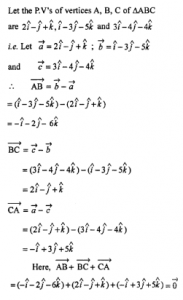
Que-10: Prove that the points 2î– ĵ + k̂, î – 4ĵ – 5k̂, 3î – 4ĵ – 4k̂ are the vertices of a right-angled triangle.
Sol: Let the P.V’s of vertices A, B, C of ∆A B C
Que-11: If the points î – ĵ + k̂, 2î + 3ĵ + 4k̂ and 3î + 7ĵ + pk̂ are collinear, then find the value of p.
Sol: Let the points are A, B and C whose P.V’s are î – ĵ + k̂,
2î + 3ĵ + 4k̂ and 3î + 7ĵ + pk̂
Since A, B, C are collinear
∴ AB→ = λAC for non-zero scalar λ
P.V of B – P.V of A = λ[P.V of C – P.V of A]
⇒ (2î + 3ĵ + 4 k̂) – (î – ĵ + k̂)
= λ[(3î + 7ĵ + pk̂) – (î – ĵ + k̂)]
⇒ î + 4ĵ + 3k̂
= λ[2î + 8ĵ + (p – 1) k̂]
on comparing the coefficients of î, ĵ and k̂ on both sides we have
1 = 2λ
⇒ λ = 1/2
and 3 = λ(p – 1)
⇒ 3 = 1/2(p – 1)
⇒ 6 = p – 1
⇒ p = 7
Thus required value of p be 7 .
Que-12: If the vertices of a triangle are the points
î – ĵ + 2k̂, 2î + 3ĵ + 4k̂,
3î + 3ĵ – 4k̂
what are the vectors determined by its sides ? i, j, k are unit vectors parallel to the axes of coordinates.
Sol: Let A, B and C are the points whose position vectors are
î – ĵ + 2k̂,
2î + 3ĵ + 4k̂
and 3î + 3ĵ – 4k̂
i.e. P.V of A = î – ĵ + 2k̂ ;
P.V of B = 2î + 3ĵ + 4k̂ and
P.V of C = 3î + 3ĵ – 4k̂
AB→ = P.V of B – P.V of A
= (2î + 3ĵ + 4k̂) – (î – ĵ + 2k̂)
= î + 4ĵ + 2k̂
BC →= P.V of C – P.V of B
= (3î + 3ĵ – 4k̂) – (2î + 3ĵ + 4k̂)
= î + 0ĵ – 8k̂
CA → = P.V of A – P.V of C
= (î – ĵ + 2k̂) – (3î + 3ĵ – 4k̂)
= -2î – 4ĵ + 6 k^
Hence the required vectors along the sides are î + 4ĵ + 2k̂ ;
î – 8k̂ and -2î – 4 ĵ + 6k̂
Que-13: Find the length and direction cosines of PQ → where OP → = -2î + 3ĵ – 4k̂ and OQ → = 2î – ĵ + 3k̂.
Sol: Given OP → = -2î + 3ĵ – 4k̂ ;
OQ → = 2î – ĵ + 3k̂
∴PQ → = OQ → – OP →
= (2î – ĵ + 3k̂) – (-2î + 3ĵ – 4k̂)
= 4î – 4ĵ + 7k̂
Thus Direction ratios of PQ → are < 4, -4, 7 >
∴ direction cosines ofPQ → are
4/√4²+(−4)²+7²,
−4/√4²+(−4)²+7² , 7/√4²+(−4)²+7² >
i.e. < 4/9, −4/9, 7/9 >
∴ |PQ →|
= √4²+(−4)²+7²
= √16+16+49 = 9
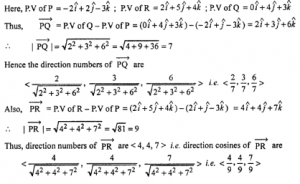
Que-14: The vertices of a triangle are P(-2, 1, -3), Q(0, 4, 3), R(2, 5, 4). Find the lengths and direction cosines of the vectors PQ → and PR →.
Sol:
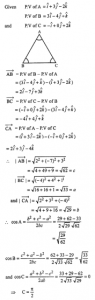
Que-15: A is the point (1, 3, -2), B is (3, -4, 1), C is (-1, 0, 2). Find the lengths of the sides of the triangle A B C and the cosines of the angles, A, B, C.
Sol:
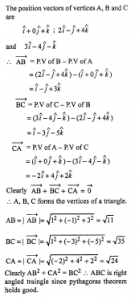
Que-16: Prove that the triangle with vertices A(1, 0, 1), B(2, -1, 4) and C(3, -4, 1) is right-angled.
Sol:
Que-17: The position vectors of A, B and C are 2î + ĵ – k̂, 3î – 2ĵ + k̂ and î + 4ĵ – 3k̂ respective show that A, B and C are collinear.
Sol: P.V of A = 2î + ĵ – k̂
P.V of B = 3î – 2ĵ + k̂
P.V of C = î + 4ĵ – 3k̂
∴ AB→ = P. V of B – P.V of A
= (3î – 2ĵ + k̂) – (2î + ĵ – k̂)
= î – 3ĵ + 2k̂
BC→ = P. V of C – P.V of P
= (î + 4ĵ – 3k̂) – (3î – 2ĵ + k̂)
= -2î + 6ĵ – 4k̂
⇒ BC→ = -2î – 3ĵ + 2k̂)
= -2AB→
Thus BC→ and AB→ are parallel vectors and point B common to both vectors AB→ and BC→.
Therefore A, B and C are collinear vectors.
Que-18: Show that the points (2, -1, 3), (3, -5, 1) and (-1, 11, 9) are collinear.
Sol: Let A, B and C are the points whose position rectors are 2 i^ – j^ + 3 k^, 3 i^ – 5 j^ + k^ and −i^ + 11 j^ + 9 k^
∴ AB→ = P.V of B – P.V of A
= (3î – 5ĵ + k̂) – (2î –ĵ + 3k̂)
= î – 4ĵ – 2k̂
BC→ = P.V of C – P.V of B
= (−î+ 11ĵ + 9k̂) – (3î – 5ĵ + k̂)
= -4î + 16ĵ + 8k̂
= -4(î – 4ĵ – 2k̂)
= -4 AB→
Thus BC→ = -4AB→
∴ BC→ and AB→ are parallel vectors and point B is common to both the vectors BC→ and AB→. Thus A, B and C are collinear points.
–: End of Coordinates in 3D System in Vector Class 12 OP Malhotra Exe-21D ISC Maths Solutions :–
Return to :- OP Malhotra ISC Class-12 S Chand Publication Maths Solutions
Please share with your friends
Thanks