Coplanar and Skew Lines in 3D Geometry Class 12 OP Malhotra Exe-23E ISC Maths Solutions Ch-23. In this article you would learn about Questions / Problems on Coplanar and Skew Lines Answer and condition using formula. Visit official Website CISCE for detail information about ISC Board Class-12 Mathematics.
Coplanar and Skew Lines in 3D Geometry Class 12 OP Malhotra Exe-23E ISC Maths Solutions Ch-23
| Board | ISC |
| Publications | S Chand |
| Subject | Maths |
| Class | 12th |
| Chapter-23 | Three Dimensional Geometry |
| Writer | OP Malhotra |
| Exe-23(e) | Coplanar and Skew Lines |
Questions / Problems on Coplanar and Skew Lines Answer and Condition Using Formula
Three Dimensional Geometry Class 12 OP Malhotra Exe-23E Solutions
Que-1: Show that the lines x−1/2 = y−2/3 = z−3/4 and x−4/5 = y−1/2 = z intersect each other. Find their point of intersection.
Sol: Eqn. of given lines are ;
x−1/2 = y−2/3 = z−3/4 = t(say )
x−4/5 = y−1/2 = z/1 = r(say )
Clearly 2/5 ≠ 3/2 ≠ 4/1
∴ both lines are not parallel.
Any point on line (1) be P(2 t + 1, 3 t + 2, 4 t + 3)
and any point on line (2) be M(5 r + 4, 2 r + 1, r)
Now both lines (1) and (2) intersects if P and M coincides.
i.e., if 2 t + 1 = 5 r + 4 ; 3 t + 2 = 2 r + 1 and 4 t + 3 = r
⇒ 2 t – 5 r = 3 ; 3 t – 2 r = -1 and 4 t – r + 3 = 0
on solving first two equations, t = -1 ; r = -1 and these values of t and r also satisfies the 3rd eqn.
Hence both lines intersects and required point of intersection be (-2 + 1, -3 + 2, -4 + 3), i.e., (-1, -1, -1).
Que-2: Prove that the lines x−4/1 = y+3/−4 = z+1/7; x−1/2 = y+1/−3 = z+10/8 intersect and find the coordinates of their point of intersection.
Sol: Given eqns. of line are ;
x−4/1 = y+3/−4 = z+1/7 = t (say)
and
x−1/2 = y+1/−3 = z+10/8 = r (say)
Clearly 1/2/ ≠ −4/−3 ≠ 7/8
∴ both lines (1) and (2) are not parallel.
Any point on line (1) are (t + 4, -4 t – 3, 7 t – 1)
and any point on line (2) are (2 r + 1, -3 r – 1, 8 r – 10)
Now both lines intersects if both points coincides.
i.e., if t + 4 = 2 r + 1 ; -4 t – 3 = -3 r – 1 ; 7 t – 1 = 8 r – 10
if t – 2 r = -3
-4 t + 3 r = 2
and 7 t – 8 r = -9
On solving eqn. (3) and eqn. (4); we have
r = 2 ; t = 1
These values of r and t also satisfies eqn. (5).
Hence, both lines intersects and required point of intersection be (1 + 4, -4 – 3, 7 – 1) i.e., (5, -7, 6).
Que-3: Show that the lines x+3/2 = y+5/3 = z−7/−3; and x+1/4=y+1/5 = z+1/−1 are coplanar.
Sol: Given eqns. of line are ;
x−4/1 = y+3/−4 = z+1/7 = t (say)
and
x−1/2 = y+1/−3 = z+10/8 = r (say)
Clearly 1/2 ≠ −4/−3 ≠ 7/8
∴ both lines (1) and (2) are not parallel.
Any point on line (1) are (t + 4, -4 t – 3, 7 t – 1)
and any point on line (2) are (2 r + 1, -3 r – 1, 8 r – 10)
Now both lines intersects if both points coincides.
i.e., if t + 4 = 2 r + 1 ; -4 t – 3 = -3 r – 1 ; 7 t – 1 = 8 r – 10
if t – 2 r = -3
-4 t + 3 r = 2
and 7 t – 8 r = -9
On solving eqn. (3) and eqn. (4); we have
r = 2 ; t = 1
These values of r and t also satisfies eqn. (5).
Hence, both lines intersects and required point of intersection be (1 + 4, -4 – 3, 7 – 1) i.e., (5, -7, 6).
Que-3: Show that the lines x+3/2 = y+5/3 = z−7/−3; and x+1/4=y+1/5 = z+1−1 are coplanar.
Sol: Given lines are,
x+3/2 = y+5/3 = z−7/−3
and
x+1/4 = y+1/5 = z+1/−1
We know that, the lines
x−x1/a1 = y−y1/b1
= z−z1/c1 and x+x2/a2 = y−y2/b2
= z−z2/c2
are coplanar if |x2−x1 y2−y1 z2−z1 a1 b1 c1a2 b2 c2| = 0
Here,
a1 = +2 ; b1 = 3 ; c1 = -3
a2 = 4 ; b2 = 5 ; c2 = -1
Here,
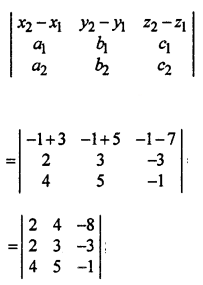
= 2(-3 + 15) – 4(-2 + 12) – 8(10 – 12)
= 24 – 40 + 16 = 0
Thus, given lines are coplanar.
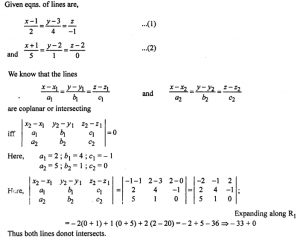
Que-4: Show that the lines x−1/2 = y−3/4 = z/−1 and x+1/5 = y−2/1, z = 2 do not intersect each other.
Sol:
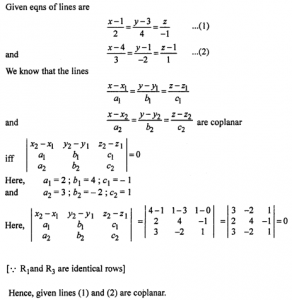
Que-5: Show that the lines x−1/2 = y−3/4 = z−1 and x−4/3 = y−1/−2 = z−1/1 are coplanar.
Sol:
Que-6: Find the equations of the line which intersects the lines x−1/2 = y−2/−2 = z−3/4 and x+2/1 = y−3/2 = z+1/4 and passes through (1, 1, 1).
Sol: Eqn. of line passing through the point (1, 1, 1) and having direction ratios < a, b, c > is given by
x−1/a = y−1/b = z−1/c
Now line (1) intersects with the line x−1/2 = y−2/3 = z−3/4
∴ a/2 ≠ b/3 ≠ c/4 and
|1−1 2−1 3−1a b c2 3 4| = 0;
Expanding along R1
0(4 b – 3 c) – 1(4 a – 2 c) + 2(3 a – 2 b) = 0
⇒ 2 a – 4 b + 2 c = 0
⇒ a – 2 b + c = 0
Now, line (1) is also intersects with the given line
x+2/1 = y−3/2
= z+1/4
∴ a/1 ≠ b/2 ≠ c/4
and |−2−1 3−1 −1−1a b c1 2 4| = 0
i.e., |−3 2 −2a b c1 2 4| = 0;
Expanding along R1
⇒ -3(4 b – 2 c) – 2(4 a – c) – 2(2 a – b) = 0
⇒ -12 b + 6 c – 8 a + 2 c – 4 a + 2 b = 0
-12 a – 10 b + 8 c = 0
⇒ 6 a + 5 b – 4 c = 0
On solving eqn. (2) and (3) by cross-multiplication method, we have
a/8−5 = b/6+4
= c/5+12
i.e., a/3 = b/10 = c/17
Hence, the required eqn. of line using eqn. (1) be given by
x−1/3 = y−1/10 = z−1/17
–: End of Coplanar and Skew Lines in 3D Geometry Class 12 OP Malhotra Exe-23E ISC Maths Solutions :–
Return to :- OP Malhotra ISC Class-12 S Chand Publication Maths Solutions
Please share with your friends
Thanks