Current Electricity Class-9 Exe-9A MCQs Concise Physics ICSE Selina Solutions Ch-9 . In this article you would learn to solve MCQS on Electric Current. Visit official Website CISCE for detail information about ICSE Board Class-9 Physics.

Current Electricity Class-9 Exe-9A MCQs Concise Physics ICSE Selina Solutions Ch-9
| Board | ICSE |
| Class | 9 |
| Subject | Physics |
| Writer / Publication | Concise Selina Publishers |
| Chapter-9 | Current Electricity |
| Exe-9A | Electric Current |
| Topics | Solution of Exe-9(A) MCQs Type |
| Academic Session | 2025-2026 |
Electric Current
Current Electricity Class-9 Exe-9A MCQs Concise Physics ICSE Selina Solutions Ch-9
Page – 214 (Choose the correct answer from the options given below).
Que-1: A cell is used to :
(a) measure current in a circuit
(b) provide current in a circuit
(c) limit current in a circuit
(d) prevent current in a circuit
Ans: (b) provide current in a circuit
Hint- The cell or a battery is a source of direct current (d.c.). It provides current as a result of irreversible reaction.
Que-2: In a cell, …………… energy changes into …………… energy when it sends current in a circuit.
(a) mechanical, electrical
(b) heat, chemical
(c) chemical, electrical
(d) electrical, chemical
Ans: (c) chemical, electrical
Hint- In a cell, chemical energy changes into electrical energy when it sends current in a circuit.
Que-4: During charging of a secondary cell, the ………….. energy changes into ………….. energy and gets stored in the cell.
(a) mechanical, chemical
(b) chemical, electrical
(c) mechanical, electrical
(d) electrical, chemical
Ans: (d) electrical, chemical
Hint- During charging of a secondary cell, the electrical energy changes into chemical energy and gets stored in the cell.
Que-5: Primary cells provide current as a result of ………….. chemical reaction and secondary cells provide current as a result of ………….. reaction.
(a) reversible, reversible
(b) reversible, irreversible
(c) irreversible, reversible
(d) irreversible, irreversible
Ans: (c) irreversible, reversible
Hint- Primary cells provide current as a result of irreversible chemical reaction and secondary cells provide current as a result of reversible reaction.
Que-5: Identify the correct statement (s)
(i) Primary cell is capable of giving low as well as high current whereas secondary cells provide a weak current only.
(ii) The internal resistance of primary cells is low and that of secondary cells is high.
(a) (i)
(b) (ii)
(c) both (i) and (ii)
(d) none of the above
Ans: (d) none of the above
Hint- Primary cell is capable of giving a weak current only and secondary cells provides a low as well as high current.
The internal resistance of primary cells is high and that of secondary cells is low.
Que-6: Current is the rate of flow of charge across a cross-section …………… the flow of current.
(a) in any direction of
(b) in a parallel direction to
(c) in the same direction as
(d) normal to the direction of
Ans: (d) normal to the direction of
Hint- Current is the rate of flow of charge across a cross-section normal to the direction of the flow of current.
Que-7: In metals, current flows due to the movement of :
(a) protons
(b) neutrons
(c) electrons
(d) electrons and protons
Ans: (c) electrons
Hint- In metals, current flows due to the movement of electrons.
Que-8: If n electrons pass through the cross-section of a conductor in time t, the current in conductor I =
(a) net
(b) et/n
(c) ne/t
(d) nt/e
Ans: (c) ne/t
Hint- If n electrons pass through the cross-section of a conductor in time t, then total charge passes (Q) = n x e and
the current in conductor (I) = Q/t = ne/t
Que-9: The conventional current is in a direction …………… the direction of motion of electrons.
(a) parallel
(b) normal
(c) opposite
(d) none of the above
Ans: (c) opposite
Hint- Conventionally, the direction of current is taken positive in the direction of flow of positive charge. Therefore, conventionally, the current will be negative in the direction of flow of electrons. Hence, current is in a direction opposite to the direction of motion of electrons.
Que-10: The S.I. unit of current is :
(a) Coulomb
(b) Ampere
(c) Coulomb per second
(d) Both (b) and (c)
Ans: (d) both (b) and (c)
Hint- The S.I. unit of charge is coulomb and S.I. unit of time is second. Hence, current is coulomb per second also known as ampere.
Que-11: A battery is correctly represented by :
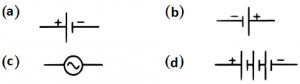
Ans: Option (d)
Hint- A battery is formed by joining a number of cells together in series (i.e., cathode of one cell connected to the anode of another cell).
Que-12: A …………… is a device by which resistance in a circuit can be varied continuously.
(a) key
(b) switch
(c) rheostat
(d) voltmeter
Ans: (c) rheostat
Hint- A rheostat is a device by which resistance in a circuit can be varied continuously. It is used to adjust the magnitude of current in a circuit by changing the length of the resistance wire included in the circuit.
Que-13: Rheostat is used in a circuit to provide :
(a) fixed current
(b) fixed voltage
(c) fixed resistance
(d) variable resistance
Ans: (d) variable resistance
Hint- A rheostat is a device by which resistance in a circuit can be varied continuously. It is used to adjust the magnitude of current in a circuit by changing the length of the resistance wire included in the circuit.
Que-14: An instrument used to measure the magnitude of current flowing in a circuit is :
(a) voltmeter
(b) galvanometer
(c) ammeter
(d) rheostat
Ans: (c) ammeter
Hint- An ammeter is an instrument used to measure the magnitude of current flowing in a circuit.
Que-15: A …………… is either used to detect the presence of a weak current or to only know the direction of flow of current in a circuit.
(a) ammeter
(b) galvanometer
(c) voltmeter
(d) rheostat
Ans: (b) galvanometer
Hint- A galvanometer is used to either detect the presence of a weak current or to only know the direction of flow of current in a circuit. It does not measure the magnitude of current in a circuit.
Que-16: Insulators have ……………electrons and conductors have …………… electrons.
(a) no free, large number of free
(b) large number of free, no free
(c) no free, small number of free
(d) small number of free, no free
Ans: (a) no free, large number of free
Hint- Insulators have no free electrons and offer very high resistance and conductors have large number of free electrons and they offer very small resistance to the flow of electrons.
Que-17: An insulator of electricity is:
(a) copper
(b) acidulated water
(c) human body
(d) silk
Ans: (d) silk
Hint- Silk does not conduct electricity, hence is an insulator.
Que-18: The presence of …………… in the path makes a circuit incomplete and current does not flow.
(a) conductor
(b) ammeter
(c) voltmeter
(d) insulator
Ans: (d) insulator
Hint- The presence of insulator in the path makes a circuit incomplete and current does not flow.
Que-19: Select the best insulator among the following
(a) Pure water
(b) Human body
(c) Aluminum
(d) Mercury
Ans: (a) Pure water
Hint- Pure water is a good insulator as it has a low concentration of ions so it does not conduct electricity very well. On the other hand, the human body, aluminum, and mercury are not good insulators. The human body contains electrolytes and can conduct electricity. Aluminum is a metal and is highly conductive. Mercury is a liquid metal and also conducts electricity well.
Que-20: Connecting wires are made of substances that have :
(a) highly conducting material
(b) negligible resistance
(c) free electrons in a large number
(d) all of these
Ans: (d) all of these
Hint- Connecting wires are typically made of substances, such as copper or aluminum, that possess highly conducting materials, negligible resistance, and a large number of free electrons. These characteristics allow for efficient flow of electric current through the wires.
–: End of Current Electricity Class-9 Exe-9A MCQs Concise Physics ICSE Selina Solutions Ch-9:–
Return to:– Concise Selina Physics ICSE Class-9 Solutions
Thanks