Current Electricity Class-9 Exe-9B MCQs Concise Physics ICSE Selina Solutions Ch-9. In this article you would learn to solve MCQS on Potential Deference and Resistance. Visit official Website CISCE for detail information about ICSE Board Class-9 Physics.
Current Electricity Class-9 Exe-9B MCQs Concise Physics ICSE Selina Solutions Ch-9
| Board | ICSE |
| Class | 9 |
| Subject | Physics |
| Writer / Publication | Concise Selina Publishers |
| Chapter-9 | Current Electricity |
| Exe-9B | Potential Deference and Resistance |
| Topics | Solution of Exe-9(B) MCQs Type |
| Academic Session | 2025-2026 |
Potential Deference and Resistance
Current Electricity Class-9 Exe-9B MCQs Concise Physics ICSE Selina Solutions Ch-9
Page – 220 (Choose the correct answer from the options given below).
Que-1: In the given figure, the flow of electrons would be :
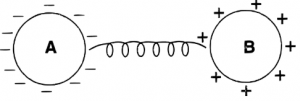
(a) B to A
(b) A to B
(c) both A to B and B to A
(d) none of the above
Ans: (b) A to B
Reason — Conductor A is negatively charged while conductor B is positively charged. Electrons flow from the negatively charged conductor A to positively charged conductor B.
Que-2: An electric cell works :
(a) as a source of electrons
(b) on deficit of electrons
(c) as a source of protons
(d) none of the above
Ans: (a) as a source of electrons
Reason — In an electric cell, excess electrons on the cathode and a deficit of electrons on the anode are maintained by a chemical reaction. This creates a continuous flow of electrons in the external circuit, from the cathode to the anode. Thus, an electric cell works as a source of electrons
Que-3: Current in a circuit flows:
(a) in direction from high potential to low potential
(b) in direction from low potential to high potential
(c) in direction of flow of electrons
(d) in any direction
Ans: (a) in direction from high potential to low potential
Reason — Electric current flows from a body at higher potential to a body at lower potential, in a direction opposite to the direction of flow of electrons.
Que-4: A conductor having an excess of electrons is said to be at …………… potential while a conductor having a deficit of electrons is at ………….. potential.
(a) lower, lower
(b) lower, higher
(c) higher, lower
(d) higher, lower
Ans: (b) lower, higher
Reason — A conductor having an excess of electrons is said to be at negative (lower) potential while a conductor having a deficit of electrons is at positive (higher) potential.
Que-5: The force between the two charges is …………… when they are at an infinite separation.
(a) finite
(b) infinite
(c) zero
(d) none of the above
Ans: (c) zero
Reason — The force between the two charges is zero when they are at an infinite separation.
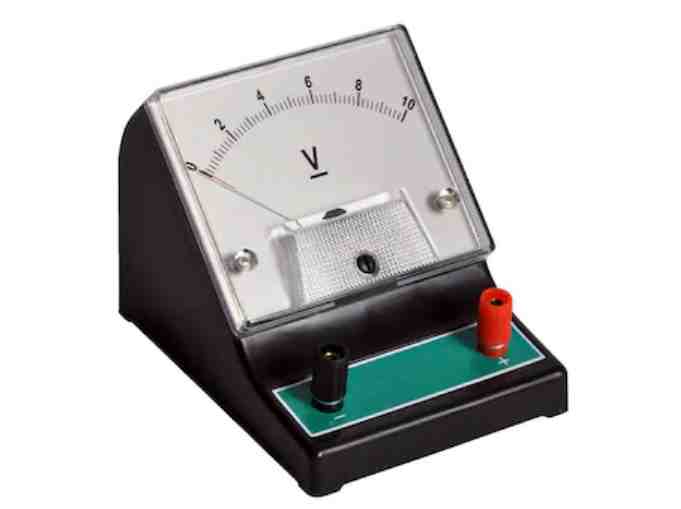
Que-6: The unit of potential difference is:
(a) ampere
(b) volt
(c) ohm
(d) coulomb
Ans: (b) volt
Reason — Potential difference is measured in joule per coulomb which is named as volt (V).
Que-7: The S.I. unit of potential is :
(a) Joule/coulomb
(b) Volt
(c) Ampere
(d) Both (a) and (b)
Ans: (d) Both (a) and (b)
Reason — The S.I. unit of potential is joule/coulomb or volt (symbol V).
Que-8: On increasing the resistance in a circuit, the current in it:
(a) decreases
(b) increases
(c) remains unchanged
(d) nothing can be said
Ans: (a) decreases
Reason — Current (I) is inversely proportional to the resistance (R) hence it decreases.
Que-9: A larger wire offers ……………. resistance than a shorter wire.
(a) less
(b) equal
(c) more
(d) none of the above
Ans: (c) more
Reason — The resistance of a wire increases with its length because the moving electrons experience more collisions when traveling a longer distance. Hence, resistance of a wire is directly proportional to the length of the wire.
Que-10: A thicker wire offers …………… resistance than a thin wire.
(a) less
(b) equal
(c) more
(d) none of the above
Ans: (a) less
Reason — In a thick wire, electrons get a larger area of cross section to flow as compared to a thin wire, therefore, a thick wire offers less resistance (i.e., resistance of wire is inversely proportional to the area of cross section of the wire).
Que-11: Upon increasing the temperature, the resistance of a wire :
(a) decreases
(b) does not change
(c) increases
(d) first increases then decreases
Ans: (c) increases
Reason — If the temperature of the wire increases, ions in it vibrate more violently. As a result, the number of collisions increases and hence the resistance of wire increases (i.e., the resistance of the wire increases with the increase in it’s temperature.
Page 221
Que-12: The resistance of a conductor would be …………… if a current of 2 A flows through it when the potential difference across its ends is 2 volt.
(a) 2Ω
(b) 0Ω
(c) 1Ω
(d) 4Ω
Ans: (c) 1Ω
Hint- As, R = V/I
I = 2A
V = 2 volt
Hence, R = 2/2 = 1Ω
—: End of Current Electricity Class-9 Exe-9B MCQs Concise Physics ICSE Selina Solutions Ch-9. :—
Return to :- Concise Selina Physics ICSE Class-9 Solutions
Thanks