Cyclic Properties of Circles Class 10 Concise Exe-17B ICSE Maths Selina Solutions Ch-17. In this article you would learn how to solve problems / questions on Cyclic Properties of Circles. Visit official Website CISCE for detail information about ICSE Board Class-10 Mathematics.
Cyclic Properties of Circles Class 10 Concise Exe-17B ICSE Maths Selina Solutions Ch-17
| Board | ICSE |
| Publications | Selina |
| Subject | Maths |
| Class | 10th |
| Chapter-17 | Circles |
| Writer | R.K. Bansal |
| Exe-17B | More Questions on Cyclic Properties. |
| Edition | 2025-2026 |
Questions on Cyclic Properties of Circles with Solutions / Answer
Class 10 Concise Exe-17B IC SE Maths Selina Solutions Ch-17 Circle
Que-1: In a cyclic-trapezium, the non-parallel sides are equal and the diagonals are also equal.
Sol: A cyclic trapezium ABCD in which AB || DC and AC and BD are joined
Chord AD subtends ∠ABD and chord BC subtends ∠BDC
At the circumference of the circle.
But ∠ABD = ∠BDC …[Proved]
Chord AD = Chord BC
⇒ AD = BC
Now in ∆ADC and ∆BCD
DC = DC …[Common]
∠CAD = ∠CBD …[Angles in the same segment]
And AD = BC …[Proved]
By Side – Angle – Side criterion of congruence, we have
∆ADC ≅ ∆BCD …[SAS axiom]
The corresponding parts of the congruent triangle are congruent
Therefore, AC = BD …[c.p.c.t]
Que-2: In the following figure, AD is the diameter of the circle with centre 0. chords AB, BC and CD are equal. If ∠DEF = 110°, calculate:
(i) ∠ AFE,
(ii) ∠FAB.
Sol:
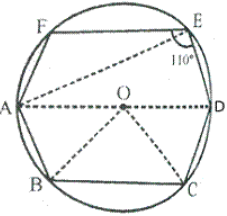
(i) Join AE, OB and OC
∵ AOD is the diameter,
∴ ∠AED = 90° …[Angle in a semi-circle]
But ∠DEF = 110° …[Given]
∴ ∠AEF = ∠DEF – ∠AED
= 110° – 90°
= 20°
(ii) Chord AB = Chord BC = Chord CD …[given]
∴ ∠AOB = ∠BOC = ∠COD …(Equal chords subtends equal angles at the centre)
But ∠AOB + ∠BOC + ∠COD = 180° …[AOD is a straight line ]
∠AOB = ∠BOC = ∠COD = 60°
In ∠OAB, OA = OB
∴ ∠OAB = ∠OBA …[radii of the same circle]
But ∠OAB + ∠OBA = 180° − AOB
= 180° − 60°
= 120°
∴ ∠OAB = ∠OBA = 60°
In cyclic quadrilateral ADEF,
∠DEF + ∠DAF = 180°
⇒ ∠DAF = 180° − ∠DEF
= 180° − 110°
= 70°
Now, ∠FAB = ∠DAF + ∠OAB
= 70° + 60°
= 130°
Que-3: If two sides of a cycli-quadrilateral are parallel; prove thet:
(i) its other two side are equal.
(ii) its diagonals are equal.
Sol: ABCD is a cyclic quadrilateral in which AB || DC. AC and BD are its diagonals.
(i) AB || DC ⇒ ∠DCA = ∠CAB …[Alternate angles]
Now, chord AD subtends ∠DCA and chord BC subtends ∠CAB
At the circumference of the circle.
∴ ∠DCA = ∠CAB …[Proved]
∴ Chord AD = Chord BC or AD = BC
(ii) Now in ΔABC and ΔADB,
AB = AB …[Common]
∠ACB = ∠ADB …[Angles in the same segment]
BC = AD …[Proved]
By Side – Angle – Side criterion of congruence, we have
ΔACB ≅ ΔADB …[SAS postulate]
The corresponding parts of the congruent triangles are congruent.
∴ AC = BD …[c.p.c.t]
Que-4: The given figure show a circle with centre O. also, PQ = QR = RS and ∠PTS = 75°. Calculate:
(i) ∠POS,
(ii) ∠ QOR,
(iii) ∠PQR
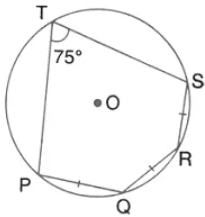
Sol: (i) Join OP, OQ and OS.
∵ PQ = QR = RS,
∠POQ = ∠QOR = ∠ROS …[Equal chords subtends equal angles at the centre]
Arc PQRS subtends ∠POS at the center and ∠PTS at the remaining parts of the circle.
∴ ∠POS = 2∠PTS = 2 × 75° = 150°
(ii)∠POQ + ∠QOR + ∠ROS = 150°
⇒∠𝑃𝑂𝑄 =∠𝑄𝑂𝑅 =∠𝑅𝑂𝑆 =150∘3 =50∘
(iii) In ΔOPQ, OP = OQ …[Radii of the same circle]
∴ ∠OPQ = ∠OQP
But ∠OPQ + ∠OQP + ∠POQ = 180°
∴ ∠OPQ + ∠OQP + 50° = 180°
⇒ ∠OPQ + ∠OQP = 180° – 50°
⇒ ∠OPQ + ∠OPQ = 130°
⇒ 2∠OPQ = 130°
⇒ ∠OPQ = ∠OQP = (130^circ)/2 = 65^circ`
∠PQR = ∠PQO + ∠OQR
= 65° + 65°
= 130°
Que-5: In the given figure, AB is a side of a regular six-sided polygon and AC is a side of a regular eight-sided polygon inscribed in the circle with centre O. calculate the sizes of:
(i) ∠ AOB,
(ii) ∠ ACB,
(iii) ∠ABC.
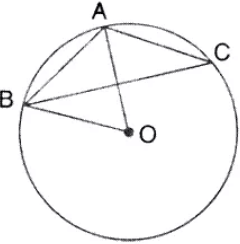
Sol: (i) Arc AB subtends ∠AOB at the centre and ∠ACB at the remaining part of the circle.
∴ ∠𝐴𝐶𝐵 = 1/2 ∠𝐴𝑂𝐵
Since AB is the side of a regular hexagon,
∠AOB = 60°
(ii) ∠𝐴𝑂𝐵 = 60°
⇒∠𝐴𝐶𝐵 = 1/2 × 60° = 30°
(iii) Since AC is the side of a regular octagon,
∠𝐴𝑂𝐶 = 360°/8 = 45°
Again, Arc AC subtends ∠AOC at the center and ∠ABC at the remaining part of the circle.
⇒ ∠𝐴𝐵𝐶 = 1/2 ∠𝐴𝑂𝐶
⇒ ∠𝐴𝐵𝐶 = 45°/2 = 22.5°
Que-6: In a regular pentagon ABCDE, inscribed in a circle; find ratio between angle EDA and angel ADC.
Sol: Arc AE subtends ∠AOE at the centre and ∠ADE at the remaining part of the circle.
∴ ∠𝐴𝐷𝐸 = 1/2 ∠𝐴𝑂𝐸
= 1/2 × 72°
= 36° …[Central angle is a regular pentagon at O]
∠ADC = ∠ADB + ∠BDC
= 36° + 36°
= 72°
∴ ∠ADE : ∠ADC = 36° : 72° = 1 : 2
Que-7: In the given figure. AB = BC = CD and ∠ABC = 132°, calculate:
(i) ∠AEB,
(ii) ∠ AED,
(iii) ∠COD.
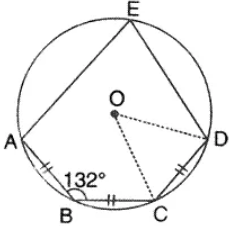
Sol: In the figure, O is the centre of circle, with AB = BC = CD.
∠ABC = 132°
(i) In cyclic quadrilateral ABCE
∠ABC + ∠AEC = 180° …[Sum of opposite angles]
⇒ ∠132° + ∠AEC = 180°
⇒ ∠AEC = 180° – 132°
⇒ ∠AEC = 48°
Since, AB = BC, ∠AEB = ∠BEC …[Equal chords subtends equal angles]
∴ ∠𝐴𝐸𝐵 = 1/2 ∠𝐴𝐸𝐶
= 1/2 × 48°
= 24°
(ii) Similarly, AB = BC = CD
∠AEB = ∠BEC = ∠CED = 24°
∠AED = ∠AEB + ∠BEC + ∠CED
= 24° + 24° + 24°
= 72°
(iii) Arc CD subtends ∠COD at the centre and ∠CED at the remaining part of the circle.
∴ COD = 2∠CED
= 2 × 24°
= 48°
Que-8: In the figure, O is the centre of the circle and the length of arc AB is twice the length of arc BC. If angle AOB = 108°, find:
(i) ∠ CAB,
(ii) ∠ADB.
Sol:
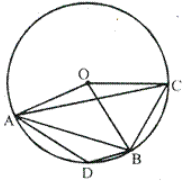
(i) Join AD and DB
Arc B = 2 arc BC and ∠AOB = 180°
∴ ∠BOC = 1/2 ∠AOB
= 1/2 × 108°
= 54°
Now, Arc BC subtends ∠BOC at the centre and ∠CAB at the remaining part of the circle.
∴ ∠CAB = 1/2 ∠BOC
= 1/2 × 54°
= 27°
(ii) Again, Arc AB subtends ∠AOB at the centre and
∠ACB at the remaining part of the circle.
∠ ACB = 12 ∠AOB
= 1/2 × 108°
= 54°
In cyclic quadrilateral ADBC
∠ADB + ∠ACB = 180° …[sum of opposite angles]
⇒ ∠ADB + 54° = 180°
⇒ ∠ADB = 180° − 54°
⇒ ∠ADB = 126°
Que-9: The figure shows a circle with centre O. AB is the side of regular pentagon and AC is the side of regular hexagon. Find the angles of triangle ABC.
Sol: Join OA, OB and OC
Since AB is the side of a regular pentagon,
∠𝐴𝑂𝐵 = 360°/5 = 72°
Again AC is the side of a regular hexagon,
∠𝐴𝑂𝐶 = 360°/6 = 60°
But ∠AOB + ∠AOC + ∠BOC = 360° …[Angles at a point]
⇒ 72° + 60° + ∠BOC = 360°
⇒ 132° + ∠BOC = 360°
⇒ ∠BOC = 360° – 132°
⇒ ∠BOC = 228°
Now, Arc BC subtends ∠BOC at the centre and ∠BAC at the remaining part of the circle.
⇒∠𝐵𝐴𝐶 = 1/2 ∠𝐵𝑂𝐶
⇒∠𝐵𝐴𝐶 = 1/2 × 228° = 114°
Similarly, we can prove that
⇒∠𝐴𝐵𝐶 = 1/2 ∠𝐴𝑂𝐶
⇒∠𝐴𝐵𝐶 = 1/2 × 60° = 30°
And
⇒∠𝐴𝐶𝐵 = 1/2 𝐴𝑂𝐵
⇒∠𝐴𝐶𝐵 = 1/2 × 72° = 36°
Thus, angles of the triangle are, 114°, 30° and 36°
Que-10: In the given figire, BD is a side of a regular hexagon, DC is a side of a regular pentagon and AD is a diameter. Calculate:
(i) ∠ ADC
(ii) ∠BAD,
(iii) ∠ABC
(iv) ∠ AEC.
Sol:
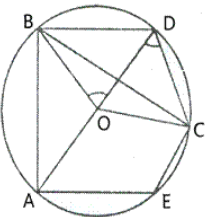
Join BC, BO, CO and EO
Since BD is the side of a regular hexagon,
∠𝐵𝑂𝐷 = 360°/6 = 60°
Since DC is the side of a regular pentagon,
∠𝐶𝑂𝐷 = 360°/5 = 72°
In ∆BOD, ∠BOD = 60° and OB = OD
∴ ∠OBD = ∠ODB = 60°
(i) In ∆OCD, ∠COD = 72° and OC = OD
∴ ∠𝑂𝐷𝐶 = 1/2 (180°−72°)
= 1/2 × 108°
= 54°
Or ∠ADC = 54°
(ii) ∠BDO = 60° or ∠BDA = 60°
(iii) Arc AC subtends ∠AOC at the centre and ∠ABC at the remaining part of the circle.
∴ ∠𝐴𝐵𝐶 = 1/2 ∠𝐴𝑂𝐶
= 1/2 [∠𝐴𝑂𝐷 −∠𝐶𝑂𝐷]
= 1/2 × (180°−72°)
= 1/2 × 108°
= 54°
(iv) In cyclic quadrilateral AECD
∠AEC + ∠ADC = 180° …[Sum of opposite angles]
⇒ ∠AEC + 54° = 180°
⇒ ∠AEC = 180° – 54°
⇒ ∠AEC = 126°
–: Cyclic Properties of Circles Class 10 Concise Exe-17B ICSE Maths Selina Solutions :–
Return to :- Selina Concise Solutions for ICSE Class-10 Maths
Please Share with Your Friends
Thanks