Differential Equations Class 12 OP Malhotra Exe-17F Maths Solutions. In this article you would learn about solving a linear differential equations of first order . Step by step solutions of latest textbook has been given as latest syllabus. Visit official Website CISCE for detail information about ISC Board Class-12 Mathematics.

Differential Equations Class 12 OP Malhotra Exe-17F ISC Maths Solutions Ch-17
| Board | ISC |
| Publications | S Chand |
| Subject | Maths |
| Class | 12th |
| Chapter-17 | Differential Equations |
| Writer | OP Malhotra |
| Exe-17(f) | Solving a Linear Differential Equations of First Order |
Solving a linear differential equations of first order
Differential Equations Class 12 OP Malhotra Exe-17F Solutions
Que-1: Find the integral factor of the following differential equations :
(i) (e2√x/√x − y/√x)dx/dy = 1
(ii) (1 + y²) + (2xy – cot y)dy/dx = 0
Sol: (i) Given diff. eqn. can be written as
dy/dx= e2√x/√x − y/√x
⇒ dy/dx + y/√x =e2√x/√x … (1)
which is linear differential eqn. of first order
On comparing eqn. (1) with dy/dx + Py = Q
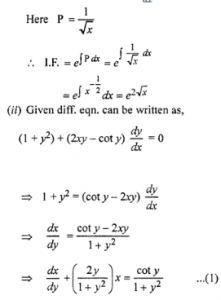
which is linear diff. eqn. in x of first order On comparing eqn. (1) with dy/dx + Px = Q
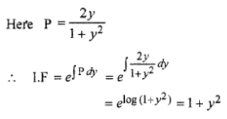
Solve the following equations :
Question 2.
dy/dx + y = e-x
Sol: Given diff. eqn. be dy/dx + y = e-x
which is L.D.E of first order in y.
On comparing with dy/dx + Py = Q dx
Here, P = 1 ; Q =e-x
∴ LF. = e∫Pdx = e∫dx ex
and solution is given by
y⋅e∫Pdx =∫(Q⋅e∫Pdx ) dx + c
⇒ y ex = ∫e-x⋅ex dx + c = x + c
⇒ y = (x + c) e-x
which is the required solution.
Que-3: x dy/dx – ay = x+1
Sol: Given diff. eqn. can be written as,
dy/dx−a/x y=x+1/x
which is L.D.E in y of first order.
On comparing with dy/dx + Py = Q
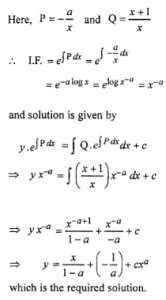
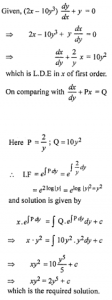
Que-4: (2x – 10y³)dy/dx + y = 0
Sol:
Que-5: dy/dx + 2y = 6 ex
Sol: Given, dy/dx + 2y = 6 ex
which is L.D.E in y of first order
On comparing eqn. (1) with dy/dx + Py = Q
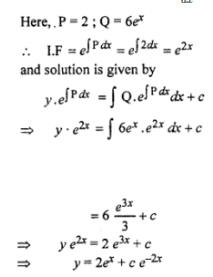
be the required solution.
Que-6: (i) x dy/dx – y = x²
(ii) 2x dy/dx + y = 6x³
Sol: (i) Given diff. eqn. can be
dy/dx – y = x
which is L.D.E in y of first order
On comparing with dy/dx + Py = Q dx
Here P = – 1/x and Q = x
∴ I.F = e∫Pdx = e∫-1/x dx
= e-log x = elog x^(-1) = 1/x
and solution is given by
y⋅ e∫Pdx =∫Q⋅ e∫Pdx dx+c
⇒ y⋅1/x =∫x⋅1/x dx + c = x + c
⇒ y = x (x + c)
which is the required solution.
(ii) Given diff. eqn. can be written as
dy/dx+y/2x=3x²
which is L.D.E my of first order and is of
the form dy/dx + Py = Q.
Here P = 1/2x ; Q = 3x²
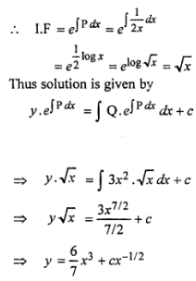
which is the required solution
Que-7: (i) (x² + 1)dy/dx + 2xy = 4x²
(ii) (x² – 1)dy/dx + 2xy = 2/x²–1
Sol: (i) Given diff. eqn. can be written as,
dy/dx+(2x/x²+1)y=4x²/x²+1
which is L.D.E in y of first order and is of dv
the form dy/dx + Py = Q
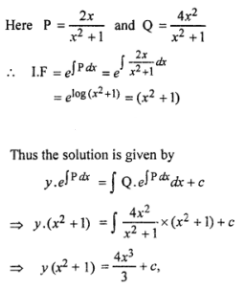
which is the required solution.
(ii) Given, (x² – 1) dy/dx + 2xy = 2/x²−1
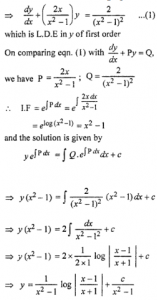
which is the required solution.
Que-8: (i) x logx dy/dx + y = 2logx
(ii) x log x dy/dx + y = 2/x log x
(iii) x dy/dx + 2y = x² log x
Sol: (i) Given x logx dy dx + y = 2logx
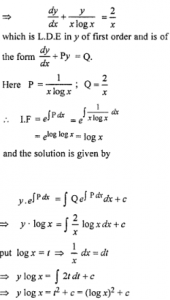
which is the required solution.
(ii) Given x log x dy dx + y = 2/x log x
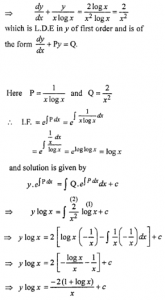
which gives the required solution.
(iii) Given x dy/dx + 2y = x² log x
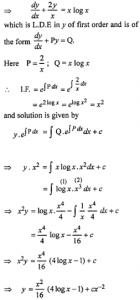
which gives the required solution.
Que-9: x sin dy/dx + (xcosx + sinx)y = sin x
Sol: Given
x sin x dy/dx + (xcos x + sin x) y = sin x
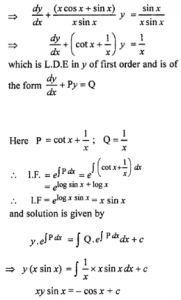
which gives the required solution.
Que-10: dy/dx + 2y = xe4x
Sol: Given dy/dx + 2y = xe4x
which is L.D.E in y of first order and is of dy
the form dy/dx + Py = Q.
Here P = 2 ; Q = xe4x
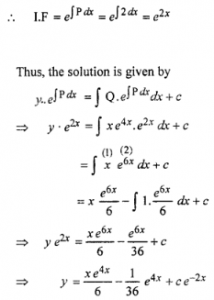
which is the required solution.
Que-11: sin x dy/dx + 2y + sin x (1 + cos x) = 0
Sol: Given
sin x dy/dx + 2y + sin x (1 + cos x) = 0
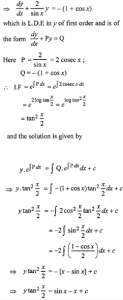
which gives the required solution.
Que-12: (i) (1 + x²) dy/dx + y =etan^(-1)x
(ii) (1 + x²) dy/dx + y =tan-1x
(iii) dy/dx+y/x =cosx+sinx/x
(iv) y’ + y = 1+xlogx/x
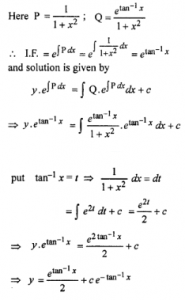
Sol: (i) Given (1 + x²)dy/dx + y =etan^(-1)x
⇒ dy/dx+(1/1+x²)y=etan^(-1)x/1+x²
which is L.D.E in y of first order and is of the form dy/dx + Py = Q
(ii) Given (1 + x²)dy/dx + y = tan-1x
⇒ dy/dx+(1/1+x²)y= tan-1x/1+x²
which is linear diff. eqn. in y of first order and is of the form dy/dx + Py = Q.
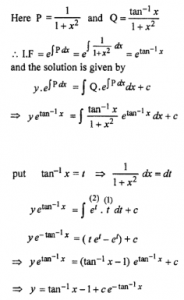
which gives the required solution.
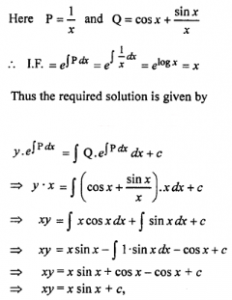
(iii) Given differential eqn. be
dy/dx+y/x = cosx+sinx/x
which is L.D.E in y of first order and is of the form dy/dx + Py = Q
(iv) Given, y’ + y = 1+xlogx/x
which is L.D.E in y of first order and is of
the form dy/dx + Py = Q
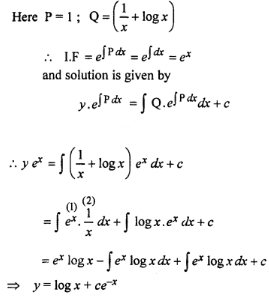
gives the required solution.
Que-13: y log y dx/dy + x – logy = 0
Sol: Given y log y dx/dy + x – logy = 0
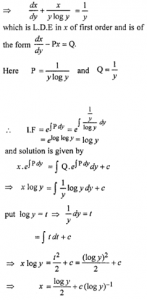
which is the required solution.
Que-14: dx/dy + y sec x = tan x
Sol: Given dx/dy + y secx = tan x
which is L.D.E in y of first order and is of the form dx/dy + Py = Q.
Here P = sec x ; Q = tan x
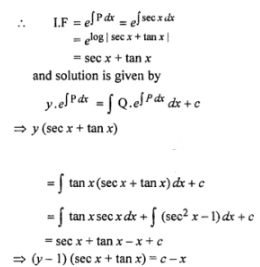
which gives the required solution.
Que-15: (x + tan y) dy = sin 2y dx
Sol: Given diff. eqn. can be written as
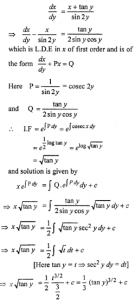
which gives the required solution.
Que-16: Solve the following equations :
(i) dy/dx – y/x = 2x²
(ii) dy/dx + y/x = sinx, giving the general solution and also the solution for which y = 0 and x = π/2
Sol: (i) Given diff. eqn. be, dy/dx – y/x = 2x²
which is L.D.E in y of first order and is of
the form dy/dx + Py = Q
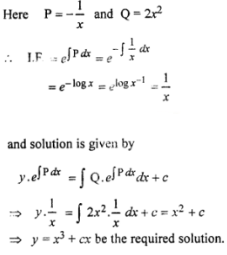
(ii) Given dy/dx + y/x = sin x
which is L.D.E in y of first order and is of
the form dy/dx + Py = Q.
Here P = 1x ; Q = sin x
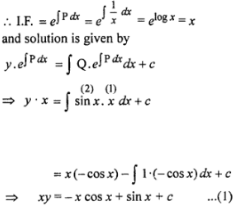
which gives the required general solution
given y = 0 when x = π/2
∴ from (1); we have
0 = – π/2 cos π/2 + sin π/2 + c ⇒ c = – 1
Thus eqn. (1) becomes ;
x/y = – x cos x + sin x – 1
which gives the required solution.
Que-17: (i) dy/dx = y tanx – 2sin x
(ii) y’ + y = sin x
(iii) y’ + y = cosx
(iv) y’ + 2y = sin x
(v) 2 dy/dx + 4y = sin 2x
Sol: (i) Given diff. eqn. can be written as
dy/dx – y tan x = – 2 sin x
which is L.D.E in y of first order and is of the form dy/dx + Py = Q
Here P = – tan x ; Q = – 2 sin x
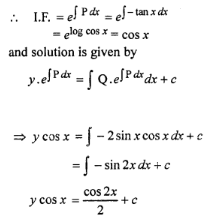
which gives the required solution.
(ii) Given, y’ + y = sin x, which is linear in y of first order and is of the form dy/dx + Py = Q
Here P = 1 ; Q = sin x
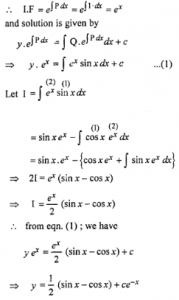
which gives the required solution.
(iii) Given y’ + y = cos x
which is L.D.E in y of first order and is of the form dy/dx + Py = 0
Here P = 1 ; Q = cos x
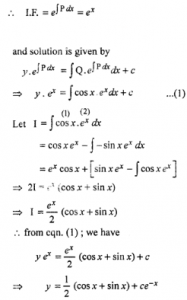
which gives the required solution.
(iv) Given y’ + 2y = sin x … (1)
which is L.D.E in y of first order and is of the form dy/dx + Py = Q.
Here P = 2 ; Q = sinx
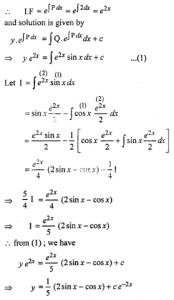
which gives the required solution.
(v) Given diff. eqn. be,
dy/dx + 2y = 1/2 sin 2x … (1)
which is linear in y of first order and is of the form dy/dx + Py = Q
Here P = 2 ; Q = 1/2 sin 2x
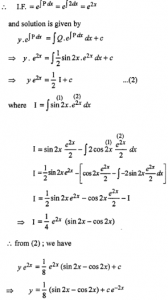
which gives the required solution.
Que-18: (i) (x + 2y²) dy/dx = y, y > 0
(ii) (x + 3y²)dy/dx = y, given that when x = 2, y = 1.
(iii) (3y² – x)dy = ydx
(iv) y² + (x – 1/y)dy/dx = 0
(v) (x + y + 1)dy/dx = 1
(vi) y dx + (x – y³)dy = 0
Sol: (i) Given (x + 2y²)dy/dx = y, y > 0
⇒ dy/dx = x+2y²/2y=x/y + 2y
⇒ dx/dy – x/y = 2y which is linear diff. eqn. in x of first order and is of the form
dx/dy + Px = Q.
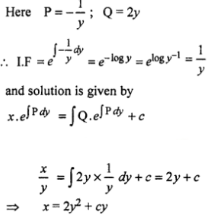
which gives the required solution.
(ii) Given diff. eqn. be, (x + 3y²)dy/dx = y
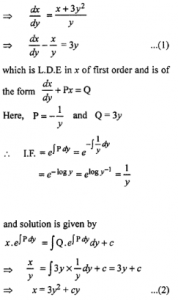
given that when x = 2, y = 1
∴ from (2); we have 2 = 3 + c ⇒ c = – 1
∴ from (2); we have
x = 3y² – y be the required solution.
(iii) Given (3y² – x)dy = ydx
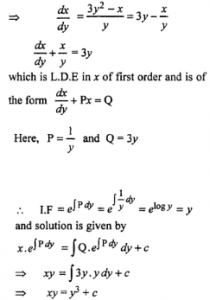
which gives the required solution.
(iv) Given diff. eqn. be,
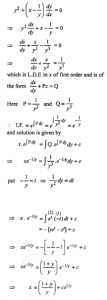
which gives the required solution.
(v) Given (x + y + 1)dy/dx = 1
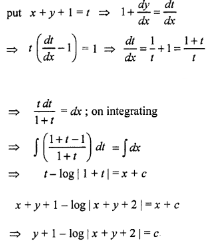
which gives the required solution.
(vi) Given diff. eqn. be,
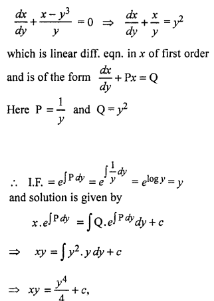
which is the required solution.
Que-19: Solve the differential equations :
(i) dy/dx – 3 y cot x = sin 2x given that y = 2, when x = π/2
(ii) dy/dx + 2y tan x = sin x,
if y = 0 for x = π/3
(iii) dy/dx + x cot y = 2y + y² cot y, (y ≠ 0)
given that x = 0 when y = π2
(iv) x dy/dx + y = x cos x + sin x, given y(π/2) = 1
Sol: (i) Given, dy/dx – 3 y cot x = sin 2x … (1)
which is linear in y of first order and is of
the form dy/dx + Py = Q
Here P = – 3 cot x ; Q = sin 2x
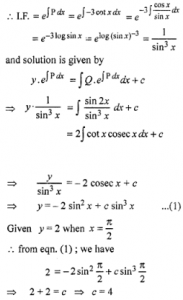
∴ from (1); we have
y = – 2 sin² x + 4 sin³ x
gives the required solution.
(ii) Given dy/dx + 2y tan x = sin x
which is linear in y of first order and is of the form dy/dx + Py = Q.
Here P = 2 tan x; Q = sin x
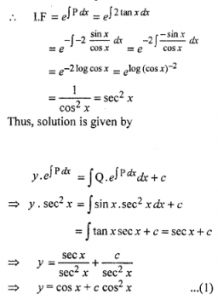
which is the required general solution.
When x = π/3, y = 0 ∴ from (1); we have
0 = 1/2 + c/4
⇒ c/4 = – 1/2
⇒ c = – 2
Thus eqn. (1) becomes; y = cos x – 2 cos² x
be the required particular solution.
(iii) Given diff. eqn. be dx
dx/dy + x cot y = 2y + y² cot y
which is linear is x of first order and is of the form dx/dy + Px = Q
Here P = cot y and Q = 2y + y² cot y
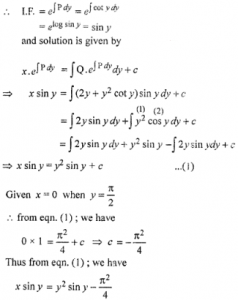
be the required solution.
(iv) Given diff. eqn. can be written as
dy/dx + 1/x y = cos x + sinxx
which is linear in y of first order and is of the form dx/dy + Py = Q.
Here P = 1/x and Q = cos x + sinx/x
and solution is given by
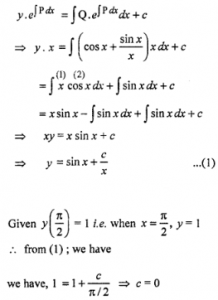
∴ eqn, (1) becomes ; y = sin x be the required particular solution.
Que-20: Solve the differential equation (1 + x²)dy/dx + 2xy – 4x² = 0 subject to the initial condition y (0) = 0.
Sol: Given diff. eqn. be
(1 + x²)dy/dx + 2xy – 4x² = 0
⇒ dy/dx+(2x/1+x²)y=4x²/1+x²
which is L.D.E in y of first order and is of the form dy/dx + Py = Q
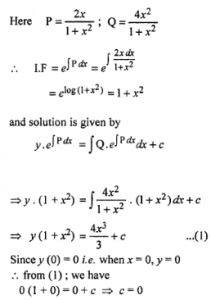
Thus eqn. (1) gives ; y (1 + x²) = 4x³/3
gives the required particular solution.
Que-21: Solve dy/dx + (2x/1+x²) y=1/(1+x²)², if when y = 0, x = 1.
Sol: Solution:
Given dy/dx + (2x/1+x²) y = 1/(1+x²)²
which is L.D.E in y of first order and is of
the form dydx+ Py = Q.
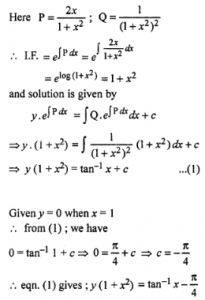
be the required solution.
Que-22: x dy/dx + y = x³ given that y = 1 when x = 2.
Sol: Given diflf. eqn. can be written as
dy/dx + y/x = x²
which is L.D.E in y of first order and is of the form dy/dx + Py = Q.
Here P = 1/x and Q = x²
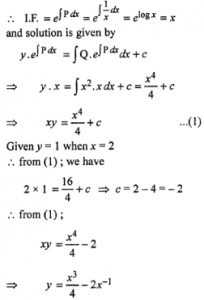
be the required particular solution.
Que-23: Find the particular solution of differential equation dy/dx=−x+ycosx/1+sinx, given that y = 1, when x = 0.
Sol: Given dy/dx=−x/1+sinx−ycosx/1+sinx
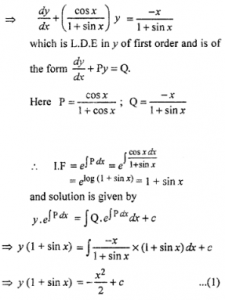
Given y = 1 when x = 0
∴ from (1); we have
1 (1 + 0) = 0 + c ⇒ c = 1
∴ eqn. (1) becomes ;
y (1 + sin x) = – x²/2 + 1
be the required solution.
–: End of Differential Equations Class 12 OP Malhotra Exe-17F ISC Math Ch-17 Solution :–
Return to :- OP Malhotra ISC Class-12 S Chand Publication Maths Solutions
Please share with your friends
Thanks