Differential Equations Class 12 OP Malhotra Exe-17G Maths Solutions. In this article you would learn about applications of differential equations . Step by step solutions of latest textbook has been given as latest syllabus. Visit official Website CISCE for detail information about ISC Board Class-12 Mathematics.

Differential Equations Class 12 OP Malhotra Exe-17G ISC Maths Solutions Ch-17
| Board | ISC |
| Publications | S Chand |
| Subject | Maths |
| Class | 12th |
| Chapter-17 | Differential Equations |
| Writer | OP Malhotra |
| Exe-17(g) | Applications of Differential Equations |
Applications of Differential Equations
Differential Equations Class 12 OP Malhotra Exe-17G Solutions
Que-1: Obtain the equation of the curve whose slope at any point is equal to y + 2x and which passes through the origin.
Sol: We know that, slope of tangent at any point P (x, y) on the curve = dy/dx
also given slope of tangent to the curve = y + 2x
∴ dy/dx = y + 2x
⇒ dy/dx – y = 2x
which in L.D.E in y of first order and is of dy the form dy/dx + Py = Q
Here P = – 1 ; Q = 2x
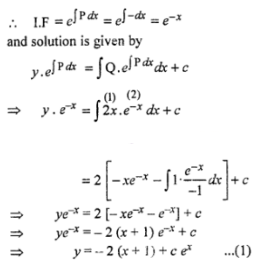
Since given curve passes through origin i.e. x = Q,y = Q
∴ from (1); 0 = -2 (0 + 1) + c ⇒ c = 2
Thus from (1); y = – 2 (x + 1) + 2ex
which is the required eqn. of curve.
Que-2: The surface area of a balloon being inflated changes at a constant rate. If initially, its radius is 3 units and after 2 seconds, it is 5 units, find the radius after t second.
Sol: Let r (t) be the radius of balloon after time t seconds
Let S be the surface area of balloon d/S
Then ds/dt = k where k be the constant of proportionality
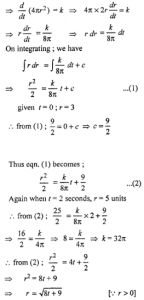
which is the required radius after time t.
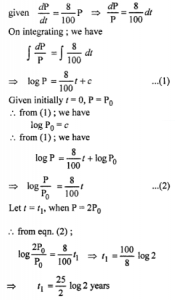
Que-3: A population grows at the rate of 8% per year. How long does it take for the population to double? Use differential equation for it.
Sol: Let the initial population be P0 and P be the population after t years.
Que-4: The slope of a tangenrat point P (x, y) on the curve is – x/y. If the curve passes through the point (-3, 4), find the equation of the curve.
Sol: We know that, slope of the tangent to the curve at any point P(x, y) = dy/dx
also, given slope of tangent to given curve = – xy
∴ dy/dx=−x/y ⇒ y dy + x dx = 0
On integrating ; we have
∫ ydy + ∫ xdx = c/2
⇒ y²/2+x²/2=c/2
⇒ x² + y² + c …(1)
Since the curve given by (1) passes through
the point (- 3, 4)
from (1) ; 9 + 16 = c ⇒ c = 25
Thus eqn. (1) becomes ; x² + y² = 25 be the required eqn. of curve.
Que-5: The slope of the tangent to a curve at any point is reciprocal of twice the ordinate of that point. The curve passes through (4,3). Formulate the differential equation and hence find the equation of curve.
Sol: We know that, slope of the tangent to a curve at any point P (x, y) = dy/dx
also given slope of the tangent to curve = 1/2y
∴ dy/dx = 1/2y ⇒ 2y dy = dx
On integrating ; we have
∫ 2ydy =∫ dx ⇒ y² = x + c …(1)
Since the curve given by (1) passes through point (4, 3)
∴ from (1); 9 = 4 + c ⇒ e = 5
∴ from (1) ; y² = x + 5
which is the required eqn. of curve.
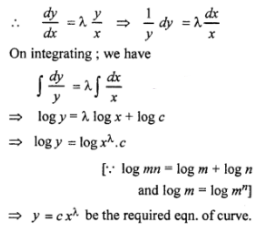
Que-6: The slope of tangent at any point to a curve is λ. times the slope of the line joining the point of contact to the origin. Find the equation of curve.
Sol: It is given that, slope of tangent at any point (x, y) to a curve is A times the slope of the line joining the point of contact to the (0, 0).
Que-7: The slope of the tangent to a curve at a point (x, y) on it is given by
y/x – cot y/x . cos y/x(x > 0, y > 0)
and curve passes through the point (1, π/4). Find the equation of the curve.
Sol: Since the slope of the tangent to a curve at a point is y/x – cot y/x cos y/x.
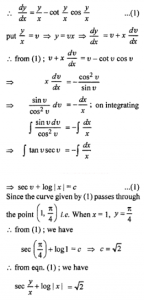
be the required eqn. of curve.
Que-8: (i) Find the equation of the curve for which the intercept cut off by a tangent on the xvaxis is equal to four times the ordinate of the point of contact.
(ii) Similar question. The x-intercept of the tangent line to a curve is equal to the ordinate of the point of contact. Find the particular curve through the point (1,1).
Sol: (i) eqn. of any tangent at any point (x, y) is given by
Y – y = dy/dx (X – x) …(1)
For x-intercept, Y = 0 ∴ from (1); we have
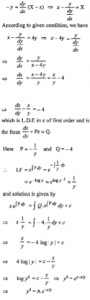
be the required eqn. of curve.
(ii) The eqn. of tangent to curve at any point (x, y) is given by
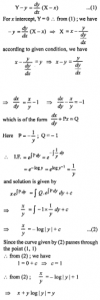
which is the required eqn. of curve.
Que-9: Find the differential equation of ail circles which pass through the origin and whose centre lies on the y-axis.
Sol: eqn. of circle having centre on y-axis i.e. (0, b) and radius r is given by
(x – 0)² + (y – b)² = r² … (1)
since circle passes through origin
∴ 0² + (0 – b)² = r² ⇒ r² = b²
∴ eqn. (1) becomes ; x² + (y – b)² = b²
⇒ x² + y² – 2by = 0 … (2)
where b be the arbitrary constant
Diff. both sides of eqn. (2) w.r.t. x ;
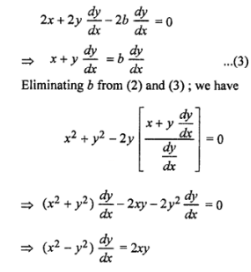
which is the required eqn. of differential eqn.
Que-10: The line normal to a given curve at each point (x, y) on the curve passes through the point (2, 0). If the curve contains the point (2,3) find its equation.
Sol: The eqn. of normal to curve at any point (x, y) is given by
Y – y = – 1 / dy/dx (X−x) … (1)
Clearly it is given that line (1) passes through the point (2, 0).
∴ 0 – y = – 1 / dy/dx(2−x)
⇒ y dy/dx = 2 – x ⇒ y dy = (2 – x) dx
On integrating ; we have
y²/2=(2−x)²/−2 + c/2
⇒ y² = – (2 – x)² + c … (2)
Since the curve given by eqn. (2) passes through (2, 3).
∴ from (2); we get
3² = – (2 – 2)² + c ⇒ c = 9
∴ from (2); y² = – (2 – x)² + 9 = 4x – x² + 5
which is the required eqn. of curve.
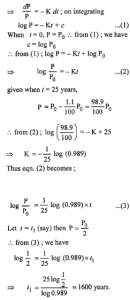
Que-11: Assume that a radioactive substance decomposes at a rate proportional to the quantity of the substance present. In an experiment, with Radium 226, it was observed that in 25 years only 1.1 per cent of the quantity was decomposed. Find how long will take for one half of the original amount to decompose.
Sol: Let P be the amount of radioactive substance present at any time t. Then
dP/dt ∝P ⇒ dP/dt = – KP
where K be the constant of proportionality
Que-12: A certain radioactive material has a half life of 2 hours. Find the time interval required for a given amount of this material to decay to one tenth of its original mass.
Sol: Let M be the quantity of mass at any time t
Then dM/dt ∝M ⇒ dM/dt = – KM
where K = constant of proportionality
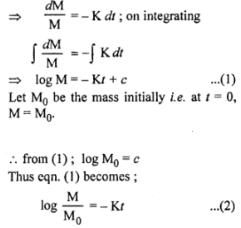
also it is given that, radiactive material has a half life be 2 hours
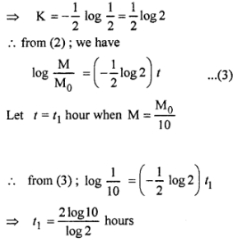
∴ When t = 2 hours,
M = Mo/2
∴ from (2); log 1/2 = – K x 2
Que-13: Experiments show that radium disinte-grates at a rate proportional to the amount of radium-present at the moment. Its half life is 1590 years. What percentage will disappear in one year?
[Use elog 2/1590 = 0.99%]
Sol: Let P the amount of radium present at any time t then
dP/dt ∝P ⇒ dP/dt = – KP
where K = constant of proportionality
dP/dt = – K dt ; on integrating
log P = – Kt + c …(1)
Let P0 be the amount of radium present initially
∴ t = 0, P = Po
∴ from (1) ; we have log Po = c
from (1); log P = – Kt + log Po
⇒ logP/Po = – Kt … (2)
Given half life of radioactive substance be 1590 years
![Que-13: Experiments show that radium disinte-grates at a rate proportional to the amount of radium-present at the moment. Its half life is 1590 years. What percentage will disappear in one year? [Use elog21590 = 0.99%]](https://icsehelp.com/wp-content/uploads/2025/09/13-3-219x300.png)
Thus, the required % of radius will disappears in one year
= (100 – 99.96)% = 0.04%
Que-14: A spherical raindrop evaporates at a rate proportional to its surface area. If originally its radius be 3 mm and 1 hour later it reduces to 2 mm, find an expression for the radius of the raindrop at any time.
Sol: Let r (t) be the radius of raindrop after time t hours. Since the radius is decreases as t increases.
∴ the rate of change of r must be negative. Let V be the volume of the raindrop and S be the surface area of raindrop.
Also it is given that dV/dt ∝ S
⇒ d/dt(4/3 πr³)=−K×4πr²
where K = constant of proportionality
⇒ 4/3 π × 3 r² dr/dt =−4πr² K
⇒ dr/dt=−K⇒dr=−Kdt
On integrating ; we have
r = – Kt + c …(1)
given t = 0, r = 3 mm ∴ from (1); c = 3 ,
∴ eqn. (1) becomes ; r = – Kt + 3 …(2)
when t = 1 hr; r = 2 mm
∴ from(2); 2 = – K + 3 ⇒ K = 1
Thus eqn. (2) becomes ; r = – t + 3
be the required radius after time t.
Aliter : Let r (t) be the radius of raindrop after time t hours. Since the radius r decreases as t increases. ∴ the rate of change of r must be negative.
Then dr/dt ∝ S,
where S = surface area of raindrop
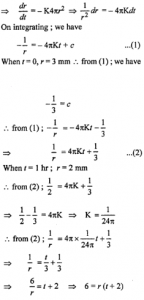
be the required radius after time t.
Que-15: An equation relating to stability of an aeroplane is given by dv/dt = g cos α – kv, where v is the velocity and g, α, k are constants. Find the expression for the velocity, if v = 0 at t = 0.
Sol: Given eqn. related to stability of an aeroplane is given by
dv/dt = g cos α – kv
⇒ dv/dt + kv = g cos α
which is of the form dv/dt + Pv = Q
where P = k; Q = g cos α
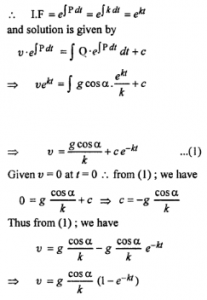
which is the expression for velocity after time t.
Que-16: The acceleration of a particle moving in a straight line is (10 – 6t) cm/s² after t seconds. If the velocity of the particle is zero at t = 1/3, show that it will be zero at t = 3.
Sol: Let a (t) be the acceleration of particle moving in a straight line after time t
Then a (t) = 10 – 6t ⇒ dv/dt = 10 – 6t
⇒ dv = (10 – 6t) dt; on integrating
∫ dv = ∫ (10 – 6t)dt
⇒ v = 10t – 3t² + c … (1)
It is given that v = 0 at t = 1/3
∴ from (1); 0 = 10/3 – 3 x 1/9 + c ⇒ c = – 3
∴ from (1); we have
v = 10t – 3t² – 3
at t = 3; v = 10 x 3 – 3 x 3² – 3 = 0
Hence the velocity of the particle is zero at t = 3.
Que-17: The population of a country doubles in 40 years. Assuming that the rate of increase is proportional to the number of inhabitants, find the number of years in which it will treble itself.
Sol: Let P be the population after time t
Also it is given that dP/dt ∝ P
⇒ dP/dt = kP
where k = constant of proportionality
⇒ dP/P = kdt; on integrating ; we have
log P = kt + c …(1)
Let P0 be the population initially i. e. at t = 0
∴ log p0 = c
∴ from (1); log P = kt + log Po
⇒ log P/Po = kt …(2)
Given P = 2Po When t = 40 years
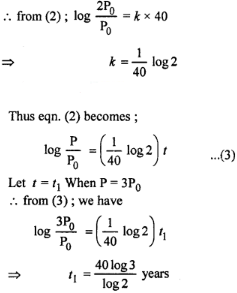
Thus after 40log3 / log2 years, population will become treble itself.
Que-18: The rate of increase of bacteria in a culture is proportional to the number of bacteria present and it is found that the number doubles in 5 hours. Express this mathematically using rate of increase of bacteria with respect to time. Hence, calculate how many times the bacteria may be expected to grow at the end of 15 hours.
Sol: Let x be the no. of bacteria after time t
Then dx/dt∝x⇒dx/dt=kx
where k = constant of proportionality variable separation ; we have
dx/x = kdt; on integrating ;
∫dx/x=∫kdt
⇒ log x = kt + c …(1)
Let x be the population initially i. e. at t = 0
∴ from (1); log x0 = c
Thus eqn. (1) becomes
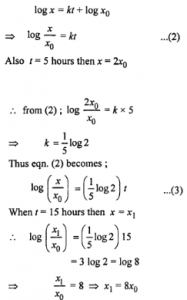
Thus the required no. of bacteria may be expected to grow at the end of 15 years be eight times the no. of bacteria present initially.
Que-19: A slow motorist levelling 1 m/s disengages gear and free wheels to rest. The retardation the car has two components 0.04 m/s2 due to friction in working parts and road resistance i retardation due to air resistance of 0.04 v² m/s², where v is the speed in m/s. Find how would it take the car to free wheel to rest?
Sol: Let a be the retardation of the car
Then a = – 0.04 – 0.04 v²
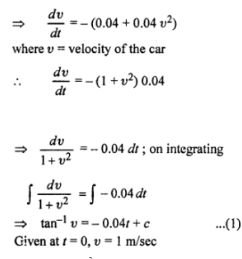
∴ from (1); tan-11 = c ⇒ c = π/4
Thus eqn. (1) becomes ;
tan-1 v = – 0.04 t + π/4 …(2)
The car goes to rest at t = t1 sec.
∴ v = 0 at t = t1
∴ from (2) ; tan-1 0 = – 0.04 x t1 + π/4
⇒ 0.04 t1 = π/4 ⇒ t1 = 25π/4 seconds
Que-20: A wet porous substance in the open air loses its moisture at rate proportional to the moisture content. If a sheet hung in the wind loses half of its moisture during the first hour, when it have lost.
(i) 90% moisture, weather conditions remaining the same.
(ii) 95% moisture, weather conditions remaining the same.
(iii) 98% moisture, weather conditions remaining the same.
Sol: Let M be the moisture content at time t
Then dM/dt∝M⇒dM/dt=−kM
where k = constant of proportionality
Since moisture content loses after time t
∴ dM/dt = – kdt; On integrating
∫dM/M=−k∫dt
⇒ log M = – kt + c …(1)
Let M0 be the moisture content in the net porous substance initially i.e. at t = 0, M = M0.
∴ from (1); log M0 = c
Thus eqn. (1) becomes ;
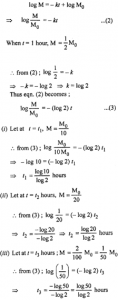
Que-21: The engine of a motor boat moving at 10 m/s is shut off. Given that the retardation at subsequent time (after shutting of the engine) equals the velocity at that time, find
(i) the velocity after 2 sees of switching off the engine;
(ii) the distance travelled in these 2 seconds (Leave your answer in terms of e).
Sol: Let a be the retardation of engine of motor boat and v be the velocity of engine of motor boat.
Then a = – v ⇒ dv/dt = – v ⇒ dv/v = – dt
On integrating ; we have
∫dv/v=−∫dt ⇒ log v = – t + c …(1)
Given at t = 0 ; v = 10 m/s
∴ from (1); log 10 = c
Thus eqn, (1) becomes ;
log v/10=−t⇒ v/10 = e-t
⇒ v = 10 e-t … (2)
(i) When t = 2 ;
velocity after 2 secs = 10 e-2 m/sec
(ii) Let x be the distance travelled by motor boat
∴ dx/dt = 10 e-t ⇒ dx = 10 e-t dt
On integrating ; we have
x = 10e-t/-1 + c … (3)
When t = 0 ; x = 0 from (3); we have
0 = – 10 + c ⇒ c = 10
∴ from (3); x = – 10 e-t + 10
⇒ x = 10 (1 – e-t)
Thus required distance travelled by motor boat in 2 seconds = (x)t=2 = 10(1 – e-2)
Que-22: A steam boat is moving at velocity v0 when steam is shut off. Given that the retardation at any subsequent time is equal to the magnitude of the velocity at the time, find the velocity and distance travelled in time t after the steam is shut off.
Sol: Given retardation at any subsequent time is equal to magnitude of the velocity at that time.
Let a be the retardation and v be the velocity after time t.
Then a = dv/dt = – v ⇒ dv/dv = – dt
On integrating ; we have
log v = – t + c … (1)
at t = 0 ; v = v0
∴ from (1); log v0 = c
Thus eqn. (1) becomes ; log vv0 = – t
⇒ v/v0 = e-t ⇒ v = v0 v0…(2)
Let x be the distance travelled by steam boat after time t
∴ v = dx/dt = v0/e-t
On integrating x = v0 e-t/−1 + c1 …(3)
When t = 0 ; x = 0
∴ from (3); 0 = – v0+ c1 ⇒ c1 =v0
Thus eqn. (3) becomes ; x = – v0 e-t + v0
⇒ x = v0(1 – e-t) be the required distance covered by steam boat
–: End of Differential Equations Class 12 OP Malhotra Exe-17G ISC Math Ch-17 Solution :–
Return to :- OP Malhotra ISC Class-12 S Chand Publication Maths Solutions
Please share with your friends
Thanks