Differential Equations Class 12 OP Malhotra Exe-17B ISC Maths Solutions Ch-17 Solutions. In this article you would learn about formation of differential equations . Step by step solutions of latest textbook has been given as latest syllabus. Visit official Website CISCE for detail information about ISC Board Class-12 Mathematics.
Differential Equations Class 12 OP Malhotra Exe-17B ISC Maths Solutions Ch-17
| Board | ISC |
| Publications | S Chand |
| Subject | Maths |
| Class | 12th |
| Chapter-17 | Differential Equations |
| Writer | OP Malhotra |
| Exe-17(b) | formation of differential equations |
Formation of differential equations
Indefinite Integrals Class 12 OP Malhotra Exe-17B Solutions
Que-1: Write the differential equation representing the family of curves y = nix, where m is an arbitrary constant.
Sol: Given family of curves be,
y = mx …(1)
where m be an arbitrary constant.
Diff. both sides of eqn. (1) w.r.t. x; we have
dydx = m … (2)
putting the valueof m from (2) in eqn. (1) ; we have
y = x dy/dx be the required diff. eqn.
Que-2: Form the differential equation by eliminating the parameters A and B from the equation y =Aeax + Be-ax.
Sol: Given eqn. be,
y = Aeax + Be-ax …(1)
Diff. eqn. (1) both sides w.r.t. x, we have
dy/dx = Aeax – Bae-ax …(2)
Diff. eqn. (2) both sides w.r.t. x, we have
d²y/dx²=Aa²eax+Ba²e-ax = a²(Aeax – Bae-ax)
⇒ d²y/dx² [using eqn. (1)]
Que-3: Form the differntial equation represen-ting the family of curves
y = tan-1 x + c etan-1 x, where c is an arbitrary constant.
Sol: Given eqn. of family of curves be
y = tan-1 x + c etan-1 x … (1)
where c be any arbitrary constant diff. both sides w.r.t. x; we have
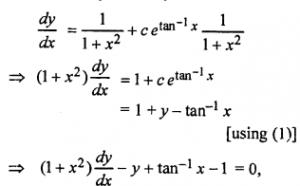
which is the required diff. eqn.
Que-4: Form the differential equation representing the family of curves: y = e2x(A + Bx), where A and B are constants.
Sol: Given eqn. of family of curves be
y = e2x(A + Bx) … (1)
Diff. both sides w.r.t. x ; we have
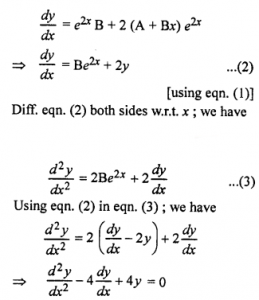
which is the required differential equation.
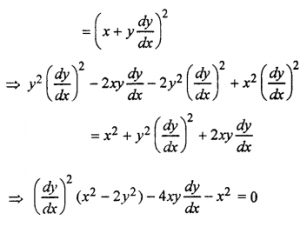
Que-5: Form the differential equation corres-ponding to y² – 2ay + x² = a² by eliminating a.
Sol: Given differential eqn. be,
y² – 2ay + x² = a² …(1)
Diff. eqn. (1) both sides w.r.t. x ; we get
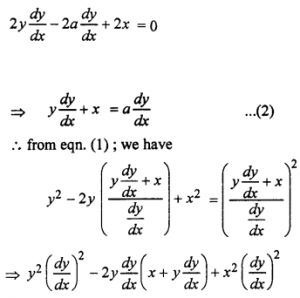
Que-6: Find the differential equation of family of circles touching y-axis at the origin
Sol: The family of circles having radius a and touching y-axis at origin is given by (x – a)² + y² = a²
⇒ x² – 2ax + y² = 0 …(1)
where a be the arbitrary constant.
Diff. both sides eqn. (1) w.r.t. x ; we have
2x – 2a + 2y dy/dx = 0
⇒ a = x + y dy/dx
∴ from eqn. (1); we have
x² + y² – 2x(x + y dy/dx) = o
⇒ y² – x² – 2x dy/dx = 0
⇒ 2xy dy/dx + x² – y² = 0
which is the required diff. eqn.
Que-7: Form the differential equation of the family of curves y = a sin (bx + c), a and c being arbitrary constants.
Sol: Given eqn. of family of curves be
y = a sin (bx + c) …(1)
where a and c are arbitrary constants.
Diff. eqn. (1) both sides w.r.t. x ; we have
dy/dx = a cos (bx + c). b … (2)
diff. eqn. (2) both sides w.r.t. x ; we have
d²y/dx² = – a sin (bx + c)b²
= – b²y [using (1)]
⇒ d²y/dx² + b²y = 0,
which is the required diff. eqn.
Que-8: Find the differential equation repre-senting the family of curves given by y = Ax + B/x where A and B are constants.
Sol: Given eqn. of family of curves be,
y = Ax + B/x … (1)
where A and B arbitrary constants
Diff. eqn. (1) both sides w.r.t. x, we get
dy/dx = A – B/x²… (2)
Multiply eqn. (2) by x and adding to eqn. (1); we get
x dy/dx + y = 2Ax ⇒ dy/dx + y/x =2A …(3)
Diff. eqn. (3) both sides w.r.t. x ; we get
d²y/dx² + x dy/dx -y /x² = 0
⇒ d²y/dx² + 1/x dy/dx -y/x² = 0
be the required diff. eqn.
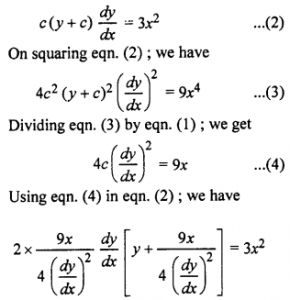
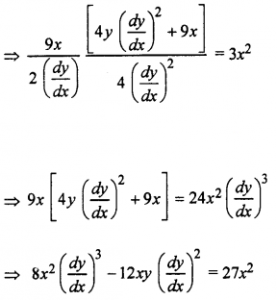
Que-9: Form the differential equation of the family of curves represented by
c(y + c)² = x³.
Sol: Given eqn. of family of curves be given by
c(y + c)² = x³ … (1)
Diff. eqn. (1) both sides w.r.t. x ; we get
Que-10: Find the differential equation of the family of concentric circles x² + y² = a².
Sol: Given eqn. of family of concentric circle be x² + y² = a² …(1)
Diff. (1) both sides w.r.t. x ; we have
2x + 2y dy/dx = 0
⇒ x + y dy/dx =0
which is the required differential equation.
Que-11: Form the differential equation representing the family of curves, y =A cos 2x + B sin 2x, where A and B are constants.
Sol: Given eqn. of family of curves be
y = A cos 2x + B sin 2x …(1)
Diff. both sides of eqn. (1) w.r.t. x; we have
dy/dx = – 2A sin 2x + 2B cos 2x …(2)
Diff. eqn. (2) both sides w.r.t. x ; we have
d²y/dx² = – 4A cos 2x – 4B sin 2x = – 4 [A cos 2x + B sin 2x] = – 4y [using eqn. (1)]
⇒ d²y/dx² = 0,
which is the required diff. eqn.
Que-12: Obtain the differential equation by eliminating ‘a’ and ‘b’ from equation y = ex (a cos x + b sin x).
Sol: Given eqn. be,
y = ex (a cosx+ b sinx) …(1)
Diff. both sides eqn. (1) w.r.t. x ; we get
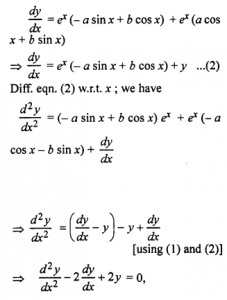
which is the required diff. eqn.
Que-13: Form the differential equation of the family of curves represented by the equation (x – a)² + 2y² = a², where a is an arbitrary constant.
Sol: Given eqn. of family of curve be
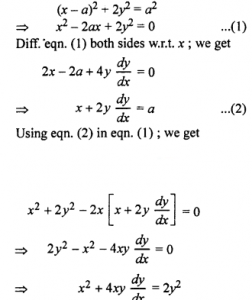
which is the required diff. eqn.
Que-14: Form the differential equation representing family of ellipses having foci on X-axis and centre at the origin.
Sol: The eqn. of family of ellipses having foci on x-axis and centre at origin be given by
which is the required differential equation.
Que-15: Form a differential equation of the family of curves y² = 4ax.
Sol: eqn. of family of curves be, y² = 4ax …(1)
diff. eqn. (1) both sides w.r.t. x; we have
2y dy/dx = 4a … (2)
From (1) and (2); we have
y²= 2xy dy/dx = y/2x
which is the required differential equation.
–: End of Differential Equations Class 12 OP Malhotra Exe-17B ISC Math Ch-17 Solution :–
Return to :- OP Malhotra ISC Class-12 S Chand Publication Maths Solutions
Please share with your friends
Thanks