Differentiation Class 12 OP Malhotra Exe-8L ISC Maths Solutions Ch-8 Solutions. In this article you would learn about higher derivatives (successive differentiation). Step by step solutions of latest textbook has been given as latest syllabus. Visit official Website CISCE for detail information about ISC Board Class-12 Mathematics.
Differentiation Class 12 OP Malhotra Exe-8L ISC Maths Solutions Ch-8
| Board | ISC |
| Publications | S Chand |
| Subject | Maths |
| Class | 12th |
| Chapter-8 | Differentiation |
| Writer | OP Malhotra |
| Exe-8(L) | higher derivatives (successive differentiation) |
Higher Derivatives (Successive Differentiation)
Differentiation Class 12 OP Malhotra Exe-8L ISC Maths Solutions Ch-8 Solutions
Que-1: (i) x²
(ii) ax
(iii) ax³ + bx² + cx + d
(iv) log x
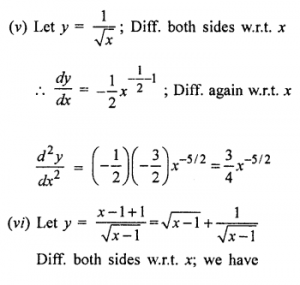
(v) 1/√x
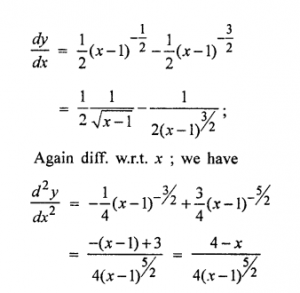
(vi) x/√x-1
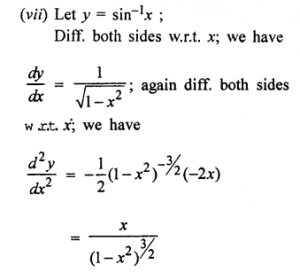
(vii) sin-1 x
Sol: (i) Let y = x² ; Diff. both sides w.r.t. x,
dy/dx = 2x ; Again diff. both sides w.r.t. x
∴ d²y/dx² = 2
(ii) Let y = ax ; Diff. both sides w.r.t. x, we have
dy/dx = ax log a; Again diff. both sides w.r.t. x ; we have
∴ d²y/dx² = a²(log a)²
(iii) Let y = ax³ + bx² + cx + d; Diff. both sides w.r.t. x
dy/dx = 3ax² + 2bx + c; Diff. again w.r.t. x
d²y/dx² = 6ax + 2b
(iv) Let y = log x ; Diff. both sides w.r.t. x
dy/dx = 1/x ; Diff. again w.r.t. x; we have
d²y/dx² = – 1/x²
Que-2: (i) ex + sin x
(ii) e-x sin x
Sol: (i) Let y = ex + sin x ;
Diff. both sides w.r.t. x; we have
dy/dx = ex + cos x ;
Diff. again both sides w.r.t. x; we have
d²y/dx² = ex – sin x
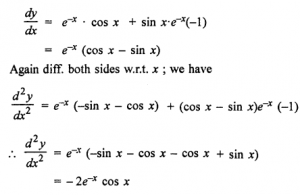
(ii) Let y = e-x sin x ;
Diff. both sides w.r.t. x,
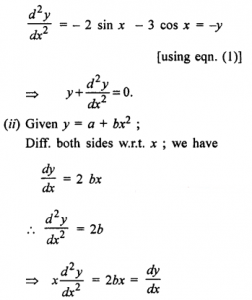
Que-3: (i) If y = 2 sin x + 3 cos x, prove that y + d²y/dx² = 0.
(ii) If y = a + bx², prove that x.d²y/dx² = dy/dx
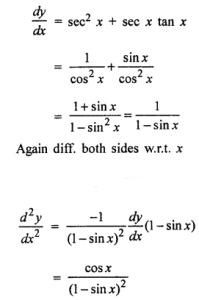
(iii) If y = tan x + sec x, prove that d²y/dx² = cos x/(1-sin x)².
(iv) If y = 500, e7x + 600 e-7x, show that d²y/dx² = 49 y.
(iv) If ey (1 + x) = 1, show that d²y/dx² = (dy/dx)².
Sol: (i) Given y = 2 sin x + 3 cos x …(1)
Diff. both sides w.r.t. x; we have
dy/dx = 2 cos x – 3 sin x ;
Again diff. both sides w.r.t. x
(iii) Given y = tan x + sec x … (1)
Diff. eqn. (1) both sides w.r.t. x; we have
(iv) Given y = 500 e7x + 600 e-7x …(1)
Diff. eqn. (1) both sides w.r.t. x; we have
dy/dx = 3500 e7x – 4200 e-7x
Again diff. both sides w.r.t. x
dy/dx = 7 x 3500 e7x + 4200 x 7 e-7x
= 49[500 e7x + 600 e-7x] = 49 y [using eqn. (1)]
(v) Given ey (1 + x) = 1 ⇒ ey = 1/1+x
Taking logorithm both sides w.r.t. x, we have
y = log(1/1+x) = – log(1 + x)
Diff. both sides w.r.t. x ; we have
dy/dx = – (1/1+x)… (1)
Again diff. both sides w.r.t. x
d²y/dx² = 1/(1+x)² = (dy/dx)² [using eqn. (1)]
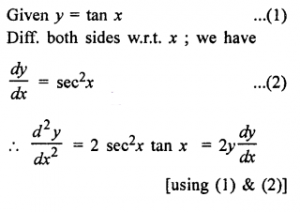
Que-4: If y = tan x, prove that d²y/dx² = 2y dy/dx .
Sol:
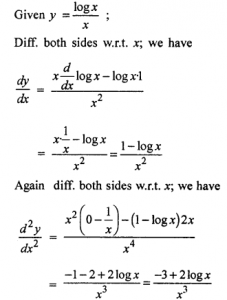
Que-5: If y = logx / x, prove that d²y/dx² = 2 log x – 3 / x³.
Sol: Given y = log x / x
Diff. both sides w.r.t. x; we have
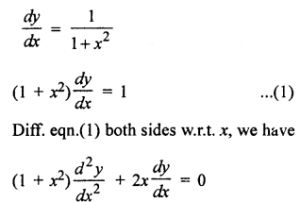
Que-6: (i) If y = tan-1 x, prove that
(1 + x²) d²y/dx² + 2x dy/dx = 0.
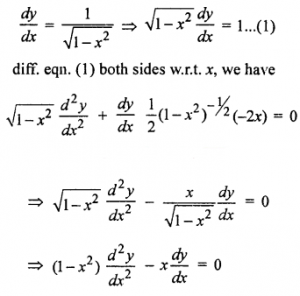
(ii) If y = sin-1x, then show that
(1 + x²) d²y/dx² – x dy/dx = 0.
Sol: (i) Given y = tan-1 x;
Diff. both sides w.r.t. x, we have
(ii) Given y = sin-1 x;
Diff. both sides w.r.t. x, we have
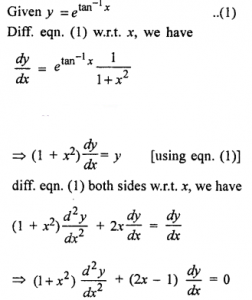
Que-7: If y = e^(tan-1 x) , prove that
(1+x²)d²y/dx² + (2x-1) dy/dx = 0.
Sol:
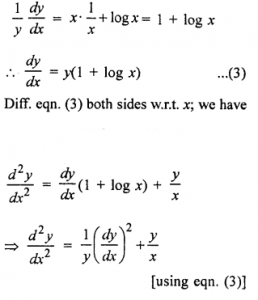
Que-8: If y = xx, prove that
d²y/dx² – 1/y (dy/dx)² -y/x = 0
Sol: Given y = xx, … (1)
Taking logarithm on eqn. (1); we have
log y = x log x …(2)
Diff. eqn. (2) w.r.t. x, we have
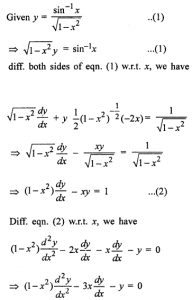
Que-9: If y = sin-1x / √1-x², prove that
(1-x²) d²y/dx² – 3x dy/dx – y = 0.
Sol:
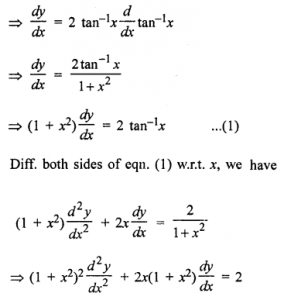
Que-10: If y = (tan-1 x)², prove that
(x²+1)² d²y/dx² + 2x (x²+1) dy/dx = 2.
Sol: Given y = (tan-1x)²,
Diff. both sides w.r.t. x, we have
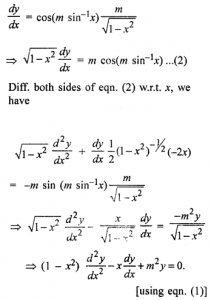
Que-11: If y = sin (m sin-1 x) show that (1 – x²) d²y/dx² – x dy/dx + m²y = 0
Sol:
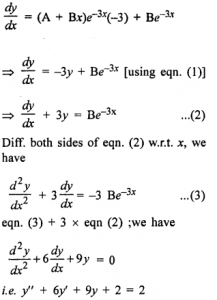
Que-12: If y = (A + Bx)e3x, prove that y” + 6y’ + 9y + 2 = 2.
Sol: Given y = (A + Bx)e-3x …(1)
Diff. eqn. (1) w.r.t. x, we have
Que-13: If xmyn = (x + y)m+n, prove that d²y/dx² = 0.
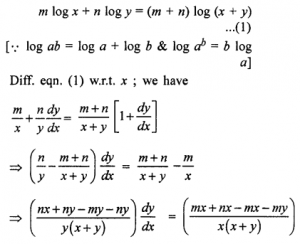
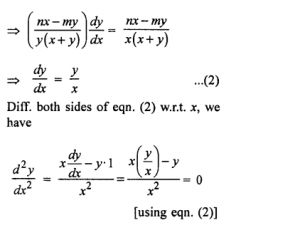
Sol: Given xmyn = (x + y)m+n
Taking logaritum on both sides, we have
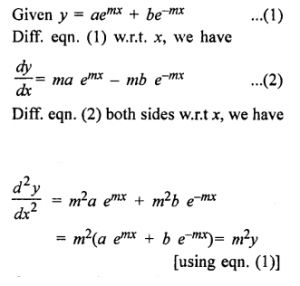
Que-14: If y = aemx + be-mx, prove that d²y/dx² + m²y = 0.
Sol:
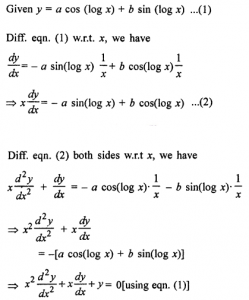
Que-15: If y = a cos (log x) + b sin (log x), prove that x² d²y/dx² + x dy/dx + y = 0.
Sol:
Que-16: Find d²y/dx² when
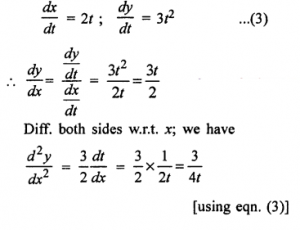
(i) x = t², y = t³.
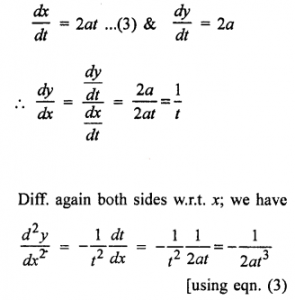
(ii) x = at², y = 2at.
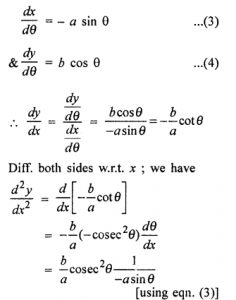
(iii) x = a cos θ, y = b sin θ
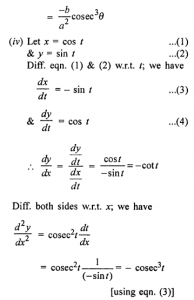
(iv) x = cos t, y = sin t
Sol: (i) Let x = t² … (1)
& y = t³ … (2)
Diff. eqn. (1) & (2) w.r.t. t; we have
(ii) x = at² … (1)
& y = 2at … (2)
(iii) Let x = a cos θ …(1)
& y = b sin θ …(2)
Diff. eqn. (1) & (2) w.r.t. θ; we have
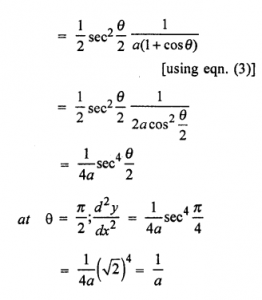
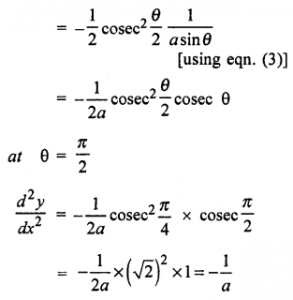
Que-17: Find d²y/dx² when θ = π/2 :
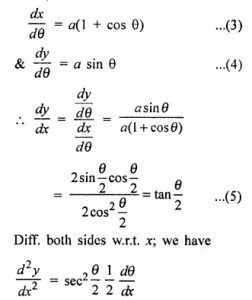
(i) x = a(θ + sin θ), y = a(1 – cos θ)
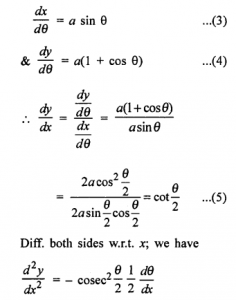
(ii) x = a(1 – cos θ), y = a(θ + sin θ).
Sol: (i) Let x = a(θ + sin θ) …(1)
& y = a(1 – cos θ) …(2)
Diff. eqn. (1) & (2) w.r.t. θ; we have
(ii) Given x = a(1 – cos θ) …(1)
& y = a(θ + sin θ) …(2)
Diff. eqn. (1) & (2) w.r.t. θ; we have
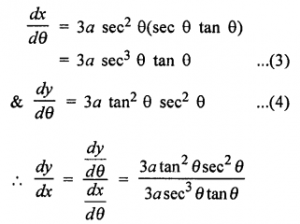
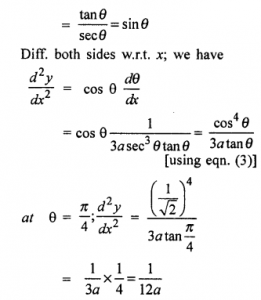
Que-18: If x = a sec³θ, y = a tan³θ, find d²y/dx² at θ = π/4 .
Sol: Let x = a sec³θ …(1)
& y = a tan³θ …(2)
Diff. eqn. (1) & (2) w.r.t. θ; we have
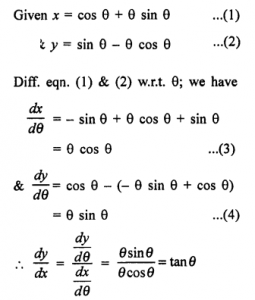
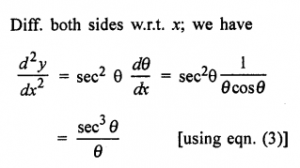
Que-19: If x = cos θ + θ sin θ, y = sin θ – θ cos θ, 0 < θ < π/2 , prove that d²y/dx² = sec³θ / θ.
Sol:
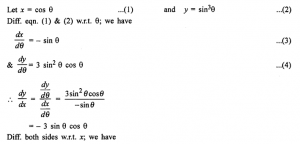
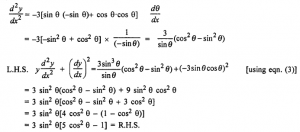
Que-20: If x = cos θ, y = sin³θ, show that d²y/dx² . (dy/dx)² = 3 sin²θ(5cos²θ-1).
Sol:
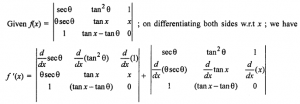
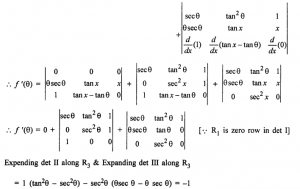
Que-21:
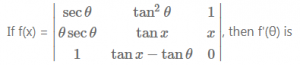
(a) 0
(b) – 1
(c) independent of θ
(d) None of these.
Sol:
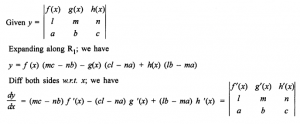
Que-22:

Sol:
–: End of Differentiation Class 12 OP Malhotra Exe-8L ISC Math Ch-8 Solution :–
Return to :- OP Malhotra ISC Class-12 S Chand Publication Maths Solutions
Thanks
Please share with your friends