Distance of Point from Plane Class 12 OP Malhotra Exe- 24E ISC Maths Solutions Ch-24 The Plane. In this article you would learn how to find distance of a point from a plane using equation with practice questions / Problems with answer / solutions. Visit official Website CISCE for detail information about ISC Board Class-12 Mathematics.
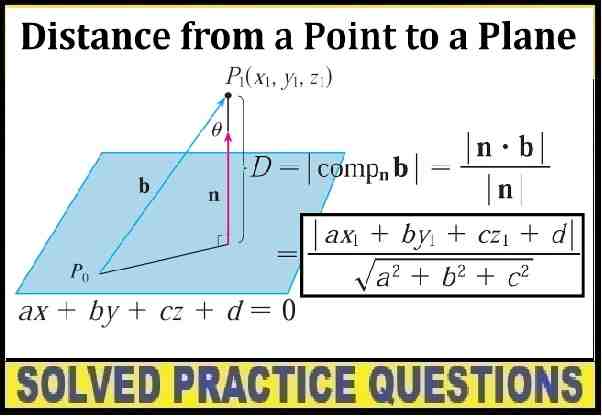
Distance of Point from Plane Class 12 OP Malhotra Exe- 24E ISC Maths Solutions Ch-24 The Plane
| Board | ISC |
| Publications | S Chand |
| Subject | Maths |
| Class | 12th |
| Chapter-24 | The Plane |
| Writer | OP Malhotra |
| Exe-24(e) | Distance of a Point from a Plane |
Distance of a Point from a Plane Example / Equations
The Plane Class 12 OP Malhotra Exe-24E Solutions
Que-1: Find the distance from the point.
(i) P(-4, 3, 7) to the plane 2 x + 6 y – 9 z = 2
(ii) P(2, 1, -1) to the plane x – 2 y + 4 z = 9.
(iii) 2î – ĵ – 4k̂ from the plane r→ (4î – 12ĵ – 3k̂) – 7 = 0
Sol: (i) eqn. of given plane be 2 x + 6 y – 9 z = 2 …………….(1)
∴ required ⊥ distance from point P(-4,3,7) to plane (1)
= |2(−4)+6×3–9×7−2|/√2²+6²+(−9)²
= |−8+18−63−2|/√4+36+81
= |−55|/√121
= 55/11
= 5 units
(ii) eqn. of given plane be x – 2 y + 4 z – 9 = 0 …………..(1)
∴ reqd. ⊥ distance from P (2, 1, -1) to plane (1)
= |2−2×1+4(−1)−9|/√1²+(−2)²+4² = |2−2−4−9|/√1+4+16 = 13/√21 units
(iii) eqn. of given plane be r→ =(4î – 12ĵ – 3k̂) – 7 = 0
∴ reqd. ⊥ distance from point P} whose P.V 2î –ĵ – 4k̂ to plane (1)
= |(2î−ĵ −4k̂)(4î−12ĵ −3k̂)−7|/√4²+(−12)²+(−3)² = |2(4)−1(−12)−4(−3)−7|/√16+144+9
= |8+12+12−7|/13 = 25/13 units
Que-2: Find the distance of the point
(i) (3, 3, 3) from the plane r→ (5î + 2ĵ – 7k̂) + 9 = 0
(ii) î – 2ĵ – 3k̂ from the plane r→ (2î + 5ĵ –k̂) = 0
Sol: (i) We know that, the ⊥ distance of point with position vector a⃗ from given plane r→ n→ – d = 0 is given by |a→ ⋅n→ −d|/|n→ |
Given eq̣n. of plane be r→ (5î + 2ĵ – 7k̂) + 9 = 0 ……………(1)
Here a→ = 3î + 3ĵ + 3 k̂ ; n→ = 5î + 2ĵ – 7k̂ ; d = -9
∴ required ⊥ distance of point (3, 3, 3) from given plane (1)
= |(3î+3ĵ+3k̂)(5î+2ĵ−7k̂)+9|/√5²+2²+(−7)²
= |3(5)+3(2)+3(−7)+9|/√25+4+49 = 9/√78
(ii) eqn. of given plane be r→ (2î + 5ĵ – k̂) = 4 ……………….(2)
∴ required distance of point î – 2ĵ – 3k̂ from given plane (1)
= |(î−2ĵ−3k̂)⋅(2î+5ĵ−k̂)−4|/√2²+5²+(−1)²
= |1(2)−2(5)−3(−1)−4|/√4+25+1
= |−9|/√30 = 9/√30 units
Que-3: Find the equation of the planes parallel to the plane x – 2 y + 2 z – 3 = 0 which is at a unit distance from the points (1, 2, 3).
Sol: The eqn. of given plane be
x – 2 y + 2 z – 3 = 0 …………….(1)
Thus eqn. of plane parallel to plane (1) be given by
x – 2 y + 2 z + k = 0 ………………..(2)
Now plane (2) is at a unit distance from the point (1, 2, 3).
|1−2(2)+2(3)+k|/√1²+(−2)²+2² = 1
⇒ |3+k|/3 = 1
⇒ |3+k| = 3 ⇒ 3 + k = ± 3 ⇒ k = 0,-6
∴ from (2); x – 2 y + 2 z = 0 and x – 2 y + 2 z – 6 = 0 be the required eqns. of planes.
Que-4: Find the distance between the parallel planes x + y – z + 4 = 0 and x + y – z + 5 = 0.
Sol: Given eqns. of given planes are
x+y-z+4=0
x+y-z+5=0
∴ required distance between parallel planes =⊥ distance of any point on plane (1) from plane (2)
= |x+y−z+5|/√1²+1²+(−1)² = |−4+5|/√1+1+1= 1/√3
[using eqn. (1); x + y – z = -4 ]
Que-5: Find the shortest distance between the planes 2 x – y + 3z – 4 = 0 and 6 x – 3 y + 9 z + 13 = 0.
Sol: Let P(x1, y1, z1) be any point on plane
2 x – y + 3 z – 4 = 0 i.e. 2 x1 – y1 + 3z1 – 4 = 0
Let d be the distance between given parallel planes.
∴ d =⊥ distance of P(x1, y1, z1) from 6 x – 3 y + 9 z + 13 = 0
= |6x1−3y1+9z1+13|/√6²+(−3)²+9²
= |3(2x1−y1+3z1)+13|/√36+9+81
= |3(4)+13|/√126
= 25/√126 = 25/3√14
Que-6: Show that the two points î + ĵ + k̂ are – 3î + k̂ equidistant from the plane r⃗ (3î + 4ĵ – 12k̂) + 13 = 0 and lie on opposite side of the plane.
Sol: eqn. of given plane be
r→ (3î + 4ĵ – 12k̂) + 13 = 0
⇒ (xî + yĵ+ zk̂) (3î + 4ĵ – 12k̂) + 13 = 0
⇒ 3 x + 4 y – 12 z + 13 = 0
Given î + ĵ + k̂ and -3î + k̂ are P.V’s of points (1, 1, 1) and Q(-3, 0, 1).
∴ ⊥ distance of P(1, 1, 1) from plane (1) = |3+4−12+13|/√3²+4²+(−12)² = 8/13
∴ ⊥ distance of Q(-3, 0, 1) from plane (1) = |3×(−3)+4×–12×1+13|/√3²+4²+(−12)²= 8/13
Thus both points P and Q are equidistant from given plane (1). putting P(1, 1, 1) in L.H.S. of eqn. (1) = 3 + 4 – 12 + 13 = 8 > 0
and putting Q(-3, 0, 1) in L.H.S. of eqn. (1) = 3(-3) + 4 × 0 – 12 × 1 + 13
= -21 + 13 = -8 < 0
Thus both points P and Q lies on opposite side of given plane (1).
Que-7: Find the equation of the plane through the point (3, 4, -1) which is parallel to the plane r⃗ (3î– 3ĵ + 5k̂) + 7 = 0. Also, find the distance between the two planes.
Sol: eqn. of given plane in cartesian form be given by
(xî + yĵ + 7k̂) (2î – 3ĵ + 5k̂) + 7 = 0
⇒ 2 x – 3 y + 5 z + 7 = 0
⇒ Thus, the eqn. of plane parallel to plane (1) be given by
2 x – 3 y + 5 z + k = 0
Now plane (2) passes through the given point (3, 4, -1).
∴ 2 × 3 – 3 × 4 + 5 × (-1) + k = 0 ⇒ k = 11
putting the value of k in eqn. (2); we get
2 x – 3 y + 5 z + 11 = 0
Let P(x1, y1, z1) be any point on plane (1)
∴ 2x1 – 3y1 + 5z1+ 7 = 0
Thus reqd. distance between planes = Length of ⊥ from P(x1, y1, z1) on plane (4)
= |2x1−3y1+5z1+11|/√2²+(−3)²+5²
= |−7+11|/√4+9+25
= 4/√38 units
Que-8: A plane is at a constant distance p from the origin and meets the coordinate axes in A, B, C. Show that the locus of the centroid of triangle A B C is x-2 + y2 + z-2 = 9 p-2.
Sol: Let the eqn. of plane be x/a + y/b + z/c = 1
where the plane (1) meets x-axis at A(0, 0, 0) ; B(0, b, 0) and C(0, 0, c).
∴ Centroid of ∆ABC be (a+0+0/3, 0+b+0/3, 0+0+c/3) i.e. (a/3, b/3, c/3)
Let the centroid of ∆ABC be Q(α, β, γ).
∴ α = a/3 ; β = b/3 and γ = c/3
⇒ a = 3 α ; b = 3β and c = 3γ
given p =⊥ distance from (0,0,0) to plane (1)
p = ∣∣0/a+0/b+0/c − 1∣/√∣1/a²+1/b²+1/c²
= 1/√1/a²+1/b²+1/c²
⇒ √1/a²+1/b²+1/c²
= 1/p ; on squaring both sides; we have
1/a²+1/b²+1/c²
= 1/p²
⇒ 1/9α² + 1/9β²+ 1/9γ²
= 1/p²
⇒ 1/α² + 1/β²+ 1/γ²
= 9/p²
∴ Locus of centroid Q(α, β , γ) be given by
1/x² + 1/y² + 1/z² = 9/p²
⇒ x-2 + y2 + z-2 = 9 p-2
Que-9: Find the distance of the point (2, 3, 5) from the x y-plane.
Sol: Equation of x y plane be z = 0.
⊥ distance of point (2, 3, 5) from plane z = 0 = |5−0|/√1² = 5
Que-10: Find the equation of the plane mid-parallel to the planes
(i) 2 x – 2 y + z + 3 = 0 and 2 x – 2 y + z + 9 = 0
(ii) 2 x – 3 y + 6 z + 21 = 0 and 2 x – 3 y + 6 z – 14 = 0.
Sol: (i) Equations of given planes are
and
2 x – 2 y + z + 3 = 0
2 x – 2 y + z + 9 = 0
Since both planes are parallel.
Let the eqn. of plane parallel to both given planes be
2 x – 2 y + z + k = 0
Let P(x1, y1, z1) be any point on plane (1).
∴ 2x1 –2y1+ z1+3 = 0
∴ d1 = distance between planes (1) and (3)
=⊥ distance of point P (x1, y1, z1) from plane (3)
= |2x1–2y1+z1+k|/√2²+(−2)²+1² = |−3+k|/3
d2 = distance between planes (2) and (3)
= ⊥ distance of point P (x1, y1, z1) from plane (3)
= |2x1−2y1+z1+k|/√4+4+1
= |-9+k|/3
[∵2x1−2y1+z1+9 = 0]
Since, plane (3) is mid parallel to eqn. (1) and eqn. (2).
∴ d1 = d2 ⇒|-3 + k|=|-9 + k|
On squaring ; we have
(k – 3)² = (k – 9)²
⇒ k² – 6 k + 9 = k² – 18 k + 81
⇒ 12 k = 72 ⇒ k = 6
putting the value of k in eqn. (3); we get
2 x – 2 y + z + 6 = 0 be the required eqn. of plane.
Que-11: Show that the line whose vector equation is r→ = 2î – 2ĵ + 3k̂ + λ(î –ĵ + 4 k̂) parallel to the plane whose vector equation is r→ (î + 5ĵ + k̂) = 5. Also, find the distance between them.
Sol: The given eqn. of line in vector form be
r→ = 2î – 2ĵ + 3k̂ + λ(î – ĵ + 4k̂)
Thus its cartesian eqn. be
x−2/1 = y+2/−1 = z−3/4
Also, given vector eqn. of plane be r→ (î + 5ĵ +k̂) = 5
So its cartesian eqn. be
x + 5 y + z = 5
d ratios of normal to plane (1) are < 1, 5, 1 >
Now line is parallel to plane (2)
if 1(1) – 1(5) + 4(1) = 0 and (2, -2, 3) does not lies on plane (2)
if 0 = 0, which is true and 2 + (-2) + 3 = 5
⇒-5 = 5
Thus, line (1) is parallel to plane (2).
∴ required distance between line (4) and plane (2) = distance of point (2, -2, 3) from plane (2)
=|2+5(−2)+3−5|/√1²+5²+1²
= 10/√27 units
Que-12: From the point (1, 2, 4) a perpendicular is drawn on the plane 2 x + y – 2 z + 3 = 0. Find the equation, the length and the coordinates of the foot of the perpendicular.
Sol: Given eqn. of plane be 2 x + y – 2 z + 3 = 0
Thus eqn. of ⊥ PM which passes through the point P(1, 2, 4) and having direction ratios < 2, 1, -2 > is given by
x−1/2 = y−2/1
= z−4/−2 = t (say)
So any point on line ( 2) be given by (2 t + 1, t + 2, -2 t + 4).
This point be the required foot of ⊥ i.e. M if it lies on plane (1).
∴ 2(2 t + 1) + t + 2 – 2(-2 t + 4) + 3 = 0
⇒ 4 t + 2 + t + 2 + 4 t – 8 + 3 = 0
⇒ 9 t = 1 ⇒ t = 1/9
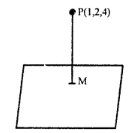
∴ required coordinates of foot of ⊥ be given by M(11/9, 19/9, 34/9)
∴|PM| = length of ⊥ from P(1, 2, 4) to plane (1)
|2×1+2−2×4+3|/√2²+1²+(−2)² = 1/3 units.
Que-13: Find the image of the point P(1, 3, 4) in the plane 2 x – y + z + 3 = 0. Alternatively. Find the image of the point having position vector î + 3ĵ + 4k̂ in the plane r→ (2î –ĵ + k̂) + 3 = 0.
Sol: Given eqn. of plane be 2 x – y + z + 3 = 0
Let M be the foot of ⊥ drawn from given point P(1, 3, 4).
∴ eqn. of line PM. i.e. passes through the point P(1, 3, 4) and normal to given plane be given by
x−1/2 = y−3/−1 = z−4/1 = t (say)
Any point on line (2) be M(2 t + 1, -t + 3, t + 4) and this point be the foot of ⊥ M, if M(2 t + 1, -t + 3, t + 4) lies on plane (2).
∴ 2(2 t + 1) – (-t + 3) + t + 4 + 3 = 0
⇒ 6 t + 6 = 0 ⇒ t = -1
∴ Coordinates of point M are (-1, 4, 3).
Let Q(α, β , γ) be the image of point P if M be the mid point of the segment PQ
![Que-13: Find the image of the point P(1, 3, 4) in the plane 2 x – y + z + 3 = 0. Alternatively. Find the image of the point having position vector i^ + 3 j^ + 4 k^ in the plane r⃗ (2\hat{i}[/latex] – j^ + k^) + 3 = 0.](https://icsehelp.com/wp-content/uploads/2025/11/7-1.png)
∴(α+1/2, β+3/2, γ+4/2) = (-1, 4, 3)
i.e. α+12 = -1
⇒ α = -3 ; β+3/2 =4
⇒ β = 5 and γ+4/2 = 3
⇒ γ = 2
Thus the required image of point (1, 3, 4) be (-3, 5, 2).
Que-14: Find the equation of the planes which are perpendicular to each of the planes 3 x – y + z = 0 and x + 5 y + 3 z = 0 and at a distance of √6 units from the origin.
Sol: Let the eqn. of required plane be a x + b y + c z + d = 0 where < a, b, c > be the direction ratios of normal to plane (1).
The eqns. of given planes are
3 x – y + z = 0
x + 5 y + 3 z = 0
and
Since the plane (1) is ⊥ to both given planes.
∴ 3 a – b + c = 0
a + 5 b + 3 c = 0
on solving (4) and (5) simultaneously
∴ a/−8 = b/1−9 = c/15+1
⇒ a/1 = b/1 = c/−2 = k (say); where k ≠ 0
∴ a = k ; b = k ; c = -2 k
putting the values of a, b, c in eqn. (1); we have
x + y – 2 z + d/k = 0 ⇒ x + y – 2 z + d = 0
Also it is given that ⊥ distance from (0,0,0) to given plane (6) = √6
|0+0−2×0+d′|/√1²+1²+(−2)²
= √6 ⇒ d = ± 6
∴ from eqn. (6) ; we have x + y – 2 z ± 6 = 0 be the reqd. equations of planes.
Que-15: Find the locus of a point whose distance from the origin is three times its distance from the plane 2 x – y + 2 z = 3.
Sol: Let P (x, y, z) be any point whose locus is to be find out.
It is given that distance of point P from origin O = 3 × distance of point P(x, y, z) from plane 2 x – y + 2 z – 3 = 0
√(x−0)²+(y−0)²+(z−0)² = 3|2x−y+2z−3|/√2²+(−1)²+2²
⇒ √x²+y²+z² = 3(2x−y+2z−3)/3
On squaring both sides ; we have
x2 + y2 + z2 = 4 x2 + y2 + 4 z2 – 4 x y + 9 – 12 z + 2(2 x – y)(2 z – 3)
⇒ x2 + y2 + z2 = 4 x2 + y2 + 4 z2 – 4 x y + 9 – 12 z + 8 x z – 12 x – 4 y z + 6 y
⇒ 3 x2 + 3 z2 – 4 x y + 8 x z – 4 y z + 6 y – 12 z + 9 = 0
which is the required eqn. of locus.
–: End of Distance of Point from Plane Class 12 OP Malhotra Exe- 24E ISC Maths Solutions :–
Return to :- OP Malhotra ISC Class-12 S Chand Publication Maths Solutions
Please share with your friends
Thanks