Electrolysis Intex-2 Concise Class-10 ICSE Chemistry Selina Solutions Chapter-6. We Provide Step by Step Answer of Intex-2 Questions of Exercise-6 for ICSE Class-10. The given Solutions is according to the Latest editions. Visit official Website CISCE for detail information about ICSE Board Class-10.
Electrolysis Intex-2 Concise Class-10 ICSE Chemistry Selina Solutions Chapter-6
| Board | ICSE |
| Book / Publication | Concise / Selina |
| Subject | Chemistry |
| Class | 10th |
| Writer | Dr SP Singh |
| Chapter-6 | Electrolysis |
| Topics | Intex-2 |
| Edition | 2025-2026 |
Intex-2 Questions on Electrolysis
Page-115
Que-1: Name two substances in each case:
(a) Contain only molecules
(b) Contain only ions
(c) Contain ions as well as molecules
Ans:
(a) Glucose, Kerosene
(b) NaCl and NaOH
(c) CH3COOH and NH4OH
Que-2: Select the ion in each case that would get selectively discharged from the aqueous mixture of the ions listed below:
(a) SO42-, NO3–, and OH–
(b) Pb2+, Ag+, and Cu2+
Ans:
(a) OH–
(b)Ag+
Que-3:
(a) Among Zn and Cu, which would occur more readily in nature as metal and which as ion?
(b) Why cannot we store AgNO3 solution in copper vessel?
(c) Out of Cu and Ag, which is more active?
Ans:
(a) Zn occurs readily as ion whereas Cu occurs more readily as metal in nature.
(b) Copper is above silver in the electrochemical series and is thus more reactive than silver. So, copper displaces silver from silver nitrate. Hence, we cannot store AgNO3 solution in copper vessel.
Cu +AgNO3 Cu(NO3)2 + 2Ag
(c) Copper is more active than Ag.
Que-4:
(a) How would you change a metal like Cu into ions?
(b) How would you change Cu2+ ions to Cu?
Ans:
(a) By treating its salt with a more reactive metal.
(b) By supplying two electrons to Cu+2
Cu+2 + 2e–Cu
Que-5: A solution of caustic soda (NaOH) in water or when fused, conducts an electric current. What is the similarity in these two cases?
Ans: In the aqueous state, the slightly negatively charged oxygen atoms of the polar water molecule exerts a pull on the positively charged sodium ions. A similar pull is exerted by the slightly charged hydrogen atoms of the water on the negatively charged chloride ions. Thus the ions become free in solution. These free ions conduct electricity.
In the molten state, the high temperatures required to melt the solid weakens the bond between the particles and the ions are set free.
Que-6: During electrolysis of an aqueous solution of sulphuric acid between platinum electrodes, two types of anions migrate towards the anode but only one of them is discharged.
(a) Name the two anions.
(b) Name the main product of the discharge of anion at the anode and write the anode reaction.
(c) Name the product at the cathode and write the reaction.
(d) Do you notice any change in colour. State why?
(e) Why this electrolysis is considered as an example of catalysis.
Ans:
(a) Two anions are SO42- and OH–
(b) OH– is discharged at anode and the main product of the discharge of OH– is O2
Reaction is :
OH–  OH +e–
4OH 2H2O + O2
(c) The product formed at cathode is hydrogen. The reaction is :
H+ + e– H
H + H H2
(d) No change in colour is observed.
(e) Dilute sulphuric acid catalyse the dissociation of water molecules into ions, hence electrolysis of acidified water is considered as an example of catalysis.
Que-7: Copper sulphate solution is electrolysed using a platinum anode. Study the diagram given alongside and answer the following questions:
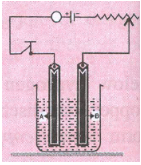
(a) Give the names of the electrodes A and B.
(b) Which electrode is the oxidising electrode?
Ans:
(a) A = Platinum anode, B = Platinum or copper cathode
(b) A = Platinum anode
Que-8: To carry out the so-called ‘electrolysis of water’, sulphuric acid is added to water. How does the addition of sulphuric acid produce a conducting solution?
Ans: The addition of sulphuric acid causes dissociation of water into H+ ions and OH– ions.
Que-9:
(a) Choosing only words from the following list, write down the appropriate words to fill in the blanks (i) to (v) below: Anions , anode, cathode, cations , electrode, electrolyte, nickel , voltameter.
The electroplating of an article with nickel requires an (i) ____ which must be solution containing (ii) ____ ions. The article to be plated is placed as the (iii) ____ of the cell in which the plating is carried out. The (iv) ____ of the cell is made from pure nickel. The ions that are attracted to the negative electrode and discharged are called (v) _____.
(b) When a molten ionic compound is electrolysed, the metal is always formed at …………… and the non-metal is formed at …………..
(c) Electrolysis of acidulated water is an example of ………… (Reduction/ oxidation/ redox reaction/synthesis)
Ans:
(a) (i) 0 Electrolyte
(ii) Nickel
(iii) Cathode
(iv) Anode
(v) Cations
(b) cathode, anode
(c) Electrolysis of acidulated water is an example of redox reaction.
Que-10: Explain the following :
(a) A solution of cane sugar does not conduct electricity, but a solution of sodium chloride is a good conductor,
(b) Hydrochloric acid is a good conductor of electricity.
(c) During the electrolysis of an aqueous solution of NaCl, hydrogen ion is reduced at the cathode and not the sodium ion though both Na+ and H+ ions are present in the solution.
(d) On electrolysis of dilute copper (II) sulphate solution, copper is deposited at the cathode but hydrogen gas evolves there. Explain why.
(e) When a dilute aqueous solution of sodium chloride is electrolysed between platinum electrodes, hydrogen gas is evolved at the cathode but metallic sodium is not deposited. Why?
(f) Zinc can produce hydrogen on reacting with acids but copper cannot. Explain.
Ans:
(a) Cane sugar is a compound which does not have ions even in solution and contains only molecules. Hence, it does not conduct electricity. On the other hand, sodium chloride solution contains free mobile ions and allows electric current to pass through it. This makes it a good conductor of electricity.
(b) Hydrochloric acid is a strong electrolyte and dissociates completely in aqueous solution. The solution contains free mobile ions which allow electric current to pass through it. Hence, hydrochloric acid is a good conductor of electricity.
(c) Hydrogen is placed lower in the electrochemical series and sodium is placed at a higher position. This is because H+ ions are discharged more easily at the cathode than Na+ during electrolysis and gains electrons more easily.
Therefore, H+ ion is reduced at the cathode and not Na+ ion.
(d)Copper is placed below hydrogen in the activity series. Cu2+ on reduction is discharged as metallic copper in preference to hydrogen.
(e) Since hydrogen is much below sodium in the activity series, hydrogen is discharged at the cathode in preference to sodium.
(f)Zinc is more reactive than hydrogen, so it displaces hydrogen from acids, but copper is less reactive than hydrogen, so it does not liberate hydrogen from acids.
—: End of Electrolysis Intex-2 Concise Class-10 ICSE Chemistry Selina Solutions : –
Return to:- Concise Selina Chemistry for ICSE Class-10 Solutions
Please Share with Your Friends if Helpful
Thanks