Electrolysis Long Ans Concise Class-10 ICSE Chemistry Selina Solutions Chapter-6. We Provide Step by Step Answer of Long Ans Questions of Exercise-6 for ICSE Class-10. The given Solutions are according to the Latest editions. Visit the official Website CISCE for detail information about ICSE Board Class-10.
Electrolysis Long Ans Concise Class-10 ICSE Chemistry Selina Solutions Chapter-6
| Board | ICSE |
| Book / Publication | Concise / Selina |
| Subject | Chemistry |
| Class | 10th |
| Writer | Dr SP Singh |
| Chapter-6 | Electrolysis |
| Topics | Long Ans |
| Edition | 2025-2026 |
Long Ans Questions on Electrolysis (Electroplating)
Page-121
Que-1: Element X is a metal with a valency 2. Element Y is a non-metal with a valency 3.
(a) Write equations to show how X and Y form ions?
(b) If Y is a diatomic gas, write the equation for the direct combination of X and Y to form a compound. (2015)
(c) If the compound formed between X and Y is melted and an electric current passed through the molten compound, the element X will be obtained at the _____ and Y at the _________of the electrolytic cell.(Provide the missing words)
Ans:
(a) X –> X2+ +2e–,Y + 3e –> Y3-
(b) Y2 + 3X –> X3Y2
(c) Cathode, Anode
Que-2:
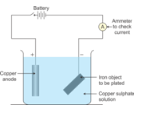
(a) Draw a labeled diagram to show how iron is electroplated with copper.
(b) Which solution is preferred as electrolyte, CuSO4 or FeSO4?
(c) Describe what happens to the iron object and the copper rod.
Ans: (a)
(b) CuSO4 is preferred as an electrolyte.
(c) The copper anode continuously dissolves as ions in solution and is replaced periodically. The electrolyte dissociates into Cu2+ ions which migrate towards the iron object taken as the cathode. Here, the Cu2+ ions gain electrons and become atoms of copper which deposit on the iron object as a firm coating. Thus, the iron object gets electroplated with copper.
Que-3: A metal article is to be electroplated with silver. The electrolyte selected is sodium argentocyanide.
(i) What kind of salt is sodium argentocyanide?
(ii) Why is it preferred to silver nitrate as an electrolyte?
(iii) State one condition to ensure that the deposit is smooth, firm and long lasting.
(iv) Write the reaction taking place at the cathode.
(v) Write the reaction taking place at the anode.
Ans:
(i) Complex salt
(ii) On using silver nitrate, the deposition of silver on the cathode is very fast and hence not very smooth and uniform because it is a strong electrolyte.
(iii) A long current for a longer time should be used.
(iv) Ag++ e– → Ag
(v) Ag – e– → Ag+
Que-4: During the electrolysis of copper [H] sulphate solution using platinum as a cathode and carbon as an anode,
(i) State what you observe at the cathode and at the anode.
(ii) State the change noticed in the electrolyte.
(iii) Write the reactions at the cathode and at the anode.
Ans:
(i) Red shiny metal deposits at the cathode.
(ii) The colour of the electrolytes changes gradually from blue to colourless.
(iii) At the cathode:
Cu2+ + 2e– → Cu
Reaction at the anode:
OH– → OH + e–
4OH → 2H2O + O2
Que-5:
(a) Copy and complete the following table which refers to two practical applications of electrolysis
| Anode | Electrolyte | Cathode | ||
| Silver plating of spoon | Solution of potassium argentocyanide | |||
| Purification of copper | ||||
(b) write equation of reaction taking place at anode for Q-2 (a)
Ans: (a)
| Anode | Electrolyte | Cathode | |
| Silver plating of spoon | Plate of pure clean silver | Solution of potassium
argento cyanide |
Article to be electroplated |
| Purification of copper | Impure copper | Solution of copper sulphate and dilute sulphuric acid | Thin strip of pure copper |
(b) Reaction at anode
(i) Ag – e– ⟶ Ag+
(ii) Cu – 2e– ⟶ Cu2+
(iii) Cl– – e– ⟶ Cl
Cl + Cl ⟶ Cl2
Que-6: The following sketch represents the electroplating of an Iron cup with Nickel metal. Study the diagram and answer the following questions :
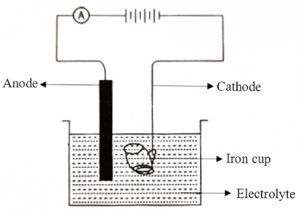
(a) During electroplating the iron cup is placed at the cathode. Why?
(b) Name the ion that must be present in the electrolyte.
(c) State one condition that is necessary to ensure that the deposit is smooth, firm and even.
(d) Write the reaction taking place at the cathode.
(e) What change would you observe at the anode ?
Ans:
(a) In electroplating, the cathode is the electrode where reduction (gain of electrons) occurs. The iron cup is placed at the cathode because the metal ions from the electrolyte will be reduced and deposit onto the iron cup. This process coats the iron cup with a layer of metal, achieving the plating effect.
(b) Ni2+ must be present in the electrolyte.
(c) A low current for a longer time should be used as longer time and low current initiates a thicker, uniform deposit.
(d) Ni2+ + 2e- → Ni
(e) The Nickel plate is gradually dissolved as ions in solution.
Que-7: Copper sulphate soln. is electrolysed using copper electrodes.
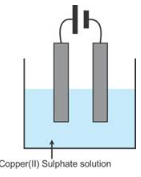
(i) Which electrode to your left or right is known as the oxidising electrode and why?
(ii) Write the equation representing the reaction that occurs.
(iii) State two appropriate observations for the above electrolysis reaction.
Ans:
(i) The right electrode is the anode and oxidising electrode. Cu → Cu2+ + 2e– losing electrode.
(ii) Reaction at the anode: Cu → Cu2+ + 2e–
Reaction at the cathode: Cu2+ + 2e–→ Cu
(iii) The anode dissolves and anode mud containing precious metal is recovered.
—: End of Electrolysis Long Ans Concise Class-10 ICSE Chemistry Selina Solutions : –
Return to:- Concise Selina Chemistry for ICSE Class-10 Solutions
Please Share with Your Friends if Helpful
Thanks